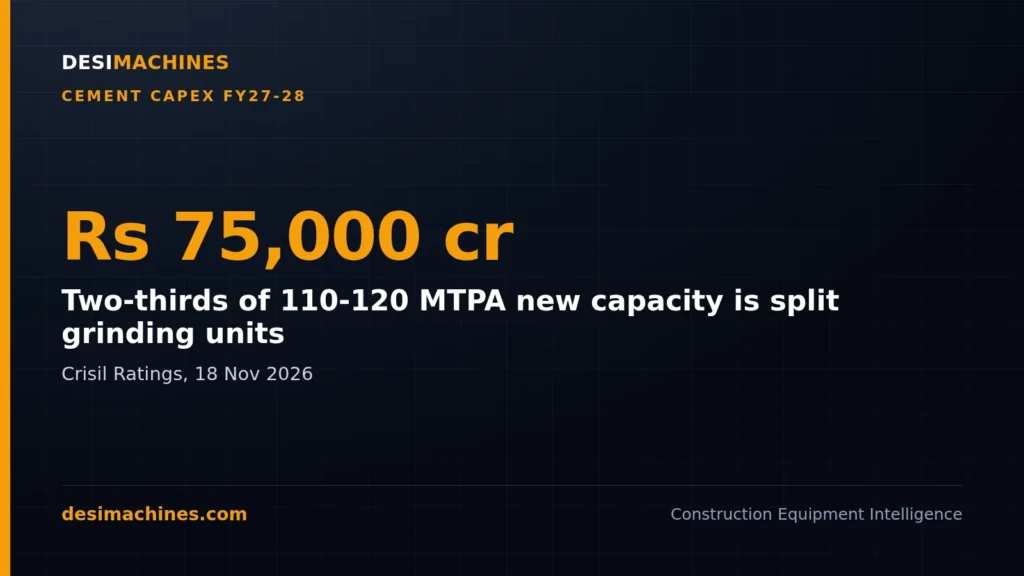
India’s cement makers plan to spend about Rs 75,000 crore across FY27 and FY28, according to a Crisil Ratings analysis released on 18 November. That puts cement capex for FY27-28 roughly 10 percent above the previous two years. For machine owners the useful part is what the money builds: about two-thirds of the new tonnage will come from split grinding units, which are concrete-and-crane jobs near cities, with far less mine work attached.
The figures
- Capex of about Rs 75,000 crore over FY27 and FY28, or Rs 36,000-38,000 crore a year, with capacity additions taking three-fourths of it.
- New capacity of 110-120 million tonnes a year (MTPA) across the two years, against 84 MTPA added in the previous two. Installed capacity stood at 718 MTPA on 31 March 2026.
- Operating profit expected to fall to Rs 875-900 a tonne this fiscal from about Rs 980 in FY26, as petcoke and imported coal prices ran about 35 percent higher on-year in the first half.
- Net debt to Ebitda expected near 1.5 times this fiscal, the highest in five years, easing to 1.2-1.3 times in FY28.
What Crisil published
The rating agency based the estimate on 18 cement companies that hold around 90 percent of domestic capacity. Director Anand Kulkarni said that at current utilisation of about 70 percent the additions should broadly match new demand. Upstox and The Tribune, carrying ANI copy, reported the same figures the same day.
What moved against the last two years?
Mostly the tonnage per rupee. About 10 percent more money is buying 31-43 percent more capacity than the 84 MTPA of the last two years. On our arithmetic, three-fourths of the capex spread over 110-120 MTPA comes to roughly Rs 450-520 crore per MTPA. Ambuja’s own plan, which we covered in Ambuja Cements’ 30 MTPA expansion, works out near Rs 483 crore per MTPA, inside that band. Cheap tonnes usually mean grinding, and Crisil says so outright.
A grinding unit has no kiln and no captive limestone pit. It needs piling, silos, a mill house and a packing plant on one compact site, which keeps cranes, piling rigs, a batching plant, transit mixers and concrete pumps busy for the build. Earthmoving is limited to site grading. Because these units sit close to markets, the work lands in consuming states, often far from the limestone belts where clinker is made.
The mines see a different signal. Crisil notes that clinker comes in large blocks and grinding catches up later. If grinding units absorb existing clinker, existing limestone quarries are asked to run steadier, which favours replacing worn excavators and dumpers over opening new pits. Our guess, and only that: fresh mine fleets come mainly from the smaller share of new kiln lines. More on quarry fleets is in the mining equipment guide.
Contractors also pay for cement. With margins squeezed, Crisil expects calibrated price hikes, so fixed-price road and building jobs without a cement escalation clause carry the risk.
What could shift it
- Commissioning delays, which Crisil names as the main risk to its leverage forecast.
- Fuel prices. A faster fall in petcoke and coal would lift margins and ease the pressure on cement prices.
- Company plant announcements naming grinding-unit sites, which show where the crane and concrete work will go.
FAQ
How much will cement companies spend in FY27 and FY28?
About Rs 75,000 crore across the two years, per Crisil Ratings, with three-fourths of the yearly Rs 36,000-38,000 crore going to new capacity.
What is a split grinding unit?
A cement grinding plant set up away from the main clinker plant, usually near buyers, to cut freight. About two-thirds of new capacity will be of this type.
Will cement prices rise?
Crisil expects calibrated price hikes to partly offset higher fuel and power costs, which are up Rs 100-125 a tonne this fiscal.
Bidding for cement plant civil work? Grinding-unit builds run on cranes, batching plants, transit mixers and pumps. Compare models and finance options on DesiMachines before the next round of plant packages is let.
Related on DesiMachines: UltraTech vendor registration for quarry and plant contractors
Source: Upstox
Machines, tenders and news for this industry: Steel, Cement and Process Plants

 Excavator
316 models
 Backhoe Loader
54 models
 Crane
68 models
 Concrete Mixer
79 models
 Wheel Loader
65 models
 Compactor / Roller
45 models
 Motor Grader
42 models

 Concrete Pump
66 models
 Skid Steer Loader
11 models