
 Excavator
294 models
Excavator
294 models  Backhoe Loader
51 models
Backhoe Loader
51 models  Crane
68 models
Crane
68 models  Concrete Mixer
79 models
Concrete Mixer
79 models  Wheel Loader
54 models
Wheel Loader
54 models  Compactor / Roller
45 models
Compactor / Roller
45 models  Motor Grader
42 models
Motor Grader
42 models  Concrete Pump
66 models
Concrete Pump
66 models  Skid Steer Loader
11 models
Skid Steer Loader
11 models  Telehandler
13 models
Telehandler
13 models  Dozer
Dozer 


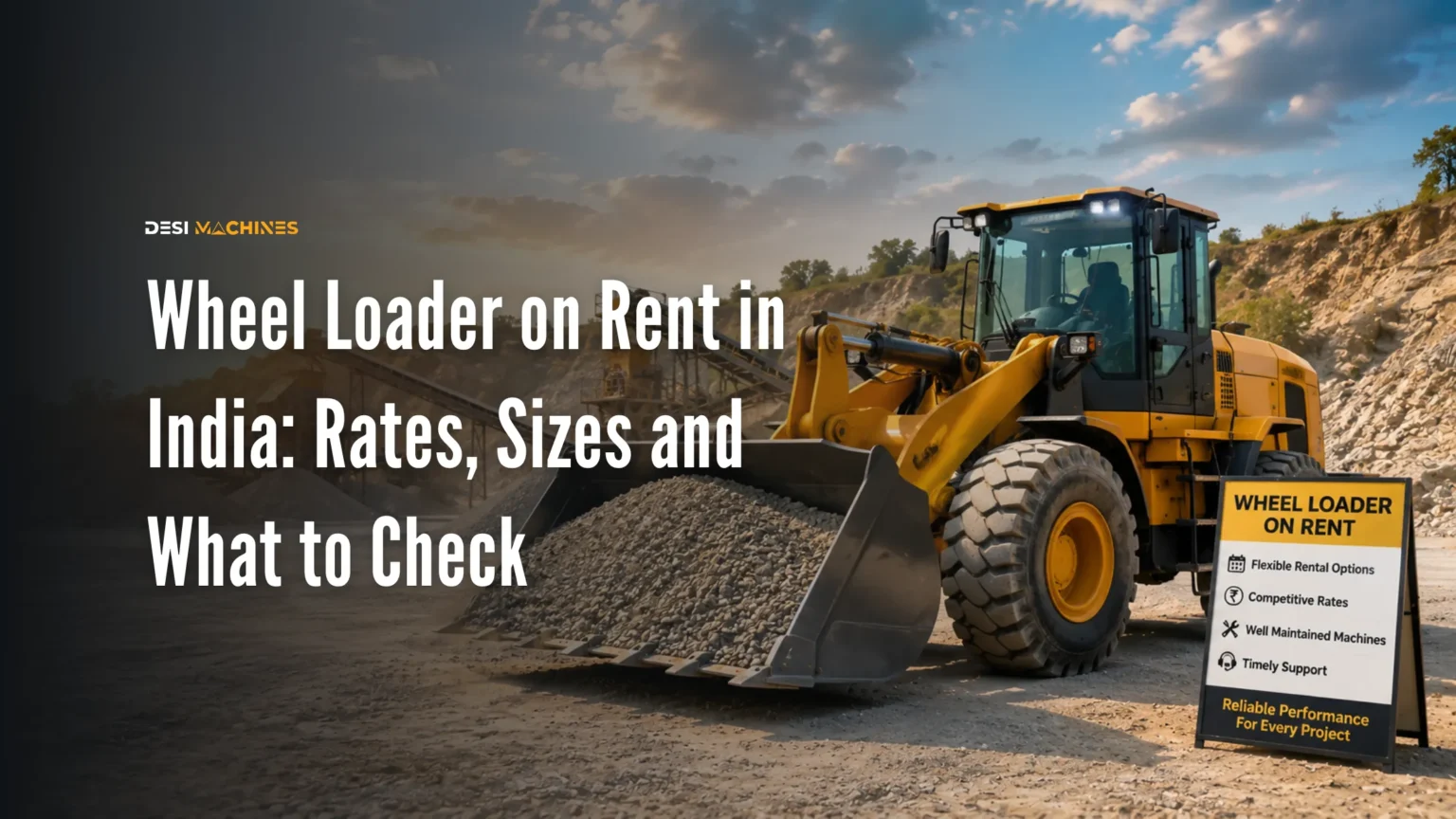
Renting a wheel loader on rent — the machine most Indian sites call a payloader — means hiring a wheeled loading machine by the hour, day or month instead of buying one. Indicative wet-hire rates, with operator, run about ₹1,000–1,600 an hour as of July 2026, and the machine most commonly hired is the 17 to 18 tonne class carrying a 3 cubic metre bucket.
A wheel loader does one job better than anything else on a site: it fills trucks. That is why it is hired by the month at crushers, sand depots and material yards, and by the day almost everywhere else. Get the bucket size wrong and you pay for a machine that either cannot keep up with your tippers or is too big to move around your yard.
This guide covers what the machine costs to hire, which size fits which job, how the billing actually works, and what to check before you sign for it.
What does it cost to rent a wheel loader in India?
Indicative market rates as of July 2026: a wheel loader hires at roughly ₹1,000–1,600 an hour. For comparison on the same rate card, a backhoe loader runs about ₹550–900 an hour on dry hire and a 20 tonne excavator about ₹1,400–2,200 an hour on wet hire. Fuller figures, and the terms that sit behind them, are set out in the equipment rental rate card.
Rates move with four things, and only the first is obvious.
- Machine size. A 10 tonne compact loader and a 22 tonne machine are not in the same price bracket, and the gap widens on monthly hire.
- Duration. Monthly hire always works out cheaper per hour than daily, and daily cheaper than hourly. Anything running more than about ten days a month should be priced monthly.
- Where you are. Rates near a crusher belt or a metro project are keener than in a district town, simply because more machines are competing.
- Who fuels it. A quoted rate means very little until you know whether diesel is in it. On a machine burning steadily all shift, fuel is a large share of the true cost.
Ask for the rate as a full landed number: machine, operator, diesel, transport both ways, and the minimum hours or days. A low headline rate with transport and fuel added afterwards is not a cheaper machine.
Which size wheel loader should you hire?
Size the machine by the bucket, and size the bucket by what you are loading into. Across the wheel loaders listed for the Indian market, operating weight runs from 4,000 kg (4 tonne) to well over 50 tonne in mining classes, and standard bucket capacity from 1.0 m³ to 6.4 m³ in the working range, with the middle of the catalogue at about 3.3 m³.
| Class | Operating weight | Standard bucket | What it is hired for |
|---|---|---|---|
| Compact | 4,000–10,000 kg (4–10 t) | 1.0–1.7 m³ | Tight yards, godowns, small batching plants, farm work |
| Small | 10,000–13,000 kg (10–13 t) | 1.5–2.5 m³ | Builders’ yards, block plants, loading small tippers |
| Mid (the common hire machine) | 16,000–19,000 kg (16–19 t) | 2.7–3.5 m³ | Crushers, sand and aggregate depots, loading 20–25 t tippers |
| Large | 19,000–25,000 kg (19–25 t) | 2.6–3.6 m³ | High-volume quarry and stockpile work, continuous truck loading |
| Mining | Above 25,000 kg (25 t) | 4 m³ and up | Mine faces and large plants; rarely a short-term hire |
The practical way to choose is to count passes. A tipper is loaded fastest in four to six bucket passes: fewer, and you are paying for a machine bigger than the job; more, and the loader becomes the bottleneck while trucks queue. As a rough guide, aggregate and sand weigh about 1.5 to 1.6 tonne per cubic metre loose, so a 3 m³ bucket carries roughly 4.5 tonne a pass and fills a 25 tonne tipper in about five or six. That is exactly why the 17 to 18 tonne class, machines like the JCB 455-5N at 3.3 m³ or the Hyundai HL650I-V at 3.0 m³, is the machine hire yards keep most of.
Go smaller when access decides the job rather than output. A compact machine such as the ACE ALN 100 at 4 tonne turns inside a godown where an 18 tonne machine cannot. Size classes are set out in full in the types of wheel loader guide, and bucket options in wheel loader bucket types.
Dry hire or wet hire: which should you take?
Dry hire means the machine only. You provide the operator and usually the diesel. Wet hire means the machine with an operator, and often with fuel and routine maintenance included.
For a wheel loader, wet hire is the more common choice and usually the right one. The machine works fast and close to trucks and people, and a loader operator who knows the machine loads a tipper in noticeably fewer passes than one who does not. On a payloader the difference between a good and an average operator shows up directly in trucks per hour, which is the only number that matters at a crusher.
Dry hire earns its place when you already employ a steady operator, when the machine is on a long monthly hire, or when your own diesel supply is cheaper than the hirer’s. What each arrangement includes, and the documents and deposits involved, are covered in how to rent construction equipment in India.
How is wheel loader hire billed?
Three ways, and the choice matters more than the rate.
Hourly billing runs on the hour meter, almost always with a daily minimum of eight or nine hours. It suits short bursts of work. Watch the definition of an hour: some hirers count engine hours, which includes idling, and a loader waiting for trucks idles a great deal.
Daily billing fixes a shift, typically eight or nine hours, with overtime charged per hour beyond it. This is the usual arrangement for a few days of yard work.
Monthly billing sets a fixed sum against a monthly hour cap, commonly around 200 to 250 hours, with a rate per hour beyond the cap. It is the cheapest per hour by a wide margin and is how crushers and material yards hire. If your loader will run most days, monthly is almost always the better deal even if some days go unused.
Whichever you take, agree in writing what happens on a breakdown day. A fair contract stops the clock when the machine is down and puts the repair on the hirer, and that clause is worth more than a small discount on the rate.
What to check before you accept the machine
Ten minutes at handover saves an argument at the end of the hire. Do this walk-around with the hirer’s man present, and photograph everything.
- Hour meter reading. Photograph it. Every billing dispute comes back to this number.
- Tyres. On a wheel loader, tyres are the single biggest wear item and the most common cause of a deduction at return. Photograph all four, including the sidewalls and any cuts. Sizes and types are explained in the wheel loader tyre guide.
- Bucket and cutting edge. Check the bucket is the size you agreed and that the cutting edge and teeth are not worn away. A worn edge digs into stockpiles badly and slows every pass.
- Leaks and oil levels. Look under the machine where it has been standing, and check the hydraulic sight glass.
- Brakes and steering. Take a short drive. A loader articulates in the middle, so check that the steering is even both ways and that there is no play in the centre pin.
- Lights, horn, reversing alarm and mirrors. These are safety items on a machine that reverses constantly around trucks.
- Fuel level at handover. Note it, because you will be asked to return it the same.
Get the condition and the hour reading signed by both sides on the challan before the machine starts work. How the machine is put together, and which parts wear on hire, is covered in how a wheel loader works.
When does renting beat buying?
Rent when the work is short, seasonal or uncertain. A loader hired for a two-month crushing season, or for the material-shifting phase of a building job, costs nothing once the job ends, and the hirer carries the tyres, the repairs and the idle months.
Buying starts to make sense when a machine would run most days of the year, when you have steady captive work such as your own crusher or depot, and when you have somewhere secure to keep it and someone to look after it. A wheel loader is a heavy consumer of tyres and fuel, and those costs land on the owner every month whether the machine works or not.
There is a middle path many buyers miss: a good used machine. Prices, hours and the checks that matter are set out in the used wheel loader buying guide. If you are weighing ownership, compare live wheel loader models and prices before deciding.
What the rate does not include
Four costs sit outside most quoted rates, and they decide whether the hire was cheap.
Transport. A wheel loader drives on rubber, so short moves can be done under its own power, but it is slow and it chews tyres on hard road. Any real distance means a trailer, charged both ways.
Diesel. On dry hire this is yours. A mid-size loader working steadily is a serious fuel consumer, and idling while trucks are away burns diesel for no output.
Overtime beyond the shift or the monthly cap. Check the rate for extra hours before you plan a double shift.
Damage and wear deductions. Tyres, cutting edges and glass are the usual ones. This is why the handover photographs matter.
If the machine is yours rather than hired, the running side is set out in the construction equipment service schedule, and refill quantities in the wheel loader fuel and oil capacities reference.
Wheel loader on rent: the short version
A payloader hires at roughly ₹1,000–1,600 an hour on indicative July 2026 rates, and the machine most yards keep is the 17 to 18 tonne class with a 3 m³ bucket, because that fills a 25 tonne tipper in five or six passes. Size the bucket to your truck, not to the biggest machine available. Take wet hire unless you have your own steady operator, price it monthly if the machine will run most days, and photograph the hour meter and all four tyres at handover. Confirm before signing whether diesel, transport and overtime are inside the rate or outside it.
Other machines in the same lane: excavator rental, backhoe loader rental and road roller rental. Start with the equipment rental guide for the rest of the cluster.
Before fixing the hire size, count what the haul needs: wheel loader productivity and truck matching sets out passes per tipper and how many trucks keep one loader working.
Specifications on this page are taken from our listings at the time of writing, and rental rates are indicative market ranges as of July 2026. Prices, specifications and features are indicative, vary by variant, location and date, and should always be confirmed with the official OEM or authorised dealer before any purchase decision. DesiMachines is not liable for decisions taken on the basis of information that may have changed after publication.
Pouring concrete rather than loading material? The self-loading concrete mixer on rent guide covers that machine on the same terms.