
 Excavator
294 models
Excavator
294 models  Backhoe Loader
51 models
Backhoe Loader
51 models  Crane
68 models
Crane
68 models  Concrete Mixer
79 models
Concrete Mixer
79 models  Wheel Loader
54 models
Wheel Loader
54 models  Compactor / Roller
45 models
Compactor / Roller
45 models  Motor Grader
42 models
Motor Grader
42 models  Dozer
41 models
Dozer
41 models  Concrete Pump
66 models
Concrete Pump
66 models  Skid Steer Loader
11 models
Skid Steer Loader
11 models  Telehandler
13 models
Telehandler
13 models 


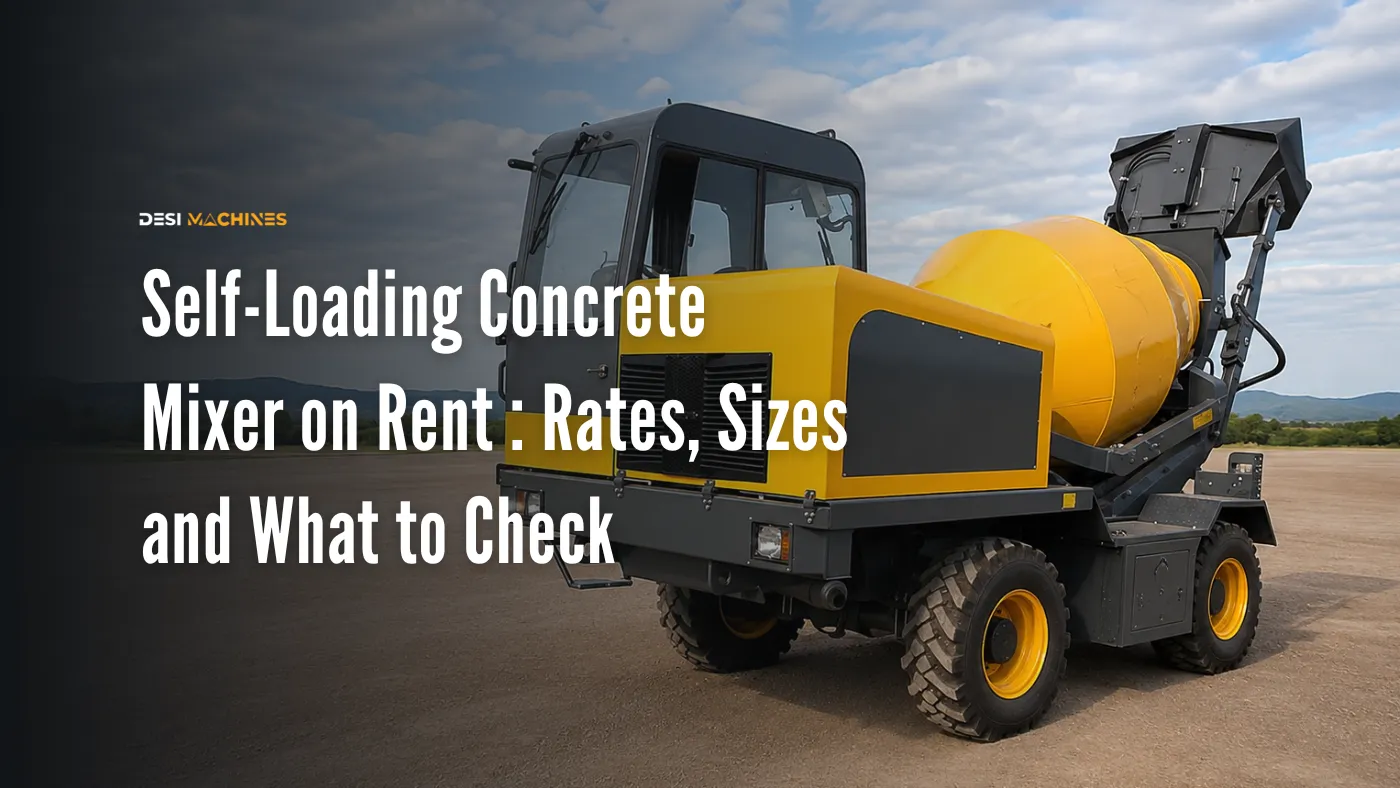
Renting a self-loading concrete mixer means hiring a machine that loads its own sand, aggregate and cement, mixes the concrete on board, and drives it to the pour — without a batching plant behind it. Indicative hire rates run about ₹1,200–2,000 an hour as of July 2026, and the machines most commonly hired in India batch between 2.0 and 4.8 cubic metres at a time.
For a contractor pouring in scattered lots, a village site or anywhere a ready-mix truck will not reach, this is often the cheapest concrete you can get. This page covers what it costs, which size to ask for, how the billing works, and what to check before you sign for the machine. Where a truck can reach the site, ready mix concrete suppliers by state show who has a plant nearby.
What does it cost to rent a self-loading concrete mixer in India?
Indicative market rates as of July 2026: a self-loading mixer hires at roughly ₹1,200–2,000 an hour. On the same rate card a wheel loader runs about ₹1,000–1,600 an hour and a backhoe loader about ₹550–900 an hour on dry hire, so an SLCM sits at the upper end of the common-machine range — you are paying for a batching plant and a mixer in one vehicle. Fuller figures and the terms behind them are set out in the equipment rental rate card.
Treat that band as a starting point for a local check, not a fixed price. Four things move it:
Duration. Monthly hire always works out cheaper per hour than daily, and daily cheaper than hourly. If your pour runs over weeks rather than days, ask for a monthly number before you accept an hourly one.
Batch size. A 2 m³ machine and a 4.5 m³ machine are not the same hire. The bigger drum costs more per hour and pours far more per hour, so the rate per cubic metre usually falls as the machine grows — provided you can keep it fed.
Season and location. Rates in the dry-season building months, and anywhere near a live highway or metro package, sit at the top of the band. In a district town out of season they sit at the bottom.
What is inside the rate. This is the one that decides whether a quote is cheap or only looks cheap. Ask for the number as a full landed figure: machine, operator, diesel, transport both ways, and the minimum hours or days.
Which size self-loading mixer should you hire?
Match the drum to the pour you actually have, and to the road that reaches it.
Check the road against real figures before you fix the size. Across the machines listed, width varies by only about half a metre, but height runs from roughly 2.8 m to 4.5 m, so the dimensions and site access of a self-loading mixer are worth reading before you tell the owner which drum to send.
| Batch size | What it suits | Examples listed in India |
|---|---|---|
| 2.0–2.5 m³ | House slabs, boundary walls, rural roads, tight lanes and first-time hirers | AJAX ARGO 2000, VENUS ULTRA 2.0, MACONS MST 2, Schwing Stetter SLM 2100 |
| 3.0–3.2 m³ | Small commercial work, column and footing pours, canal and culvert jobs | AJAX ARGO 3000, VENUS ULTRA 3.0, Tarle SLM 3000, Apollo Carmix 30 FX |
| 4.0–4.8 m³ | Steady site batching, larger slabs, contractors pouring most days | AJAX ARGO 4800, CONMAT CSLM 4800, VENUS ULTRA 4800, Fiori DBS 4300 |
Thirty-eight self-loading mixers are currently listed in India, and they cluster between 2.0 and 4.8 m³ per batch, with one machine, the Universal SLM-4, listing a larger 5.4 m³ drum. Specifications are as per the current August 2026 listings.
A word of warning on sizing up. A self-loader has to fill its own bucket before every batch, so a bigger drum only pays if your sand and aggregate stockpiles are close to the pour and the machine is not waiting on material. On a cramped site, two batches from a 2.5 m³ machine often beat one slow batch from a 4.5 m³ one.
If the job is large, steady and there is a ready-mix plant within reach, the honest answer may be a different machine altogether — the self-loading mixer versus transit mixer comparison works that decision through, and the transit mixer capacity guide covers what a plant-fed truck delivers per trip.
Dry hire or wet hire: which should you take?
Dry hire means you get the machine only; you arrange the operator and the diesel. Wet hire means the owner supplies the machine with an operator, and often the diesel too.
On a self-loading mixer, take wet hire unless you have a genuinely experienced operator. The reason is specific to this machine: the operator is not just driving, he is batching. He decides how many buckets of sand, how much aggregate, how many bags of cement and how much water go into each drum. There is no laboratory and no plant computer behind him. A poor operator gives you weak concrete that looks fine until it does not.
That single point is why the mix quality on an SLCM job varies more than on a ready-mix job, and why an experienced operator is worth more than a small discount on the hourly rate. What each arrangement includes, and the documents and deposits involved, are covered in how to rent construction equipment in India.
How is self-loading mixer hire billed?
Three ways, and the choice matters as much as the rate.
Hourly, with a daily minimum. The common arrangement for short jobs. Watch the minimum: a four-hour pour billed against an eight-hour minimum is an eight-hour bill.
Per day or per shift. Fixes a shift, usually eight or nine hours, with overtime charged per hour beyond it. Check the overtime rate before you plan a double shift.
Monthly, against an hour cap. A fixed sum for a monthly cap, commonly around 200 to 250 hours, with a per-hour rate beyond it. Cheapest per hour by a wide margin, and how contractors on a long project should be hiring.
Some owners also quote per cubic metre poured rather than per hour. That can suit you well when your material supply is unreliable, because the waiting is the owner’s problem rather than yours — but read the clause on who supplies cement, sand and aggregate, because that is where the number is really made.
Whatever the basis, a fair contract stops the clock when the machine is down and puts the repair on the hirer. That clause is worth more than a small discount. The equipment rental agreement guide sets out the terms that matter on both sides.
What to check before you accept the machine
Walk around it before you sign the delivery challan, not after.
The drum and blades. Look inside. Hardened concrete build-up on the mixing blades cuts the real capacity and gives you a poor mix. Worn-down blades do the same thing more quietly.
The loading bucket and its pins. This bucket does the work a wheel loader would otherwise do, and it takes the same punishment. Check for play in the pins and cracks at the bucket ears.
The water system. Water tank, pump and the gauge or meter that measures the dose. If the water measurement is broken, the operator is guessing, and guessing water is guessing strength.
The weighing system, if fitted. Many machines carry load cells for batching by weight. Ask whether they work and when they were last checked; an uncalibrated weigh system is worse than none, because it invites trust.
Tyres, brakes and the articulation joint. These machines carry a heavy wet load on rough ground and steer from the middle. A loose articulation joint on a loaded machine is a genuine safety problem.
Hour meter and service record. Note the reading on the challan at handover and at return, especially on an hourly contract.
The same checks, in more detail and with the paperwork side, are in the used self-loading concrete mixer buying guide — a rented machine deserves the same inspection as one you are buying.
When does renting beat buying?
Rent when the work is short, seasonal or uncertain. Buy when you are pouring most weeks of the year.
A new self-loading mixer is listed from about ₹27 – 30 Lakh for a small 3.2 m³ machine up to ₹52 – 54 Lakh for a 4.3 m³ Fiori DBS 4300 (indicative, as of Aug 2026). These are wheeled, registrable machines, so on-road cost adds transportation, RTO registration, TCS, warranty, insurance and FOC charges where applicable.
Set that against hire. At the middle of the ₹1,200–2,000 an hour band, a machine worked steadily for a few hundred hours a year is comfortably cheaper to hire. Past roughly a thousand hours a year of genuine, repeatable work, ownership starts to look sensible — and at that point resale, service cover and dealer reach matter more than the sticker price. Work it in cubic metres poured per month, not in hours available.
Compare live self-loading concrete mixer models and prices before you decide either way.
What the rate does not include
Four costs usually sit outside the quoted number, and together they decide whether the hire was cheap.
Transport both ways. A self-loader drives itself, but only slowly and only on reasonable roads. Over any distance it goes on a trailer, and that is billed to you at both ends.
Diesel, on a dry hire. Confirm whether the machine arrives full and must be returned full.
Cement, sand, aggregate and water. Unlike a ready-mix delivery, the concrete is not part of the hire. You supply everything that goes into the drum, and getting the stockpiles right next to the machine is your job.
Overtime and idle time. Ask what happens when your material does not arrive and the machine sits.
Self-loading mixer on rent: the short version
A self-loading concrete mixer hires at roughly ₹1,200–2,000 an hour on indicative July 2026 rates, and the machines commonly available batch 2.0 to 4.8 m³. Take wet hire, because on this machine the operator is the batching plant. Confirm before signing whether diesel, transport and overtime are inside the rate or outside it, and check the drum blades and the water system before you accept delivery.
Other machines in the same lane: excavator rental, backhoe loader rental, road roller rental and wheel loader rental. Start with the equipment rental guide for the rest of the cluster.
If site batching in small lots is the real requirement, also read about the volumetric concrete mixer, which measures and mixes differently again.
Before you hire
Prices, specifications and features are indicative, vary by variant, location and date, and should always be confirmed with the official OEM or authorised dealer before any purchase decision. DesiMachines is not liable for decisions taken on the basis of information that may have changed after publication. Specifications on this page are taken from our listings at the time of writing, and rental rates are indicative market ranges as of July 2026.
Machines, tenders and news for this industry: Ready-Mix Concrete