
 Excavator
294 models
Excavator
294 models  Backhoe Loader
51 models
Backhoe Loader
51 models  Crane
68 models
Crane
68 models  Concrete Mixer
79 models
Concrete Mixer
79 models  Wheel Loader
54 models
Wheel Loader
54 models  Compactor / Roller
45 models
Compactor / Roller
45 models  Motor Grader
42 models
Motor Grader
42 models  Concrete Pump
66 models
Concrete Pump
66 models  Skid Steer Loader
11 models
Skid Steer Loader
11 models  Telehandler
13 models
Telehandler
13 models  Dozer
Dozer 


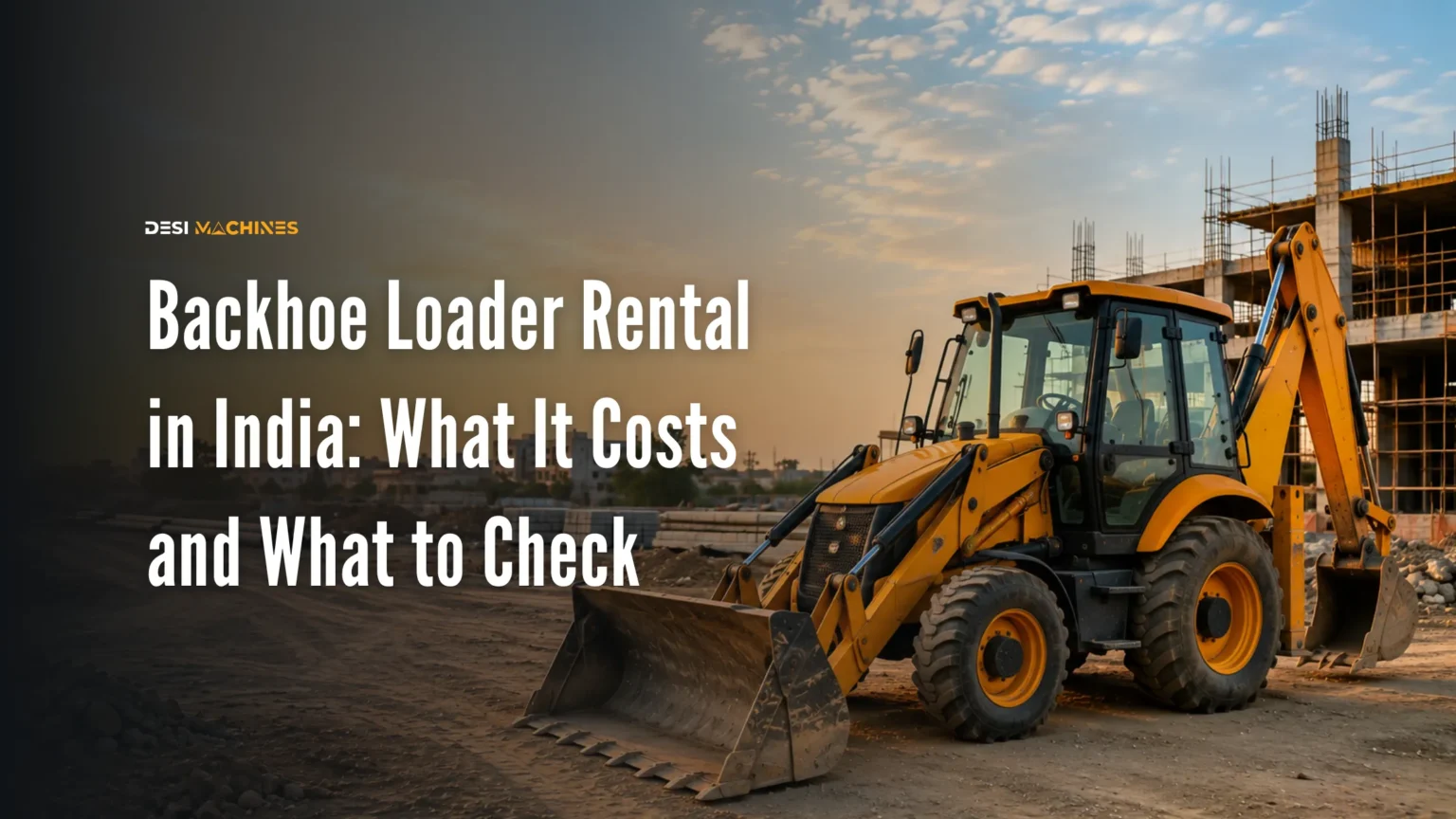
Backhoe loader rental means hiring a JCB-type machine by the hour, the day or the month instead of buying one. In India a backhoe on dry hire, where you get the machine and arrange your own operator and diesel, works out at roughly ₹550–900 an hour, about ₹5,000–9,000 for an eight-hour day, or ₹90,000–1,40,000 for a full month (indicative, as of Jul 2026). Wet hire, with the operator and diesel included, adds roughly ₹300–400 an hour to that.
The backhoe is the machine most first-time hirers ask for, and for good reason. It digs at the back, loads at the front, drives itself to your site on its own wheels, and handles the mixed work a small contractor actually has: a foundation, a drain line, a pile of malba to shift, a bit of levelling. One machine, one day’s hire, several jobs done.
What follows is what the rate covers, what it does not, which variant to ask for, and what to check before you sign for the machine. Rate figures here follow the equipment rental rate card, which tracks what machines earn per day across India.
Watch: the full rental-rate math in 5 minutes
Key moments: 0:43 the full one-hour cost khata, all six components · 2:05 dry vs wet market rates · 4:04 the three-step method to set a rate.
What does it cost to rent a backhoe loader in India?
A backhoe hires for about ₹550–900 an hour on dry hire as of Jul 2026, and the spread inside that band is not random. The same machine costs more in a busy metro corridor than in a quiet district, more in the dry season when everyone is building, and more for a two-day job than for a two-month deployment.
| Hire period | Dry hire (machine only) | Wet hire (operator + diesel included) |
|---|---|---|
| Per hour | ₹550–900 | Roughly ₹300–400 an hour more |
| Per day (8 hours) | ₹5,000–9,000 | Quoted per hour more often than per day |
| Per month | ₹90,000–1,40,000 | Negotiated case by case |
All figures indicative, as of Jul 2026, and they move with city, season, machine age and the length of your commitment.
Three things push a quote up or down more than anything else.
- How long you commit. A monthly hire almost always works out cheaper per hour than a day-by-day arrangement, because the owner is not hunting for the next job every week.
- The age and condition of the machine. A five-year-old backhoe with 6,000 hours on it hires for less than a nearly new one, and it also breaks down more. The cheaper rate is not always the cheaper day.
- Where the work is. A yard 10 km away can send the machine over on its own wheels. A yard 200 km away is charging you for the journey one way or another.
Ask for the rate in writing along with the minimum hours, the diesel arrangement and the overtime rate, before the machine leaves the yard. The general process, including deposits and paperwork, is set out in the guide to renting construction equipment in India.
What is included in the rate, and what is extra?
The single biggest source of argument in a backhoe hire is what the quoted number covers. Two quotes ₹350 an hour apart can both be honest, because one is dry and the other is wet.
| Item | Dry hire | Wet hire |
|---|---|---|
| The machine | Included | Included |
| Operator and his wages | You arrange and pay | Included |
| Diesel | You fill it | Included |
| Routine service and oil | Owner, usually | Owner |
| Breakdown repair | Owner | Owner |
| Damage from misuse | You | You |
| Moving the machine to site | Agree in advance | Agree in advance |
Two details are worth pinning down before work starts. The first is the minimum billing: most yards bill a minimum number of hours per day whether or not the machine works them, so a half day of work often costs a full day of hire. The second is how the hours are counted. The hour meter in the cab runs whenever the engine runs, including while the machine idles waiting for a tipper, so idling time is billed time. Note the meter reading in front of the operator when the machine arrives and again when it leaves.
If you take the machine on dry hire, the diesel is your cost, and it is a real one. A backhoe on normal Indian site work burns somewhere in the region of 4 to 8 litres of diesel per working hour, which the guide to backhoe mileage and fuel consumption explains in detail. At eight hours a day, the diesel bill can approach the hire charge itself.
Should you ask for a 2WD or a 4WD backhoe?
Ask for 2WD for hard, level ground and 4WD for soft, wet or sloping ground. The rental yard will usually quote 4WD at a higher rate, and on the wrong site that extra money buys nothing.
A 2WD backhoe drives through its rear wheels only. On a compacted site, a road job or a yard, it works perfectly well and costs less to hire. A 4WD machine drives all four wheels, so it keeps working in mud, on loose fill, on a slope and in the monsoon, where a 2WD machine spends the afternoon stuck and you pay for that afternoon anyway.
The honest test is what happens after rain. If the site drains and dries, take 2WD. If it turns to slush, or if the machine has to climb in and out of a pit, take 4WD and treat the extra as insurance against idle hours. The 2WD versus 4WD backhoe comparison goes through the trade-off properly.
Also tell the yard what you are digging. Bucket width is fixed on most hired machines, but many owners carry a spare narrow bucket for trench work and a breaker for concrete. Ask before the machine is loaded, because a second trip for an attachment is a second charge. The backhoe attachments guide covers what these machines can carry.
How does the machine reach your site?
A backhoe loader drives itself to site on its own wheels, and this is the practical advantage it holds over almost every other hired machine. It is a wheeled machine built to travel on roads, so for a local hire nobody needs a trailer, a crane or a permit. The operator brings it over and starts work.
That changes the economics of a short hire. Hiring a tracked excavator for one day means paying for a trailer both ways, which can cost as much as the machine. The guide to excavator rental in India covers that side. With a backhoe, a one-day hire is genuinely a one-day cost.
Two things still need agreeing. Travelling time is often billed, so confirm whether the meter starts at the yard or at your gate. And beyond roughly 50 to 60 km, most owners prefer to load the machine on a trailer rather than run it on the road for hours, because road running wears tyres and burns diesel without doing any work. Settle who pays for that before the machine moves.
What should you check before you accept the machine?
Check the machine in front of the operator, before you sign anything, and write down what you find. A hired backhoe that arrives with a weeping cylinder is the owner’s problem if you noted it on arrival and yours if you did not.
- Walk around and look underneath. Fresh oil on the ground under the loader arms, the boom or the stabilisers means a leaking seal. A leak that drips while the machine is parked will get worse under load.
- Check the pins and bushes. Ask the operator to raise and lower the loader arms and swing the digging boom fully both ways. Knocking, or side-to-side play at the joints, means worn pins. The machine will still work, but slowly and roughly.
- Look at the tyres. On a 4WD machine especially, worn front tyres cost you the traction you paid extra for. Traction is simply grip on the ground.
- Test the stabiliser legs. They should go down firmly and hold the back of the machine steady. Legs that sink under load make trench digging slow and unsafe.
- Start it cold if you can. Heavy white or black smoke that does not clear after a few minutes points to an engine problem the owner already knows about.
- Note the hour meter and the fuel level. Photograph both. This one habit settles most end-of-hire disputes before they start.
The same checks, in more depth, are what a buyer runs on a second-hand machine, and the used backhoe loader buying guide sets them out. If a fault does appear mid-hire, the owner’s service schedule matters more than his promises, and the backhoe maintenance schedule shows what a properly kept machine should have had done.
How much work should a hired backhoe do in a day?
Plan on six to seven productive hours from an eight-hour hire, not eight. Fuelling, greasing, moving between positions, waiting for tippers and the operator’s breaks all come out of the day, and none of them stop the hour meter if the engine is left running.
What the machine gets through in those hours depends on the work. Trench digging in soft soil moves quickly; the same trench through hard murram or old concrete moves slowly and may need a breaker instead of a bucket. Loading a tipper from a heap is fast work for a backhoe; digging deep foundations is not, and past a certain depth a tracked excavator is the right machine.
Two habits get more out of a hired day. Keep the tippers coming so the machine is not standing loaded and idle, and position the machine so the operator swings through the shortest arc he can. On a wet hire you are paying for the operator’s time either way, and on a dry hire you are burning your own diesel while the machine waits.
If you find yourself hiring for more than fifteen to twenty days a month, every month, the arithmetic starts pointing elsewhere. Compare live backhoe loader models and prices and talk to a dealer before you renew another monthly hire.
Is it cheaper to rent a backhoe or to buy one?
Renting is cheaper while your work is irregular; buying is cheaper once the machine is busy most days of the month. The turning point is utilisation, not the price of the machine.
Hiring costs you nothing when the machine sits idle, which is exactly what happens between contracts, during the monsoon, and while a payment is stuck. An owned machine costs you the EMI, the insurance and the parking whether it works or not. Against that, an owned backhoe earns on every job instead of paying rent, holds resale value, and is available the morning you need it rather than the week the yard can spare it.
Work it out on your own days, not on averages. Count the days you genuinely used a machine over the last six months, multiply by the day rate above, and compare that against what ownership would have cost over the same period. The buy versus rent decision guide walks through that calculation, and the backhoe loader guide covers what to look for if the answer comes out in favour of buying. Running costs after purchase are set out in the backhoe parts and components guide.
Renting a backhoe loader: the short version
A backhoe hires for roughly ₹550–900 an hour dry, or ₹5,000–9,000 a day, with wet hire adding about ₹300–400 an hour (indicative, as of Jul 2026). Confirm the minimum hours, who fills the diesel, how travelling time is billed and what happens on a breakdown, all before the machine leaves the yard. Ask for 4WD only if your ground needs it. Photograph the hour meter and the fuel gauge on arrival and on return.
Get those five things right and a hired backhoe is the cheapest way for a small contractor to take on work that needs a machine. Kirāye par makes sense until the machine is busy nearly every day, and then it stops making sense. When it does, browse the current range of backhoe loaders and speak to a dealer. The rest of this series sits on the equipment rental guide hub, and the tractor-loader-backhoe explainer covers what the machine actually is.
Driving itself to site is exactly what makes a backhoe cheap to mobilise; rental mobilisation and transport sets out how that charge is built for machines that cannot.
If the backhoe is needed for years rather than weeks, a hire rate is the wrong yardstick. Construction equipment leasing compares a fixed-term lease against hiring and against a loan to buy.
Prices, specifications and features are indicative, vary by variant, location and date, and should always be confirmed with the official OEM or authorised dealer before any purchase decision. DesiMachines is not liable for decisions taken on the basis of information that may have changed after publication. Rental figures are market ranges, not quoted prices, and vary by city, season and machine.
A backhoe loads, but a dedicated loading machine fills trucks far faster on a stockpile. Rates and sizing for that machine are in the wheel loader on rent guide.