
 Excavator
294 models
Excavator
294 models  Backhoe Loader
51 models
Backhoe Loader
51 models  Crane
68 models
Crane
68 models  Concrete Mixer
79 models
Concrete Mixer
79 models  Wheel Loader
54 models
Wheel Loader
54 models  Compactor / Roller
45 models
Compactor / Roller
45 models  Motor Grader
42 models
Motor Grader
42 models  Dozer
41 models
Dozer
41 models  Concrete Pump
66 models
Concrete Pump
66 models  Skid Steer Loader
11 models
Skid Steer Loader
11 models  Telehandler
13 models
Telehandler
13 models 


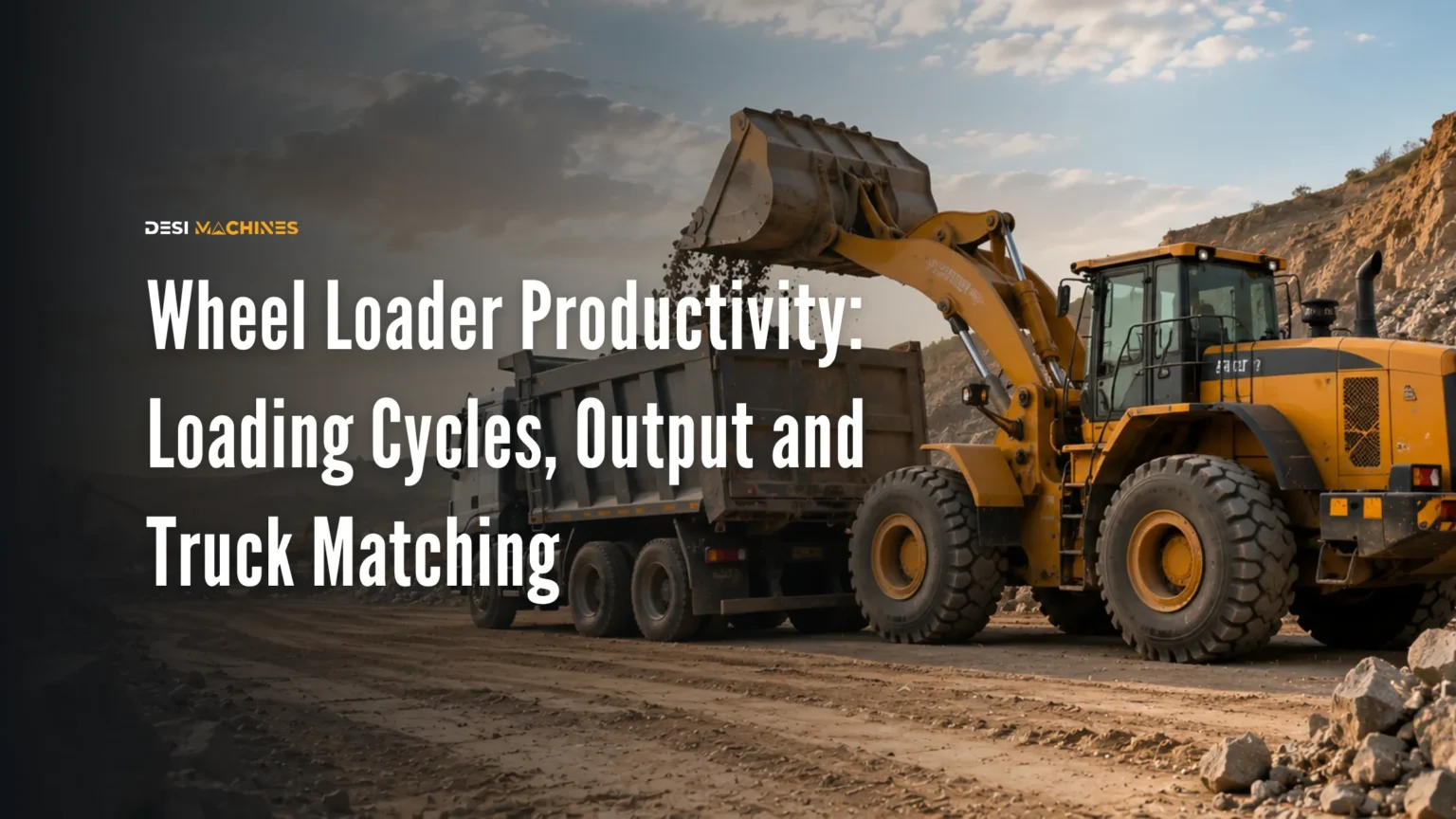
Wheel loader productivity is how much material the machine loads in an hour, measured in cubic metres per hour (m³/hr) or in tippers filled per hour. It is the bucket load multiplied by the number of loading passes the machine completes, and on most Indian sites it is limited by something other than the loader: the trucks.
A wheel loader working a face with a queue of tippers is very fast. A 3.0 m³ machine fills a 9 m³ tipper in three passes, roughly three minutes including spotting the truck. Keep it fed and it will clear twenty tippers an hour. The reason yards rarely see that number is that the trucks are away on haul, and a loader waiting for a truck produces nothing. This guide shows how to work out both halves: what your loader can do, and how many tippers it takes to keep it doing it.
How many bucket passes does it take to fill a tipper?
Divide the tipper body volume by the bucket capacity and round up. That is the whole calculation, and it is the number that decides how long each truck sits under the loader.
| Bucket capacity | 6 m³ tipper | 9 m³ tipper | 12 m³ tipper | 16 m³ tipper |
|---|---|---|---|---|
| 1.5 m³ | 4 passes | 6 | 8 | 11 |
| 2.0 m³ | 3 | 5 | 6 | 8 |
| 2.5 m³ | 3 | 4 | 5 | 7 |
| 3.0 m³ | 2 | 3 | 4 | 6 |
| 3.4 m³ | 2 | 3 | 4 | 5 |
| 4.2 m³ | 2 | 3 | 3 | 4 |
Add one pass when the material is sticky, oversize or badly blasted, because the bucket will not fill to its rated figure every time. Bucket ratings are heaped measurements, and the difference between struck and heaped is explained in the guide to wheel loader bucket types and sizing.
Four to six passes per truck is the range most contractors settle on. Fewer than three and you are usually carrying a machine bigger than the job needs; more than six and the truck is standing under the bucket long enough to hold up the whole haul.
What is the formula for wheel loader output per hour?
Output per hour is the bucket load multiplied by the passes completed in an hour:
Output (m³/hr) = bucket capacity (m³) × passes per hour
A steady loader working a face manages roughly 50 to 70 passes an hour once you allow for repositioning, waiting and the odd clean-up. So a 2.5 m³ bucket at 60 passes moves around 150 m³ an hour of loose material, and a 3.4 m³ bucket around 200 m³.
Those are big numbers, and they are the reason the trucks matter more than the machine. Loose material also occupies more volume than the same material did in the ground, so a hundred cubic metres loaded is not a hundred cubic metres of excavation. Use loaded volume for truck planning and in-ground volume for earthwork measurement, and keep them apart.
How long is one loading cycle?
A short V-cycle at the pile, where the loader drives in, fills, reverses, turns and dumps into a truck standing alongside, takes about 35 to 45 seconds. Stretch the distance between the pile and the truck and the cycle grows quickly, because the machine is then driving rather than loading.
| Part of the cycle | Typical time | What changes it |
|---|---|---|
| Drive in and fill the bucket | 10 to 15 seconds | Material, how well the face is prepared, operator technique |
| Reverse and turn | 8 to 12 seconds | Room to manoeuvre, ground condition |
| Approach and dump | 10 to 15 seconds | Distance to the truck, dump height needed |
| Return to the pile | 5 to 10 seconds | Same distance, travelling empty |
Keeping the truck close to the pile is the cheapest productivity gain available on any site. Every extra ten metres is repeated on every pass of every truck, all day. Where the machine has to raise the bucket high to clear a tipper rail, the extra lift time counts too, which the guide to wheel loader dump height and reach works through.
How many tippers do you need to keep one loader working?
This is the question that decides your day, and it has a clean answer. Take the time a tipper needs for one full round trip, add the time it spends being loaded, and divide by the loading time:
Tippers needed = (round trip time + loading time) ÷ loading time
| Tipper round trip | 3 minutes to load | 4 minutes to load | 5 minutes to load |
|---|---|---|---|
| 10 minutes | 5 tippers | 4 | 3 |
| 20 minutes | 8 | 6 | 5 |
| 30 minutes | 11 | 9 | 7 |
| 40 minutes | 15 | 11 | 9 |
Read that table honestly before you buy a bigger loader. A machine loading in three minutes instead of five needs more trucks to stay busy, not fewer. If you cannot put eight tippers on a twenty minute haul, a faster loader simply waits more, and you have paid for capacity you cannot use.
The same arithmetic works the other way. If you already run six tippers on a twenty minute haul, aim for a four minute load, which on a 9 m³ body means a bucket around 2.5 m³. Match the machine to the fleet you actually have.
Comparing machines on bucket size and weight? Browse wheel loader models and specifications and talk to a dealer about the class your haul really needs.
Which bucket size comes with which size of machine?
Bucket capacity tracks machine weight closely, so the size class you choose sets your passes per truck. Across the wheel loaders listed in India:
| Size class | Machines listed | Bucket, as standard | Engine power | Example |
|---|---|---|---|---|
| Compact, under 8 tonne | 2 | 1.0 to 1.2 m³ | 74 to 75 HP (55 to 56 kW) | ACE ALN 100 |
| Small, 8 to 15 tonne | 12 | 1.5 to 2.5 m³ | 121 to 180 HP (90 to 134 kW) | JCB 433-5, ACE ALN 300 |
| Medium, 15 to 30 tonne | 22 | 2.5 to 5.2 m³ | 192 to 337 HP (143 to 251 kW) | Liugong 848H, Tata Hitachi ZW 310-5A |
| Large, over 30 tonne | 16 | 4.2 m³ and above | 357 HP (266 kW) and above | Tata Hitachi ZW 370-5A, Komatsu WA500-6R |
Most Indian road, quarry and crusher work sits in the small and medium classes, which is where 34 of the 52 machines with published specifications fall. The large class runs on into mining sizes that answer a different question entirely. How the classes are defined is covered in the guide to wheel loader types by size class.
To see which loader suits your tippers, enter the tipper size in the finder.
Does a bigger bucket always load faster?
Only up to the point where the trucks can keep up. A bigger bucket cuts passes per truck, which shortens the time each tipper spends under the loader. That helps if trucks are queueing. It does nothing at all if the loader is already waiting between trucks.
There is a second limit. A bucket has to be filled as well as carried, and breaking into a tight or unblasted face takes engine power and breakout force, not bucket volume. A big bucket on a machine short of power comes out half full, and half a big bucket is worse than a full smaller one. Power by size class is set out in the guide to wheel loader engine power and torque, and the drive that puts it on the ground in the guide to wheel loader transmission types.
Fuel is the third consideration. A larger machine burns more per hour whether it is loading or waiting, so an oversized loader on a thin haul costs money twice. Consumption bands and tank sizes are covered in the guide to wheel loader fuel tank and oil capacities.
What slows a wheel loader down on Indian sites?
Nearly all of it is organisation rather than machine capability:
- Trucks not there. The single biggest loss, and the one this guide’s arithmetic is meant to prevent.
- The pile too far from the loading point. Every metre is repeated on every pass.
- A badly prepared face. Oversize rock and a ragged toe mean part-filled buckets on every cycle.
- Soft or rutted ground. Loaded travel slows sharply in the monsoon, and tyre wear rises with it. On a long loaded haul this is also where ride control earns its keep, because it stops the machine pitching and spilling as it travels.
- Waiting on one operator. A machine that stops for lunch stops the whole haul chain behind it.
To measure your own machine, count the passes for ten consecutive trucks and time them from the first bucket to the truck pulling away. Ten trucks smooths out one awkward load and gives you a loading time you can put straight into the table above. Do it on your own material, because a figure from a different site is a figure for a different job.
Wheel loader productivity, in short
Passes per truck is the tipper body divided by the bucket, rounded up, and four to six is the range that usually works. A steady loader manages 50 to 70 passes an hour, so the machine is rarely the limit. What limits the day is truck supply: work out your haul round trip, divide by your loading time, and you have the number of tippers needed to keep the loader working. Buy the loader that matches that fleet rather than the biggest bucket you can afford.
If you are hiring rather than buying, the guide to wheel loader hire in India covers rates and what to check on the machine. The same output arithmetic applied to other machines is in excavator productivity and output per hour and backhoe loader productivity and output. To start further back, the full wheel loader guide covers how the machine works and how to choose one.
A note on the figures in this guide
Bucket capacity, operating weight and engine power are the published specifications taken from our listings at the time of writing, covering the 52 of 54 wheel loaders that publish a full specification. Thirty-seven of those quote a bucket range rather than a single figure, because the machine takes several bucket options. Where a range is published, the first, as-standard figure is the one used in the class table above, so treat the classes as the standard-bucket picture rather than the maximum a machine can be fitted with.
The force behind that fill, and the weight the machine can still carry once it has turned towards the truck, are set out in our guide to wheel loader breakout force and tipping load.
Cycle times, passes per hour and loading times are field guides for planning, not manufacturer specifications, and no maker publishes them. Actual output varies with the material, the face, the ground, the haul and the operator. Prices, specifications and features are indicative, vary by variant, location and date, and should always be confirmed with the official OEM or authorised dealer before any purchase decision. DesiMachines is not liable for decisions taken on the basis of information that may have changed after publication.
Machines, tenders and news for this industry: Steel, Cement and Process Plants · Ports and Dredging
