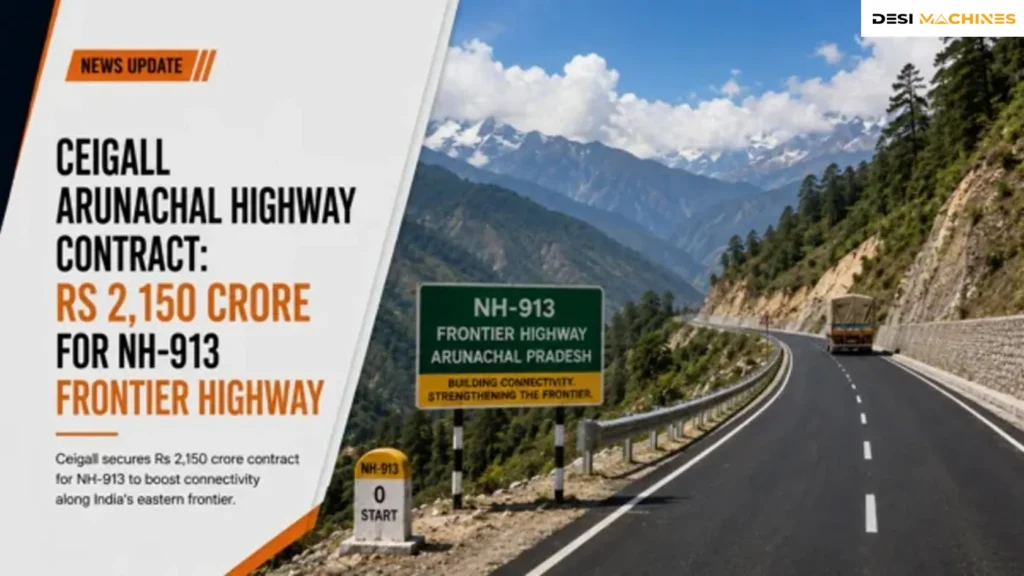
Ceigall India and Sushee Infra & Mining now hold four signed letters of acceptance for road work on NH-913 in Arunachal Pradesh, worth Rs 2,149.62 crore between them. The headline value is the least interesting part. What matters to anyone who owns iron is where the work sits: the Eastern Himalaya, where a rupee buys a fraction of the road it buys on the plains, and where the fleet that wins the job looks nothing like a plains highway fleet.
The quick facts
- Four letters of acceptance from the Ministry of Road Transport and Highways, by a letter dated 17 August 2026, aggregating Rs 2,149.62 crore.
- The winner is a joint venture of Ceigall India (74 per cent) and Sushee Infra & Mining (26 per cent).
- Scope is road construction on sections of NH-913, the Frontier Highway, in Arunachal Pradesh.
- The same joint venture was reported as lowest bidder on these packages back in March. The acceptance letters are the stage that turns a bid into work.
What Ceigall disclosed
The award reached the market through Ceigall’s exchange disclosure, and Business Standard’s capital-market desk, ET Infra, CNBC-TV18, the Free Press Journal and Business Upturn all carried it on 18 August with the same aggregate and the same joint-venture split. One carrier publishes the section chainages, covering Sarli to Huri plus three stretches of Huri to Taliha; we are treating that breakdown as single-desk and have not attached rupee values to individual packages. On those chainages the four packages run to roughly 240 km, which puts the award near Rs 9 crore a kilometre.
What does a border highway in Arunachal actually pull?
Rs 9 crore a kilometre is not a widening rate. For comparison, the nine Uttarakhand roads sanctioned this month work out near Rs 1.26 crore a kilometre, because that alignment already exists. This one does not. At this rate the money is going into fresh formation cut into a hill face, retaining and breast walls, drainage and cross structures, and the carriageway itself is almost an afterthought.
So the hours go to tracked excavators working benched cuts, most of them paired with rock breakers rather than buckets, with tippers running short shuttles because a hill bench offers nowhere to stockpile. Dozers spread, a motor grader holds formation and soil compactors follow. Transit mixers off small local batching setups feed the walls and culverts, and a mobile crane earns on bridge substructure. Backhoe loaders take utilities and access.
Two constraints decide who can realistically bid, and no carrier writes either. First, hill geometry caps machine size: hairpins and a narrow working bench will not take a 30-tonne class machine or a long-based paver, so this is 13 to 21 tonne work with small tippers. A yard stocked for plains highway contracts is the wrong yard. Second, Arunachal’s rainfall is among the heaviest in the country, so a multi-year contract does not contain multi-years of earthwork. Price on utilisation across the dry window, not on the contract term.
Our take: the subcontract and hire pull-through here is real but slow, and thinner than Rs 2,149.62 crore suggests. Remoteness means machines go in and stay, so mobilisation, spares, operator housing and diesel haulage all sit inside the rate, and a breakdown is measured in days rather than hours. That favours owners who can afford a spare machine on site. The realistic opening for an outside fleet is a specialist package, rock breaking, drilling or bridge work, rather than general earthmoving the joint venture will self-execute.
What to watch
- Ceigall’s next exchange filings for the appointed date on each of the four packages. Work does not begin on the letter date, and the gap is often months.
- Whether the joint venture moves its own fleet in or hires in the Northeast, which decides if any of this reaches the open market.
- The pre-monsoon mobilisation window, when hire demand in the belt spikes and rates firm.
Sizing a machine for hill work? Compare excavator and compaction classes side by side on DesiMachines, and check what the monthly outgo looks like before you commit a machine to a remote site. See our equipment finance guidance before you commit.
FAQ
Is this a new government sanction?
No. It is the acceptance stage of packages that were bid earlier in the year, when the same joint venture was reported as lowest bidder. The dated event is the ministry’s letter of 17 August 2026, not a fresh approval.
When does equipment demand actually start?
Not immediately. A letter of acceptance is followed by contract signing and an appointed date, and only then does mobilisation begin. On a remote hill alignment that sequence usually runs into months.
Does Rs 2,149.62 crore mean that much machine work?
No. A hill highway package carries heavy costs in structures, land, logistics and materials haulage. Earthmoving and compaction are a share of it, and on this alignment a demanding share, but nowhere near the whole.
Related on DesiMachines: Guwahati-Tezpur corridor approved: Rs 8,970 crore for NH-15
Source: Business Standard

 Excavator
294 models
Excavator
294 models  Backhoe Loader
51 models
Backhoe Loader
51 models  Crane
68 models
Crane
68 models  Concrete Mixer
79 models
Concrete Mixer
79 models  Wheel Loader
54 models
Wheel Loader
54 models  Compactor / Roller
45 models
Compactor / Roller
45 models  Motor Grader
42 models
Motor Grader
42 models  Concrete Pump
66 models
Concrete Pump
66 models  Skid Steer Loader
11 models
Skid Steer Loader
11 models  Telehandler
13 models
Telehandler
13 models  Dozer
Dozer