
 Excavator
316 models
 Backhoe Loader
54 models
 Crane
68 models
 Concrete Mixer
79 models
 Wheel Loader
65 models
 Compactor / Roller
45 models
 Motor Grader
42 models

 Concrete Pump
66 models
 Skid Steer Loader
11 models


A DG set that will not start usually shows you where the fault is by what it does when you press start: the starter does not turn at all, the engine turns but never fires, it fires and then stops within seconds, or it runs but gives no power. Before you chase any of those, look at the control panel, because a set left in Off or Manual mode, a pressed emergency stop or a shutdown alarm that nobody has reset will keep a healthy engine from starting.
This guide works through a DG set not starting in that order, the panel first and then the engine. It is written for site owners, contractors and supervisors who run a diesel generator on a construction site and need to know what they can check themselves and when to call the dealer. The checks come from the troubleshooting sections of two makers’ manuals, Airman’s SDG45S-8E2 instruction manual and Cummins’ service manual for the Onan HDKAG set, and from Mahindra Powerol’s own list of common faults, all read on 20 November 2026. Your set’s manual comes first wherever it says something different.
Why is my DG set not starting?
Start with what you see and hear when you press the start button, or when the set should have started on its own. Each symptom points to a different part of the set, so naming it correctly saves an hour of guessing.
| What happens | Where the fault usually is | Check this first |
|---|---|---|
| Nothing at all, the panel stays dark | Control power: the battery and its cables, a fuse or the panel’s power switch | Battery terminals and the panel power switch |
| Panel lights up, but the engine does not crank | Controller mode, emergency stop, a latched alarm, a weak battery or the starter motor | The mode the controller is in and any lamp or message on the screen |
| Starter turns slowly | Battery run down or not being charged | Battery charge and the charger on a standby set |
| Starter turns normally, engine does not fire | Fuel: empty tank, air in the lines, a blocked filter, or no preheat in cold weather | Fuel level, then the water separator and filter |
| Engine fires and stops after a few seconds | A protection shutdown (oil pressure, coolant temperature, overspeed) or fuel starvation | The shutdown message, then engine oil and coolant levels |
| Engine runs, but no power reaches the load | Output breaker, the voltage regulator (AVR) or the alternator | Whether the breaker has tripped |
Airman’s troubleshooting table splits engine faults the same way, between “starter does not rotate” and “starter rotates normally but engine does not start up”, and the Cummins service manual uses three flow charts: engine does not crank, engine cranks but does not start, and engine starts but stops after running several seconds. The same split runs through our guides for an excavator not starting and a backhoe loader starting problem. What is different on a genset is the controller sitting in front of the engine, so that is where to look first.
Is the control panel stopping the DG set from starting?
Often it is. A modern DG set does not start just because the battery is good and the tank is full. The controller decides whether to crank, and it will refuse for reasons a new operator may not know about.
Mode. Most controllers have at least Off, Manual and Auto. In Manual the set starts only when someone presses start. In Auto it waits for a start signal, from a remote switch or from the mains-failure (AMF) panel that senses a power cut. Mahindra Powerol puts this first in its list of reasons a generator fails: the auto start switch left off, so the set does not start when the power goes. On the Airman set, auto mode is a separate button on the controller, and the engine then starts and stops only on the remote signal.
Emergency stop. A pressed emergency stop button stays pressed. Airman’s manual says the set cannot restart until the button is reset, by turning its head in the direction of the arrow, and only after the reason it was pressed has been found and put right.
Latched alarms. After a shutdown the controller keeps the fault on the screen and will not crank until someone clears it. Read the message before you clear it, and write it down; a dealer needs it. On sets with an electronically controlled engine, the screen can also show the engine’s own fault codes. Airman’s controller shows “ECU Red” or “ECU Amber” and one button press brings up the current codes.
Why does a DG set not crank at all?
If the panel is in the right mode and shows no alarm but the starter does not turn, the cause is almost always electrical. Airman lists four causes in its table, in this order: the battery, its charging, the charging alternator and the starter itself.
The battery comes first for good reason. Mahindra Powerol calls battery failure the single most common reason a generator fails and suggests replacing the battery every three years. It also asks owners to follow the maker’s battery routine, keep terminals and clamps clean and coated with petroleum jelly, never grease, top up only with distilled water, and never fit a battery of lower capacity than the maker recommends.
Standby sets have a battery problem of their own. A set that waits in Auto for a power cut may sit for weeks without running, and the battery still runs down. Airman’s manual says plainly that battery discharge will occur during auto-mode standby and that a battery charger must be used to keep the battery charged. If your standby set will not crank after a quiet month, check the charger before you blame the battery.
When the battery is good and the terminals are tight but the starter still does not turn, the fault is in the start circuit or the starter motor. The Cummins flow chart for “engine does not crank” walks a technician through the circuit breaker, the start relay and the starter solenoid with a meter. That is work for someone trained on the set. How a self motor and alternator fail on diesel machines, and the signs of each, is covered in our parts guide.
Why does a DG set crank but not start?
When the starter turns at normal speed and the engine will not fire, the engine is not getting fuel, or in cold weather it is not getting warm enough to light. Airman’s table gives five causes: no diesel, air in the fuel lines, a clogged fuel filter, a clogged injector nozzle and a controller fault. Its manual adds the same short list for repeated failed starts: no fuel, a clogged fuel filter and a run-down battery giving low cranking speed.
Air in the fuel lines is the one that catches people out. A set that ran dry, or ran for long on a nearly empty tank, draws air into the lines, and refilling the tank does not push that air out. Mahindra Powerol warns about exactly this: running on low fuel lets air into the lines and causes “many complications”. The fix is to bleed the air out. On the Airman set that means refuelling, switching the control power on, pressing the manual mode button to run the electric fuel pump, then loosening the bleed plug on the filter and working the priming pump until fuel, not air, comes out. Your set’s manual gives its own steps; follow those.
The Cummins chart for “engine cranks but does not start” gives one quick test anyone can watch for: while cranking, an engine that is getting fuel shows blue-white exhaust smoke and a steady flow from the fuel return line. If there is no smoke and no steady flow, fuel is not getting through. From there the chart checks the fuel solenoid, which has to energise to let fuel through, and the glow plugs. Some sets preheat by themselves in cold weather; on the Airman set the glow lamp lights, and the engine starts once it goes out. Injector and injection pump work is for the dealer; our guide to the fuel injector and injection pump explains what those parts do.
What does “Fail to Start” on a DG set panel mean?
It means the controller tried to start the engine several times, gave up and shut the set down to protect the starter and battery. You have to find the cause and reset the alarm before it will try again.
Airman’s manual prints the cycle its controller runs. After the start signal it preheats for up to 15 seconds in cold weather, cranks for 10 seconds, rests for 8 seconds, and repeats. If the engine has not started after three attempts, the SHUTDOWN lamp lights for a Fail to Start error, and the manual says to troubleshoot the cause before going any further.
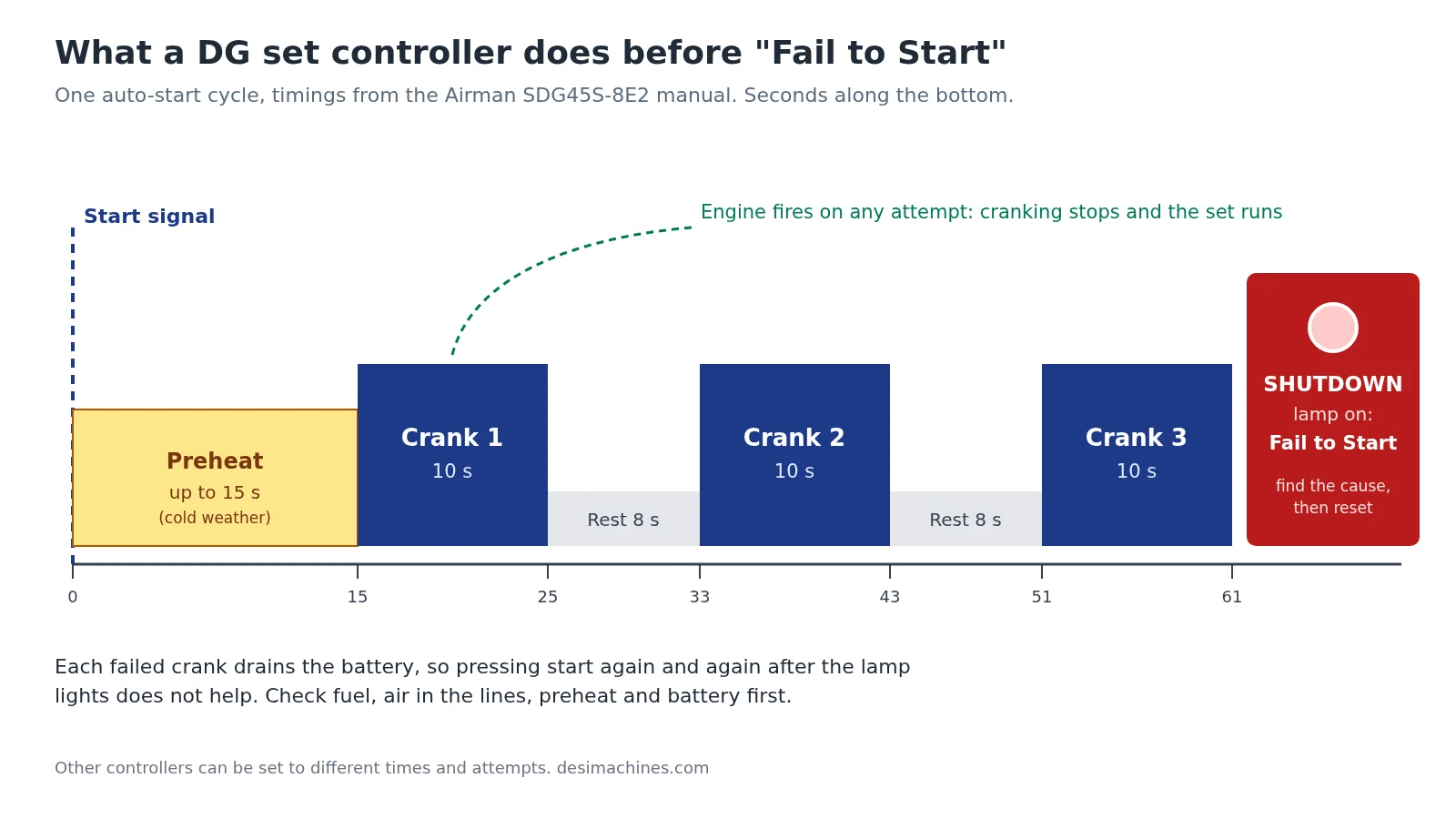
Two things follow from that cycle. First, a Fail to Start lamp is the result of a fault elsewhere: the set already cranked three times and none of them worked, so the reason is in the crank-but-no-start or no-crank list above. Second, resetting the alarm and pressing start again and again does not help. Each attempt drains the battery further, and a flat battery turns a fuel problem into two problems.
Why does a DG set start and then stop after a few seconds?
Usually because a protection device stopped it. Every DG set watches its own engine and shuts down when a reading goes past a limit. The Cummins manual has a separate flow chart for a set that “starts but stops after running several seconds”, and its first question is whether a fault condition is showing on the panel.
The Airman manual lists its protection devices and the limits for that model. They show what kind of reading a controller acts on:
| Message on the Airman SDG45S-8E2 | Limit or trigger in the manual | Causes the manual lists |
|---|---|---|
| Engine oil pressure low | Warning below 0.098 MPa (about 1 bar, 14 psi) | Low engine oil, clogged oil filter, loose wiring, faulty pressure switch |
| Water temperature high | Shutdown above 100°C | Low coolant, slipping belt, clogged radiator, faulty thermostat, loose wiring, faulty temperature switch |
| Engine speed high (overspeed) | Shutdown above 2,070 rpm | None listed; the manual sends engine trouble it does not list to the dealer |
| Over current | Overload or short circuit | Too much load, or a short on the load side |
| High voltage | Shutdown above 108% of rated voltage | Loose AVR wiring or a faulty AVR |
These figures are for that one set. Your set’s limits are in its own manual and on its controller, and they will differ by engine. What carries over is the method: read the message, check the level or part it names, and only then reset. A set that keeps stopping on low oil pressure when the oil level is correct needs the dealer before anyone tries it again.
Fuel can cause the same symptom without any alarm: a nearly blocked filter or a little air in the lines lets the engine fire on what is in the pump and then starve. The genset maintenance schedule lists when filters are due and how to read the warning signs before a service.
Why is the DG set running but not giving power?
If the engine runs steadily but the site has no supply, look at the output side. Airman’s table starts with the circuit breaker: it trips on an overload or a short in the wiring, and the manual asks you to stop the set, remove the cause and only then reset the breaker.
Its next checks are for low or no voltage at rated speed: loose terminals, a tripped circuit protector on the AVR (the automatic voltage regulator, which holds the output voltage steady), a faulty AVR, and faults in the exciter or alternator windings. Airman’s circuit protector trips when a heavy load is put on while engine speed is low, or when the voltage goes above its setting. Pressing its reset button is an operator job; anything in the windings or the AVR is for the dealer.
If the breaker trips again every time a big motor starts, the set may simply be too small for the job. How to size a set for the machines it has to start is worked through in the generator size calculation guide.
Need a working genset while yours is down? See machines available on rent for your site and send an enquiry.
What should you not do when a DG set will not start?
Do not keep cranking. The manuals limit each attempt for a reason. Airman cranks for 10 seconds and then rests for 8, and repeated attempts on a set that is not firing only flatten the battery.
Do not reset an emergency stop or a shutdown alarm until you know why it happened. Airman’s manual is direct about this for the emergency stop, and the same sense applies to an oil pressure or temperature shutdown.
Do not disconnect the battery while the set is running, which Mahindra Powerol warns against, and leave the battery cables alone for a few minutes after a stop, because the Airman manual notes that the engine controller stays on for a while after the engine has stopped.
Do not work inside the set while it is in Auto. Airman warns that the start signal is still live in auto mode even when the engine is stopped, so a start signal can crank the engine with your hands inside. Switch to Off, tag the remote switch and disconnect the battery’s negative terminal first.
Before calling the dealer, the Cummins manual suggests a short list that saves time: what has been repaired, replaced or changed since the set last ran properly, because a loose wire left after a repair is a common cause, plus any open switch, tripped breaker or loose plug you can see. Add the message on the panel, the hour meter reading and when the set was last serviced.
If the battery has to be replaced, match the voltage and capacity on the old one, or the maker’s recommendation, and never fit a smaller battery. You can get a quote for a heavy-duty battery from dealers near you.
Which DG set starting problems can a site fix without a technician?
The panel-side causes and the simple fuel and battery causes are within a careful operator’s reach: setting the right mode, resetting an emergency stop once its cause is clear, cleaning and tightening battery terminals, charging or replacing the battery, refuelling, draining the water separator and bleeding air from the fuel system as the manual describes, and resetting a breaker or AVR protector after removing the overload.
Starter motors, start relays, fuel solenoids, injectors, injection pumps, oil pressure faults on a full sump, overspeed shutdowns and anything in the alternator windings or AVR belong with the dealer or a trained technician. Airman’s manual tells owners to contact the dealer when a repair is hard to do themselves, and Cummins says only qualified service people should carry out its troubleshooting procedures because of the electrical, fuel and machinery hazards.
Regular running also shows a fault before the day you need power. Airman’s manual asks for a 5 to 10 minute run once a week to check the set’s performance. What to do at each service, and what to note in the log book, is in the genset maintenance schedule. How much diesel a set should use at each load, which helps spot a fuel fault, is in genset fuel consumption per hour. More guides on gensets are on the genset guide hub.
Planning power for your next project? Check machines on rent near your site, and compare options before you hire.
Where the facts in this guide come from. The start cycle (preheat up to 15 seconds, 10-second cranking, 8-second rest, three attempts, Fail to Start), the 10-second protection delay, the protection limits, the troubleshooting tables, the emergency stop reset, the air-bleeding steps, the auto-mode battery and safety warnings and the weekly test run are from Airman’s SDG45S-8E2 engine generator instruction manual (Hokuetsu Industries), sections 3.5, 3.6, 4.1 and 4.2, read on 20 November 2026; it is used here as one fully published example of a maker’s method. The three-way fault split, the blue-white smoke and fuel return test and the pre-troubleshooting checks are from the Cummins Onan HDKAG service manual (0981-0516, issue 9, 2024), section 3. The auto start switch, battery and low-fuel points are from Mahindra Powerol’s note on common reasons a generator might fail. Unit conversions are our own.
Prices, specifications and features are indicative, vary by variant, location and date, and should always be confirmed with the official OEM or authorised dealer before any purchase decision. DesiMachines is not liable for decisions taken on the basis of information that may have changed after publication.