
 Excavator
294 models
 Backhoe Loader
51 models
 Crane
68 models
 Concrete Mixer
79 models
 Wheel Loader
54 models
 Compactor / Roller
45 models
 Motor Grader
42 models

 Concrete Pump
66 models
 Skid Steer Loader
11 models


Generator size calculation for a site comes down to one sum and one check. Add up the running kVA of every load that can work at the same time, then make sure the set can also start your largest motor while the others are running. A 45 kW electric concrete pump shows why the check matters: it needs about 60 kVA to keep running, and up to 453 kVA for the few seconds it takes to start direct on line.
This guide is the worked version of the sizing steps in the guide to choosing a diesel generator for a construction site. It shows what to read off each nameplate, how much each way of starting a motor pulls from the set, and a full load list for a building site running a concrete pump and a small batching plant, from the first line to the set size. The motor figures come from IS 12615:2018, the Indian Standard for three-phase motors. Everything else is arithmetic you can redo with your own machines.
How do you calculate generator size in kVA?
Use one of two formulas, depending on what the nameplate gives you. For a load rated in kW, divide by the power factor: kVA = kW ÷ 0.8. The 0.8 is the power factor a genset’s rating assumes under IS/ISO 8528-1, unless its maker states another figure. For a three-phase motor, work from the full-load current on its plate instead: kVA = 1.732 × 415 × amps ÷ 1,000, which at 415 volts is simply amps × 0.72.
Amps are the better starting point for a motor. A motor’s kW is what it delivers at the shaft, and it draws more than that from the supply. IS 12615 puts a 45 kW, 4-pole IE3 motor at 94.2 per cent efficiency, so it takes about 47.8 kW in. Its full-load current already allows for those losses and for the motor’s power factor.
The same formula run backwards tells you what current a set can carry on each phase. Electricians size the cable and the main breaker from this number.
| Set size (kVA) | Power at 0.8 power factor (kW) | Full-load current per phase (A) |
|---|---|---|
| 25 | 20 | 35 |
| 62.5 | 50 | 87 |
| 125 | 100 | 174 |
| 160 | 128 | 223 |
| 200 | 160 | 278 |
| 250 | 200 | 348 |
| 320 | 256 | 445 |
All seven sizes appear in Mahindra Powerol’s list of diesel genset models, read in November 2026. The kW and amps columns are our arithmetic.
What do you read off each machine’s nameplate?
You need four things from every load: its power, its voltage, its full-load current if it has a motor, and how that motor is started. Walk the site with a notebook. Do not work from memory or from a brochure for a different model.
- A motor’s plate gives kW or HP (1 HP is 0.746 kW), the voltage and the full-load current in amps. The starter is written on its panel, not on the motor.
- A packaged plant often gives one total for all its motors. Ajax, for example, lists a maximum operational load of 34 kW for its CRB 20 batching plant and 46 kW for the CRB 30 on its own model pages. Ask the plant’s maker which is the largest single motor inside that total, and how it starts.
- If a welding set or a charger states its input in kVA, use that figure as it is. If it states amps, convert them.
- Lights, fans and the site office are usually listed in watts. Add them up and divide by 0.8, which errs on the safe side for most of these loads.
Mark which loads are single-phase. Each phase of a three-phase set carries one third of its rating, so a 25 kVA set gives about 8.3 kVA per phase. Put all the site lighting and the office on one phase and that phase can overload while the meter on the other two shows room to spare. Spread single-phase loads across all three phases.
How much power does a motor need to start?
Started straight on the supply, a motor draws many times its running current until it reaches speed. IS 900:2019, the code for installing induction motors, says the starting current is 6 to 7 times the rated current. IS 12615 sets the ceiling for each efficiency class. For 4-pole motors from 2.2 to 55 kW, locked-rotor current (the current drawn at standstill) may be up to 7 times full-load current for an IE2 motor, 7.5 times for IE3 and 8.3 times for IE4. From 75 kW the ceilings are 7, 7.7 and 8.9 times.
That last point catches people out. The standard notes that locked-rotor current rises by roughly 10 to 15 per cent for each step up in efficiency class. So a new IE3 or IE4 motor that saves diesel while it runs can be harder on the set at the moment it starts than the old motor it replaced.
| Motor kW (HP) | Full-load current, max (A) | Running kVA | Starting kVA, direct on line | Starting kVA, star-delta |
|---|---|---|---|---|
| 3.7 (5) | 8.1 | 5.8 | 44 | 15 |
| 7.5 (10) | 15.4 | 11.1 | 83 | 28 |
| 15 (20) | 30.0 | 21.6 | 162 | 54 |
| 22 (30) | 43.0 | 30.9 | 232 | 77 |
| 37 (50) | 69.0 | 49.6 | 372 | 124 |
| 45 (60) | 84.0 | 60.4 | 453 | 151 |
| 75 (100) | 134.0 | 96.3 | 742 | 247 |
Full-load currents and the locked-rotor ceilings are from IS 12615:2018 Table 2. The kVA columns are our arithmetic, at the IE3 ceiling, so they are the most a compliant motor of that size should pull. A given motor may draw less, and its maker’s data sheet gives the exact figure.
IS 900 lists four ways to start a motor with less current than direct on line:
- Star-delta. The windings are connected in star for the start, so each one sees only 1 ÷ 1.732 of the line voltage, then switched to delta to run. The starting current, and the starting torque with it, falls to about one third of a direct start.
- Auto-transformer. A transformer lowers the voltage for the start. How much current it saves depends on the tap it is set to.
- Soft starter. Electronics ramp the voltage up gradually. If the starter has a current-limit setting, that setting is the figure to use in your sum; if not, ask its supplier for the starting current.
- Frequency converter (VFD). The drive starts the motor at low frequency and brings it up to speed, so the start is gentle on the set. A drive is a non-linear load, though, and IS/ISO 8528-5 lists non-linear loads as something to tell the genset maker about when sizing.
A motor start lasts a few seconds, and what the set has to survive is the dip in voltage and frequency it causes. So the starting kVA is a number to check with the set’s maker, not the size of set to buy. The worked example below shows how.
Worked example: what size genset does a building site need?
Take a city building job with a small batching plant beside the tower, feeding a stationary electric concrete pump. There is no grid connection yet, so one diesel set runs everything. The pump and the batching plant are real machines with published ratings. The other loads are typical example values: replace them with the plates on your own site.
| Load | Rating | Where the figure comes from | Running kVA |
|---|---|---|---|
| Schwing Stetter SP 1200 E stationary concrete pump | 45 kW motor | the pump’s specification, November 2026; current from IS 12615 (84 A) | 60.4 |
| Ajax CRB 20 batching plant, 20 m³/h | 34 kW maximum operational load | Ajax’s model page, November 2026; kW ÷ 0.8 | 42.5 |
| Dewatering pump | 7.5 kW motor | example; current from IS 12615 (15.4 A) | 11.1 |
| Bar bending machine | 3.7 kW motor | example; current from IS 12615 (8.1 A) | 5.8 |
| Bar cutting machine | 2.2 kW motor | example; current from IS 12615 (5.1 A) | 3.7 |
| Site lights, 12 LED floodlights of 200 W (single-phase) | 2.4 kW | example; kW ÷ 0.8 | 3.0 |
| Site office: two 1.5 kW air conditioners, computers, printer (single-phase) | 4.0 kW | example; kW ÷ 0.8 | 5.0 |
| Everything running together | 131.5 |
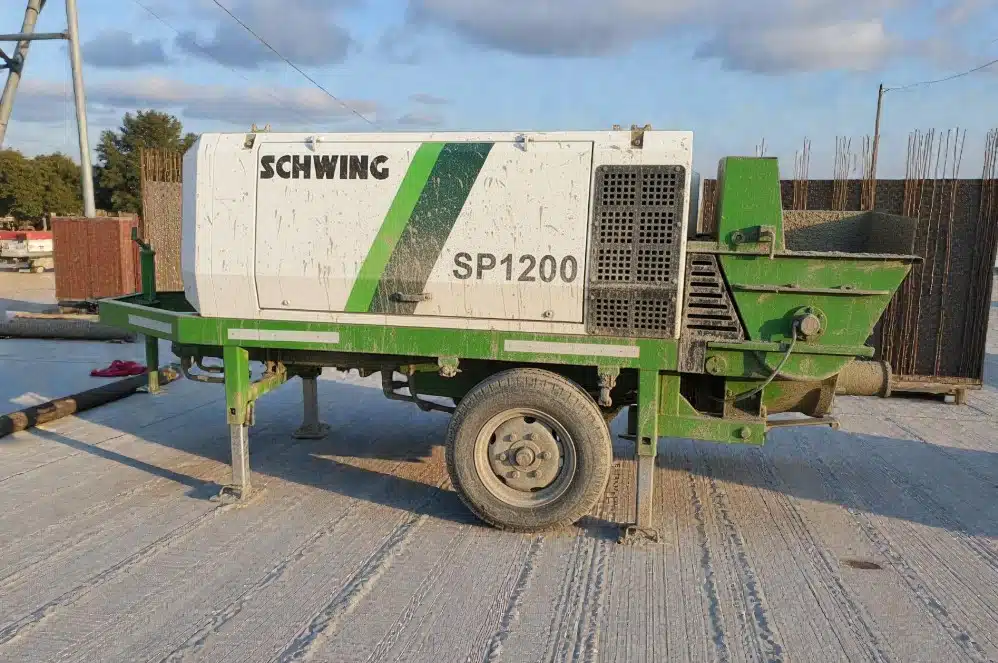
Step 1: the running load. If every load can run at once, the set must carry 131.5 kVA. IS/ISO 8528-5 lists the diversity factor of the load, meaning how much of it actually runs together, as one of the things to weigh when sizing. If the bar yard always stops during a pour, the peak falls to 122.0 kVA. Only count on that if someone on site will actually enforce it.
Step 2: the start of the biggest motor. That is the pump’s 45 kW motor. On a star-delta panel it pulls about 151 kVA while it starts. Direct on line, up to 453 kVA. If the pump is started while the other 71.1 kVA of load is already running, the set sees about 222 kVA for those seconds even on star-delta. Start the pump first, before the batching plant and the bar yard, and the set sees the 151 kVA on its own. IS/ISO 8528-5 gives the reason this works: a set picks up load better in steps, and an engine with a higher brake mean effective pressure, a measure of how hard the engine is worked for its size, usually needs its load applied in several steps.
1 running load
131.5 kVA
2 pump starts last
222
3 pump starts first
151
4 set rating 160 kVA
kVA drawn from the set (bar length to scale)
Step 3: pick the set. A 125 kVA set is below the running load, so it is out. A 160 kVA set on its prime power rating carries the 131.5 kVA peak at 82 per cent of its rating. IS/ISO 8528-1 lets a prime-rated set run unlimited hours on a varying load, provided the average over 24 hours stays within 70 per cent of the rating, unless the engine maker agrees otherwise. When the average is worked out, any spell below 30 per cent of the rating counts as 30 per cent.
On a pour day the load might run like this: 8 hours with everything on (131.5 kVA), 4 hours with the bar yard, dewatering pump and office (25.6 kVA), and 12 hours of night lights and dewatering (14.1 kVA). Both of the lighter spells sit below 48 kVA, which is 30 per cent of 160, so each counts as 48. The 24-hour average is (8 × 131.5 + 16 × 48) ÷ 24 = 75.8 kVA, or 47 per cent. That is inside the 70 per cent limit with room for a longer pour.
Step 4: check the start with the maker. Give the maker or dealer of the 160 kVA set the pump’s motor kW, its starter and the 71.1 kVA that may already be running, and ask whether the set holds the dip within performance class G2. IS/ISO 8528-5 Table 4 allows a class G2 set a voltage dip of up to 20 per cent on a sudden load increase, recovering within 6 seconds. G1 allows 25 per cent and 10 seconds, and G3 allows 15 per cent and 4 seconds. If the answer is no, you have three fixes: start the pump first every time, fit a soft starter to the pump panel, or move up to a 200 kVA set.
Step 5: correct for the site. The rating holds only at the conditions the set was rated under. A May afternoon in the plains or a site in the hills can cut it, as the guide on heat, altitude and dust derating explains. If the maker’s derating for your site takes the 160 kVA set below 131.5 kVA, go to 180 or 200 kVA.
The night load also matters. For 16 hours this set carries 14.1 to 25.6 kVA, between 9 and 16 per cent of its rating. Ask the maker what minimum load it recommends. One answer is a second, small set for nights: a 20 or 25 kVA set carries the 14.1 kVA night load at 56 to 71 per cent.
What changes if the concrete pump is bigger?
The pump decides most of this site’s answer, so changing it changes the set. Swap the 45 kW pump for a 75 kW one such as the Schwing Stetter SP 1800 E or the Aquarius 1406 E. The running load rises from 131.5 to 167.4 kVA, and a star-delta start with everything else running rises to about 318 kVA. The 160 kVA set is now too small, and the same steps point to 200 kVA at 84 per cent of rating, or 250 kVA if the site is hot. The 90 kW Aquarius 1405 E needs about 118 kVA just to run its motor.
The Schwing Stetter BP 350 E carries the same 45 kW motor rating as the SP 1200 E, so either one gives the same answer. Motor powers here are from each pump’s specification as of November 2026. How a pump’s motor or engine power relates to its output is explained in concrete pump engine power. If the pump is still to be chosen, set the genset sum beside the stationary concrete pumps you are considering before you decide between an electric and a diesel drive. The plant side of the same job is covered in the types of batching plant guide.
What mistakes make a site genset trip or struggle?
Most sizing mistakes come from one of a few habits.
- Adding a motor’s kW straight to a set’s kVA, or comparing a motor’s HP with a set’s kVA. Convert everything to kVA first.
- Sizing on the running load alone. The set that carries the day’s work can still stall when the biggest motor starts on top of everything else.
- Replacing an old motor with an IE3 or IE4 one and not rechecking the start.
- Loading one phase with all the single-phase lighting and office load.
- Buying far bigger than the load “to be safe”, then running it at 10 per cent for most of the day.
- Reading a standby rating as if it were a prime rating. A standby rating is meant for power cuts of up to 200 hours a year, and the guide to choosing a site diesel generator sets out all four ratings.
Battery machines add a different kind of load: a charger that may run at night when the rest of the site is quiet. The sizes involved are worked through in charging an electric excavator on site.
What should you tell the genset supplier?
IS/ISO 8528-5 puts this on the buyer. The customer, it says, should specify any particular load types and any load acceptance the set’s maker should consider. Hand the dealer or hire firm one page with:
- the load list, with kW, amps and phase for each load, and which ones run together;
- the largest motor, its starter, and what may already be running when it starts;
- any frequency converters, chargers or other electronic loads;
- the performance class you need: G2 suits pumps, lights, fans and hoists, and G3 or G4 suits sensitive electronics and computers;
- the hottest and coldest temperatures on site, the altitude, and whether the air is dusty;
- whether the set will be the only supply, which means a prime rating, or cover for grid cuts only.
Ask for the answer, and the rating it is based on, in writing with the quote. If you are hiring, put the same rating and the running hours into the hire terms, as the guide to the generator rental business in India explains. The approvals a site set needs before it runs are listed in DG set permission on a construction site, and the rest of the series is in the genset guide.
Sources: IS 12615:2018, line-operated three-phase a.c. motors, efficiency classes and performance (Table 2 and clause 14.4); IS/ISO 8528-5:2005, generating sets, Part 5 (clauses 9.2 and 9.4, Table 4); IS/ISO 8528-1:2005, clause 13.3.2; IS 900:2019, clauses 7.2.1.4 and 7.2.1.5. Maker figures are from the Ajax CRB 20 and CRB 30 model pages and Mahindra Powerol’s genset range page, read in November 2026.
Prices, specifications and features are indicative, vary by variant, location and date, and should always be confirmed with the official OEM or authorised dealer before any purchase decision. DesiMachines is not liable for decisions taken on the basis of information that may have changed after publication. A genset installation must be designed and checked by a licensed electrical contractor and approved by your state electrical inspectorate.