Excavator
294 models
Excavator
294 models  Backhoe Loader
51 models
Backhoe Loader
51 models  Crane
68 models
Crane
68 models  Concrete Mixer
79 models
Concrete Mixer
79 models  Wheel Loader
54 models
Wheel Loader
54 models  Compactor / Roller
45 models
Compactor / Roller
45 models  Motor Grader
42 models
Motor Grader
42 models  Dozer
41 models
Dozer
41 models  Concrete Pump
66 models
Concrete Pump
66 models  Skid Steer Loader
11 models
Skid Steer Loader
11 models  Telehandler
13 models
Telehandler
13 models 


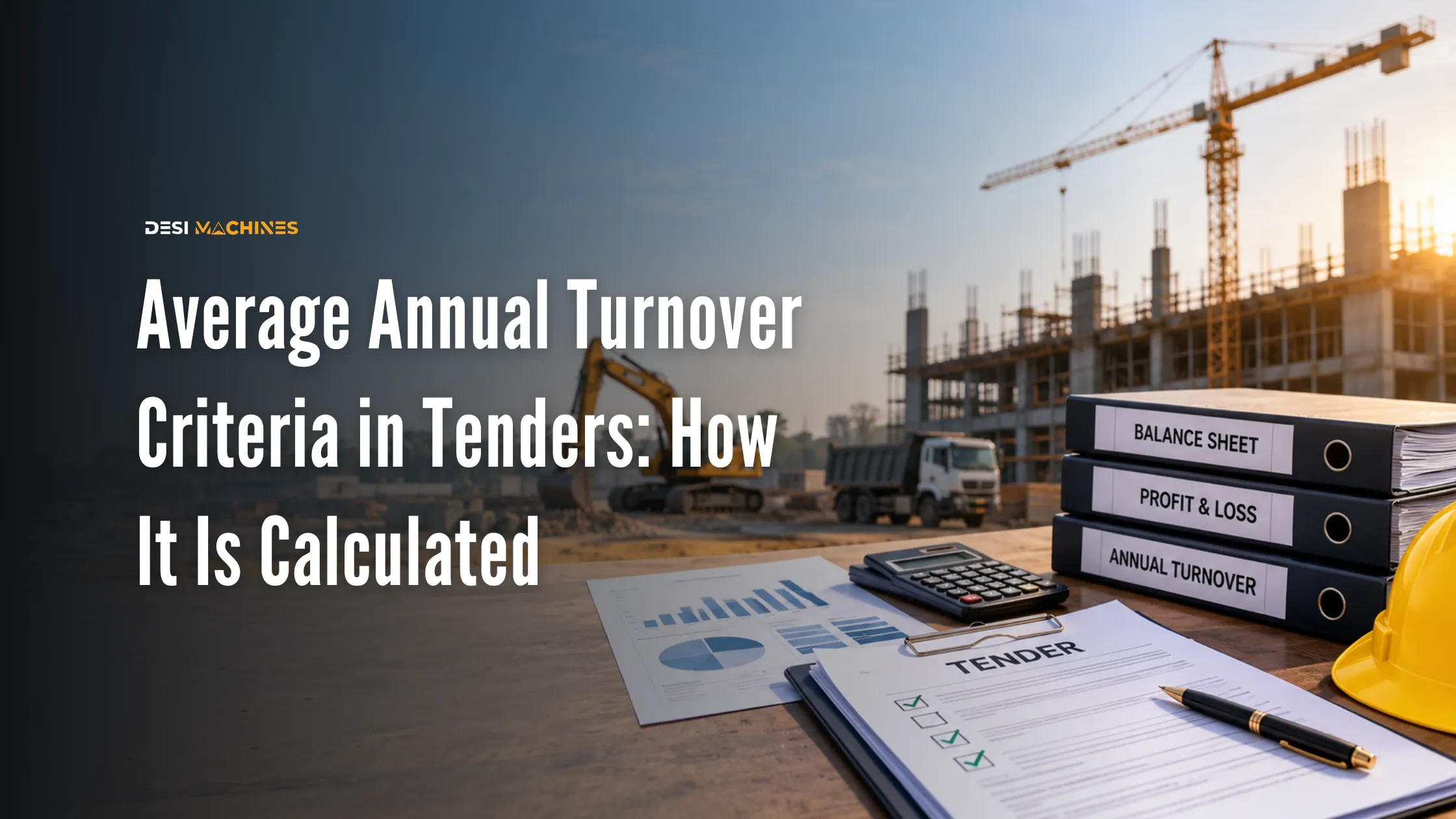
The average annual turnover criteria in tender documents is a financial capacity test: add your turnover for the three financial years the notice names, divide by three, and compare the result against the figure the notice sets. For central civil and electrical works that figure is commonly 30% of the estimated cost, though each department fixes its own. Proof is audited accounts for all three years, not a self-declaration, and the year that ends after the notice’s cut-off date does not count however good it was.
Take a road package with an estimated cost of ₹12 crore. At a 30% requirement, the bidder needs an average annual turnover of ₹3.6 crore across three years. A firm that billed ₹2 crore, ₹4 crore and ₹5 crore in those years averages ₹3.67 crore and clears it by ₹7 lakh. The same firm reading the clause as “turnover in any one year” would have assumed it cleared comfortably on the ₹5 crore year alone, and would have been right only if the notice actually said that. Many do not.
That gap between what the clause says and what bidders assume it says is where most financial disqualifications happen.
What the average annual turnover criteria in tender notices asks for
The clause has three moving parts, and all three are set by the notice rather than by any general rule.
The first is the window. Notices name three financial years explicitly, as in 2020-21, 2021-22 and 2022-23, or define them as the three years ending on a stated 31 March. One central tender put it as turnover “during the last 3 years, ending 31st March”, with the year fixed in the document.
The second is the benchmark. For central government civil and electrical works the widely used figure is an average annual turnover of at least 30% of the estimated cost. Other notices set a flat rupee amount instead: a Directorate of Handloom and Textiles tender required not less than ₹50 lakh as the average annual financial turnover over three named years, with no reference to project cost at all.
The third is what counts as turnover. Some clauses take the whole figure from your profit and loss account. Others restrict it to receipts from similar works, which for a firm that also trades in parts or hires out machines is a very different number. This one word decides more bids than the percentage does.
The arithmetic, worked through
| Estimated cost of work | Requirement at 30% | Your three-year turnover | Your average | Result |
|---|---|---|---|---|
| ₹12.00 crore | ₹3.60 crore | ₹2.0 + ₹4.0 + ₹5.0 crore | ₹3.67 crore | Qualifies |
| ₹12.00 crore | ₹3.60 crore | ₹1.2 + ₹3.0 + ₹6.0 crore | ₹3.40 crore | Fails |
| ₹5.00 crore | ₹1.50 crore | ₹1.4 + ₹1.5 + ₹1.7 crore | ₹1.53 crore | Qualifies |
Illustrative only, at a 30% benchmark. The percentage, the years and the definition of turnover are set by each tender document.
Row two is the instructive one. That bidder has the single best year in the table at ₹6 crore and still fails, because averaging drags a weak first year across the whole test. A lumpy order book is the enemy of this clause, and the fix is to know your average before you spend money on a bid rather than after.
Turnover is not the only financial gate in the document. Notices frequently add a working capital requirement alongside it, one central tender asking for evidence of working capital of at least 20% of the annualised or estimated value of the work, whichever is less. Clearing the turnover line and failing the working capital line disqualifies you just as completely.
What you have to produce as proof
Audited accounts, in every case worth the name. Departments ask for the balance sheet and profit and loss account for each of the three years, and commonly for a chartered accountant’s certificate stating the turnover figure so the evaluator does not have to derive it. One steel plant tender required a notarised audited balance sheet and profit and loss account for all three years, and refused anything less.
Two practical points follow. A firm that files its accounts late cannot bid, because the most recent year has no audited figure to submit, and provisional numbers are not accepted by most departments. And where you are already enlisted with the department, check the exemption clause: the same tender exempted parties registered with the plant in the relevant discipline from submitting turnover and experience proof at all, on the basis that the registration already established it. That is a strong argument for getting enlisted before chasing individual jobs, which is the logic behind departmental PWD contractor registration.
Where bidders actually lose it
Reading “average” as “any one year” is the most common error, and the second most common is its mirror: a notice that genuinely asks for turnover in one of the three preceding years rather than an average, which a bidder fails by averaging when they did not need to. Read the verb.
Joint ventures split the figure by share, the same way experience does. A partner holding 40% of the venture brings 40% of the relevant turnover to the qualification, and if the notice splits turnover by share it applies the same discount there, which our note on a joint venture for tender work sets out with the arithmetic.
New firms hit a wall the clause has no door in. Three completed financial years is three completed financial years, and no department waives it on the strength of a good order book. The realistic routes are a joint venture, subcontract packages under somebody else’s awarded work, and the tenders our guide to bidding for government construction tenders identifies as reachable without the full qualification stack. The technical half of the same gate is covered separately in what a work experience certificate for tender eligibility has to prove.
Central procurement does exempt micro and small enterprises from prior turnover and prior experience criteria under the public procurement policy for MSEs, provided quality and technical specifications are met. Registration must be valid at the time of bidding. Central notices and their eligibility clauses are published on the Central Public Procurement Portal at eprocure.gov.in, and reading the qualification section of two live notices in your line of work is the fastest way to learn which variant your departments use.
Check these four things in every turnover clause
Work out your own three-year average once, before the bidding season, and write it on the wall. Then for every notice check four things in order: which three years it names, whether it wants an average or a single year, whether turnover means total receipts or works receipts only, and what the percentage is measured against. Those four answers decide eligibility before a single rate is quoted.
Where the average falls short, the honest options are a joint venture, subcontract work, smaller municipal jobs, and the MSE route if you qualify for it. Building the turnover means taking on work, and taking on work usually means capacity, so compare construction equipment finance options and track live infrastructure tender opportunities against the qualification you can actually meet this year.
Qualification percentages, turnover windows, working capital norms and exemption limits are fixed by each tender document and vary between departments and years. The figures and worked examples here are indicative and illustrative. Confirm the exact clause in the notice you are bidding against, and with the issuing department, before relying on it.