Excavator
316 models
 Backhoe Loader
54 models
 Crane
68 models
 Concrete Mixer
79 models
 Wheel Loader
54 models
 Compactor / Roller
45 models
 Motor Grader
42 models

 Concrete Pump
66 models
 Skid Steer Loader
11 models


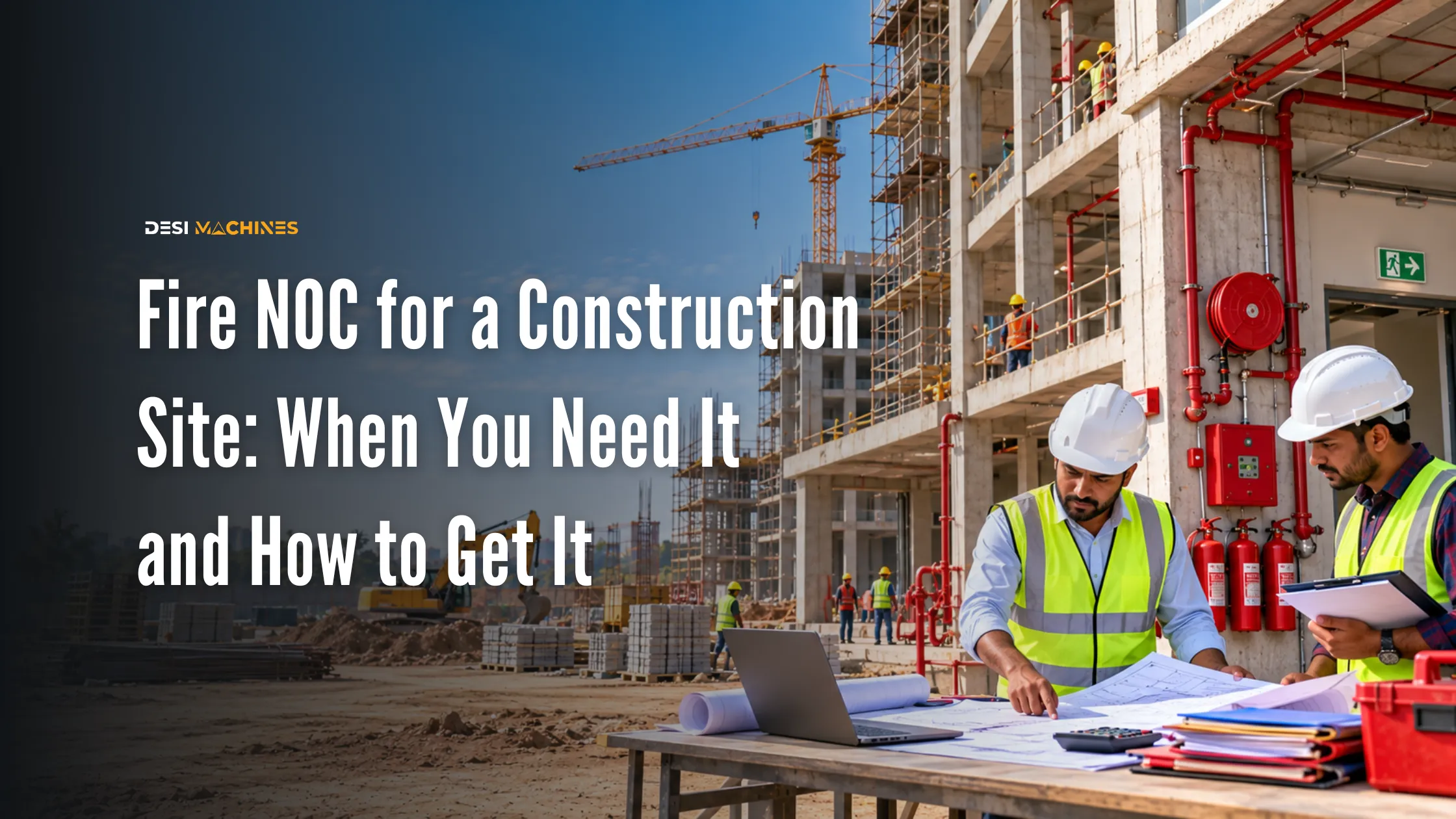
What the industry calls a fire NOC for construction site work does not appear under that name in the statute that governs it. Taking Maharashtra’s Act as the worked example, what the law actually requires is that the owner provide the fire fighting installations prescribed for that class of building, furnish a Licensed Agency certificate confirming compliance, and repeat a maintenance certificate every January and July. The teeth sit in section 3(2): no authority may issue a completion certificate, or even a part completion certificate, until it is satisfied those requirements are met. Since a 2023 amendment the owner must also obtain a Provisional Fire Safety Approval from the Chief Fire Officer at the building plan stage and a Final Fire Safety Approval before the completion or occupancy certificate, the two documents the state fire service’s own portal calls the provisional and final NOC.
Search for the phrase and you will find a thousand pages explaining how to apply for a fire NOC. Open the Maharashtra Fire Prevention and Life Safety Measures Act, 2006 and search it for the words “no objection certificate” and you get nothing. Not once.
That is not a drafting oversight. The Act is built on a different idea, and the gap between the phrase everyone uses and the mechanism that actually exists is where sites lose months.
What a fire NOC for construction site work really is
Three separate things get bundled under one informal label.
The first is the scrutiny of your building proposal by the fire service before the planning authority sanctions it. Until 30 May 2023 that sat in the municipal law and the development control rules of your state, not in the Fire Act, which is why the Act as first enacted never named it. The Maharashtra Fire Prevention and Life Safety Measures (Amendment) Act, 2023 brought it into section 3(1) as the Provisional Fire Safety Approval, defined as the recommendation the Director or Chief Fire Officer gives “at the time of building plan approval and before the construction thereof”. The fire service’s online application calls it a Provisional NOC.
The second is the compliance certificate under section 3(3). The owner or occupier has to furnish the Chief Fire Officer a certificate in the prescribed form, issued by a Licensed Agency, confirming that the fire prevention and life safety measures required for the building are in place. The same sub-section then requires a maintenance certificate in the prescribed form twice a year, in the months of January and July, confirming the installations are still in good repair.
The third is the fee assessment, and this one catches people. Section 14(1) applies to any person who intends to construct a building for which the Authority’s permission is required, “whether he has applied for such permission or not”, or who has commenced construction. Starting work without permission does not take you outside the fee machinery; it only means the Authority serves a notice and assesses you anyway.
The same amendment named the step at the other end. A Final Fire Safety Approval is the certificate the Director or Chief Fire Officer issues after checking that the measures on site match the Provisional Fire Safety Approval, “before granting building completion certificate or occupancy certificate by the appropriate authority”. The portal calls it the Final No Objection Certificate. So the phrase everyone uses now does point at something in the statute: two approvals either side of construction, with the Licensed Agency certificate and the six-monthly maintenance certificates running alongside them.
Who carries the duty, and when it starts
Section 3(1) puts the obligation on the owner, and on the occupier only where the owner is not traceable. The owner of a building classified in Schedule I has to provide the fire prevention and life safety measures and the minimum fire fighting installations specified against that building in the Schedule, and then maintain them “in good repair and efficient condition at all times”.
The 2023 amendment rewrote section 3(1) around those approvals. The owner, or the occupier where the owner is not traceable, must obtain the Provisional, Final or Renewal of Fire Safety Approval, as the case may be, and provide the measures recommended in that approval, which cannot fall below the minimum installations in Part 4 of the National Building Code of India and those specified against the building in Schedule I. Both Schedules were themselves replaced in 2023.
For buildings already finished when the Act came into force in that area, the proviso shifts the forward-looking work to the occupier. For buildings under construction on that date, it names the owner.
The Schedule classification is not the Act’s own invention. The Explanation to section 3 in the Act as first enacted stated that the classification of buildings in Schedule I, and in Schedule II under section 11, conforms to the classification made under the National Building Code of India, 2005. So the question “which fire installations do I need” resolves to “which NBC occupancy class is this building”, and the Schedule answers from there.
That Explanation went in 2023, replaced by the definitions of the approvals, and section 3(1) now refers to Part 4 of the National Building Code of India without naming an edition. The current edition is NBC 2016, published by the Bureau of Indian Standards as SP 7, whose Part 4 deals with fire and life safety. The answer to “which occupancy class” still comes from Part 4; it is now the 2016 text you read.
A works contract can and usually does pass the execution and the cost of this to the contractor. That is a commercial allocation. It does not move the statutory liability, which stays on the owner, so a contractor relying on an informal assurance that “the client is handling fire” should still get the allocation written into the work order and its scope.
The certificate it blocks
Section 3(2) is the provision worth reading twice:
“Notwithstanding anything contained in any law for the time being in force, no authority empowered to sanction the construction plan of any building or part of a building and to issue certificate of completion thereof, shall issue any certificate of completion or part completion thereof, unless it is satisfied that the owner has complied with the requirements specified in Schedule-I, or as the case may be, in the notice so served on him as aforesaid.”
Note the two details. It overrides any other law. And it covers part completion as well as completion, so the common strategy of taking partial handover on finished wings does not route around it.
That single sentence is why fire compliance is a programme item and not a paperwork item. Everything downstream of the completion certificate, including occupation, the occupancy certificate that follows it, final billing and the release of retention money, queues behind a document the authority is barred from issuing.
A plan sanction is not fire approval
Section 46 closes the gap that most disputes live in:
Where anything relating to fire prevention and life safety measures is required to be done or approved under the Act, it “shall not be deemed to have been lawfully done or approved by reason only of the fact that permission, approval or sanction required under such other law therefore has been obtained.”
In plain terms: your sanctioned plan proves the planning authority was satisfied. It proves nothing about the fire side. Treat them as two files.
What happens when you skip it
The enforcement ladder is short and it moves fast once it starts.
| Section | What the officer may do | What it costs you |
|---|---|---|
| 5 | Enter and inspect the building after three hours’ notice to the occupier, or to the owner if there is no occupier | Obstructing the inspection is itself an offence under section 36 |
| 6 | Record the deviations and serve a notice directing the measures to be done within a stated time | The clock in the notice is the one the rest of the ladder runs on |
| 7 | Take the steps himself on non-compliance | Expenses payable on demand; recoverable as arrears of property tax if unpaid for fifteen days |
| 8 | Order occupants out, direct the electricity and water supply to be disconnected, have the building sealed by police | Site stops. Removing the seal without a written order is a separate offence |
| 36 | Prosecute | Rigorous imprisonment of six months to three years, fine of Rs 20,000 to Rs 50,000, and up to Rs 3,000 per day while the offence continues after a first conviction |
Section 36 reaches the Licensed Agency too. Giving a certificate under section 3(3) without actual compliance, and carrying out fire prevention work as someone other than a Licensed Agency, are both listed offences. A cheap certificate from an unlicensed vendor is worth less than nothing, because it is evidence against the person who commissioned it.
One more obligation sits apart from all of this. Under section 45, every owner or occupier of a building taller than 30 metres used as a hotel, hospital, business or mercantile premises, or in mixed occupancy, has to appoint a fire officer or fire supervisor. That is a staffing line in the operating budget, not a construction-stage cost.
The 2023 amendment widened that list to residential buildings taller than 70 metres, large oil and natural gas installations such as refineries and LPG bottling plants, and industrial buildings of 30,000 square metres or more with moderately hazardous activity, or 10,000 square metres or more with highly hazardous activity. It also added two duties for every building covered by section 45: an automated continuous monitoring system for the fire fighting installations under section 3(3A), and a fire and life safety audit by a licensed auditor under section 45A, first within a year of the amendment coming into force and then once every two years.
What to ask the Chief Fire Officer for, in writing
Four questions, sent as a letter, save more time than any number of site visits.
Which Schedule I entry the building falls under, and the list of minimum installations specified against it. Whether the Act has been notified in your area yet, since section 1(3) commences it area by area on a date the State Government appoints. The current list of Licensed Agencies for your jurisdiction. And the fee assessment under section 14, which you are required to apply for in any case.
Ask in writing and the reply becomes the record that settles the argument later. A verbal clearance from a site visit does not.
We have not reproduced the fee amounts here. They sit in the Schedule to the Act and in state notifications that are revised, and a figure quoted from the wrong vintage is worse than no figure. Get your number from the Authority’s own assessment under section 14.
What can be stated is how the fee is worked out, because since 2023 Schedule II sets it as a formula rather than a rate card. The fire and emergency service fee is a percentage of the Annual Statement of Rates, the ready reckoner rate published under the stamp rules, applied per square metre of built-up area:
| Building height | Residential | Institutional | Commercial | Industrial |
|---|---|---|---|---|
| Up to 45 m | 0.25% | 0.50% | 0.75% | 0.75% |
| Above 45 m | 0.50% | 0.75% | 1.00% | 1.00% |
The occupancy groups follow Part 4 of the National Building Code. The rupee figure still turns on the ready reckoner rate for your plot and year, which is why the Authority’s own assessment remains the number to use.
Where this sits with your other clearances
Fire is one of four or five parallel approvals a site needs, and they are usually run by different people, which is how one of them gets forgotten. The pollution board route runs separately and has its own sequence, covered in consent to establish and consent to operate. Within 20 km of an airport, the building’s height, and any crane used to build it, also needs clearance from the Airports Authority of India, explained in AAI NOC for height clearance. On government work, a stalled clearance that delays your programme also carries a reputational risk, since the department’s own remedies can run as far as blacklisting.
Two more apply on larger or deeper jobs. A building project with 20,000 square metres or more of built-up area needs prior environmental clearance for construction projects before work starts, and a site that pumps out groundwater for a basement or uses it to build needs a groundwater NOC for construction.
If you are bidding work where these clearances are in the employer’s scope, say so in your bid and price the risk of them arriving late. Contractors carrying unpriced approval risk is a recurring theme in how government construction tenders get bid.
Read your state fire law, not an NOC checklist
Stop looking for a fire NOC and start reading your state’s Fire Act. The obligation is specific to a building class, it belongs to the owner, it is certified by a Licensed Agency rather than by the fire brigade, and it is re-certified every January and July. Miss it and the completion certificate cannot legally be issued, which stops everything that depends on it.
Working capital that sits idle while a clearance catches up is the most expensive kind. If a stalled approval has pushed your programme and stretched your cash cycle, our equipment and project finance options are worth a look, and current tenders and project opportunities are listed as they open. The Maharashtra Fire & Emergency Services department publishes jurisdiction and contact details at mahafireservice.gov.in.
Statutory provisions are summarised here as a guide and are quoted from the Maharashtra Fire Prevention and Life Safety Measures Act, 2006; other states have their own fire legislation with different section numbers and schedules. Requirements, fees and notified areas change, so confirm the current position for your building with the Chief Fire Officer, the planning authority or your own legal adviser before acting. DesiMachines is not liable for decisions taken on the basis of information that may have changed after publication.
Checked on 25 October 2026 against the Act as amended by the Maharashtra Fire Prevention and Life Safety Measures (Amendment) Act, 2023 (Mah. XXIV of 2023, in force from 30 May 2023 under Urban Development Department notification FFS-2022/C.R.36/UD-14), as published by the Maharashtra Fire and Emergency Services.