 Suno Sabki, Chuno Apni.
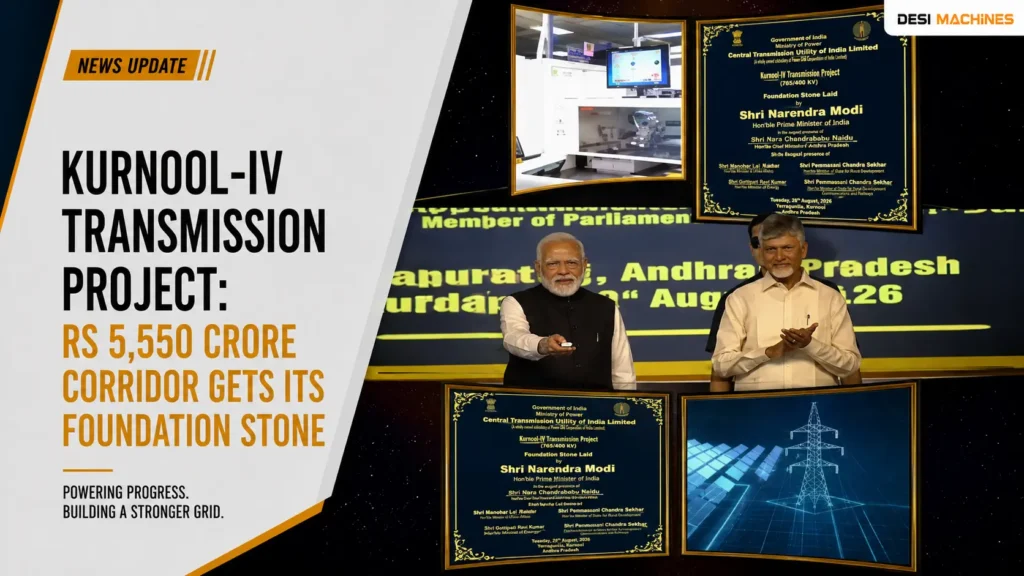
Transmission work rarely makes an equipment buyer’s shortlist, and that is exactly why the Kurnool-IV transmission project is worth reading properly. The Prime Minister laid its foundation stone on Saturday 1 August at Visakhapatnam, alongside two finished POWERGRID systems he switched on the same afternoon. Only one of those three will put machines on the ground, and it is the one that has not been built yet.
The Prime Minister’s Office listed all three items in the same announcement, which is how most carriers ran it, and the wording is where the money is. Two schemes were dedicated to the nation. Those are finished assets, their contractors paid and demobilised. The third, Kurnool-IV Phase-I, only got a foundation stone, so its civil and erection scope is still ahead of it.
One more detail worth holding on to: several outlets refiled this story on 3 and 4 August, and at least one of them dated the event to a Tuesday. The event was Saturday 1 August. If you are tracking the tender calendar off news dates, start the clock from the first.
A power corridor is not a highway package, and treating it like one is how fleet owners lose money on this class of job. There is no long mass-earthwork front here. A transmission line is a string of small, scattered worksites, each needing a foundation pit, a concrete pour and a tower stood up, connected by temporary access tracks cut through farmland and scrub.
That shapes the fleet very specifically. The workhorse is the backhoe loader, because it digs the pit, loads the spoil, backfills and then drives itself to the next location without a trailer. In this class that means the JCB 3DX and Tata Hitachi equivalents that already dominate rental yards in the district. Compact and mid-size excavators handle the rocky Rayalaseema stretches where a backhoe stalls. Foundation concrete arrives by transit mixer from small mobile batching plants, so concrete mixers matter more than volume suggests. Tower erection pulls in cranes, though a good deal of Indian tower work is still done with derricks and winches rather than hired iron.
Our take: this is a hire market, not a buy signal. Machine hours per site are short, the sites move constantly, and utilisation depends entirely on how fast right-of-way clearances come through, which on linear projects is the single thing nobody controls. Buying a machine against an SPV project that has not tendered its packages is speculation. The sensible read is that operators already working the Andhra Pradesh solar belt around Kurnool and Ananthapuram are best placed, since the plant is already in the district and the access-road work is the same job they have been doing.
The second-order point is supply. Two POWERGRID schemes in this belt just finished. The plant that built them is coming free at roughly the moment Kurnool-IV starts tendering, which argues against rates firming much locally.
Sizing a fleet for corridor work? Compare backhoe loaders and compact excavators on price, running cost and resale before you commit, and check what finance costs today. Start with our compactor and earthmoving comparisons.
On Saturday 1 August 2026, at an event in Visakhapatnam. Several outlets refiled the story on 3 and 4 August, so later datelines are republications rather than a second event.
About Rs 5,550 crore for Phase-I, which integrates 4.5 GW of renewable capacity. POWERGRID is implementing it through a special purpose vehicle.
No. A foundation stone is a start-of-project marker. The foundation and erection packages have not been awarded, so machine demand follows the tender, not the ceremony.
Related on DesiMachines: Live equipment and project opportunities
Source: The Federal
Desi Machines is a platform where you can see and compare construction equipment. It showcases images, brochures, features, technical specifications, brand details & dealer information. All these are taken from respective brand websites, brochures, and other public resources. We do not claim ownership of these materials and strive to ensure their accuracy. However, the disparity may happen and we advise users to verify directly with respective brands and dealers. Desi Machines is not liable for any inaccuracies or reliance on the information provided. Use of this website is at your own discretion.

 Excavator
  Backhoe Loader
  Motor Grader
  Wheel Loader
  Crane
Crane  Concrete Mixer
  Compactor
  Skid Steer Loader
  Concrete Pump
  Telehandler


