
 Excavator
316 models
 Backhoe Loader
54 models
 Crane
68 models
 Concrete Mixer
79 models
 Wheel Loader
65 models
 Compactor / Roller
45 models
 Motor Grader
42 models

 Concrete Pump
66 models
 Skid Steer Loader
11 models


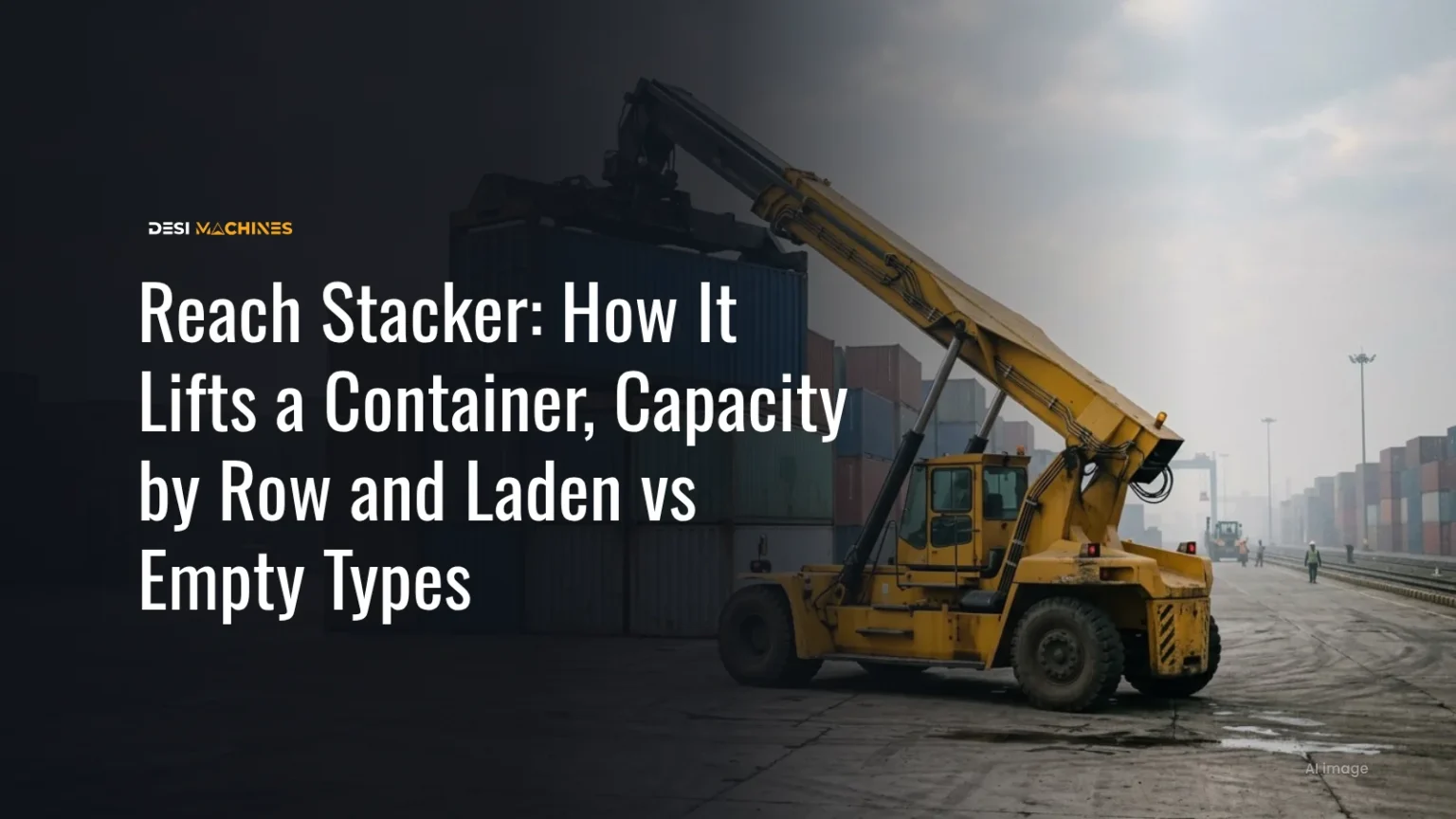
A reach stacker lifts a loaded shipping container of up to 45 or 46 tonnes on a telescopic boom and stacks it as much as five boxes high and three rows deep. That headline figure holds only in the first row: on the load charts of two makers selling in India, the same class of machine is rated at 14 to 40 tonnes in the third row, because the box now hangs about three times further out in front of the wheels.
That one fact decides most of what a container yard can do with the machine, from how deep it can store boxes to which row the heavy ones must go in. This guide explains how a reach stacker lifts, reads the row-by-row load charts of SANY’s 45-tonne series and the Hyster-TIL 46-33CH, and sets out when a yard needs a laden machine, an empty container handler or something else. All figures are from the makers’ sheets, read in November 2026.
What is a reach stacker used for?
It moves and stacks ISO shipping containers wherever boxes are stored on the ground: port container yards, inland container depots (ICDs, the dry ports inland where boxes clear customs), container freight stations (CFS) and rail yards. SANY India’s model pages list 20-foot, 40-foot and 45-foot ISO containers up to 45 tonnes, plus logs, steel tubes and intermodal containers. TIL Limited lists ports, terminals, rail yards and logistics hubs.
Its advantage is reach. The boom can stretch over the first row of boxes to set down or pick up one behind it, so a yard can store containers more than one row deep and still get at the back rows. Wikipedia’s article on the machine puts it simply: with second-row access, container blocks can be kept four deep.
One machine also does several jobs in a row. It picks a box off a trailer or a rail wagon, carries it across the yard and stacks it, with no crane and no second machine.
How it fits with the quay cranes, yard cranes and terminal tractors around it, and how a port differs from an ICD or a CFS, is explained in the guide to container handling equipment. Where it sits among lift trucks in general is covered in the guide to types of forklift.
How does a reach stacker lift a container?
Think of it as a very large telehandler built around one job. A boom hinged at the back of the machine reaches forward over the front wheels, and a steel frame on its tip grips the container from the top.
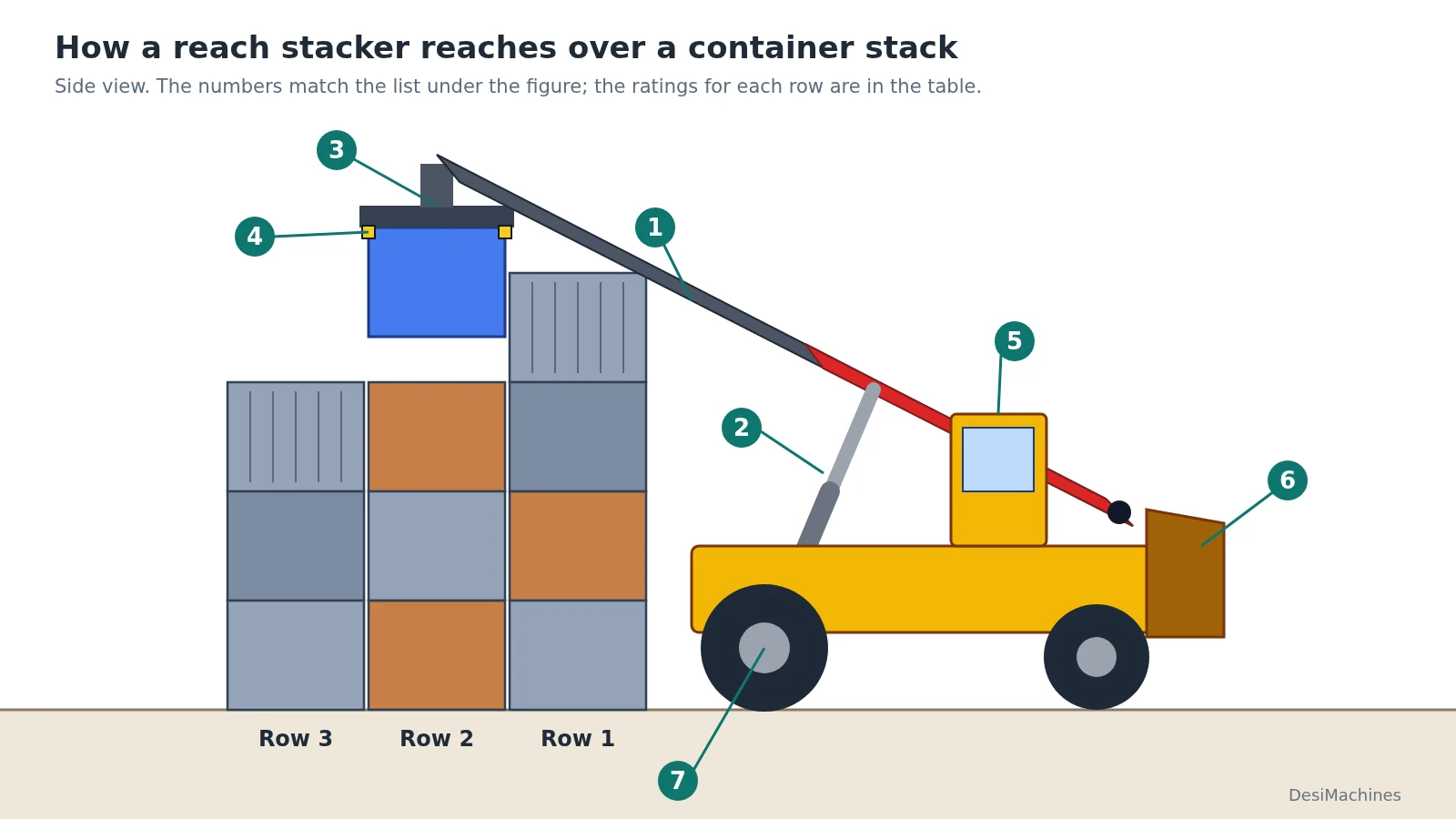
The numbered parts:
- Boom: a telescopic arm hinged at the rear. It extends to reach out and up. On SANY’s 45-tonne machines it rises from flat to 60 degrees and puts the spreader at up to 15.1 metres (15,100 mm).
- Lift cylinders: the hydraulic rams that raise and lower the boom.
- Spreader: the frame that grips the box. It telescopes between 20-foot and 40-foot lengths (45-foot on some), so one spreader handles all the common boxes. SANY’s SDJ450H spreader weighs 7.1 tonnes, turns 105 degrees one way and 195 the other, tilts 5 degrees each way and slides 800 mm to either side, so the driver can line it up without moving the whole machine.
- Twistlocks: four pins at the spreader corners that drop into the container’s corner castings and turn to lock. TIL describes them as hydraulically worked ISO twistlocks with electrical safety and signalling, so the driver gets a signal in the cab once they are locked.
- Cab: in the middle of the machine. SANY lists a movable cab, which shifts for a better view of the box.
- Counterweight: the heavy block at the rear that balances the container.
- Front drive axle and big tyres: the load rides over the front axle. SANY’s sheet lists a Kessler D102 drive axle and 18.00-25 tyres.
A lift goes like this. The driver comes up square to the box, sets the spreader to its length, lowers it on top and locks the twistlocks. The driver lifts, pulls the boom in to carry the box low and close, drives to the stack, then raises and extends the boom and sets the box down. On the diesel SANY SRSC45V the spreader rises at 420 mm per second empty and 250 mm per second with a full load, and the machine travels at up to 25 km/h empty and 21 km/h loaded.
A boom that only lifted would swing the box in an arc as it rose. SANY’s controller adjusts the boom so the spreader goes straight up, which keeps a box clear of its neighbour on a tight stack.
What is the capacity of a reach stacker?
The capacity is a set of numbers, one for each row and height, printed on the load chart. The headline figure (45 or 46 tonnes) is the first row only. The table puts the rows side by side for five machines.
| Model or series | Row 1 | Row 2 | Row 3 | Maximum lift height | Stack height in row 1, 8 ft 6 in boxes |
|---|---|---|---|---|---|
| SANY SRSC4531 series (SRSC45V) | 45 t | 31 t | 15 t | 15,100 mm | 5 high (43 t on the fifth) |
| SANY SRSC4535 series | 45 t | 35 t | 19 t | 15,100 mm | 5 high (43 t on the fifth) |
| SANY SRSC4540 series | 45 t | 40 t | 31 t | 15,100 mm | 5 high (40 t on the fifth) |
| SANY SRSC4545 series | 45 t | 45 t | 40 t | 13,600 mm | 5 high |
| Hyster-TIL 46-33CH | 46 t | 28 t | 14 t | Not stated on the page | 4 high in every row |
Row figures are for the lower tiers of each stack. SANY’s charts measure the rows from the front of the machine to the middle of each row: 1,965 mm, 3,815 mm and 6,315 mm, or 2,100, 3,900 and 6,400 mm on the SRSC4545. The SANY figures are from its 2026 reach stacker brochure and the 46-33CH figures from TIL’s product page.
Four things in the table matter more than the headline.
The third row is where machines differ. All four SANY series lift 45 tonnes in the first row, but the third-row rating runs from 15 to 40 tonnes. In SANY’s series names the two numbers match the first-row and second-row ratings: 4531 means 45 and 31 tonnes.
Height costs capacity at the top. On the SRSC4540 the third row drops from 31 tonnes at the bottom to 30 and then 28 tonnes as the stack rises, and the fifth box in the first row is rated 40 tonnes, not 45.
High-cube boxes stack lower. A standard box is 8 ft 6 in tall and a high-cube box 9 ft 6 in. On SANY’s charts a row of high-cube boxes often stops one tier short of a row of standard ones: the SRSC4531 stacks the third row three high in high-cube against four high in standard.
The machine that holds most in the back row gives up height. The SRSC4545 keeps 40 tonnes in the third row, and its maximum lift height is 13.6 metres against 15.1 metres on the others.
Lifting pallets, cement bags or steel on a building site, not containers? That is telehandler work. Compare telehandler models and capacities and talk to a verified dealer.
Why does a reach stacker lift less in the second and third row?
Because it balances like a see-saw over its front axle. The box pulls the front of the machine down with its weight times its distance out in front of the wheels. Engineers call this the load moment. The counterweight and the machine’s own weight push back the other way. Move the same box further out and it pulls harder, so the rating has to fall.
On SANY’s chart the third row sits about 3.2 times further out than the first (6,315 mm against 1,965 mm). On the SRSC4531 the rating falls to one third, from 45 tonnes to 15. It is the same rule that cuts a forklift’s capacity when the load sits further out on the forks, explained in the guide to forklift capacity and load centre, and the same reason a telehandler carries a load chart with different figures at each reach.
So the yard plan follows the chart. Heavy loaded boxes go in the first row, where the full rating applies. Lighter boxes and empties go behind. A box heavier than the third-row rating must never be placed there, however careful the driver is.
The machines carry systems that watch for overload. TIL lists a load moment indicator and overload protection on its rough-terrain empty reach stacker, and SANY lists anti-rollover protection that reads the working figures in real time and adjusts the machine’s operation. These are a backstop. The chart is the plan.
Laden reach stacker or empty container handler: which does a yard need?
A laden reach stacker can handle empty boxes too, but it is a 71-tonne machine moving a box that weighs a few tonnes. Yards that store many empties often add a machine built only for them. Wikipedia’s article mentions these empty stackers, and the makers sell two kinds: a lighter reach stacker for empties, and an empty container handler that lifts on a tall mast like a forklift.
| Machine | Type | Rated capacity | Maximum lift height | Other details on the maker’s page |
|---|---|---|---|---|
| SANY SRSC45V | Laden reach stacker | 45 / 31 / 15 t by row | 15.1 m | 71 t machine, Volvo TAD1151 engine |
| SANY SRSC1009-6E | Reach stacker for empties | 10 / 9 / 5 t by row | 16.2 m | Cummins QSB 6.7 engine, 25 km/h loaded |
| TIL rough terrain empty container reach stacker | Reach stacker for empties | 8 t (4 high), 6.5 t (4 high), 4.5 t (2 high) | 12.6 m | About 37 t, four-wheel drive and four-wheel steer, paved or unprepared ground |
| SANY SDCY90K7H2 | Empty container handler, mast type | 9 t | 18.75 m | Cummins QSB 6.7 engine, 22 km/h loaded |
TIL’s page does not say which row each of its three ratings belongs to. It does say the machine handles high-cube boxes four high in the first row and standard boxes four high in the second.
The mast-type handler lifts highest but only from the front face of a stack. The reach type for empties can work the rows behind, as a laden reach stacker does. The rough-terrain machine is the one to look at for a new depot whose yard is not yet paved.
A yard with a large block of empties can split the work: laden reach stackers for loaded boxes, and a lighter machine for the empties. The electric versions of both, and how a yard charges them between shifts, are in the guide to electric reach stackers.
Can a reach stacker lift anything other than containers?
Yes. The spreader is an attachment, and changing it changes the job. SANY’s brochure lists these for its reach stackers:
- A turnover spreader (38 t) that rolls a 20-foot open-top container through a full circle to tip out bulk cargo.
- A tilting spreader (35 t) that tilts a 20-foot box up to 55 degrees for bulk loading and unloading.
- A log spreader (31 t) and a steel coil spreader (45 t).
- A hook spreader (70 t) for wind turbine tower sections and bulk cargo.
- A combined spreader for 20, 30, 35, 40 and 45-foot containers and the European swap bodies that cannot be stacked.
A different spreader has its own weight and its own rated load, and the machine’s chart applies to the spreader it was drawn for. Ask the maker for the load chart with the spreader you will actually fit. Attachments change a forklift’s rating in the same way.
Reach stacker vs forklift, telehandler and crane: what is the difference?
All four lift loads off the ground, but they are built for very different weights and places.
| Machine | What it lifts | How it reaches | Where it works |
|---|---|---|---|
| Reach stacker | Loaded 20, 40 and 45-foot containers, 45 to 46 t in row 1 | Telescopic boom over the front, up to three rows deep | Port yards, ICDs, CFS, rail yards |
| Container handler with a mast | Containers on a mast, such as the 9 t empty handler above | Straight up the front face of a stack, first row only | Depots that store empties in tall blocks |
| Telehandler | Pallets, bags, steel and blocks: 3,000 kg on the JCB 530-70, 4,540 kg on the SANY STH1056A | Telescopic boom, up to 7 m and 17.1 m high on those two | Building sites, farms, plant yards |
| Mobile crane | Loads on a hook, from a set position | Boom and hook, often on outriggers | Building and project sites, factories |
Reach stacker vs forklift
A forklift lifts on a mast straight in front of it and cannot reach past the first row. Heavy container forklifts exist: TIL markets Hyster’s high-capacity forklifts and laden and empty container handlers in India alongside its reach stackers. The reach stacker wins where boxes are stored more than one row deep.
Reach stacker vs telehandler
The idea is the same, a telescopic boom over the front wheels. The scale is not. A telehandler such as the JCB 530-70 weighs about 7.2 tonnes and lifts 3 tonnes. A reach stacker weighs around 70 tonnes and lifts 45. A telehandler cannot lift a loaded container. What it does well is explained in the guide to the telescopic handler.
Reach stacker vs crane
TIL’s own answer is that cranes generally lift from a fixed position, while a reach stacker drives with the box and moves it quickly over short distances in crowded spaces. The gantry cranes and straddle carriers of a big terminal are covered in the guide to container handling equipment, and other crane types in the guide to types of cranes.
How much space and ground does a reach stacker need?
More than most buyers expect. The diesel SANY SRSC45V is a typical 45-tonne machine.
| Item | Figure |
|---|---|
| Overall weight | 71 t |
| Overall length | 11,320 mm |
| Overall width, spreader closed to fully open | 6,053 to 12,185 mm |
| Wheelbase | 6,000 mm |
| Height, boom retracted | 4,770 mm |
| Minimum turning radius | 8,000 mm |
| Aisle width for a 20-foot box | 11,300 mm |
| Aisle width for a 40-foot box | 13,600 mm |
| Gradeability, empty / loaded | 39% / 32% |
| Engine options | 265 to 280 kW diesel |
| Tyres | 18.00-25 |
Aisles come first. A reach stacker carries a 40-foot box across its front, so it needs about 13.6 metres of clear aisle between stacks to turn and set it down. Plan the stack layout around that figure, not around the machine’s length.
The ground comes next. Seventy-one tonnes of machine plus a 45-tonne box is a heavy load on four tyres, and with a full box most of it rides on the front pair. A paved yard has to be designed for it: ask the maker for the axle loads before the pavement is laid. Where the yard is still gravel, a rough-terrain empty machine like TIL’s, at about 37 tonnes with four-wheel drive, is built for that ground. A loaded machine is not.
Slopes matter less but still count. The diesel SRSC45V climbs 32 percent with a full load, and the battery SRSC45E3, with the same dimensions, 14 percent. A yard with ramps should check that figure before choosing electric.
What should you check before you buy or hire a reach stacker?
Start from the boxes and the yard, then match the machine.
- The load chart for your rows and your box heights, standard and high-cube, with the spreader you will use. Read row 3, not the headline.
- Your heaviest box and the furthest row it must reach.
- Laden or empty work, and whether one machine can do both in your volumes.
- Aisle width and turning room: about 13.6 metres for 40-foot boxes on SANY’s 45-tonne machines.
- The yard surface and the maker’s axle loads, before you pave.
- Safety systems: load moment indicator and overload protection (TIL), anti-rollover, spreader anti-collision and automatic braking when reversing (SANY), and the optional camera and pedestrian-warning packages.
- Twistlock signalling that works, and lights at the spreader corners for night shifts (a SANY option).
- Service engineers and spares within reach of your yard, and training for the drivers from the maker or dealer.
- Diesel or electric, which depends on charging, shift length and slopes.
The machines and tenders for port work are on the port equipment page, and the wider warehouse and yard picture on the material handling equipment page. More lift-truck guides are on the forklift guide hub.
Need a lifting machine for site work? Compare telehandler models for loads up to a few tonnes, and connect with a dealer near your site.
Where the figures in this guide come from. Row-by-row ratings, row distances, lift heights, dimensions, speeds, gradeability, engines, spreader movements and the special spreaders are from SANY’s reach stacker brochure (version dated 1 August 2026) and SANY India’s pages for the SRSC45V, SRSC1009-6E and SDCY90K7H2. The 46-33CH ratings are from TIL Limited’s 46-33CH reach stacker page, and the rough-terrain empty reach stacker, twistlock and safety-system details from TIL’s rough-terrain empty reach stacker page, all read in November 2026. Telehandler figures are from the JCB 530-70 and SANY STH1056A specifications. Second-row access is from Wikipedia’s reach stacker article. The row-distance ratio is our own arithmetic.
Prices, specifications and features are indicative, vary by variant, location and date, and should always be confirmed with the official OEM or authorised dealer before any purchase decision. DesiMachines is not liable for decisions taken on the basis of information that may have changed after publication.