
 Excavator
316 models
 Backhoe Loader
54 models
 Crane
68 models
 Concrete Mixer
79 models
 Wheel Loader
65 models
 Compactor / Roller
45 models
 Motor Grader
42 models

 Concrete Pump
66 models
 Skid Steer Loader
11 models


The ruling gradient is the steepest slope a road designer may use as a matter of course along the length of a road. On Indian highways in plain or rolling country, IRC:73-2023 sets the ruling gradient at 2.5 per cent (1 in 40), with 3.3 per cent (1 in 30) as the limiting gradient, and both climb with the terrain: 5 per cent in mountainous country and 6 per cent on steep ground.
A gradient is the rise or fall of a road along its length. It is written three ways: as a percentage (3.3 per cent), as “1 in n” (1 in 30, meaning one metre of rise for every 30 metres along the road), or as an angle. This guide gives the four gradient types Indian engineers work with, the current IRC values for every terrain, how those values changed in 2023, the grade compensation rule on curves, and what a slope means for a loaded tipper and the rollers that build the road. It sits beside the guides to camber, superelevation and sight distance.
What is ruling gradient in road design?
Ruling gradient is the design gradient. It is the slope a designer can use anywhere along a road without having to justify it, chosen so that heavy vehicles can climb it with the fewest gear changes. IRC:73-2023 puts it plainly: in hilly regions the gradient should be one that heavier vehicles can negotiate “with the least change of gears”, because that saves time and running cost.
Three other gradients sit around it:
- Limiting gradient is steeper. It is allowed where the ground forces it, or where keeping to the ruling gradient would add enormously to the cost. Stretches at the limiting gradient should be as short as possible.
- Exceptional gradient is steeper again. It is used only in very difficult places and for no more than 100 m at a stretch.
- Minimum gradient works the other way. It is the smallest fall a road needs so that rain runs off along it, which matters in cuttings and on kerbed roads.
Two textbook terms also turn up in exams and site talk. The floating gradient is the slope on which a vehicle rolls at a steady speed with neither power nor brakes. The average gradient is the total rise over a long length divided by that length. IRC:73 does not use either as a design value, but it does cap the average: the rise over any 2 km must not exceed 100 m in mountainous terrain or 120 m in steep terrain. That works out to an average of 5 per cent and 6 per cent, the same as the ruling gradient for those terrains on highways.
What is the ruling gradient as per IRC?
IRC:73-2023, Geometric Design Standards for Non-Urban (Rural) Roads, gives two tables: one for highways and one for the smaller roads. For 2, 4, 6 and 8-lane highways, the values are:
| Terrain | Ruling gradient | Limiting gradient |
|---|---|---|
| Plain or rolling | 2.5% (1 in 40) | 3.3% (1 in 30) |
| Mountainous | 5% (1 in 20) | 6% (1 in 16.7) |
| Steep | 6% (1 in 16.7) | 7% (1 in 14.3) |
| Expressway (note to the table) | 2% | 3%, only in very difficult places and for short lengths |
The highway table has no exceptional column at all. For major district roads (MDR), other district roads (ODR) and village roads (VR), the code keeps the older three-level pattern:
| Terrain | Ruling gradient | Limiting gradient | Exceptional gradient |
|---|---|---|---|
| Plain or rolling | 3.3% (1 in 30) | 5% (1 in 20) | 6% (1 in 16.7) |
| Mountainous, and steep terrain above 3,000 m | 5% (1 in 20) | 7% (1 in 14.3) | 10% (1 in 10) |
| Steep terrain up to 3,000 m | 6% (1 in 16.7) | 8% (1 in 12.5) | 10% (1 in 10) |
Terrain here means the slope of the land across the road line, not the road itself. The types of roads guide gives the bands: plain under 10 per cent cross slope, rolling 10 to 25, mountainous 25 to 60 and steep over 60.
The code also asks for a flatter 2 per cent in two special cases: an isolated over-bridge in flat country, and a road carrying a lot of slow traffic. Both are about looks, traffic flow and safety rather than what a truck can climb.
What is the difference between ruling, limiting and exceptional gradient?
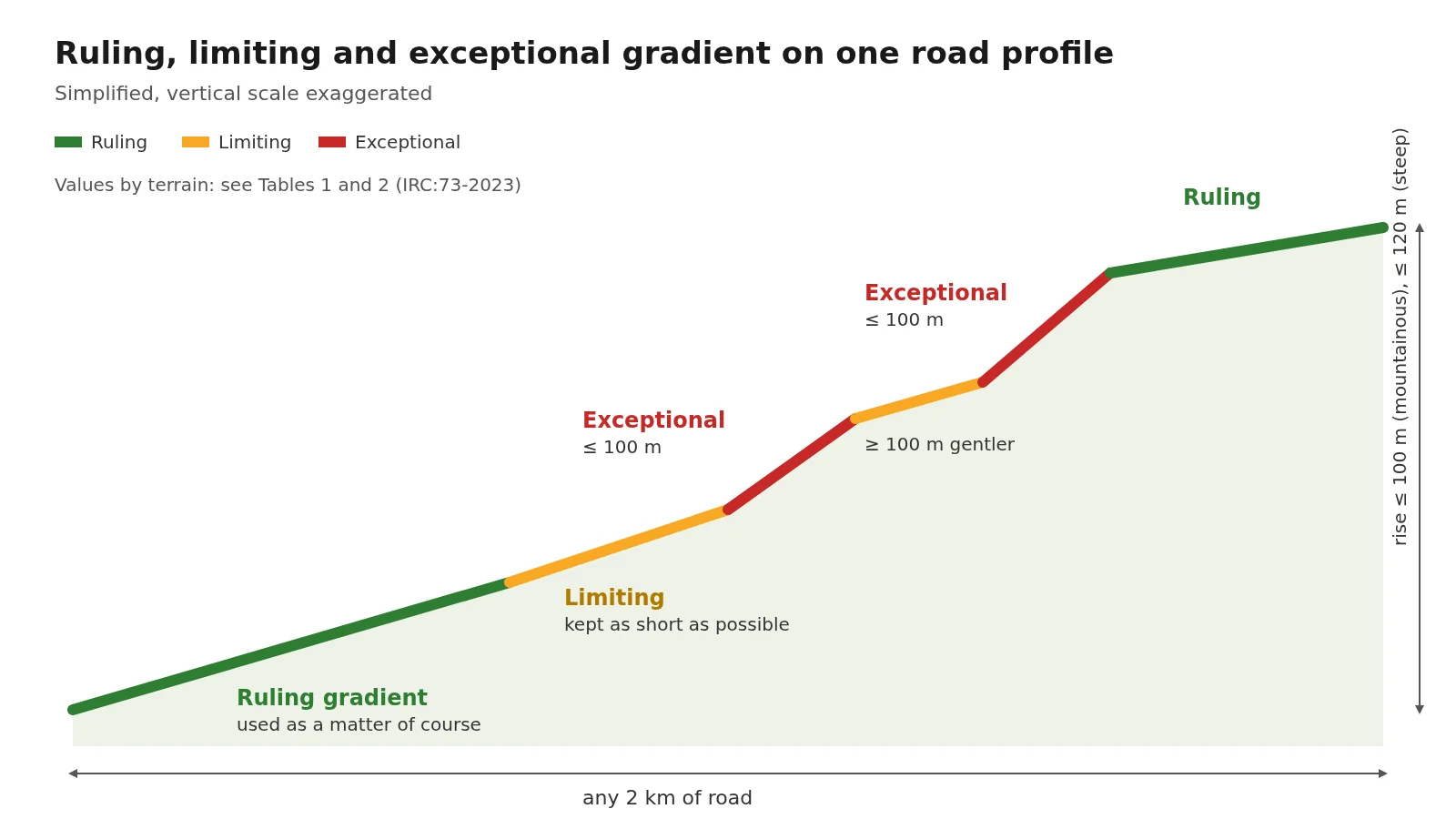
The difference is how freely each may be used. Ruling gradient is used by default. Limiting gradient needs a reason (difficult ground or a large saving) and should be kept short. Exceptional gradient needs a very difficult site and comes with two hard limits in IRC:73:
- No single stretch at the exceptional gradient may be longer than 100 m.
- In mountainous and steep terrain, two stretches at the exceptional gradient must be separated by at least 100 m at the limiting gradient or flatter.
Put together with the 2 km rise cap, this means a hill road cannot simply be built at its steepest allowed slope all the way up. It has to mix in long runs at the ruling gradient so the average stays within the cap. Figure 1 shows the pattern.
The code also wants a smooth profile. Desirably there should be no change of gradient within 150 m, relaxed to 75 m in constrained mountain sections and 90 m on overlay work, where re-profiling costs money.
How did the IRC gradient values change in 2023?
The gradient values in older study notes come from IRC:73-1980, which applied one table to every rural road. The 2023 revision split highways from the smaller roads and tightened the highway values. If a source tells you the ruling gradient in plain terrain is 3.3 per cent, it is quoting the 1980 code.
| Terrain | 1980, all rural roads (ruling / limiting / exceptional) | 2023, highways (ruling / limiting) | 2023, MDR, ODR, VR (ruling / limiting / exceptional) |
|---|---|---|---|
| Plain or rolling | 3.3% / 5% / 6.7% | 2.5% / 3.3% | 3.3% / 5% / 6% |
| Mountainous, and steep above 3,000 m | 5% / 6% / 7% | 5% / 6% (mountainous) | 5% / 7% / 10% |
| Steep up to 3,000 m | 6% / 7% / 8% | 6% / 7% (steep) | 6% / 8% / 10% |
Three changes stand out. A plain-terrain highway now designs to 2.5 per cent where it used to design to 3.3. The plain-terrain exceptional value for smaller roads moved from 6.7 per cent (1 in 15) to 6 per cent (1 in 16.7). And hill roads in the smaller classes may now go to 10 per cent for short stretches, where the 1980 code stopped at 7 and 8. The rules around the table (the 100 m limits and the 2 km rise cap) carried over unchanged.
The code explains why the values are not steeper even though new trucks climb better: they were set so that “even old heavy vehicles” can manage them.
How do you convert 1 in 30 into a percentage and degrees?
Divide 100 by the “n” to get the percentage: 1 in 30 is 100 ÷ 30 = 3.33 per cent. To get degrees, take the angle whose tangent is 1/30, which is 1.91 degrees. Road gradients are small, so the degree figure always looks surprisingly low. The table converts every value in the IRC tables.
| Per cent | 1 in n | Degrees | Where IRC uses it |
|---|---|---|---|
| 2% | 1 in 50 | 1.15° | Expressway ruling gradient |
| 2.5% | 1 in 40 | 1.43° | Highway ruling, plain or rolling |
| 3.3% | 1 in 30 | 1.91° | Highway limiting, plain; MDR/ODR/VR ruling, plain |
| 5% | 1 in 20 | 2.86° | Ruling, mountainous |
| 6% | 1 in 16.7 | 3.43° | Ruling, steep |
| 7% | 1 in 14.3 | 4.00° | Highway limiting, steep |
| 8% | 1 in 12.5 | 4.57° | MDR/ODR/VR limiting, steep |
| 10% | 1 in 10 | 5.71° | MDR/ODR/VR exceptional, hills |
A 10 per cent road rises one metre in every ten. That is the steepest design value anywhere in IRC:73, and it is still under six degrees.
What is the minimum gradient for drainage on a road?
On an open road in embankment, a near-level grade is acceptable because the camber throws rain sideways off the surface. In a cutting, or where the road has kerbs, water has nowhere to go sideways, so the road itself must fall along its length.
The numbers depend on which document you read:
- IRC:73-1980 (clause 10.2.7) set the desirable minimum at 0.5 per cent where the side drains are lined and 1.0 per cent where they are unlined.
- IRC:73-2023 no longer gives a figure. It sends the designer to IRC:SP:42, Guidelines on Road Drainage, and IRC:SP:50 for urban drainage.
- IRC:SP:42-2014 (clause 4.4.1) says a minimum longitudinal gradient of 0.3 per cent is considered essential in most conditions, written with kerbed urban roads in mind.
IRC:73-2023 adds one more check: the finished carriageway should be checked for flat spots, with a minimum of 0.5 per cent across it so that water drains quickly, because standing water thrown up as spray cuts visibility. The side drains guide covers the drain channels themselves, their shapes and the bed slope they need.
What is grade compensation on a curve?
Grade compensation is a reduction in the gradient where a road curves. A vehicle on a curve that is also climbing fights two resistances at once: the grade and the curve. IRC:73 asks the designer to ease the gradient on the curve to make up for it, using:
Grade compensation (per cent) = (30 + R) ÷ R, where R is the radius of the curve in metres, subject to a maximum of 75 ÷ R per cent.
Two more rules come with it. Compensation is not needed on gradients flatter than 4 per cent. And when you apply it, you never ease the gradient below 4 per cent. Worked through:
| Curve radius | Gradient | (30 + R) ÷ R | Cap, 75 ÷ R | Compensation used | Gradient on the curve |
|---|---|---|---|---|---|
| 200 m | 5% | 1.15% | 0.375% | 0.375% | 4.625% |
| 100 m | 7% | 1.30% | 0.75% | 0.75% | 6.25% |
| 60 m | 6% | 1.50% | 1.25% | 1.25% | 4.75% |
| 30 m (a tight hill bend) | 5% | 2.00% | 2.50% | 2.00% | 4% (5 − 2 = 3%, but not below 4%) |
The cap decides the answer on every curve wider than 45 m, because there 75 ÷ R is smaller than (30 + R) ÷ R. Only on very tight bends does the formula itself govern. The same curves also need superelevation, the sideways tilt that holds a vehicle on the bend; grade compensation deals with the climb.
What does a steep gradient mean for a loaded tipper?
On a slope, part of a vehicle’s own weight pulls it back downhill. For the small slopes of a road, that pull is very close to the weight multiplied by the gradient as a fraction: about 10 kg of extra pull for every tonne of weight and every 1 per cent of grade. Take a tipper that weighs 25 tonnes (25,000 kg) with its load:
| Gradient | Where it applies | Extra pull from the slope |
|---|---|---|
| 2.5% | Highway ruling, plain | About 6.1 kN (625 kg) |
| 3.3% | Highway limiting, plain | About 8.1 kN (825 kg) |
| 5% | Ruling, mountainous | About 12.2 kN (1,250 kg) |
| 7% | Highway limiting, steep | About 17.1 kN (1,750 kg) |
| 10% | Exceptional, hill MDR/ODR/VR | About 24.4 kN (2,500 kg) |
Going up, that pull is what drops a loaded truck into a low gear and slows it to a crawl. Going down, the same force pushes the truck forward and the brakes and engine have to hold it back. On a road at 7 per cent instead of 2.5 per cent, the slope’s pull on every loaded trip is 2.8 times as large. That is the reason the code fixes gradients around heavy vehicles, and why it asks for an extra lane on long, steep climbs.
Mine haul roads are a different case. They are not designed to IRC:73; the mine sets them, and the trucks are off-highway dumpers. The rigid vs articulated dump truck guide works through grade plus rolling resistance on a haul road, including the gradient a loaded dumper can hold.
Can road rollers and graders work on these gradients?
Yes, with a large margin. Roller makers publish a maximum gradeability, the steepest slope the machine can climb under its own power on good ground. Across the compactors in the DesiMachines catalogue, every published figure is more than twice the steepest gradient anywhere in IRC:73:
| Roller class | Machines publishing a figure | Range | Lowest and highest |
|---|---|---|---|
| Tandem roller (gradeability with vibration) | 19 of 20 | 25% to 45% | HAMM HD 109i VV 25%; ACE ADD-95 45% |
| Single drum soil compactor | 21 of 21 | 26% to 53% | Volvo SD110 26%; Dynapac CA305D CEV-V 53% |
| Pneumatic tyred roller | 3 of 4 | 23% to 35% | Volvo PT220 23%; L&T 2490 HD 35% |
So the roller is never what limits a road’s gradient. These are the makers’ published maximums; on site, wet or loose material gives less grip. The gradient limit is set by the loaded trucks that will use the road for decades, not by the machines that build it.
The machine that puts the gradient into the road is the motor grader. It trims the formation and the granular layers to the levels on the design profile, so a 2.5 per cent grade on the drawing becomes 2.5 per cent on the ground before the bituminous layers go down. Graders in the catalogue include the Mahindra RoadMaster G9075 and the Cat 120. Compare live motor grader models and specifications and connect with a dealer.
How does gradient affect the rest of the road design?
Gradient is fixed before almost anything else in the vertical design, because the vertical curves that join two grades are drawn from it. It then feeds into other parts of the design:
- Sight distance: a vehicle needs longer to stop going downhill and less going uphill. IRC:73 corrects the stopping distance for gradient, and the sight distance guide works through the code’s example on a 1 in 40 grade.
- Earthwork and cost: a flatter gradient through rolling or hilly ground means deeper cuttings and higher fills. That trade-off is the reason the code allows limiting and exceptional gradients at all.
In railway engineering, “ruling gradient” means something different: the gradient that decides the heaviest train one locomotive can haul. Railway values are far flatter and are not covered here.
For more on how roads are designed and built in India, start from the road construction guide. To see the rollers that compact each layer on a gradient, compare live road roller and compactor models and connect with a dealer.
Sources: the highway and MDR/ODR/VR gradient tables, the 100 m and 2 km rules, the flat-spot check and the grade compensation formula and example are from IRC:73-2023, Geometric Design Standards for Non-Urban (Rural) Roads, Section 7.2 and clause 8.5, with Tables 7.1 and 7.2 read from the page images. The 1980 values and drainage minimums are from IRC:73-1980, Table 19 and clause 10.2.7. The 0.3 per cent kerbed-road minimum is from IRC:SP:42-2014, clause 4.4.1. All three were read in November 2026. Conversions, the grade compensation examples other than the code’s own, and the tipper pull figures are our own arithmetic. Roller gradeability is the catalogue figure for each machine as of November 2026.
Prices, specifications and features are indicative, vary by variant, location and date, and should always be confirmed with the official OEM or authorised dealer before any purchase decision. DesiMachines is not liable for decisions taken on the basis of information that may have changed after publication.
Machines, tenders and news for this industry: Road Construction