
 Excavator
294 models
Excavator
294 models  Backhoe Loader
51 models
Backhoe Loader
51 models  Crane
68 models
Crane
68 models  Concrete Mixer
79 models
Concrete Mixer
79 models  Wheel Loader
54 models
Wheel Loader
54 models  Compactor / Roller
45 models
Compactor / Roller
45 models  Motor Grader
42 models
Motor Grader
42 models  Dozer
41 models
Dozer
41 models  Concrete Pump
66 models
Concrete Pump
66 models  Skid Steer Loader
11 models
Skid Steer Loader
11 models  Telehandler
13 models
Telehandler
13 models 


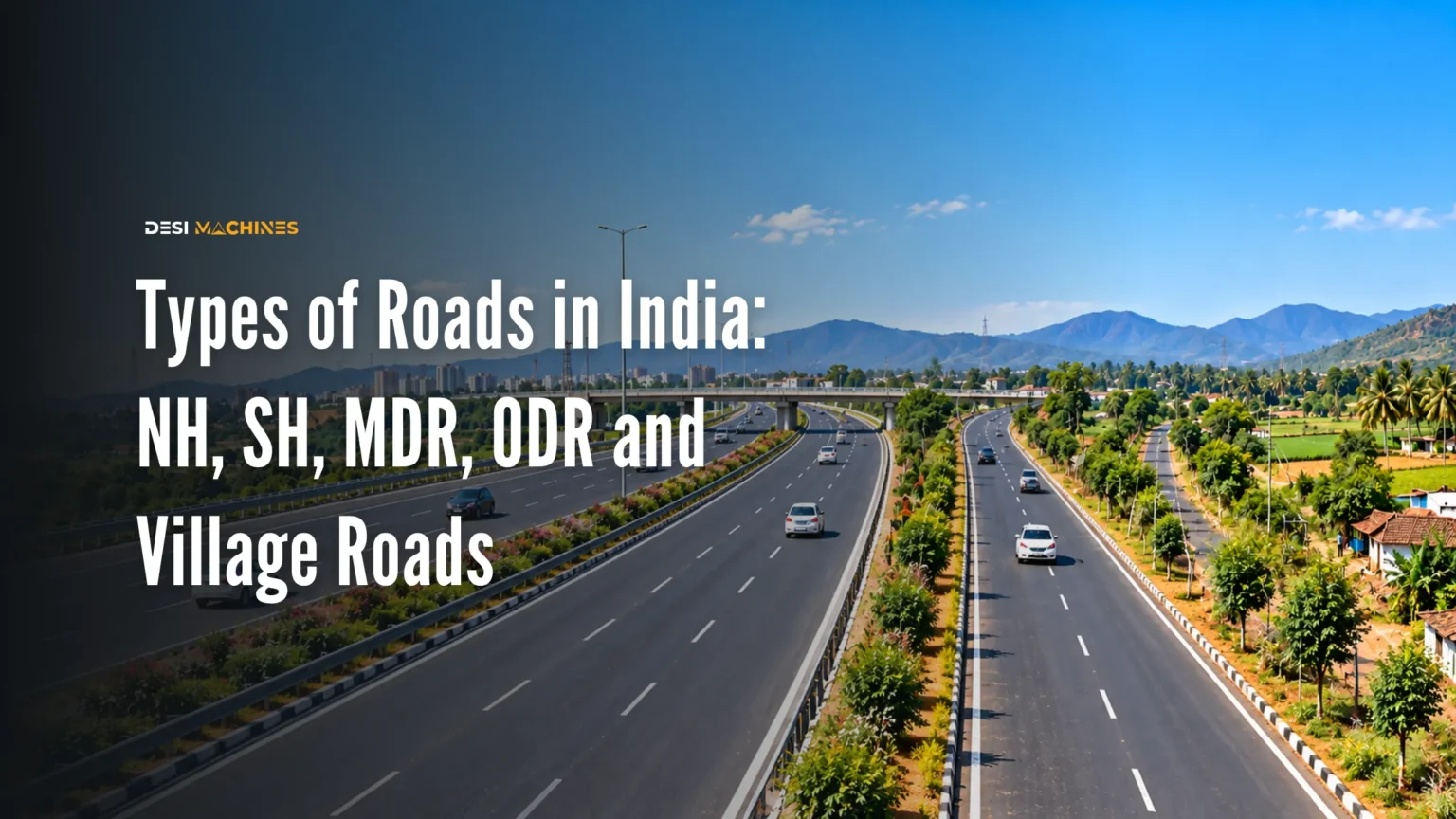
There are six types of roads in India by function: expressways at the top, then National Highways, State Highways, Major District Roads, Other District Roads and Village Roads. A village road is designed for 50 km/h on flat ground. A national highway is designed for 100 km/h, and an expressway for 120 km/h.
Those speeds matter more than they look. The design speed sets the width, the curves, the land that has to be bought and the machines that turn up on the job. Every figure on this page comes from the Indian Roads Congress (IRC), the body that writes India’s road codes, mainly IRC:73-2023, Geometric Design Standards for Non-Urban Roads, and IRC:SP:20, the Rural Roads Manual.
What are the types of roads in India?
Outside towns, India has six classes of road. The first five come from the Nagpur Road Plan of 1943. The expressway was added later as the top class. IRC:73-2023 groups them into three systems, and the system tells you roughly who looks after the road.
| Road class | System | What it connects | Design speed on plain ground (ruling / minimum) | Right-of-way on plain, open ground |
|---|---|---|---|---|
| Expressway (EW) | Primary | Long through routes for heavy, fast traffic, with full control of access | 120 km/h (main line) | 90 to 120 m |
| National Highway (NH) | Primary | Ports, state capitals, large industrial and tourist centres, border routes | 100 / 80 km/h | 30 m (2-lane) to 120 m (8-lane) |
| State Highway (SH) | Secondary | District headquarters and important cities inside a state, linked to NHs | 100 / 80 km/h | 30 m (2-lane) to 120 m (8-lane) |
| Major District Road (MDR) | Secondary | Production areas and markets inside a district, and the main highways | 80 / 65 km/h | 25 m (range 25 to 30 m) |
| Other District Road (ODR) | Tertiary (rural road) | Rural production areas to market centres, tehsil and block headquarters | 50 / 40 km/h | 15 m (range 15 to 25 m) |
| Village Road (VR) | Tertiary (rural road) | Villages to each other and to the nearest bigger road | 50 / 40 km/h | 12 m (range 12 to 18 m) |
The “ruling” design speed is the one the road should be built for. The “minimum” is allowed only where land, site conditions or cost make the ruling speed impossible. Right-of-way (also called road land width) is the full strip of land acquired for the road, which is always wider than the tarred or concrete surface you drive on.
The idea behind the classes is simple. Expressways and national highways are built for mobility, which means moving traffic fast over long distances with few entry points. Other district roads and village roads are built for access, which means reaching every farm, village and market even if the trip is slow. State highways and major district roads do a bit of both.
What is the difference between a National Highway and a State Highway?
The difference is who the road serves and who pays for it. A national highway runs across the country and carries a number, such as NH-16, which IRC:73-2023 gives as running 1,711 km from Chennai to Dankuni near Kolkata. It is the Centre’s road, handled by the Ministry of Road Transport and Highways (MoRTH), mostly through the National Highways Authority of India (NHAI). A state highway links the district headquarters and big towns of one state and feeds traffic onto the national highways. The state government builds and maintains it, usually through its public works department (PWD).
On geometry the two are treated alike. IRC:73-2023 gives the same design speeds to a two-lane NH and a two-lane SH, and the same right-of-way to a highway of the same lane count, whoever owns it.
The national network is the one that has grown fastest. MoRTH put it at 1,46,560 km at the end of 2025, with 43,512 km of that at four lanes or more and 3,052 km of access-controlled high-speed corridors and expressways open to traffic (as reported by IANS and NBM&CW from the ministry’s year-end statement, December 2025).
What is an expressway, and how is it different from a highway?
An expressway is a highway with full control of access: traffic joins and leaves only at interchanges, the two directions are split by a median, and crossings go over or under the road through grade separators. IRC:73-2023 sets its main-line design speed at 120 km/h. Pedestrians, two-wheelers, three-wheelers, bullock carts and tractors are not allowed on it.
The other differences show up in the numbers. An expressway lane is 3.75 m wide against 3.5 m on a multi-lane highway. IRC:73-2023 asks for expressways to be planned as six-lane roads from the start, and they need a right-of-way of 90 to 120 m. Their detailed standards sit in a separate code, IRC:SP:99.
What are MDR, ODR and village roads?
These are the roads most of rural India actually uses. A major district road (MDR) is an important road inside a district that connects areas of production with markets and with the main highways. An other district road (ODR) serves rural areas and gives them an outlet to market towns, tehsil or block headquarters. A village road (VR) connects villages to each other and to the nearest road of a higher class.
ODRs and village roads together are called rural roads, and they follow their own manual, IRC:SP:20. The standards are modest by design:
- The carriageway (the paved strip vehicles run on) is a single lane of 3.75 m. Where fewer than 100 motor vehicles a day use the road and traffic is not expected to grow, it may be cut to 3.0 m.
- The roadway (carriageway plus shoulders) is 7.5 m on plain and rolling ground and 6.0 m in hills.
- The design speed on plain ground is 50 km/h, with 40 km/h as the minimum. In mountainous and steep country, IRC:73-2023 brings it down to 30 km/h.
IRC:73-2023 adds a rule worth knowing if you work on these roads: even where a village road starts as a single lane, the land should be acquired for a future two-lane road, so it can be widened later without demolishing what has grown up along it.
How wide is each type of road?
Width is set by lanes, not by class name, so the same rules run from village roads to the national highways.
| Road | Carriageway | Minimum right-of-way |
|---|---|---|
| Single-lane road (most village roads and ODRs) | 3.75 m | 12 to 15 m for VR and ODR on plain, open ground |
| Intermediate lane (allowed except on important trunk routes) | 5.5 m | Not given separately |
| Two-lane highway | 7.0 m (two lanes of 3.5 m) | 30 m |
| Four-lane highway | 3.5 m per lane | 45 m |
| Six-lane highway | 3.5 m per lane | 60 m |
| Eight-lane highway | 3.5 m per lane | 120 m |
| Expressway | 3.75 m per lane | 90 to 120 m |
In hilly areas IRC:73-2023 recommends at least a two-lane carriageway of 7.0 m for every class of road. Wherever a divided road needs a median, it must be at least 1.5 m wide.
Land needed for each type of road
Each bar is the land a road of that type needs on plain, open ground. The jump at the end is real: an eight-lane highway needs twice the land of a six-lane one. Source: IRC:73-2023, Tables 4.1 and 4.2 (normal values for MDR, ODR and village roads).
Who builds village roads under PMGSY?
Most new village roads are built under the Pradhan Mantri Gram Sadak Yojana (PMGSY), a Ministry of Rural Development scheme launched on 25 December 2000 to give all-weather road links to villages that had none. The work is tendered by state rural road agencies, with the National Rural Roads Development Agency (NRRDA) setting the standards, and it is built by contractors, many of them small and local.
The fourth phase, PMGSY-IV, was approved by the Union Cabinet on 11 September 2024 for 2024-25 to 2028-29. It covers 62,500 km of roads to connect 25,000 habitations that are still unconnected: those with more than 500 people in the plains, more than 250 in the North-East, hill states, Union Territories and special category areas, and more than 100 in districts affected by Left Wing Extremism, counted by Census 2011.
If you want to bid for this kind of work, live road tenders are listed on construction tenders and opportunities, and the difference between the two common tender types is explained in item rate vs percentage rate tenders.
What are the types of roads by material?
The class tells you what a road does. The material tells you how it is built, and IRC:73-2023 lists several ways to sort roads on that basis:
- By surface material: earthen roads, gravel roads, water bound macadam (WBM), bituminous roads and concrete roads.
- By how the pavement carries load: flexible (bitumen layers that spread the load through the base below), semi-rigid (a cement-treated base under bitumen) and rigid (a concrete slab that spreads the load on its own).
- By surface condition: paved or unpaved.
- By traffic: light, medium or heavy.
- By terrain: plain (cross slope under 10%), rolling (10 to 25%), mountainous (25 to 60%) or steep (over 60%).
A national highway and a village road can both be bituminous, and both can be concrete. What changes is the thickness and the strength of each layer. The road construction layers guide walks through those layers from the subgrade up. A cement concrete road is covered in CC road construction, the bitumen grades in bitumen grades for roads, the semi-rigid base in CTSB and CTB, and the stone, soil and sand each type uses in road construction materials.
Inside towns the IRC uses a different list. IRC:86-2018 sorts urban roads into urban expressways, arterial roads, sub-arterial roads, collector streets, local streets, and streets for walking and cycling.
Which machines build each type of road?
The bigger the road class, the bigger the fleet. On a four-lane national highway the earthwork is done with excavators such as the Tata Hitachi EX 210 Infra, the layers are shaped by motor graders like the Mahindra Roadmaster G90, and each layer is compacted with a soil compactor such as the L&T 1190 before tandem rollers like the Ammann ARX 90.2 finish the bitumen.
Village roads are a different job. The NRRDA’s 2016 Manual on Construction Equipment for Rural Roads plans the work around tractors with loader, dozing, grading and backhoe attachments, small vibratory tandem rollers, plate compactors and a backhoe loader, because many rural road contractors work far from a hire yard. A machine like the JCB 3DX digs side drains, loads tippers and spreads material on the same day.
Before you buy for road work, compare backhoe loader models and prices and read road construction equipment, which goes through the job machine by machine.
Which type of road work suits a small contractor?
Start with rural roads. ODR and village road packages are small, they use machines a single owner can keep busy, and the standards are written in one manual, IRC:SP:20. A backhoe loader, a tipper and a hired roller can handle much of the earthwork on a PMGSY package. Highway work, by contrast, comes in long stretches with strict layer tests, and a small fleet usually enters it as a sub-contractor to a larger firm rather than as the main bidder.
Then work out the money before you bid. Road construction cost per km breaks down what a village road and a national highway cost to build, and construction equipment finance shows how the first machine is usually paid for. When you are ready, compare compactors and rollers for the layers you will be asked to lay. Every road topic in this series is collected in the road construction guide.
The two codes quoted most on this page are public: IRC:73-2023, Geometric Design Standards for Non-Urban Roads and IRC:SP:20, Rural Roads Manual.
Design figures on this page are quoted from IRC:73-2023, IRC:SP:20-2002 and IRC:86-2018, as named beside each figure; network figures are MoRTH’s as reported in December 2025, and PMGSY-IV details are from the Union Cabinet approval of September 2024. Codes are revised, so confirm the edition named in your contract. Machine names are taken from our listings at the time of writing. Prices, specifications and features are indicative, vary by variant, location and date, and should always be confirmed with the official OEM or authorised dealer before any purchase decision. DesiMachines is not liable for decisions taken on the basis of information that may have changed after publication.
Machines, tenders and news for this industry: Road Construction