Excavator
316 models
 Backhoe Loader
54 models
 Crane
68 models
 Concrete Mixer
79 models
 Wheel Loader
65 models
 Compactor / Roller
45 models
 Motor Grader
42 models

 Concrete Pump
66 models
 Skid Steer Loader
11 models


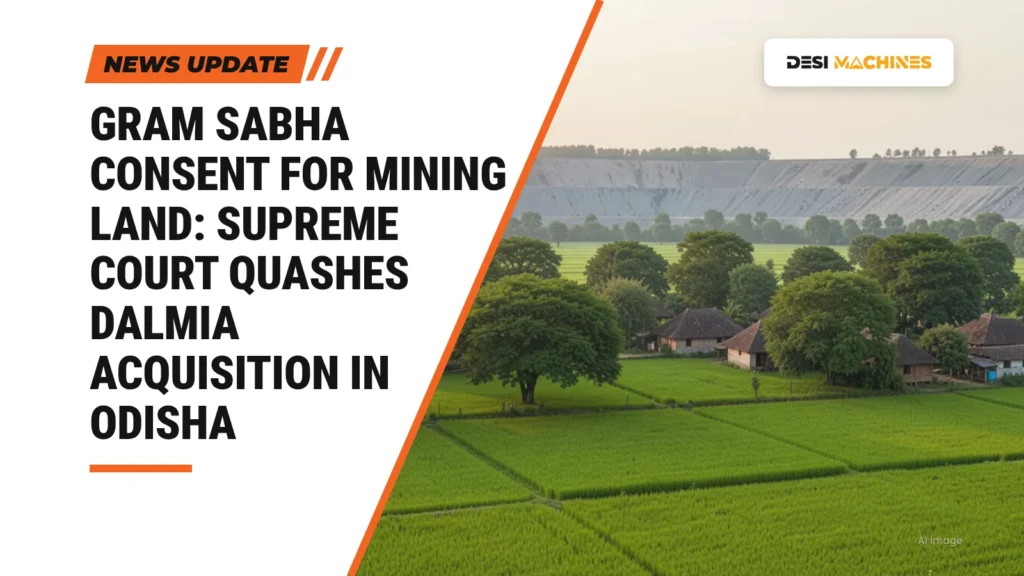
A mining lease does not hand over the land on top of the mineral, and in a Scheduled Area the land cannot be taken without the gram sabha’s prior consent. That is the short reading of the Supreme Court’s 18 November judgment in Bibol Toppo and others against the State of Odisha, which set aside Odisha’s acquisition of land in three Sundergarh villages for mining by Dalmia Cements Bharat Limited. For mine owners, mining contractors and the people who hire them excavators and dumpers, gram sabha consent for mining land is now a hard gate on any expansion that needs new surface rights.
What the judgment says
- Civil Appeal No. 8294 of 2026, 2026 INSC 1244, decided by Justices Dipankar Datta and Satish Chandra Sharma.
- Prior consent of the gram sabha under Section 41(3) of the 2013 land acquisition law is mandatory in Scheduled Areas.
- The acquisition and its notifications are set aside, along with the Orissa High Court’s 6 September 2024 ruling that had upheld them.
- The state may start a fresh acquisition, but only in line with the law and this judgment.
What happened in Sundergarh
According to the judgment, Dalmia held a mining lease that now covers 873.057 hectares after it surrendered 20.493 hectares, valid till 2040, and was mining about 335.96 hectares of it. In December 2015 it asked the state to acquire surface rights over the rest, in Kukuda, Bihabandha and Lanjiberna villages. The gram panchayats passed resolutions rejecting the proposal in January 2020. The court found no consent on record and held the process illegal. LiveLaw’s report, filed on 19 November, carries the same holding. The judgment gives the size of the expansion parcel as 273.57 but calls it hectares in one paragraph and acres in another, so we have not used it to size the job.
Who has to act
Lease holders in Scheduled Area districts first. The court said it prima facie did not accept the argument that a lessee can mine on someone else’s land just by paying compensation under Section 24A of the MMDR Act. Until that question is settled, a lease plus compensation is a weak basis for mobilising plant on land the company does not own.
Contractors next. An expansion like this one adds new benches, and new benches mean more excavators, dumpers and blast-hole drills on site. In this case the company proposed the acquisition in 2015, and in 2026 the acquisition has been set aside. If you are bidding for overburden removal or extraction on a new area, ask whether surface rights are already in hand. Tie your fleet mobilisation and any finance on new machines to that date, not to the lease date.
Owners who rent out machines should price the risk the same way. A stalled expansion leaves a mobilised fleet idle. A rental contract with a mobilisation clause linked to land possession is worth asking for. Our guide to the permissions a quarry needs sets out what a lease covers and what it does not.
Deadlines and thresholds
- 9 December 2015: Dalmia’s acquisition proposals filed.
- 26 January 2020: gram panchayat meetings reject the proposal.
- 6 September 2024: Orissa High Court dismisses the villagers’ writ petition.
- 18 November 2026: Supreme Court sets the acquisition aside; a fresh process is allowed.
Planning a fleet for a new mine area? Check the machine classes Indian mines run in our mining equipment guide before you commit to buying or hiring.
FAQ
Does the ruling stop Dalmia’s existing mine?
The judgment deals with the acquisition of the further land. It does not say anything that stops mining on the area already being worked.
Can Odisha acquire the land again?
Yes. The court said its decision is no bar to a fresh acquisition carried out in line with the law and its findings.
Does this apply outside Odisha?
Section 41(3) of the 2013 Act covers Scheduled Areas in every state, so the reasoning applies wherever land there is acquired for mining.
Related on DesiMachines: Coal mining plan guidelines 2026: blast-free mining by default
Source: LiveLaw
Machines, tenders and news for this industry: Mining