
 Excavator
316 models
 Backhoe Loader
54 models
 Crane
68 models
 Concrete Mixer
79 models
 Wheel Loader
65 models
 Compactor / Roller
45 models
 Motor Grader
42 models

 Concrete Pump
66 models
 Skid Steer Loader
11 models


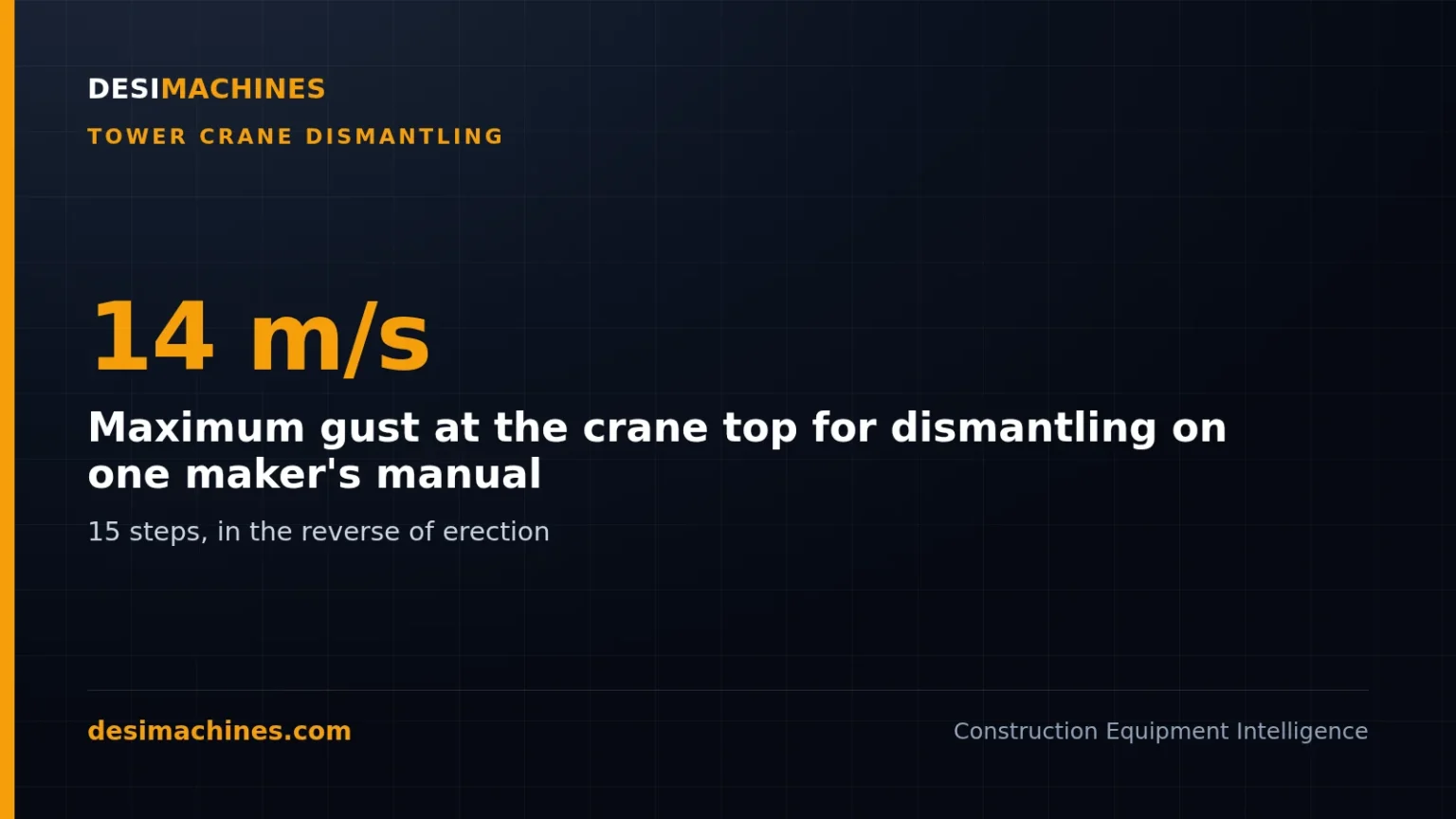
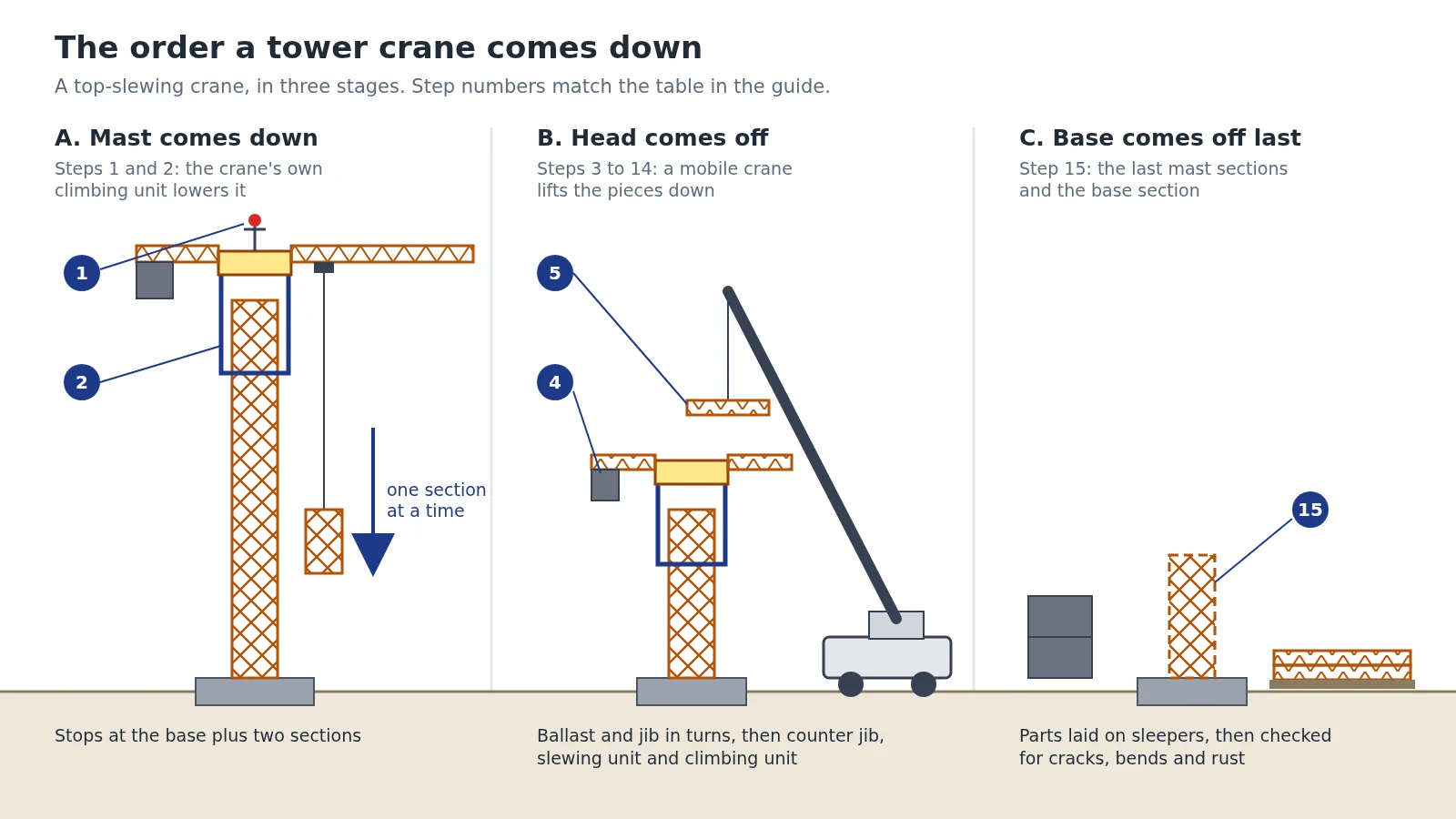
A tower crane comes down in the reverse of the order it went up, and the maker’s manual fixes that order. On one large flat-top crane, Zoomlion’s T1200-64Q, the dismantling sequence runs to 15 steps: the crane lowers its own mast one section at a time, a mobile crane then lifts off the ballast, jib, counter jib and slewing unit, and the last mast sections and the base come off at the end.
The order is not a choice made on the day. Each step keeps the crane balanced while the next piece is removed, and a step taken early can tip the top of the crane or overload a pin. This guide walks through that sequence, the reverse climbing that brings the mast down, the size of support crane the job needs, the wind limit, the method statement, who may do the work and what the site must arrange. It is written for builders and contractors who hired a tower crane and now need it off a finished building. The sources are the Zoomlion instruction manual and IS 13367 (Part 1), the Indian code of practice for the safe use of cranes, both read on 20 November 2026. No prices are quoted.
How is a tower crane dismantled, step by step?
In the order the maker prints, which on a top-slewing crane is the erection sequence run backwards. The Zoomlion manual says erection and dismantling “must be absolutely carried out in the indicated order”, and IS 13367 (Part 1) clause 11.2 says any change to the maker’s sequence has to be checked by the crane’s designer or another competent engineer, so the crane stays stable and no part is overloaded.
For the T1200-64Q on a fixed base, the manual’s dismantling sequence (section 4.25.2) reads like this:
| Step | What comes off | Why it comes off at this point |
|---|---|---|
| 1 | Warning light, camera and anemometer | Small fittings at the top go first, before anything heavy moves |
| 2 | Mast sections, down to the base section and two sections above it | The crane lowers itself with its own climbing unit, so the support crane only has to reach a short tower |
| 3 | Hoisting rope and trolley rope | The ropes are wound off before the jib is split |
| 4 | Counterweight blocks, all but the first 12.5 tonne block | Less weight on the back end, ready for a lighter front end |
| 5 | The jib, except its first two sections (jib I and jib II) | The long front end comes off while one block still balances the stub that stays |
| 6 | The first 12.5 tonne counterweight block | Only now, with the front end short, can the last block go |
| 7 and 8 | Derrick and hoisting mechanism | Equipment mounted on the counter jib comes off before the counter jib itself |
| 9 | Counter jib | The back arm, now empty |
| 10 and 11 | Jib II with the trolley mechanism, then jib I with the trolley | The last of the front arm |
| 12 | Slewing unit: turntable, slewing ring, cabin and electrical cabinets | The part that turned the crane, lifted off as one piece |
| 13 | Transition beam and mounting device | The link between the top of the mast and the slewing unit |
| 14 | Climbing unit | No longer needed once the head is down |
| 15 | Remaining mast sections and the base section | The last of the steel above the foundation |
From the Zoomlion T1200-64Q-138EN-D01 instruction manual, section 4.25.2. The right-hand column is our plain reading of the maker’s order. On a crane with a chassis the manual keeps three mast sections at step 2, and the central ballast and the chassis come off after step 15. Other models and makers use their own sequence.
Read steps 4 to 6 together. The counterweight balances the jib, so neither can come off all at once. The maker takes most of the blocks off, then most of the jib, then the last block. At no point is one side of the top left much heavier than the other.
A self-erecting crane is the exception to most of this. It travels as one unit and folds itself down again without a support crane, as the tower crane foundation and erection guide explains. The rest of this guide is about top-slewing cranes, the kind that climb with a building.
How does a tower crane take its own mast down?
By climbing in reverse. The same hydraulic climbing unit that raised the crane section by section as the building went up now lowers it, one mast section at a time. How the crane climbs in the first place is covered in the foundation, erection and climbing guide; this is the same work done downwards.
The maker’s steps for each section run like this. The jib is turned to face the side where the climbing cage opens, the slewing brake is set, and the trolley is parked at the point on the jib where the top of the crane balances. The climbing cylinder takes the weight of everything above. The pins holding the top mast section are pulled, the section is rolled out on the mounting trolley, and the crane’s own hook lowers it to the ground. The cylinder then lowers the top of the crane onto the next section, and the same cycle repeats.
Three rules from the manual matter more than the rest:
- No crane movements while the top is unpinned. The manual forbids slewing, trolley travel and hoisting until the slewing support is pinned back onto the mast with all eight pins. Temporary pins are allowed between sections, one per corner, and must be swapped for the full set when the work stops.
- Someone watches the climbing cage. A person has to keep eyes on the climbing beam, the guide rollers and the step plates as the cage comes down, and stop the cylinder the moment anything binds.
- Test the climbing unit first. The climbing gear may have stood idle for months while the crane worked at full height. The manual asks for maintenance and a test run of the climbing mechanism, with the limiters and slewing brakes checked, before any section comes out.
The mast comes down until only the base section and two sections above it remain. That is the point where the top of the crane is low enough for a mobile crane to reach.
What size of crane is needed to dismantle a tower crane?
One sized from the weight and height of each piece in the maker’s lifting table, at a radius of at least 10 m. The Zoomlion manual gives the support crane three numbers to meet: the hoisting height of the jib, the weight of the jib, and a minimum radius of 10 m from the tower crane’s centre line. It also warns that the support crane must not have to work at its own top limit switch to reach the height needed.
The manual lists the weight of every piece the support crane handles on the T1200-64Q. These are a few of them:
| Piece lifted by the support crane | Weight in the maker’s table |
|---|---|
| One mast (tower) section | 8.5 tonnes |
| One counterweight block | 12.5 tonnes |
| Hoisting mechanism, without its rope | 12.5 tonnes |
| Jib II with trolley mechanism | 12.3 tonnes |
| Jib I with trolley | 15.3 tonnes |
| Counter jib | 14.3 to 21.8 tonnes, by jib length |
| Slewing unit | 21.2 tonnes |
| Rest of the jib, lifted as one assembly | 7.7 tonnes on a 30 m jib, up to 25.2 tonnes on an 80 m jib |
From the Zoomlion T1200-64Q-138EN-D01 instruction manual, table in section 4.4.2.1 (reference weights for lifting with a mobile crane). The maker marks the table “for reference only”. Lifting heights for the same pieces in that table run from about 33 m to 48 m.
Put those numbers together and the job on this model is a string of 12 to 25 tonne lifts, more than 10 m out from the mast and over 30 m up. That is work for a large telescopic mobile crane checked against its own crane load chart at that radius and height. A smaller tower crane has lighter pieces, and its manual will give its own table; never size the support crane from another model’s numbers.
One fact keeps the support crane smaller than people expect. The tower crane has already lowered most of its mast, so the support crane works on a short tower, not at the full working height the crane reached on the building.
Down on the ground, the sections and frames still have to be loaded onto trailers. That is pick-and-carry work, which a hydra such as the Escorts Hydra 15 or Escorts Hydra 14 can do for the lighter pieces, always within the capacity its load chart gives at the radius it is working.
Two cranes working near each other carry more risk than one. IS 13367 (Part 1) clause 5.2 asks for extra care in planning such lifts, and for the drivers, the slingers and the person in charge to be briefed on how one crane’s movements affect the other.
Planning the lifts for erection or dismantling? Compare crane models and specifications, and look at pick-and-carry cranes for loading at ground level.
What wind speed is safe for tower crane dismantling?
Below 14 m/s, about 50 km/h, measured as a gust at the top of the crane. That is the Zoomlion manual’s limit for assembly, dismantling and any change of configuration. The limit for normal working on the same crane is 20 m/s, about 72 km/h, so dismantling has the tighter limit. A crane in pieces, with a jib hanging from a support crane, has far less to hold it steady than a finished one.
The manual adds a planning rule: before the work starts, confirm with the relevant authorities that the wind will stay under the limit for the whole operation, not just the first hour. A section half out of the mast, or a jib on the support crane’s hook, cannot be left there safely when the wind picks up.
The anemometer is one of the first things removed, at step 1. From then on, the wind reading has to come from the forecast and from the crew’s own check on site. The tower crane wind speed limit guide explains how these limits are measured and why gusts, not average speed, decide them.
What goes into a tower crane dismantling method statement?
A written plan of each critical stage, with drawings, and a list of who does what. IS 13367 (Part 1) clause 5.1 says every lifting operation, “including crane erection and dismantling”, should be planned, and clause 5.2 describes what a detailed plan contains: the loads and their centres of gravity, the ground conditions, obstructions and hazards, how each load is slung and controlled, plans and elevations of the lifting operation at every critical phase, and a written statement of the duties of each member of the team, which everyone on the team should know. The Zoomlion manual asks for a document that sets out the risks of assembly and dismantling and the protective measures for each.
In practice, a method statement for a tower crane coming down usually covers:
- The crane’s make, model and serial number, and the maker’s manual it follows.
- The dismantling sequence, step by step, as the manual prints it.
- The support crane: its size, where it stands, the ground under its outriggers, and the radius and height for each lift.
- The weight of each piece and how it is slung.
- The laydown area for the parts and the route trailers will use.
- The exclusion zone and its barriers and signs.
- The wind limit and who decides to stop.
- Power isolation, and who holds the isolator key.
- Names and roles: the erector in charge, the support crane driver, the slinger and signaller, and the competent person.
IS 13367 (Part 1) clause 11.1 lists what a correctly planned erection and dismantling should ensure, from the right manual being on site to one person controlling the whole operation. That list is set out in full in the tower crane foundation guide, and it applies to the way down as much as the way up. Its note says the plan made before erection should already account for dismantling.
Who is allowed to dismantle a tower crane?
A trained erection crew led by one erector in charge, working to the maker’s manual. IS 13367 (Part 1) clause 6.2.4 makes the crane erector responsible for erecting the crane according to the maker’s instructions, and where two or more erectors work together, one is named erector in charge to control the operation. Clause 11.1 extends that control to the entire erection and dismantling.
The Zoomlion manual is blunter. It says the people doing the work “shall have been trained and with certificates”, and that the slightest neglect can cause machine damage, injury or death. Some steps are reserved for the maker: the manual says that dismantling outside its normal procedures, for example where the site itself gets in the way, should be referred back to the maker.
That last case is common on Indian city sites. A crane inside a tight plot, or one that climbed with a tall building, may have no room left for a mobile crane once the building is finished. The foundation guide notes that such a crane may be taken down by a smaller crane lifted onto the roof. That is a special operation to plan with the maker or its representative, not one to improvise.
For the operator’s side of crane work, see crane safety rules and training and the guide to crane operator training in India.
How should a site prepare before a tower crane comes down?
Clear space, mark it off, and plan the power and the ropes before the first pin comes out. The Zoomlion manual warns that space is the problem most sites underestimate. Once the building is up, the ground around the crane is far smaller than it was on erection day, and the maker tells crews to plan where every dismantled part will be stacked.
Before work starts, check that:
- A laydown area is cleared and levelled for the jib sections, counter jib, slewing unit and mast sections. The manual asks for the jib to be laid on supports cushioned with sleepers.
- The safety zone is staked out with signs keeping out anyone not on the job. The manual asks for this whenever the crane is assembled, dismantled or tested.
- There is access for the support crane and the trailers, and the ground under the support crane’s outriggers can take the load.
- Overhead power lines, neighbouring buildings and other cranes nearby are mapped for every lift.
- The power supply is planned. The crane’s own power is still needed to lower the mast, and control cables that would foul the lifting of tower parts are disconnected first, as the manual’s steps require. How the supply reaches the crane is covered in the guide to tower crane power supply requirements.
- The ropes are planned. The hoist rope is unreeved by running the trolley to the jib tip, landing the hook, clamping the rope and winding it back onto the hoist drum, in the reverse of how it was reeved. The wire rope guide explains the rope itself.
What should be checked on a tower crane after dismantling?
Every main load-bearing part, before the crane goes into store or onto its next site. The Zoomlion manual asks for the dismantled crane to be checked by technical and trained maintenance staff, looking for metal fatigue, cracks in welds, bent members and damage from knocks during handling. Defects found, and likely defects, are repaired, and the steel is de-rusted and painted.
Two older Indian codes add checks that belong here. IS 13367 (Part 1) clause 11.3 asks that every major part taken apart for transport carries a clear identification mark matching the manual, that metric and imperial bolts are never mixed, and that high-tensile bolts are marked so they cannot be confused with ordinary ones. IS 6521 (Part 1), the tower crane design code, says in clause 12.3 that a friction-grip bolt slackened after final tightening is thrown away with its nut and washer, never reused, and asks for a notice on any crane whose joints use such bolts and are opened at every dismantling.
When the crane is put up again, it goes through the full examination after erection and the load test before it lifts anything. Those checks are listed in the tower crane inspection checklist. More guides on cranes of every type are on the crane guide hub.
Lining up cranes for your next building job? Compare crane models and specifications and connect with a dealer near your site.
Where the facts in this guide come from. The dismantling sequence, the reverse climbing steps, the auxiliary crane requirements, the weights table, the 14 m/s and 20 m/s wind limits, the site preparation and the after-dismantling checks are from Zoomlion’s T1200-64Q tower crane instruction manual (T1200-64Q-138EN-D01, 2023), sections 2, 4.4 and 4.25, read on 20 November 2026; it is used here as a fully published example of one maker’s method. Planning, persons and erection and dismantling clauses are from IS 13367 (Part 1):1992, clauses 5.1, 5.2, 6.2.4 and 11.1 to 11.3. The friction-grip bolt rule is IS 6521 (Part 1):1972 clause 12.3. Wind speeds in km/h are our own conversion.
Prices, specifications and features are indicative, vary by variant, location and date, and should always be confirmed with the official OEM or authorised dealer before any purchase decision. DesiMachines is not liable for decisions taken on the basis of information that may have changed after publication.