
 Excavator
294 models
Excavator
294 models  Backhoe Loader
51 models
Backhoe Loader
51 models  Crane
68 models
Crane
68 models  Concrete Mixer
79 models
Concrete Mixer
79 models  Wheel Loader
54 models
Wheel Loader
54 models  Compactor / Roller
45 models
Compactor / Roller
45 models  Motor Grader
42 models
Motor Grader
42 models  Concrete Pump
66 models
Concrete Pump
66 models  Skid Steer Loader
11 models
Skid Steer Loader
11 models  Telehandler
13 models
Telehandler
13 models 


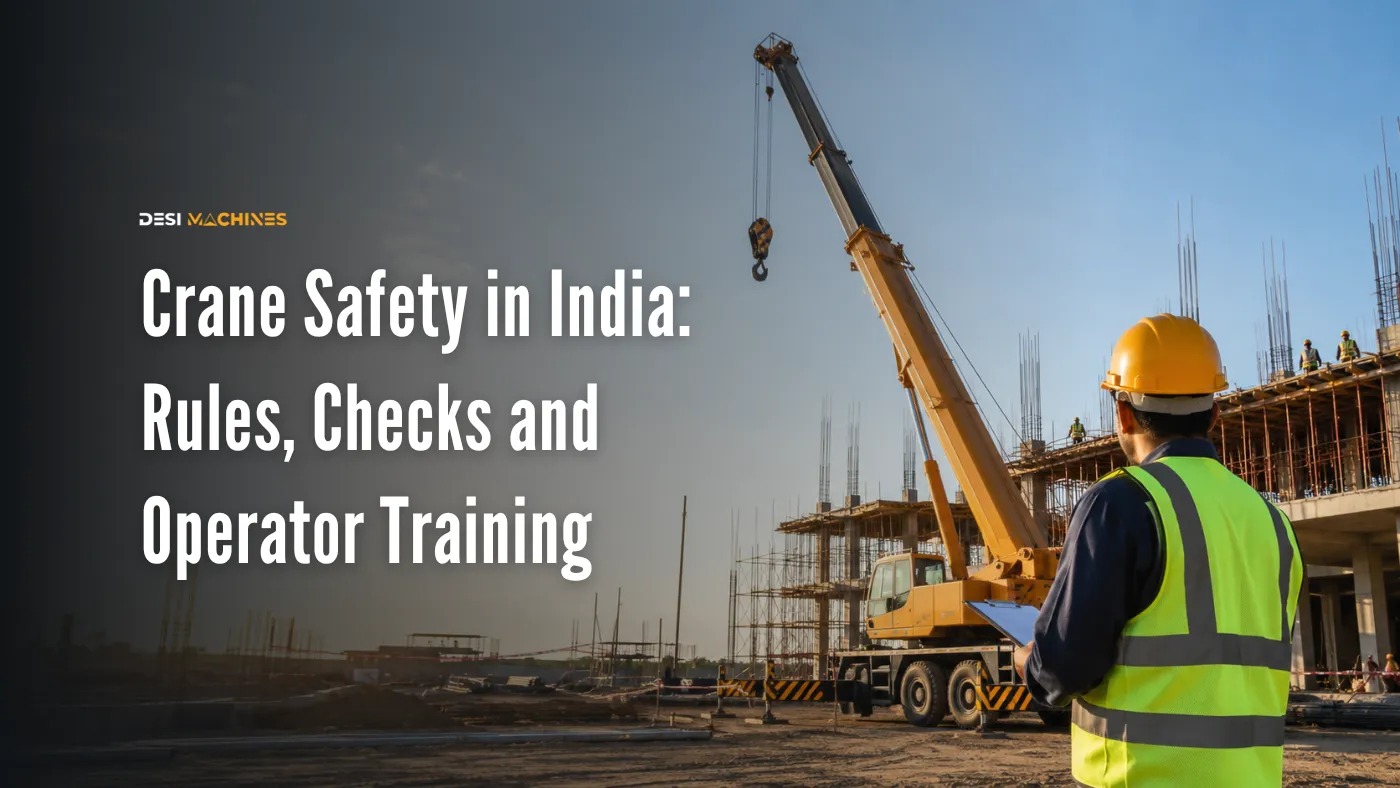
Crane safety is the set of legal duties, machine checks and site habits that keep a lifting job from going wrong. In India it rests on three things: a crane that has been tested and examined by a competent person, an operator trained for that exact machine, and a lift planned against the crane’s own load chart instead of someone’s guess. Get those three right and most crane accidents simply do not happen.
Almost every serious crane accident on an Indian site traces back to a short list of causes. The machine was overloaded at a long radius, the ground gave way under a wheel or an outrigger, or nobody had checked the crane in months. None of these are freak events. They are all covered by rules that already exist, and by checks that take a few minutes.
This guide explains what the law actually asks of a crane owner in India, how often a machine has to be tested, who is allowed to sit in the seat, and the checks that matter most before a load leaves the ground.
What does crane safety mean on an Indian site?
Crane safety means working inside the machine’s rated limits, in known ground conditions, with a person in the seat who understands what the crane will and will not do. A crane is not unsafe because it is old or because it is small. It becomes unsafe the moment the load, the radius or the ground moves outside what the maker tested it for.
Two words do most of the work here, so it is worth being clear about both.
- Safe working load (SWL). The most that particular crane may lift, in that particular setup. It is not one number for the whole machine.
- Radius. The horizontal distance from the crane’s centre of rotation to the load. As radius grows, safe capacity drops, and it drops fast.
That second point is where most operators come unstuck. A 14 ton (14,000 kg) machine is a 14 ton machine only at its shortest radius. Push the same load out to a longer reach and the crane may be rated for a third of it. The crane load chart is the only honest answer to “can it lift this”, and reading one properly is a skill worth teaching every operator on the payroll.
What law covers crane safety in India?
There is no single “crane act” in India. Duties come from a few different places depending on where the crane is working, and most fleet owners are covered by at least two of them at once.
The same duties follow the lift rather than the machine, so they apply when an excavator is used for lifting as well.
| Law or standard | What it asks for | Where it applies |
|---|---|---|
| Factories Act, 1948 — Section 29 | Every lifting machine, chain, rope and lifting tackle to be thoroughly examined by a competent person at least once every twelve months, with a register kept. Safe working load plainly marked on the machine, and no loading beyond it except for testing. | Cranes working inside a registered factory |
| Building and Other Construction Workers Act, 1996, and the Central Rules, 1998 | Lifting appliances to be tested and examined by a competent person before first use, after any alteration or repair affecting strength or stability, after erection on site, and at least once every five years. A thorough examination at least every twelve months on top of that, with records kept in the prescribed form. | Construction sites |
| IS 4573 (Bureau of Indian Standards) | The specification for power driven mobile cranes, covering design, manufacture, erection and testing. Second revision published in 2020. | The machine itself, as built and supplied |
The BOCW Central Rules also set two conditions on the person operating the machine: no one under eighteen years of age may be in control of a lifting appliance, and every crane driver must have adequate skill and training on that particular type of appliance. Both are worth reading as a floor, not a target.
Public-road travel adds one more layer. A wheeled crane driven on a public road is a motor vehicle, and the usual registration and driving-licence requirements for that vehicle class apply on top of everything above. Training to operate the crane is not a substitute for a licence to drive it.
How often does a crane have to be tested and examined?
Twelve months is the interval to remember. Both the Factories Act and the BOCW Central Rules call for a thorough examination by a competent person at least once in every period of twelve months. On construction sites the BOCW rules add a fuller test and examination before the crane is first used, again after any alteration or repair that affects its strength or stability, after it is erected on a site, and at least once every five years.
A thorough examination is not a walkaround. Under the Factories Act it means a visual examination supported, where needed, by other means and by dismantling parts of the gear, carried out carefully enough to reach a reliable conclusion about the safety of the parts examined.
Three practical points follow from this.
- Keep the register. The examination record is what proves the machine was fit. A crane with no paperwork is treated as a crane that was never checked.
- The examiner has to be a competent person as the rules define it. That means someone approved by the Central Government, attached to a testing establishment in India, with the qualification and experience to test and certify lifting appliances. Your own mechanic, however good, is not that person.
- A written finding is not advice to weigh up. If the competent person concludes the crane cannot go on working safely, that goes to the owner in writing and the machine stops.
Between the annual examinations, the daily and weekly checks belong to the operator and the site. Wire rope condition, hook and safety latch, hydraulic leaks, tyre pressures, brakes and the load-moment indicator are all cheap to look at and expensive to ignore.
Who is allowed to operate a crane in India?
Someone over eighteen, trained on that specific machine type, and able to show it. The rules speak about adequate skill and training in the operation of the particular lifting appliance, which means training on a tower crane does not qualify anyone to run a pick and carry crane.
India has a formal route for this. The Infrastructure Equipment Skill Council (IESC), the sector skill council for construction equipment under the National Skill Development Corporation, publishes national qualification packs for equipment operators. The Hydra Crane Operator qualification, code IES/Q0108 (version 2.0), sits at NSQF Level 4 and is approved by the National Skills Qualifications Committee. It is built from four assessed modules:
- IES/N0122 — carry out pre-operation checks on the hydra crane
- IES/N0123 — operate a hydra crane
- IES/N0124 — perform routine maintenance and troubleshooting
- IES/N7601 — comply with worksite health and safety guidelines
Separate qualification packs exist for crawler crane and tyre-mounted crane operators. For a contractor, the value of putting an operator through one of these is not the certificate on the wall. It is that the assessment forces the pre-operation check and the safety module to be learned properly rather than picked up on the job.
One requirement in that qualification is easy to miss: the operator should have sound eyesight and should not be colour-blind. Signal flags, indicator lamps and load-moment warning lights all depend on it.
Buying your first machine? Compare crane models available in India and ask the dealer what operator training comes with the handover.
Why do pick and carry cranes tip over?
Because they are asked to travel with a load suspended, on tyres, over ground nobody checked. Pick and carry cranes, the machines everyone calls hydra and farana, do most of the day-to-day lifting in India, and they account for a large share of the tipping incidents too. The reasons repeat themselves.
- The load chart is ignored. Operators work off the machine’s headline tonnage rather than its rated capacity at the radius and boom angle actually being used.
- The ground is soft, sloped or hollow underneath. A tyre sinking two inches on one side swings the load sideways, and a suspended load that starts swinging is very hard to settle.
- The load swings while the machine is moving. Travel speed, a turn and a suspended load together are what actually puts a hydra on its side.
- Something has been bypassed. A disconnected load-moment indicator or a jammed safety latch removes the one warning the operator was going to get.
None of this calls for expensive equipment. It calls for the radius to be measured rather than eyeballed, the route to be walked before the load is picked, the load kept low and close while travelling, and the machine’s own chart to settle any argument. No jugaad on a load-moment indicator, ever.
Where the ground is genuinely poor or the lift is genuinely heavy, the honest answer is a different machine. A mobile crane on properly set outriggers, or a crawler crane spreading its weight over tracks, will do safely what a pick and carry crane can only do by luck.
What ground and outrigger checks matter before a lift?
On any crane that sets outriggers, the whole machine plus the load reaches the ground through four small pads, and the pressure under those pads is far higher than most people expect. Firm-looking ground is not the same as firm ground.
- Extend outriggers fully unless the load chart has a column for partial extension. If it does, use that column, not the full-extension one.
- Use pads or mats under every outrigger. Spreading the load is what stops a beam punching through.
- Stay clear of trenches, backfilled ground, drains and basements. Recently excavated and refilled ground is the classic collapse spot on Indian sites.
- Level the machine before lifting. Even a small tilt pushes the load’s radius outward and eats into rated capacity.
- Look up before you look down. Overhead power lines remain one of the most common causes of crane fatalities, and a boom does not have to touch a line to arc.
For lifts inside a shed or plant, where the same load moves along the same path every day, a fixed installation is usually safer and cheaper than bringing a wheeled machine indoors. That is the case for an overhead crane.
How do you plan a lift so it goes right?
Every lift that is not routine deserves a few minutes of planning before the machine starts. The questions are always the same.
| Question | What to settle before the lift |
|---|---|
| What is the load? | Actual weight, not an estimate. Add the weight of the hook block, slings and any lifting beam. |
| What radius and height? | Measure the distance from the crane’s centre of rotation to where the load will sit, then check that figure against the load chart. |
| What is under the machine? | Ground condition, slope, buried services, trenches, recent backfill. |
| What is overhead and alongside? | Power lines, structures, other cranes working in the same airspace. |
| Who signals? | One trained signaller, agreed before the lift, using signals both people know. |
| Who is in the area? | An exclusion zone with nobody under the load or in the swing path of the counterweight. |
| What is the weather doing? | Wind is the one that gets forgotten. Tall lifts and large, light loads are the most affected. |
On a tower crane, or any lift that runs over occupied ground, this planning is written down and briefed. On a small site it can be a two-minute conversation, as long as it actually happens and one person is clearly giving the signals. Two people signalling is the same as nobody signalling.
Insurance belongs in the same conversation. Machinery cover and third-party liability do not replace safe practice, and a claim after an incident will be read against the machine’s examination records and the operator’s training. Contractors comparing construction equipment insurance should expect to be asked for both.
A crane safety checklist you can actually use
Print this, or put it on the site office wall. It covers the checks that stop the incidents described above.
| When | Check |
|---|---|
| Every shift | Wire rope for broken strands and kinks; hook and safety latch; hydraulic leaks; brakes; tyre pressures or track tension; load-moment indicator working; horn and lights. |
| Before every lift | Load weight known; radius measured; load chart checked for that radius and boom angle; ground and slope assessed; outriggers fully set on pads; machine level; overhead lines identified; signaller agreed; exclusion zone cleared. |
| While lifting | Lift a little, stop, confirm stability before continuing; keep the load low and close while travelling; no sudden braking or turning with a suspended load; nobody under the load. |
| Every twelve months | Thorough examination by a competent person; register updated; safe working load markings still legible. |
| Every five years (construction sites) | Full test and examination under the BOCW Central Rules, plus after any repair affecting strength or stability, and after erection on a new site. |
Choosing the right machine is part of safety, not a separate decision. A crane comfortably rated for the work you actually do gets pushed to its limit far less often than one bought a size too small. If you are still deciding on the type, start with the types of cranes used in India, or the complete guide to cranes. For loading and unloading work on the move, weigh up a truck mounted crane, and if you are comparing machine types by the hydraulics that drive them, the background on hydraulic cranes is a useful companion read.
Ready to compare machines? Browse pick and carry crane models and prices, or the full range of cranes available in India, and ask the dealer for the machine’s load chart and examination record before you sign anything.
The legal text referred to above is worth reading first-hand: Section 29 of the Factories Act, 1948, and the operator qualification packs published by the Infrastructure Equipment Skill Council.
Prices, specifications and features are indicative, vary by variant, location and date, and should always be confirmed with the official OEM or authorised dealer before any purchase decision. DesiMachines is not liable for decisions taken on the basis of information that may have changed after publication. This guide summarises publicly available Indian regulations for general information and is not legal advice; confirm your obligations with the relevant authority.