
 Excavator
316 models
 Backhoe Loader
54 models
 Crane
68 models
 Concrete Mixer
79 models
 Wheel Loader
54 models
 Compactor / Roller
45 models
 Motor Grader
42 models

 Concrete Pump
66 models
 Skid Steer Loader
11 models


Seven different checks keep a tower crane safe to use, each on its own clock: the operator’s before every shift, a longer list every week and every month, a competent person’s examination after each erection or climb, a load test before the crane goes into service, a thorough examination at least once a year, and a special one after any incident. Miss one and the file may look complete while a loose mast bolt or a dead limit switch goes unnoticed.
This guide sets out what goes on each of those checklists, who carries them out, how the load test works and what the inspection report should show. It is written for builders and contractors who hire a tower crane for a building job. The checks come from four Indian Standards, IS 14473 (Part 1), IS 13367 (Part 1), IS 6521 (Part 1) and IS 14470, and from one maker’s instruction manual, all read on 13 November 2026. No prices are quoted.
What does a tower crane inspection checklist cover?
It covers seven kinds of check, and they differ in who signs them. IS 14473 (Part 1):1997, the Indian Standard on crane inspections, puts the duty to arrange inspections on the user of the crane, which on a hired tower crane usually means the builder or main contractor. The operator does the first check of the day. Everything heavier belongs to a competent person: someone with the training and experience to judge whether the crane is safe and to say so in writing.
A good site fitter can handle the routine checks. Signing the yearly examination takes a competent person, and the certificate names who that was.
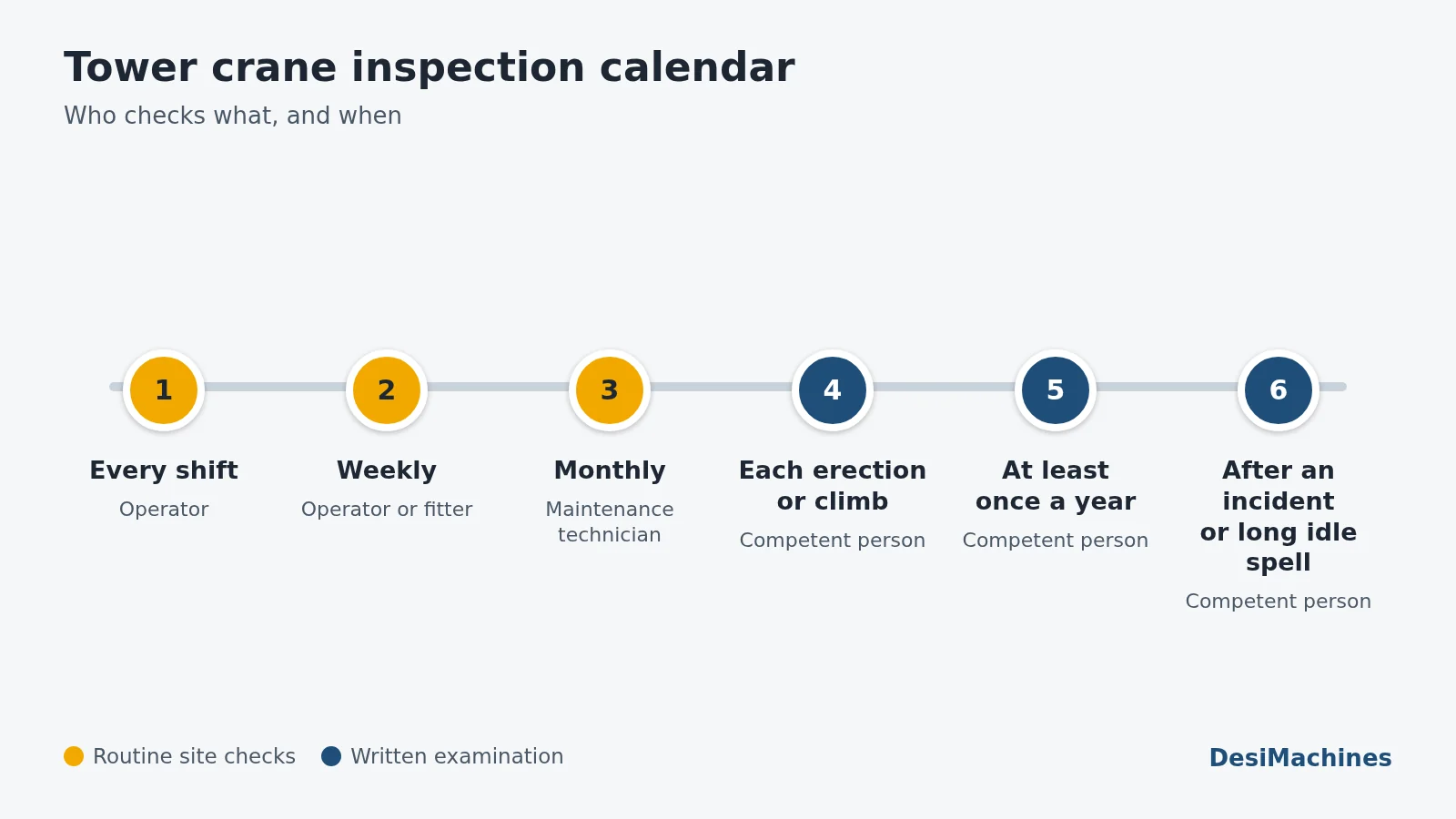
| Check | When | Who does it | Where the rule comes from |
|---|---|---|---|
| Pre-shift check | Start of every shift or working day | Crane operator | IS 14473 (Part 1) clause 4; IS 13367 (Part 1) clause 12.2.2 |
| Weekly check | Once a week | Operator or fitter named by the person in charge of lifting | IS 13367 (Part 1) clause 12.2.3 |
| Monthly maintenance check | Once a month | Maintenance technician | Maker’s manual |
| Examination after erection, climbing or alteration | Every erection, every climb, every change to the set-up | Competent person | IS 13367 (Part 1) clauses 11.2 and 14.2.3 |
| Load test | Before the crane goes into service, and after a substantial repair or alteration | Competent person, with the supplier | IS 6521 (Part 1) clause 44; IS 14470 |
| Regular (thorough) inspection | As often as the work demands, and at least once a year | Experienced technician or expert engineer | IS 14473 (Part 1) clause 5.1 |
| Special examination | After an incident or shock load, or after the crane stood idle for three or four weeks | Competent person | IS 13367 (Part 1) clauses 12.2.4 and 12.3 |
Clause numbers from the archive.org copies of each standard, read 13 November 2026.
What should the operator check before every shift?
The operator checks that every safety device works and looks for obvious damage, before any load goes on the hook. IS 14473 (Part 1) calls this a functional test of the safety equipment, done the way the operating instructions say, plus a visual check for plain defects. IS 13367 (Part 1), the code for the safe use of cranes, spells out the daily list in clause 12.2.2. For a tower crane the items that matter are these:
- Do the checks the maker’s handbook lists for the start of a shift.
- See that every rope sits in its sheave groove and has not jumped out.
- Confirm that every limit switch and cut-out works, along with the dead man’s lever that stops the crane when the operator lets go. Test them carefully, in case one has failed.
- Try every brake.
- Check that the automatic safe load indicator is set for the jib length and rope set-up fitted that day, then run the trolley in and out with no load and watch its reading change.
- Run every control once without a load, and sound the warning horn.
- Make sure no electrical panel is exposed to oil, water or dirt, and that the cabin holds no loose tools, rags or oil tins.
IS 6521 (Part 1), the tower crane design code, names the limit switches a tower crane must carry in clause 38.1: against over-hoisting, over-lowering, over-derricking in both directions, over-traversing of the trolley and over-travelling on rails. A crane without a luffing jib or rail track will not have all five; every switch it has gets tried. One maker’s manual adds the hook’s safety latch and, on rails, the track and running gear. How each device works is explained in the guide to crane safety devices and safe load indicators.
What goes on the weekly and monthly tower crane checklist?
The weekly check looks harder at ropes, hooks, brakes and structure. IS 13367 (Part 1) clause 12.2.3 lists it, and on a tower crane it comes to:
- Check the safe load indicator the way its operating instructions say.
- Look along the hoist rope and the trolley travel rope for broken wires, flattening, bird caging (strands opening out like a cage), wear and rust. The wire rope guide explains when a rope must come off.
- Check rope end fittings, pins and their retaining clips, and every sheave for damage, worn bushes or seizure.
- Inspect the mast, jib and counter-jib for bent bracing, cracked welds and odd rubbing marks.
- Check the hook, its safety catch and swivel for wear and free movement, and the hook nut for wear or rust. The crane hook guide shows what a worn hook looks like.
- Check brake linings for wear and reset them if needed, and check the controllers.
- On a rail-mounted crane, check the rails, end stops and rail clamps.
- Enter every result in the inspection record.
The monthly round is where the maker’s manual takes over. The instruction manual for one 64-tonne tower crane, the Zoomlion T1200-64, splits its schedule like this. Daily: the hoist, trolley, slewing and travel brakes. Weekly: grease the slewing ring teeth, check the electrics and cables, and test every safety device, from the load moment limiter and load limiter to the trolley, slewing and hoisting limiters. Monthly: grease the wire ropes, sheaves and drum bearings, and check the main structure, important welds, bolts and pins. Half-yearly and yearly jobs follow, with gearbox oil changes set by running hours.
Your crane’s own manual sets its intervals and overrides any general list. Ask for it at handover and keep it in the cabin.
What must be checked after erection or a climb?
A full examination by a competent person, before the crane lifts anything. Erection and climbing are when a tower crane is put together from loose parts on your site, so they get the heaviest check outside the yearly one. The Zoomlion manual asks for a competent person’s inspection each time the crane is assembled and after every conversion, and IS 13367 (Part 1) clause 11.2 asks for the maker’s erection steps to be followed closely, with any change checked by a competent engineer. Climbing adds mast sections, so treat each climb like a fresh erection.
The checks that only apply at this stage:
- Mast bolts. The high-strength bolts between mast sections must be the right grade, all present and tightened to the maker’s torque. The Zoomlion manual has them inspected again one month after erection and then once a year.
- Base and anchor bolts. The foundation must be in good condition and the anchor bolts or base connections tight. What goes into that base is covered in the guide to the tower crane foundation.
- Ballast and counterweight. The right number of blocks, of the right weight, in the right places, as the maker’s table for that mast height says.
- Anchorage and ballast test. IS 13367 (Part 1) clause 14.2.3 wants the security of anchorages and the adequacy of ballast tested after erection or any alteration, by lifting a load above the safe working load at a position that pulls on each anchorage, or a smaller load at a longer radius that gives the same test.
- Electrics and earthing. IS 6521 (Part 1) asks for the crane structure, motor frames and metal casings to be bonded to earth (clause 43.1) and for the insulation resistance of every circuit to be at least 2 MΩ (megaohms) (clause 44.1). On a rail-mounted crane at least one rail should be bonded across every joint with copper of at least 64 mm² and earthed (Appendix D).
- Ladders, platforms and ties. Every ladder and platform fixed firmly, and every tie to the building checked against the loads the structural engineer approved.
How is a tower crane load tested?
With test weights heavier than the crane’s rated load, lifted just clear of the ground under a competent person’s control.
IS 6521 (Part 1) clause 44.2 says a tower crane must pass the tests in its Table 8, plus any test the law demands, before it is put into service, with a certified record given to the buyer. Table 8 first runs the crane through hoisting, trolleying, slewing and travel with its safe working load at every radius, then repeats the motions with a load 25% above the safe working load. Only one cycle is run with each overload, and the overload need not reach full speed. Clause 44.2.2 adds that the settings of the load and radius indicators, cut-outs and limit switches are checked during these tests.
IS 14470:1997, the test code adopted from ISO 4310, gives the method in more detail:
| Test | Test load | How it is done | It passes when |
|---|---|---|---|
| Static test | 1.25 times the rated load | Load built up step by step, lifted 100 to 200 mm off the ground and held at least 10 minutes | No crack, permanent bending, paint flaking or loosened connection |
| Dynamic test | 1.1 times the rated load | Each motion started and stopped again and again over its full range for at least 1 hour, including a start with the load hanging in mid-air | Every mechanism and brake works, the load does not run back, nothing is damaged or loose |
IS 14470:1997 clauses 3.3.1 and 3.3.2. Where national rules or the contract ask for a higher test load, that higher load applies.
Three cautions from the standards. The wind speed during the test should not be above 8.3 m/s (30 km/h) under IS 14470 clause 4.4. Before any overload, IS 13367 (Part 1) clause 14.2.2 wants the maker to confirm the structure can take it at that position, because a tower crane may buckle before it shows any sign of tipping. The test area is roped off, and the crane is examined again afterwards.
Test the safe load indicator at the same time. A note to IS 13367 (Part 1) clause 14.2.4 warns that the test button on many indicators only proves the wiring and power supply; only a known weight lifted at a known radius proves the indicator itself. How the rated loads at each radius are read is explained in the guide to the tower crane load chart.
Planning lifts closer to the ground as well? Compare crane models and specifications for pick-and-carry and mobile cranes, and connect with a verified dealer.
Who carries out a tower crane third-party inspection?
A competent person from outside the hire firm, usually an engineer from an inspection agency, who examines the crane and signs a written finding. IS 14473 (Part 1) clause 5.1 asks for every crane to be inspected by an experienced technician or an expert engineer as often as its work demands, and at least once a year. The technician records what has changed from the proper condition. The expert engineer, who may take parts apart, judges whether the crane is safe and decides what must happen before it works again.
That yearly visit is what sites call the thorough examination. IS 13367 (Part 1) clause 14.1.3 describes it as detailed enough to be sure the crane is safe, using non-destructive testing (checks that find hidden cracks without damaging the part) where needed, and looking at the crane both working and at rest. IS 14473 (Part 1) clause 5.3 gives the order: identify the crane and its markings, check every component for damage, wear and corrosion, test the mechanisms, then check the safety devices and brakes under rated load.
The legal side is changing. For years the yardstick on building sites was the Building and Other Construction Workers (Central) Rules, 1998, which asked for a test and examination before first use, after erection on a site, after any repair affecting strength and at least every five years, with a thorough examination every twelve months. On 8 May 2026 the Centre’s rules under the Occupational Safety, Health and Working Conditions Code, 2020 (G.S.R. 345(E)) superseded those 1998 rules. The notified rules still list the collapse or overturning of a crane as a dangerous occurrence that must be reported, but they do not set out a crane test and examination schedule of their own, and state rules may add one. Ask your competent person in writing which rule the certificate is issued under, and do not let the twelve-month examination slip in the meantime: the Indian Standards above ask for it anyway. The older law and the operator rules are covered in crane safety rules and training, and the skill council’s Tower Crane Operator qualification is listed in the guide to operator training in India.
What should the inspection report and records show?
Enough for a stranger to the crane to see what was checked, what was found and whether it may keep working. IS 14473 (Part 1) clause 5.4 lists four things every report must carry:
- The scope of the inspection.
- Any part of the inspection still to be done.
- The defects found.
- A clear view on whether there is any cause for concern about the crane working on.
A technician’s report records every observation. An expert engineer’s report gives the conclusions drawn from them. If the examiner limits the crane, for example because the site did not allow the full range of duties to be tested, IS 13367 (Part 1) clause 14.4 says the limits go on the certificate and the load markings on the crane are changed to match.
Behind the reports sits the crane’s record. Clause 9.10.4 of the same code asks for one per crane, holding the maker’s maintenance instructions, test certificates, records of thorough examinations and inspections, significant repairs and any serious occurrence. Clause 12.5.2 adds hours worked, the main components such as rope diameter and construction, and for each defect, when it was cleared and who signed for it. On a hired crane, ask for the existing record at handover and keep adding to it on site. The site register of lifting gear that NBC 2016 asks for is a separate document, covered in the load chart guide.
When must a tower crane stop until it is examined again?
Whenever something has happened that the last examination could not have seen. IS 13367 (Part 1) clause 12.3 asks the person in charge to run a reporting system that flags at once:
- any defect found in the daily or weekly checks, or at any other time;
- any incident or accident, however slight;
- any shock load, such as a load dropped onto the hook or a snatch lift;
- any dangerous occurrence.
After any incident, the same clause wants a competent person to examine the crane before it works again, whether a repair looks necessary or not.
Long idle periods count too. Under clause 12.2.4, a crane out of use for more than three or four weeks, as many are during the monsoon or while a project waits on approvals, gets a programme of checks before it goes back to work: ropes examined and greased, control linkages freed, each motion run for several minutes without load and then under load, and every safety limit tried, with the safe load indicator tested by lifting a known weight. The results go into the crane’s record.
If the competent person writes that the crane cannot work safely, it stays parked until the defect is put right and signed off. No delivery schedule changes that. For lifting jobs that do not need a tower crane at all, browse crane models and specifications and the rest of the crane guides.
Sources
Inspection duty, intervals, inspecting personnel, order of inspection, report contents and the Annex A checklist: IS 14473 (Part 1):1997, identical to ISO 9927-1:1994, read from the archive.org copy of IS 14473 (Part 1). Daily and weekly checks, idle cranes, defect reporting, records, thorough examination, overload and anchorage tests and the safe load indicator note: IS 13367 (Part 1):1992, read from the archive.org copy of IS 13367 (Part 1). Limit switches, earthing, insulation resistance, track bonding and Table 8 tests: IS 6521 (Part 1):1972, which dates from 1972, so check for a later edition. Static and dynamic test loads and test conditions: IS 14470:1997, identical to ISO 4310:1981. Maintenance intervals: Zoomlion T1200-64 tower crane instruction manual, edition T1200-64Q-138EN-D01. Statutory status: Ministry of Labour and Employment notification G.S.R. 345(E), 8 May 2026. All read 13 November 2026.
Prices, specifications and features are indicative, vary by variant, location and date, and should always be confirmed with the official OEM or authorised dealer before any purchase decision. DesiMachines is not liable for decisions taken on the basis of information that may have changed after publication.