
 Excavator
316 models
 Backhoe Loader
54 models
 Crane
68 models
 Concrete Mixer
79 models
 Wheel Loader
65 models
 Compactor / Roller
45 models
 Motor Grader
42 models

 Concrete Pump
66 models
 Skid Steer Loader
11 models


Before any bitumen goes down on an Indian highway, the surface under it has to be swept, and the Ministry of Road Transport and Highways (MoRTH) specification names the machine for that job in about ten separate clauses: a mechanical broom, followed by an air jet from a compressor. A mechanical broom for road work is a powered rotating brush, roughly half a metre across and one to two metres long, that runs along the road on a tractor, a loader or its own chassis and throws dust, loose stone and dried mud off to one side.
It is a small machine with one job, and that job decides whether a prime coat soaks in and a tack coat holds. This guide covers what a road broom is made of, every point in the MoRTH road specification where it is asked for, the three ways it is carried (tractor-mounted, self-propelled and as a loader attachment), how many passes a two-lane road takes, and what to check on a broom before it goes on the job.
What is a mechanical broom in road work?
A mechanical broom is a long cylindrical brush that a hydraulic motor spins against the road surface. The bristles flick loose material forward and sideways, and because the brush is usually set at an angle to the direction of travel, everything it lifts is pushed to one edge of the strip it sweeps. On a road job that edge is the shoulder or the next strip still to be swept, never the part that is already clean.
Sellers and tenders call the same machine a road broomer, a mechanical broomer, a hydraulic broomer or a power broom. MoRTH uses “mechanical broom” in most clauses and “power brooms or mechanical sweepers” in the prime coat clause. They all mean a powered brush, as opposed to the hand brooms a labour gang uses.
It is a different machine from the road sweeper truck a city corporation runs. A street sweeper collects the dirt into a hopper, often with a vacuum, so it can be driven through a market. A road broom on a highway job only has to clear the surface in front of the bitumen sprayer, so most of them simply throw the dust aside.
Table 1: Parts of a mechanical broom and what each one does
| Part | What it is | Why it matters on the job |
|---|---|---|
| Brush core | A steel tube that runs the full width of the broom | Sets the sweep width; a bent core wears the bristles unevenly |
| Bristle sections | Rings or strips of polypropylene, nylon or a steel and plastic mix, fitted on the core | Plastic bristles for dust and loose stone; steel in the mix for caked mud |
| Hydraulic motor | Spins the brush, fed with oil from the carrier’s hydraulic system | Brush speed depends on the oil flow the carrier can give |
| Lift and pressure control | Raises and lowers the brush and sets how hard it presses on the road | Too little pressure leaves dust; too much wears the bristles and digs into a fresh granular layer |
| Angle control | Swings the brush left or right of square | Decides which side the swept material is thrown to |
| Frame and hitch | Mounts the broom on a tractor, a loader or its own chassis | Decides the type of broom (see the comparison table below) |
| Water spray (optional) | A small tank and nozzles that wet the dust in front of the brush | Keeps the dust cloud down near traffic and villages |
When does the road specification ask for a mechanical broom?
Almost every time a bituminous layer is laid on another layer. Section 500 of the MoRTH Specifications for Road and Bridge Works (Fifth Revision, 2013) starts with a general rule, clause 501.5.2: the surface for any bituminous work “shall be cleaned of all loose and extraneous matter by means of a mechanical broom and air jet”, and the compressor for the air jet “shall be available full time at the site”. The layer clauses then repeat the step one by one.
Table 2: Where the MoRTH specification (5th revision) names the broom
| Clause | Work | What the clause asks for |
|---|---|---|
| 404.3.6 and 404.3.7 | Water bound macadam (WBM) | Screenings spread with dry rolling and brooming, by mechanical brooms, hand brooms or both; the wet slurry swept into the voids |
| 501.5.2 | Any bituminous layer | Mechanical broom and air jet; compressor on site full time |
| 501.8.3.1 | Granular layer before bitumen | The layer must take a mechanical broom without shedding much material or dust |
| 502.4.2 | Prime coat | Swept clean by power brooms or mechanical sweepers; on WBM with soil or moorum binder, about 2 mm brushed off |
| 503.4.2 | Tack coat | Swept with a mechanical broom and high pressure air jet immediately before spraying |
| 504.3.2 and 507.4.2 | Bituminous macadam and bituminous concrete | Mechanical broom, then compressed air; other approved methods only where the broom cannot reach |
| 509.3.2 | Surface dressing | Mechanical broom and/or compressed air on the surface to be dressed |
| 512.5.2 | Slurry seal | Caked earth off with wire brushes, then mechanical brooms, then an air jet |
| 515.5.1 | Stone matrix asphalt on an old surface | Mechanical broom and high-pressure air jet before the tack coat |
| 517.3.5 | Stress absorbing membrane (SAM, SAMI) | Surface swept after the chips go on, so no loose chips are left |
The layers themselves, from subgrade to wearing course, are explained in the guide to road layers. What the prime and tack coats do, and how much bitumen each one takes, is in the guide to prime coat and tack coat.
Why sweep with a broom and then blow with air?
The two do different jobs. The broom moves the material that has weight: loose stone, sand, dried mud, leaves. It cannot pick fine dust out of the texture of a stone surface, because the bristles roll over it. The air jet blows that fine dust out of the gaps and cracks, but on its own it only scatters the heavier stuff around. That is why clauses 503.4.2, 504.3.2 and 507.4.2 all put the broom first and the air second.
Dust is what breaks the bond. A tack coat sprayed onto a dusty layer glues itself to the dust, not to the road, and the new layer can then slip on the old one under braking trucks. Slippage and the other bond failures are covered in the guide to pavement failure.
The broom also works as a check on the layer below. Clause 501.8.3.1 says a granular layer that is to carry bitumen must be capable of being swept by a mechanical broom “without shedding significant quantities of material”. If the broom keeps tearing stone out of a wet mix macadam surface, the layer is not ready for its prime coat, and sweeping harder will only make it worse. Stop and show it to the engineer.
The broom earns no separate payment, which contractors sometimes find out late. Clause 501.8.7.1 says cleaning the surface with a mechanical broom and air jet “shall be incidental to the work of preparation of surface”, so its cost sits inside the rate for surface preparation and has to be priced in there.
Where a broom is needed for shifting the stone, not removing it, the work goes the other way. On WBM the screenings are broomed into the voids of the coarse stone (clauses 404.3.6 and 404.3.7), and on surface dressing and stress absorbing membranes the surface is swept after rolling so no loose chips are left to fly up under traffic. The guide to seal coat shows where the broom sits in that crew.
Cleaning patches, bridge decks or site aprons with a loader? Compare skid steer loader models and prices that can carry a sweeper attachment, and talk to a dealer near you.
Tractor-mounted, self-propelled or loader attachment: which broom suits which job?
The brush is much the same in all three. What changes is the machine that carries and powers it.
A tractor-mounted broom hangs on a farm tractor’s hitch and runs off the tractor’s hydraulics. It needs no engine of its own, and a tractor is easy to find or hire near most road jobs. One Ahmedabad maker, KRISH Equipments, lists a tractor-mounted hydraulic broomer on L&T-SuFin’s business marketplace (read November 2026) with a sweeping width of 1,200 mm, a maximum speed of 10 km/h and a 200-litre tank.
A self-propelled broom has its own engine and drives in both directions. The Texas Department of Transportation’s seal coat manual, a useful public checklist even for Indian work, asks that a rotary broom for seal coat work be self-propelled, four-wheeled and able to run forward and in reverse, with a brush that can be raised, lowered and angled to discharge left or right.
A loader attachment turns a skid steer loader into a broom. Bobcat’s India page for its sweeper describes a pickup type that sweeps and collects debris in a bucket, forward or in reverse, and lists it for the Bobcat S70, S450 and S590 among its skid steers. Because it collects, it suits patch work, city lanes, bridge decks and site aprons, where swept material cannot be left at the roadside. The loader needs auxiliary hydraulics (an oil supply at the front for powered tools), explained in the guide to skid steer attachments.
Table 3: Three ways to carry a road broom
| Tractor-mounted | Self-propelled | Loader attachment | |
|---|---|---|---|
| Power for the brush | Tractor hydraulics | Its own engine | Loader’s auxiliary hydraulics |
| Where the dirt goes | Thrown to one side | Thrown to one side (left or right) | Collected in the bucket (pickup type) |
| Best for | Long stretches before prime, tack and seal coats | Large surface dressing and seal coat jobs | Patches, city lanes, decks, site cleaning |
| Figure from a maker’s page | 1,200 mm sweep, 10 km/h (KRISH, Nov 2026) | No Indian maker sheet read for this guide | 1,118 to 2,134 mm sweep (Bobcat, Nov 2026) |
| Watch for | Tractor hydraulic flow too low for the brush | Running well ahead of the crew, in traffic | Bucket fills fast on a very dirty surface |
How wide is a road broom, and what turns the brush?
Brush widths on the sheets we read run from about 1.1 m to 2.1 m, with a brush about 0.55 to 0.6 m across. Bobcat’s sweeper is the one Indian page that prints the full set of figures, size by size.
Table 4: Bobcat sweeper sizes for skid steer loaders (Bobcat India page, read November 2026)
| Size | Sweep width | Overall width | Broom diameter | Broom speed at 56.8 litres/min oil flow | Bristle sections |
|---|---|---|---|---|---|
| 44 inch | 1,118 mm | 1,227 mm | 546 mm | 185 rpm | 21 |
| 54 inch | 1,372 mm | 1,481 mm | 544 mm | 185 rpm | 26 |
| 60 inch | 1,524 mm | 1,681 mm | 544 mm | 215 rpm | 30 |
| 72 inch | 1,829 mm | 1,986 mm | 544 mm | 215 rpm | 36 |
| 84 inch | 2,134 mm | 2,283 mm | 610 mm | 215 rpm | 42 |
Two things in that table matter for any broom, whatever its make. First, the brush speed is quoted at a stated oil flow. A carrier that delivers less oil turns the brush slower, and a slow brush leaves dust behind. Before you hang a broom on a tractor or loader, compare the carrier’s auxiliary flow with the flow the broom’s maker asks for.
Second, the bristles come in sections. Bobcat’s are replaceable polypropylene, with steel sections available, so a worn broom is rebuilt section by section, not thrown away. Polypropylene sweeps dust and loose stone; steel in the mix scrapes caked mud and dried slurry.
How many passes does a broom take to clean a two-lane road?
About four on a 7 m carriageway with a 2.1 m broom, and about seven with a 1.2 m broom. Each pass has to overlap the last one a little, or a dusty stripe is left between them. Allowing 150 mm of overlap (our assumption), a 2,134 mm broom clears about 1.98 m a pass and a 1,200 mm broom about 1.05 m.
Table 5: Passes per sweep of the road, our arithmetic
| Width to clean | Broom of 1,200 mm (1.05 m a pass) | Broom of 2,134 mm (1.98 m a pass) |
|---|---|---|
| One 3.5 m lane | 4 passes | 2 passes |
| 7.0 m two-lane carriageway | 7 passes | 4 passes |
| 12 m: two lanes plus 2.5 m paved shoulders | 12 passes | 7 passes |
Width divided by the cleared width a pass, rounded up. The 3.5 m lane and 2.5 m paved shoulder are the IRC:SP:73-2018 figures for a two-lane highway in the plains.
Work from the crown outward. A road is built with a cross slope, called camber, falling from the centre line to the edges. Start the first pass at the crown with the brush angled to throw towards the edge, and each later pass pushes the dirt further out until it falls off the shoulder. Start at the edge and the broom throws dust back across the strip you have just cleaned.
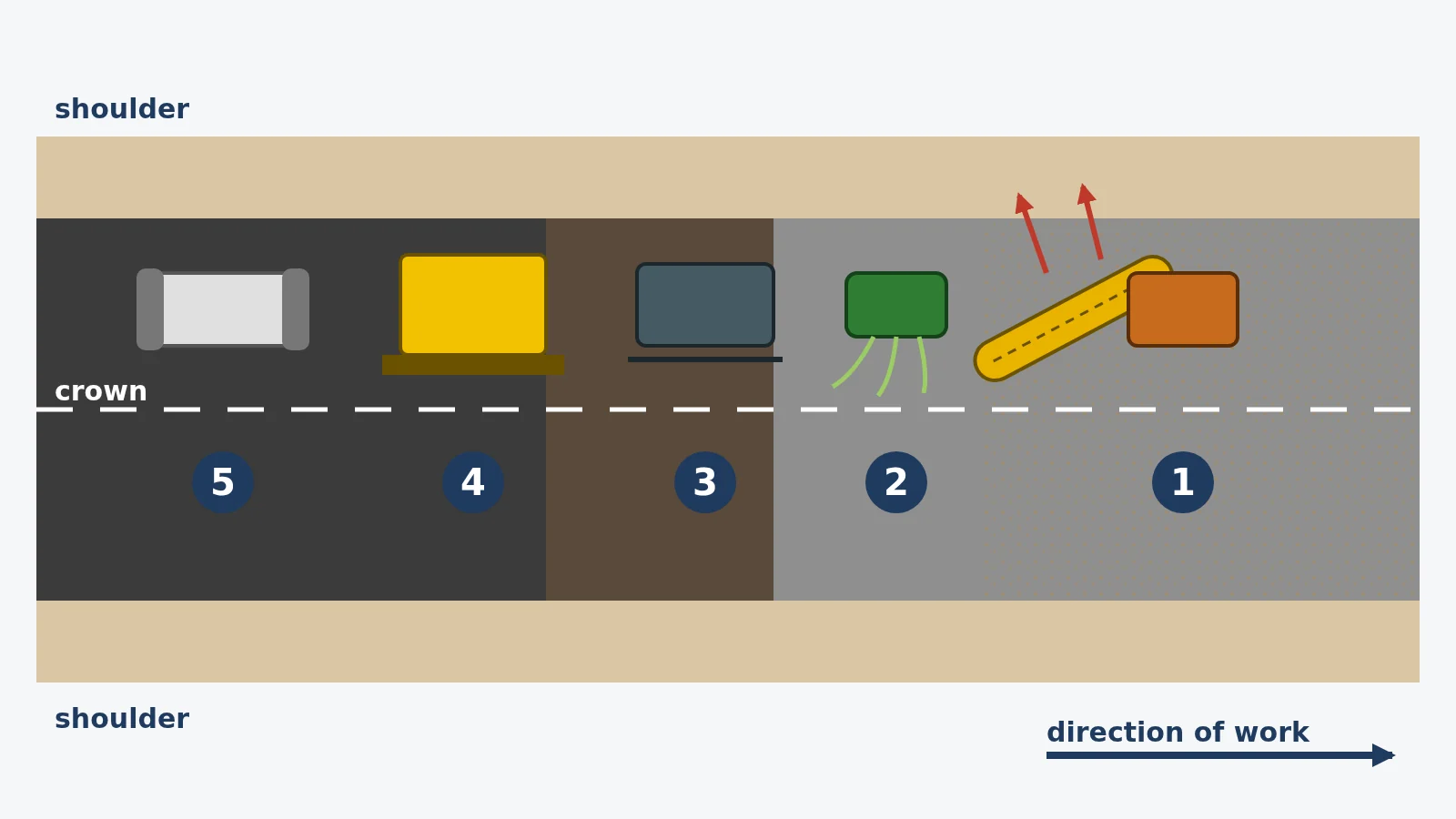
- Mechanical broom: angled brush, throws dirt towards the shoulder.
- Air jet from a compressor: blows the fine dust out of the surface texture.
- Bitumen pressure sprayer: prime coat or tack coat on the clean surface.
- Asphalt paver: lays the bituminous mix.
- Rollers: compact the mat.
What machines work with a mechanical broom?
The broom is the first machine of the bitumen stage, and the rest of the crew follows it in a fixed order. Right behind it comes an air compressor and a long hose with a nozzle for the air jet. The guide to the air compressor for construction explains which compressor suits site work.
Then the bitumen sprayer lays the prime or tack coat, with the binder heated in a plant or, on small works, a bitumen boiler. The asphalt paver lays the mix, and the rollers compact it. The full list of machines for a road package, earthwork to rolling, is in the guide to road machinery required.
The broom is the smallest machine in that crew, and the one a crew is most tempted to skip. A road that fails at the bond between layers usually fails years after the paver has left, and nobody connects it to the morning the broom did not come.
What should you check on a mechanical broom before the job?
Five checks, most of them from the Texas seal coat manual’s broom inspection and the makers’ wear notes:
- The bristles are worn evenly across the full width. Uneven wear puts too much pressure in one spot and none in another, and leaves dusty stripes.
- The brush rises, lowers and angles from the controls, and starts and stops promptly.
- On older brooms with a lift cylinder at each end, both ends press equally on the road.
- Lights, flags and reflective markings are in place. The broom works well ahead of the rest of the crew, in its own dust, close to traffic.
- The water spray works, if the broom has one, so the dust does not drift over the traffic lane or the next village.
Then sweep a short test strip and look at it. If dust still shows in the stone texture after the air jet, slow down, add a pass, or check the brush speed against the carrier’s oil flow. If the broom is pulling stone out of a fresh granular layer, stop: clause 501.8.3.1 treats that as a layer problem, not a broom problem.
When the surface is clean, the rollers are the next big hire. Compare tandem roller models and prices for bituminous rolling, and find more road guides on the road construction guide hub.
The clause numbers and quotations in this guide are from the MoRTH Specifications for Road and Bridge Works, Fifth Revision (2013). The sweeper sizes are from Bobcat’s India sweeper page, the tractor-mounted broomer figures from KRISH Equipments’ listing on L&T-SuFin, and the inspection points from the Texas Department of Transportation’s Seal Coat and Surface Treatment Manual (chapter 7, section 2), all read in November 2026. Pass counts are our arithmetic.
Prices, specifications and features are indicative, vary by variant, location and date, and should always be confirmed with the official OEM or authorised dealer before any purchase decision. Broom sizes and flows are the makers’ figures for the named models; confirm the oil flow your tractor or loader delivers with its maker before fitting a broom. DesiMachines is not liable for decisions taken on the basis of information that may have changed after publication.
Machines, tenders and news for this industry: Road Construction