
 Excavator
294 models
 Backhoe Loader
51 models
 Crane
68 models
 Concrete Mixer
79 models
 Wheel Loader
54 models
 Compactor / Roller
45 models
 Motor Grader
42 models

 Concrete Pump
66 models
 Skid Steer Loader
11 models


A road that has started to crack, sink into grooves along the wheel tracks or break into potholes is telling you what went wrong underneath, if you know how to read it. Indian road codes sort the types of pavement failure into four groups on a bitumen road (surface defects, cracks, deformation and disintegration) and into cracking, surface, joint and miscellaneous defects on a concrete road, and each named defect points to its own cause and its own repair.
This guide walks through every defect in those groups the way a site engineer would: what you see, where it shows up, why it happened and how it is put right. The bitumen-road classification, symptoms, severity limits and treatments come from IRC:82-2015, the Code of Practice for Maintenance of Bituminous Road Surfaces (First Revision). The Indian Roads Congress has since issued a second revision, IRC:82-2023, so check that edition for the current figures on a contract. The concrete-road defects come from IRC:SP:83-2018, Guidelines for Maintenance, Repairs and Rehabilitation of Cement Concrete Pavements.
What are the types of pavement failure?
A pavement is the built-up part of a road that carries traffic, from the compacted soil at the bottom (the subgrade) to the wearing surface on top. Engineers split pavements into two kinds. A flexible pavement has a bitumen surface over layers of stone, and it bends slightly under each wheel. A rigid pavement is a cement concrete slab that spreads the load over a wide area and hardly bends at all. The two fail in different ways, so the codes classify them separately.
IRC:82-2015 clause 7.1 puts every bitumen-road defect into one of four groups:
- Surface defects, which are bleeding (a fatty surface), smooth surface, streaking and hungry surface. These stay in the top layer and usually come from too much or too little bitumen.
- Cracks of six kinds: hairline, alligator (map), longitudinal, transverse, edge and reflection.
- Deformation, where the road has changed shape through slippage, rutting, corrugation, shoving, shallow depressions, or settlement and upheaval.
- Disintegration, where the surface is coming apart as stripping, ravelling, potholes and edge breaking.
IRC:SP:83-2018 clause 3.3 sorts concrete-road defects into cracking, surface defects, joint defects and a miscellaneous group that holds blowups, pumping, patch deterioration and shoulder drop-off. It also splits them by effect. A structural defect cuts the road’s ability to carry load. A functional defect leaves the strength alone but spoils the ride or the grip.
How do you tell which failure a road has?
Start with where the damage sits, because location narrows the cause faster than anything else. The IRC code records a location for every defect, and the pattern is consistent:
| Where the damage is | Likely defect (bitumen road) | What it usually points to |
|---|---|---|
| Along the wheel tracks | Alligator cracking, rutting, bleeding, slippage | Weak layers below, overloading, a soft or over-rich mix, a poor bond between layers |
| 0.3 to 0.5 m inside the edge | Edge cracking | No side support from the shoulder, poor drainage, a thin edge |
| Within 30 cm of the edge | Edge breaking | Worn shoulders, water getting in, poor compaction at the edge |
| At a joint between paving lanes or at a widening | Longitudinal or reflection cracking | A weak joint, or movement in the old road underneath |
| Where traffic brakes, turns or climbs | Shoving, corrugation, slippage | An unstable mix or a missing tack coat |
| Anywhere, as bowl-shaped holes | Potholes | Water in the surface, high voids, thin surfacing, poor camber |
| Over the full lane or carriageway | Ravelling, stripping, hungry or smooth surface | The mix itself: bitumen content, aggregate quality, ageing |
Then measure. Crack width, rut depth and pothole size decide the severity, and the severity decides the repair. IRC:82-2015 Appendix 2 measures rut depth under a 3 m straight edge, and a steel scale reads crack width. IRC:SP:83-2018 asks for a condition survey of concrete roads once a year, preferably at the start of the monsoon.
What are the types of cracks in a bitumen road?
IRC:82-2015 describes cracking as a common distress on most Indian roads and says cracks need sealing quickly, because water entering through them damages the layers below. The code names six kinds.
Hairline cracks are under 1 mm wide, short and close together, and often vanish in summer heat. They come from too little bitumen, excess filler, rolling the mix while it is still tender, or ageing of the binder. A fog seal (a thin spray of diluted bitumen emulsion), a rejuvenating agent, a slurry seal or microsurfacing treats them.
Alligator or map cracking is a network of cracks forming small irregular blocks that look like crocodile skin, normally in the wheel path. It is the warning sign of a structural problem: too much deflection, a pavement that is too thin, a subgrade softened by water, overloaded trucks or stripping in the layer below. The code tells the engineer to dig a test pit or take a core before choosing the repair, since the cause is often deep. Where the pavement is structurally weak, it needs a designed overlay. Crack sealing alone will not hold.
Longitudinal cracks run along the road, usually at the joint between two paving lanes or between the road and a paved shoulder. Wetting and drying under the shoulder and weak lane joints cause them.
Transverse cracks run across the road. They come from shrinkage of the mix in cold weather, brittle aged bitumen, or a crack or joint in a layer underneath.
Edge cracks run parallel to the edge, normally 0.3 to 0.5 m inside it. Missing shoulder support, poor drainage, inferior shoulder material and a thinner surface at the edge are the usual causes.
Reflection cracks appear in a new bitumen layer laid over an old cracked road or over a concrete road, copying the pattern below. They also show up exactly on the line where an old road was widened.
For alligator, longitudinal and transverse cracks the code grades severity by width:
| Severity (IRC:82-2015) | Crack width | Typical treatment |
|---|---|---|
| Low | 1 to 3 mm | Crack sealing with bitumen emulsion or rubberised bitumen |
| Medium | 3 to 6 mm | Crack sealing; slurry seal on transverse cracks |
| High | Over 6 mm, frequent; pieces loose on alligator cracks | Remove and replace the cracked layer, or milling and recycling; a designed overlay if the pavement is weak |
Why does a bitumen road rut, shove or sink?
Deformation means the surface has changed shape. It can sit in the bitumen layers alone or run right down into the subgrade, and the depth of the problem decides the repair.
Rutting is a groove along the wheel path. IRC:82-2015 grades it as low severity at 4 to 10 mm deep and high above 10 mm. Heavy channelled traffic, overloading, poor compaction during construction, a mix designed without enough stability, a weak subgrade, soft bitumen, and clay working up into the stone base are the listed causes. The repair is to mark the rut with a string line, apply a tack coat and fill it with premix, compacted to level.
Shoving is a bulge where the bitumen layer has flowed sideways, typically at junctions, bus stops, steep grades and sharp curves where wheels push hard. Slippage is its cousin: crescent-shaped cracks that point the way the wheels were thrusting, which on a downhill brake zone means they point uphill. Both trace back to an unstable mix or a missing or dusty tack coat, which is why the guide to prime coat and tack coat matters here. The fix is to cut out the affected area down to a sound layer and lay a fresh premix patch over a new tack coat.
Corrugation is a row of ripples across the road, about 25 mm deep and 2 to 3 m apart, caused by an unstable mix, poor rolling or braking on grades. Shallow depressions are isolated low spots 25 mm or more deep where rainwater collects, caused by a pocket of poorly compacted subgrade or base. Settlement and upheaval are larger again, often behind bridge approaches and over trenches cut for utilities, and come from an under-compacted fill, trapped water or a pavement that is too thin.
A depression is filled with premix. A settlement is a different job: the code says the faulty fill may have to be dug out and rebuilt, with drains added where water is the cause. Checking compaction properly when the road is built is the prevention, as the guide to the field density test explains.
What makes a bitumen road break up into potholes?
Disintegration is the stage where the surface starts losing material. IRC:82-2015 warns that if it is not stopped early, the road may need full reconstruction.
Stripping is the bitumen film peeling off the stone because of water. Water-loving (hydrophilic) aggregates, dust or moisture on the stone at mixing, overheating, rain soon after laying and the wrong bitumen grade all contribute. An anti-stripping agent added at construction prevents it.
Ravelling is the steady loss of fine aggregate and then the coarse stone, leaving a rough, jagged surface. The code lists thirteen causes, led by too little bitumen, overheated bitumen during mixing, poor compaction and laying in cold, wet weather. Low and medium ravelling is sealed with a fog seal, seal coat, slurry seal or microsurfacing. High severity needs a thin overlay such as an open-graded premix carpet.
Potholes are bowl-shaped holes. The commonest cause, in the code’s words, is loss of adhesion in the wearing coat because water has entered the pavement or the surface has too many voids. Plastic filler in the base, a poor bond to the water bound macadam below, thin surfacing and an inadequate camber all make them worse. The guide to camber in road construction shows why a flat road holds the water that starts them. IRC:82-2015 grades potholes by size:
| Pothole size (IRC:82-2015) | Depth | Width |
|---|---|---|
| Small | 25 mm | 200 mm |
| Medium | 25 to 50 mm | 500 mm |
| Large | Over 50 mm | Over 500 mm |
A pothole is filled with open-graded or dense-graded premix. The code allows four kinds of material: hot or cold mixes made for immediate use, storable cold mixes (cut-back bitumen to IRC:116 or emulsion to IRC:100), readymade mixes, and cold mixes laid by patching machines. Whatever the material, the broken edge around the hole is cut back and the loose stone removed first, or the patch falls out again.
Edge breaking is the edge of the bitumen surface crumbling away irregularly within about 30 cm of the edge. Water, worn shoulders and narrow carriageways cause it. The repair cuts the damaged strip back to vertical sides and rebuilds the road and shoulder together, with the shoulder sloped about one per cent steeper than the camber so water runs off.
What surface defects show up first on a bitumen road?
These four stay in the top layer, and the code ties them mostly to the amount of bitumen.
Bleeding leaves a shiny film of bitumen on the surface that turns soft in the heat and slippery in the rain. It comes from too much binder, low voids in the mix, a softer bitumen grade than the climate needs (see the guide to bitumen grades) or an over-heavy tack coat. IRC:82-2015 calls it low severity when isolated spots total less than 1 per cent of the area and medium at 1 to 5 per cent. Low severity is blotted with hot coarse sand and lightly rolled. High severity is milled out and relaid.
A smooth surface has lost its grip because traffic has polished the stone. The code rates it by skid number: 30 to 40 is low severity, below 30 is high. Streaking is alternate bands of heavy and light bitumen from a badly adjusted or too-cold sprayer. A hungry surface looks dry, with fine cracks and missing fines, because too little bitumen went in. A smooth surface is renewed with a surface dressing, premix carpet or microsurfacing using stone that does not polish. A hungry surface takes a fog seal, slurry seal or microsurfacing. A streaked surface has to be removed and replaced.
What are the types of rigid pavement failure?
On a concrete road, IRC:SP:83-2018 first asks one question about any crack: how deep does it go? A crack deeper than half the slab thickness (the code writes it as d > D/2) is structural and needs a corrective repair. A shallower one is treated as non-structural and gets preventive work such as sealing.
| Group (IRC:SP:83-2018) | Defect | What you see and why |
|---|---|---|
| Cracking | Plastic shrinkage cracks | Tight cracks 0.3 to 0.6 m long, 20 to 30 mm deep, from the surface drying too fast at paving. Fine ones are believed to heal themselves. |
| Cracking | Transverse, longitudinal and diagonal cracks | Late or shallow joint sawing, joints too far apart, misaligned dowel bars, overloading, loss of support underneath |
| Cracking | Corner breaks | A crack cutting across a corner, generally within 600 mm of it; poor load transfer and slab curling |
| Surface | Scaling, ravelling, popouts, polishing | Weak or badly cured surface concrete; popouts are holes 25 to 100 mm across and 10 to 50 mm deep left by soft particles |
| Joint | Spalling | The slab edge chips away at a joint or crack, often because stones got into the joint |
| Joint | Faulting (stepping) | One slab sits higher than the next; noticeable when the average step reaches 4 mm |
| Joint | Sealant failure and joint separation | Hardened, pushed-out or unbonded sealant; slabs drifting apart where tie bars are too few or wrongly placed |
| Other | Pumping | Water and fine soil squirting out of joints, cracks or the edge as vehicles pass, washing out the support under the slab |
| Other | Blowup | Slabs lifting more than 4 mm or shattering at a joint because expansion had nowhere to go |
Joint sawing explains a large share of early cracks. The code puts the saw cut at one quarter to one third of the slab depth; cut too late and the slab cracks at random, cut too early and the joint edge ravels. How joints and dowel bars are laid out in the first place is covered in the guide to CC road construction.
How is each type of pavement failure repaired?
The codes agree on one principle: find the cause before you patch. A repair that does not deal with water, a weak layer or overloading only buys time. The table pairs each failure with the repair route the codes name and the machines involved.
| Failure | Repair route | Machines and tools |
|---|---|---|
| Hairline and low-severity cracks | Crack sealing, fog seal, slurry seal, microsurfacing | Brooms, compressed air, pouring can and squeegee; slurry or microsurfacing unit |
| Potholes, shoving, slippage, small depressions | Cut to a sound layer, tack coat, premix patch, compact | Pavement cutter, air compressor, plate compactor or walk-behind roller |
| Rutting, ravelling, bleeding over long stretches | Mill off the damaged layer and resurface | Cold milling machine, paver, tandem and pneumatic rollers |
| Alligator cracking and settlement from a weak base | Designed overlay, or full depth reclamation and a new surface | Recycler or reclaimer, motor grader, rollers |
| Reflection cracking | Stress absorbing membrane interlayer (SAMI) before the overlay | Bitumen distributor |
| Concrete: faulting, cracked slabs, spalled joints | Dowel bar retrofit, cross-stitching, partial- or full-depth repair, then diamond grinding and joint resealing | Diamond-blade saws, crack routers, air compressor, sealant applicator |
IRC:82-2015 section 11 lists a compaction device, a vibratory walk-behind roller or a plate compactor, among the basic kit for pothole patching; the guide to the plate compactor explains how one works. On bigger jobs the milled-and-relaid route is set out in the guide to cold milling, and the deeper rebuild in the guide to FDR technology.
For concrete roads, IRC:SP:83-2018 fixes the order: full-depth repairs, dowel bar retrofit and cross-stitching come first, and diamond grinding, grooving and joint resealing follow. It also notes that some partial-depth repairs last only about six to eight years.
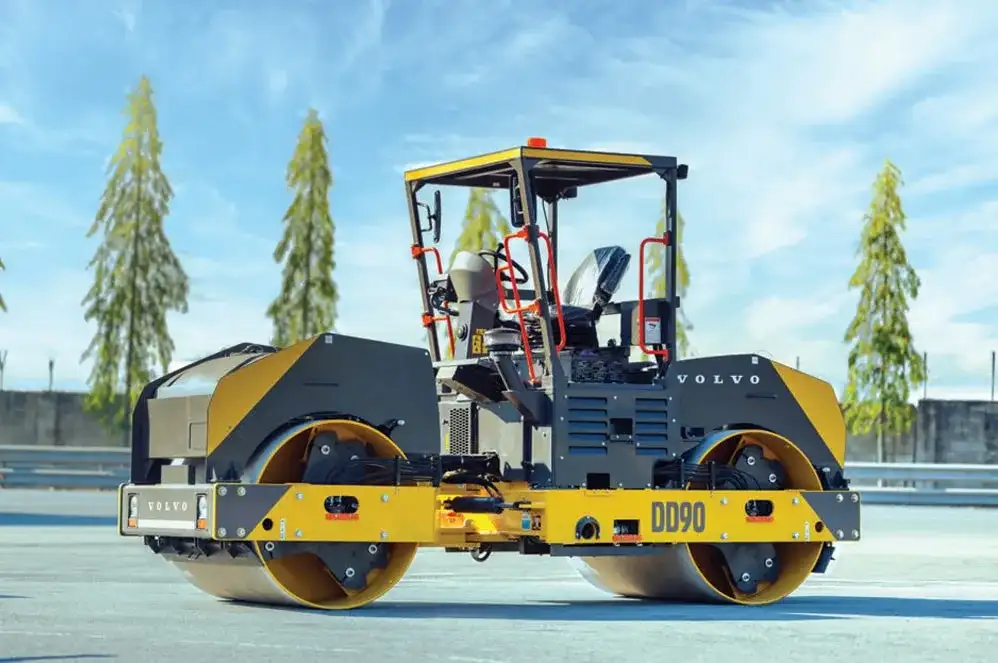
When a resurfaced stretch is rolled, the MoRTH Specifications for Road and Bridge Works (Fifth Revision), clause 501.6, ask for breakdown rolling with 8 to 10 tonne smooth-wheel rollers and finish rolling with 6 to 8 tonne tandem rollers. Two of the machines in that weight band are the Volvo DD90, with an operating weight of 8,700 kg, and the L&T 990HFi at 9,200 kg (specs as listed, Oct 2026). If you are planning resurfacing or patch work, compare tandem roller models and speak to a dealer about the right size for your road.
Which failures come from the layers underneath?
Most of the serious failures start below the surface. Alligator cracking, deep rutting, settlement, edge breaking and, on concrete roads, pumping and faulting all trace back to water in the base or subgrade, a layer that was skipped or thinned, or compaction that fell short. A new bitumen surface laid over those will crack or sink again in the same places.
That is why the codes send the engineer below the surface before choosing a repair: a test pit or core on a bitumen road, deflection and drainage surveys on a concrete one. Knowing what each layer is meant to do helps you read the result, and the guide to road construction layers sets out the subgrade, GSB, WMM and bitumen courses and what goes wrong when one is left out.
Two habits prevent a large share of the failures in this guide. Keep water off and out of the road, with a proper camber, clear side drains and shoulders kept level with the edge. And seal cracks early, while they are still narrow, because every crack the code describes gets worse once water is inside it.
Every other topic on how roads are planned, built and tested sits under the road construction guide. The defect groups, severity limits and treatments on this page are from IRC:82-2015, Code of Practice for Maintenance of Bituminous Road Surfaces, clauses 7.1 to 7.5 and section 11, and IRC:SP:83-2018, Guidelines for Maintenance, Repairs and Rehabilitation of Cement Concrete Pavements, sections 2, 3 and 5, with rolling practice from the MoRTH Fifth Revision, clause 501.6.
Prices, specifications and features are indicative, vary by variant, location and date, and should always be confirmed with the official OEM or authorised dealer before any purchase decision. DesiMachines is not liable for decisions taken on the basis of information that may have changed after publication. Defect classes, severity limits and treatments quoted here follow IRC:82-2015 and IRC:SP:83-2018; IRC:82 has a later revision (2023), and none of this replaces an inspection and repair design by a qualified engineer.
Machines, tenders and news for this industry: Road Construction