
 Excavator
294 models
Excavator
294 models  Backhoe Loader
51 models
Backhoe Loader
51 models  Crane
68 models
Crane
68 models  Concrete Mixer
79 models
Concrete Mixer
79 models  Wheel Loader
54 models
Wheel Loader
54 models  Compactor / Roller
45 models
Compactor / Roller
45 models  Motor Grader
42 models
Motor Grader
42 models  Dozer
41 models
Dozer
41 models  Concrete Pump
66 models
Concrete Pump
66 models  Skid Steer Loader
11 models
Skid Steer Loader
11 models  Telehandler
13 models
Telehandler
13 models 


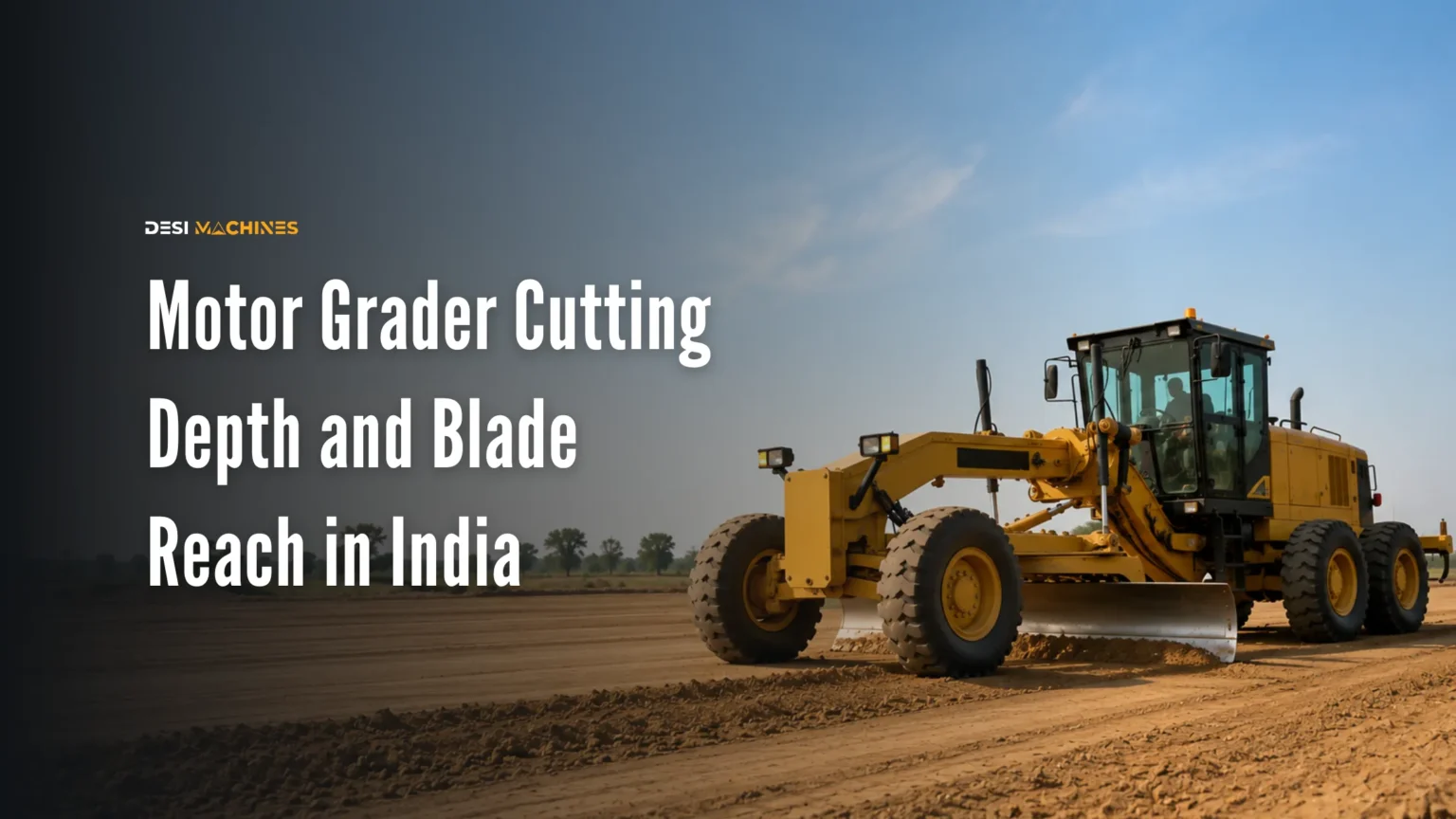
A motor grader is a road-building machine with a long steel blade slung between its front wheels and its rear wheels. That blade is the whole point of the machine. It can drop below the ground to cut, lift above the ground to spread, and swing out past the wheels to shape a drain. Motor grader cutting depth is the first of those three numbers: how far the blade can drop below the ground the machine is standing on. Across the 42 motor graders listed on DesiMachines, the 35 that publish the figure cut between 300 mm and 787 mm (about 1 foot to 2 feet 7 inches) below ground.
That is a narrower spread than most first-time buyers expect, and the machines at the deep end are not the ones you would guess. This guide gives the blade’s full working range in numbers, by size class, taken from the specification sheets of every grader listed here.
How deep does a motor grader cut?
A motor grader cuts between 300 mm and 787 mm (0.3 m to 0.79 m) below ground level, depending on the model. Of the 42 graders listed here, 35 publish a maximum cutting depth. The shallowest are the six Mahindra graders, every one of them rated at exactly 300 mm. The deepest are the two SDLG machines, the G9190Hi and the G9240F, both at 787 mm.
Motor grader cutting depth matters most on two jobs. The first is cutting a new drain or side channel where there is no existing trench to follow. The second is scarifying and re-cutting an old road surface that has gone hard, where the blade has to bite well below the loose top layer to reach sound material. For routine levelling and spreading, you will never use the full depth.
Here is the blade’s working range by size class. Sizes follow the gross vehicle weight the machines publish, and the counts are stated honestly, because not every grader publishes every field.
| Size class | Machines | Cutting depth below ground | Blade lift above ground | Shoulder reach, right side |
|---|---|---|---|---|
| Small, under 12 tonnes (12,000 kg) | 10 | 300–400 mm (9 publish) | 395–460 mm (10 publish) | 489.5–1,650 mm (9 publish) |
| Medium, 12–20 tonnes (12,000–20,000 kg) | 24 | 500–787 mm (18 publish) | 380–600 mm (22 publish) | 744–2,360 mm (8 publish) |
| Large, over 20 tonnes (20,000 kg) | 8 | 438–720 mm (8 publish) | 400–634 mm (8 publish) | 2,004–3,228 mm (7 publish) |
Read the middle column again before you read anything else on this page. The large graders do not cut deeper than the medium ones. They cut less deep at both ends of the range.
What is the blade’s working envelope?
The blade’s working envelope is the set of four numbers that together describe everywhere the blade can go. Each one answers a different question on site, and the specification sheet lists them separately.
Maximum cutting depth is how far the blade drops below the wheels. This is your trench and scarifying figure.
Maximum lift above ground is how high the blade rises above the wheels. You need this to carry the blade clear when driving between sites, and to spread material onto a surface that is already higher than the machine is standing on, such as a raised sub-base.
Maximum shoulder reach is how far the blade tip can swing out sideways past the machine, measured to the right and to the left. This is the number that decides whether the grader can shape a drain or a berm (the raised bank of soil at the roadside) while its wheels stay on firm ground.
Moldboard side shift is how far the blade can slide sideways along its own mounting without the machine turning. The moldboard is simply the technical name for the blade. Side shift is the fine adjustment you use to line the blade up with a joint or an edge.
These four are separate specifications. A machine can be generous on one and mean on another, which is exactly what the numbers below show. For what the blade physically does with these movements, see how motor graders work, which covers the six ways the blade moves.
Does a bigger grader cut deeper?
No. On the machines listed here, cutting depth runs almost backwards to machine size, and the clearest evidence comes from a single maker’s own range, where the way the figure is measured stays the same throughout.
Sorted by how deep they cut, the five Caterpillar graders listed here come out in this order: the Cat 120 GC at 775 mm, the Cat 120 at 775 mm, the Cat 24M at 657 mm, the Cat 16M3 at 470 mm and the Cat 14M3 at 438 mm. Now sort the same five by weight and the order almost reverses. The Cat 120 GC weighs 14,496 kg (14.5 tonnes). The Cat 24M weighs 65,840 kg (65.8 tonnes), four and a half times as much, carries 533 HP against the 120 GC’s 171 HP, and still cuts 118 mm shallower.
The 14M3 makes the point even more sharply. At 25,968 kg (26 tonnes) it is nearly twice the weight of the 120 GC, and it cuts 438 mm against 775 mm. That is a machine of almost double the size cutting a little over half as deep.
The same pattern holds across brands. The deepest-cutting grader listed here is the SDLG G9190Hi at 787 mm and 16,200 kg (16.2 tonnes), a mid-size machine. The heaviest grader listed here, the Cat 24M, sits mid-table on depth. The 47,320 kg (47.3 tonne) Komatsu GD955-7 cuts 498 mm, less than a 13,160 kg SEM 917F at 750 mm.
So power does not buy depth, and neither does weight. Cutting depth is set by the geometry of each model’s blade and circle mounting, which is why it has to be looked up machine by machine rather than assumed from the size class. What the large graders buy you is width and reach, covered further down.
How far can the blade reach past the wheels?
Shoulder reach runs from 489.5 mm to 3,228 mm (roughly 0.5 m to 3.2 m) across the 24 graders that publish it. This is where machine size genuinely pays, and it is a much wider spread than cutting depth. Depth varies by about two and a half times from the shallowest machine to the deepest. Reach varies by more than six and a half times.
At the bottom sit the six Mahindra graders, all rated 489.5 mm, and the two Fine machines that publish the figure, both at 744 mm. At the top is the Cat 24M at 3,228 mm to the right. In between, most mid-size machines land between 1,650 mm and 2,400 mm, including the BEML BG605I at 1,650 mm and the Komatsu GD705-5 at 2,360 mm.
The practical reading is straightforward. If your work is levelling a road surface, yard or plot where the machine drives on the ground it is shaping, reach barely matters and a small grader will do. If your work is cutting and dressing drains at the edge of an embankment, where the wheels have to stay on the sound part of the road while the blade works out over the shoulder, reach is the specification that decides whether the machine can do the job at all. A grader with 489.5 mm of reach cannot dress a drain that sits two metres off the wheel line, whatever its horsepower.
Why do the right and left reach figures differ?
Because the blade is not mounted symmetrically, and most graders reach further one way than the other. Of the 24 machines publishing shoulder reach, 16 give a separate right and left figure. On 13 of those 16 the two numbers differ. Only three publish the same figure both sides: the Cat 16M3 at 2,311 mm, the BEML BG825 at 2,400 mm and the Komatsu GD825A-2 at 2,400 mm.
The direction is consistent. Of the 13 machines with unequal reach, 12 reach further to the right. Only the Cat 140 GC reaches further left, at 1,886 mm left against 1,812 mm right. The gap can be significant: the BEML BG605A reaches 1,955 mm right but only 1,670 mm left, a difference of 285 mm.
This matters more in India than the specification sheets let on. Traffic keeps left, so the shoulder and side drain a grader is asked to dress on a public road is usually the left-hand one. If that is your regular work, read the left-hand figure rather than the headline number, because on most of these machines the headline number is the right-hand one and it flatters the machine.
How high can the blade lift above the ground?
The blade lifts between 380 mm and 634 mm above ground across the 40 graders that publish the figure. This is by far the tightest of the blade numbers. The whole class fits inside a 254 mm band, and unlike cutting depth it tracks size loosely at best: the lowest figure belongs to the mid-size SDLG G9150Hi at 380 mm and the highest to the Cat 24M at 634 mm, but the 47-tonne Komatsu GD955-7 sits at 542 mm, below the 600 mm of the far lighter LiuGong 4180D.
Lift height does two jobs. It carries the blade clear of humps and kerbs when the machine is travelling rather than working, which protects the cutting edge. It also sets how high a layer the grader can spread onto. If you are trimming a sub-base that has already been built up, the blade has to clear the top of that layer.
Because the range is so tight, lift height is rarely the number that decides a purchase. It is worth checking only if you regularly work on raised formations or move the machine between sites on its own wheels.
Which blade figures should you check before buying?
Work through them in the order the job demands, not the order the brochure prints them.
Start with shoulder reach, because it varies most and it is the one that can make a machine simply unable to do your work. Measure the furthest point from your wheel line that the blade actually has to reach on a typical job, and compare it against the correct side’s figure.
Then check cutting depth, but check it against the deepest single cut you genuinely make. Most road maintenance and levelling never approaches 300 mm, in which case every grader listed here clears the bar and the specification should not drive your decision. If you cut new drains in hard ground, it matters, and you should not assume a bigger machine gives you more.
Blade length is a separate question from the working envelope and sets how much ground you cover per pass. Across the machines listed here it runs from 2,600 mm on the Mahindra G9595 to 7,300 mm on the Cat 24M. For how blade width fits into the wider buying decision, alongside power and weight, see the motor grader buying guide.
Finally, match the machine to the work rather than the specification. What motor graders are used for sets out which size class suits road, site and mining work, and if you are still deciding between machine types, motor grader versus bulldozer covers that choice. Browse the full range of motor graders to compare models and connect with a dealer.
How do you confirm the figures for your own machine?
Every number on this page comes from the specification sheet of a grader listed on DesiMachines, read in August 2026. Blade figures are model-specific and makers revise them between variants and model years, so treat these as the current published values rather than fixed properties of a size class.
Before you buy, ask the dealer for the specification sheet of the exact variant you are quoted, and check the four blade numbers on it against the ones here. Where a machine does not publish a figure, the counts in the table above say so instead of filling the gap with an estimate. If a number matters to your work and the sheet does not carry it, ask the dealer to confirm it in writing rather than accepting a verbal figure.
For the running-cost side of the same machines, motor grader fuel tank and oil capacities gives the service refill figures by size class. Grading is also only the first half of a road job, and the layer a grader trims still has to be compacted afterwards, which is covered in soil compaction methods and equipment.
How fast the machine covers the ground between those passes is a separate question, answered in motor grader speed.
Depth and reach are what the blade can span. What it does with the soil once it is in the cut is decided by the swing, pitch and tilt settings, which are set out in the guide to motor grader blade angles.
What holds the blade down in the cut is the weight of the machine above it, set out by class in our guide to motor grader weight and dimensions.
Prices, specifications and features are indicative, vary by variant, location and date, and should always be confirmed with the official OEM or authorised dealer before any purchase decision. DesiMachines is not liable for decisions taken on the basis of information that may have changed after publication.