
 Excavator
294 models
Excavator
294 models  Backhoe Loader
51 models
Backhoe Loader
51 models  Crane
68 models
Crane
68 models  Concrete Mixer
79 models
Concrete Mixer
79 models  Wheel Loader
54 models
Wheel Loader
54 models  Compactor / Roller
45 models
Compactor / Roller
45 models  Motor Grader
42 models
Motor Grader
42 models  Dozer
41 models
Dozer
41 models  Concrete Pump
66 models
Concrete Pump
66 models  Skid Steer Loader
11 models
Skid Steer Loader
11 models  Telehandler
13 models
Telehandler
13 models 


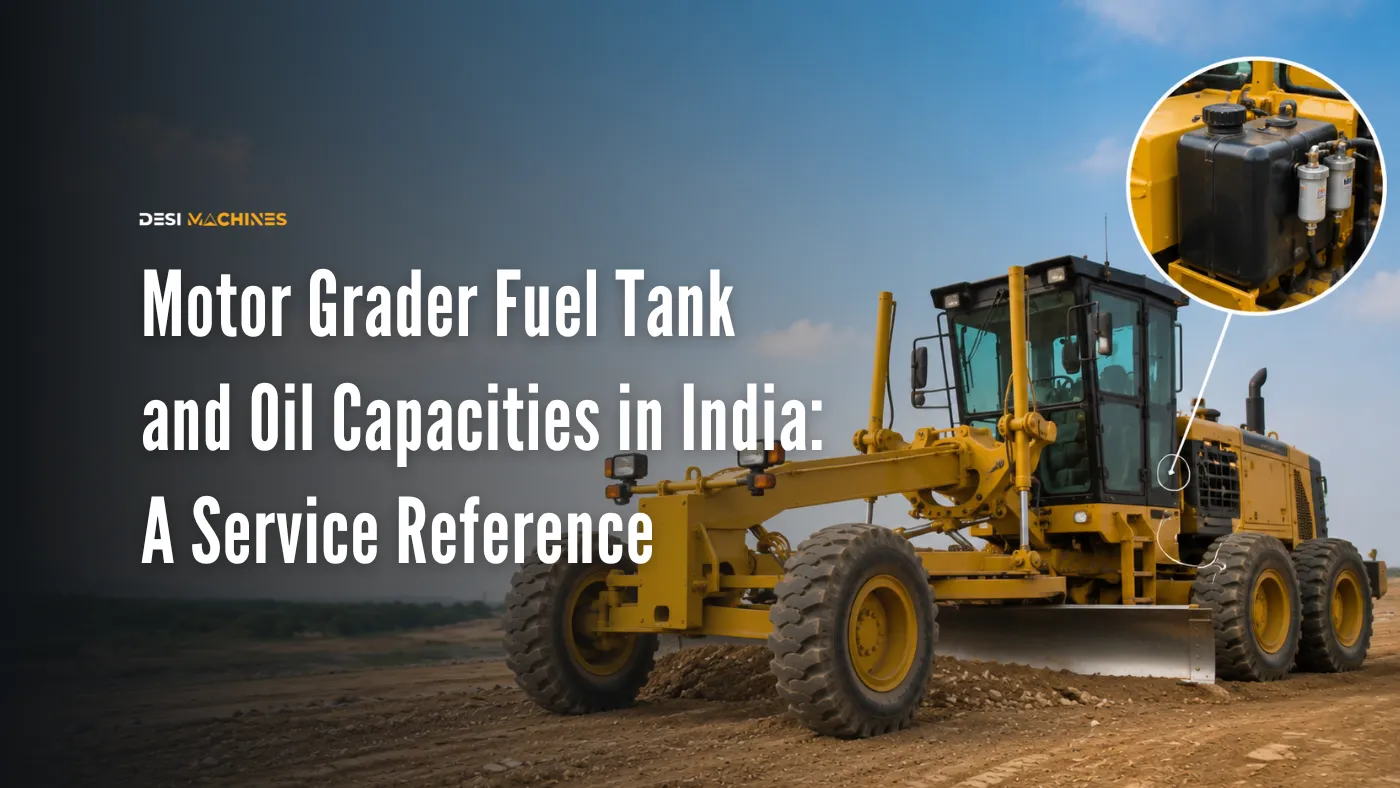
All capacities below are taken from our listings at the time of writing and are for the standard build of each model.
What is the fuel tank capacity of a motor grader?
Most motor graders working on Indian road projects carry between 200 and 400 litres of diesel. The tank grows with the engine, because a bigger engine burns more, and because a grader trimming a highway package is usually working kilometres away from the fuel bowser.
At the small end, the Mahindra Roadmaster G90 and the rest of the Roadmaster range hold 100 litres, the BEML BG405A holds 180 litres and the Fine FMG 130 holds 200 litres. These are the machines that suit village roads, plot levelling and small PMGSY packages, and you can compare the full small motor grader range.
Step up to the size most contractors actually buy and the tanks roughly double. The Komatsu GD535-6 takes 224 litres, the ACE AG 176 takes 260 litres, the Cat 140 GC takes 295 litres, the CASE 845B takes 341 litres and the XCMG GR1705 takes 380 litres.
The big machines are a different world. The Komatsu GD955-7 holds 717 litres and the Cat 24M holds 1,326 litres, more than thirteen times what a Roadmaster’s tank holds. Machines of that size work mine haul roads and large earthworks where refuelling stops are expensive.
Motor grader fuel and oil capacities by size class
The table below sets out the published service capacities for graders currently listed in India, grouped by size class. Every figure is in litres and comes from the model’s own specification.
Table: motor grader service capacities (litres), by size class — as per current August 2026 specifications
| Model | Class | Fuel tank | Engine oil | Hydraulic system | Transmission oil | Coolant |
|---|---|---|---|---|---|---|
| Mahindra Roadmaster G90 | Small | 100 | 13.5 | 60 | 16 | 17 |
| BEML BG405A | Small | 180 | 23 | 41 | 21 | 45 |
| Fine FMG 130 | Small | 200 | 13 | Not specified | 15 | 20 |
| Komatsu GD535-6 | Medium | 224 | 14.2 | 51.5 | 45 | 21.6 |
| Cat 120 GC | Medium | 269 | 7.6 | 55 | 17 | 39 |
| ACE AG 176 | Medium | 260 | 16 | 110 | 28 | 13.5 |
| Cat 140 GC | Medium | 295 | 21 | 45 | 18 | 40 |
| LiuGong 4180D | Medium | 275 | 24 | 115 | 33 | 40 |
| CASE 845B | Medium | 341 | 17.5 | 90 | 25 | 40 |
| Sany STG170C-10 | Medium | 350 | Not specified | 110 | Not specified | Not specified |
| XCMG GR1705 | Medium | 380 | 24 | 170 | 38 | 50 |
| Komatsu GD825A-2 | Large | 500 | 38 | 80 | 25 | 58 |
| Cat 16M3 | Large | 496 | 36 | 146 | 98.5 | 70 |
| Komatsu GD955-7 | Large | 717 | 50 | 147 | 85 | 80 |
| Cat 24M | Large | 1,326 | 60 | 264 | 87.1 | 90 |
Read the table down a column rather than across a row. The fuel tank rises steadily with machine size, but the oil volumes do not follow the same line, and that is the part which catches people out at service time.
Looking for a machine rather than a number? Compare live motor grader models and prices and talk to a dealer about the variant you actually need.
How much engine oil does a motor grader take?
Engine oil on a motor grader ranges from 7.6 litres on the Cat 120 GC to 60 litres on the Cat 24M, and most medium machines sit between 14 and 26 litres. Engine oil is the lubricating oil that sits in the sump under the engine and keeps the moving parts from wearing against each other.
The quantity follows the engine, not the machine’s weight. The Cat 120 GC runs a 4.4 litre Cat C4.4 engine and takes 7.6 litres of oil, while the Cat 140 GC on the same site runs a 7.01 litre C7.1 and takes 21 litres. Two graders of similar size, and one needs nearly three times the oil of the other.
This matters for a practical reason. Engine oil is sold in 5, 10 and 20 litre packs, and a machine that takes 13.5 litres leaves you with an open part-pack every service. Owners running a small fleet usually buy to the largest machine’s requirement and carry the remainder forward, which works as long as the grade is the same one the manual specifies.
How much hydraulic oil does a motor grader hold?
The hydraulic system is the largest oil chamber on most motor graders, holding anywhere from 41 litres on the BEML BG405A to 264 litres on the Cat 24M. Hydraulic oil is the oil the machine pushes through pipes under pressure to move things: on a grader it lifts and tilts the blade, slides it sideways, turns the circle, bends the frame at the articulation joint and drives the steering.
A grader asks more of its hydraulics than most machines, because the blade is being adjusted continuously through every pass instead of working in a repeating cycle. That is why the tanks are large relative to the engine.
The spread within one size class is wide. The XCMG GR1705 holds 170 litres and the ACE AG 176 holds 110 litres, while the Cat 140 GC holds 45 litres at similar engine power. A bigger tank is not a better machine; it reflects how the circuit is laid out and how much oil the designer wanted in reserve to stay cool. What it does change is the cost of a full oil change, so ask for the figure before you budget the service. The guide to hydraulic system maintenance covers what that oil does once it is in there.
What is the circle reverse housing, and why does it hold oil?
The circle reverse housing is a small gearbox that turns the grader’s circle, and it holds its own oil, typically 1.5 to 10 litres. The circle is the large toothed ring under the machine’s frame that carries the blade and lets the operator swing it to any angle, including right around to work over the side of the machine. No other class of construction equipment has this part, so it is the capacity most often missed.
The published volumes are small: 1.5 litres on the Cat 120 GC, 2 litres on the Cat 140 GC, 2.8 litres on the CASE 845B, 3 litres on the ACE AG 176, 4.1 litres on the Komatsu GD535-6 and 10 litres on the Cat 16M3. The largest listed is 27.5 litres on the Komatsu GD955-7.
Because the quantity is so small, a neglected circle housing does not announce itself the way a low engine oil level does. It shows up later as a stiff or noisy circle, and by then the drive teeth have taken the damage. Put it on the same checklist as the axles. The guide to how motor graders work explains where the circle sits in the machine and what it does during a pass.
Why do some motor graders have a DEF or AdBlue tank?
A DEF tank holds diesel exhaust fluid, sold in India as AdBlue, and it appears on graders built to the newer CEV Stage IV and Stage V emission norms. DEF is a urea and water solution sprayed into the exhaust, where it converts nitrogen oxide into nitrogen and water vapour before the gas leaves the machine. It is not a fuel additive and never goes into the diesel tank.
Listed DEF capacities run from 12 litres on the Cat 120 GC and 16 litres on the Cat 140 GC up to 36 litres on the Komatsu GD535-6 and 60 litres on the CASE 845C. The Sany STG170C-10 carries 30 litres.
Older mechanical machines built to earlier norms, including the Mahindra Roadmaster range and the BEML BG605I, have no DEF tank at all. If you are comparing an older grader against a new one, that difference is worth understanding before you buy, because a machine that uses DEF needs a supply of it near the site and will lose power if the tank runs dry. The explainer on BS4 and BS6 engine differences sets out how the norms changed and what they mean for a buyer.
How long does a full tank of diesel last on a motor grader?
Long enough for a working shift on most machines, which is what the tank is sized for. Beyond that, nobody can give you an honest number, because no manufacturer publishes a fuel consumption figure for a motor grader. Consumption swings with how deep the blade is cutting, the length of the pass, the material, the gradient and the operator’s habits, and a machine trimming a finished surface uses a fraction of what the same machine uses cutting a fresh formation.
The reliable way to know your own machine is to measure it. Fill the tank, work a normal week, refill it and divide the litres you put in by the hours the hour meter has moved. Do it twice on different jobs. The same method is set out for backhoe loaders in the guide to mileage and fuel consumption.
Once you have your own figure the arithmetic is simple. Say a 140-size grader measures 12 litres an hour on your site: a 295 litre tank then gives about 24 hours of blade time, or roughly three shifts between fills. If your measured figure is far off what a similar machine nearby returns, look at the depth of cut and the pass pattern before you blame the grader. How deep the blade can go in the first place is a published specification too, and it does not follow machine size: motor grader cutting depth and blade reach ranges it from 300 mm to 787 mm across the graders listed here.
How do you confirm the capacities for your own machine?
Check three places, in this order. The operator’s manual for your exact variant and model year is the first, because capacities change quietly between variants and between production years, and the figure in a brochure may belong to a build that is no longer sold. The specification on the model’s own listing is the second, and it is the one used throughout this guide. The dipstick or sight glass on the machine itself is the last word.
One point that confuses first-time owners: a published capacity is the volume from dry, so the quantity you actually put in after draining is usually a little less. Oil stays behind in the lines, the cooler and the filter housing. Fill to about ninety per cent of the published figure, run the machine, let it settle and then top up to the mark rather than emptying the whole pack in one go.
Buy oil to the grade the manual specifies rather than to the quantity you have in the shed, and log the litres against the hour meter each time. That record is what tells you a system is quietly losing oil, and it is worth real money when you sell the machine. For the intervals themselves, the construction equipment service schedule sets out what happens at 250, 500 and 1,000 hours, and the motor grader buying guide covers what else to check before you commit.
Similar references exist for the other machine classes: wheel loader fuel and oil capacities, fuel tank capacity of excavators and backhoe loaders.
Ready to buy? Browse the full range of medium motor graders, the size most road contractors settle on, and match the class to the work you actually do before you sign anything.
The same spec sheets also publish a forward and a reverse travel speed, and what those two figures mean on site is covered in motor grader speed.
Prices for DEF by pack, and how much a machine burns in a month, are in the AdBlue price guide.
Prices, specifications and features are indicative, vary by variant, location and date, and should always be confirmed with the official OEM or authorised dealer before any purchase decision. DesiMachines is not liable for decisions taken on the basis of information that may have changed after publication.