
 Excavator
294 models
Excavator
294 models  Backhoe Loader
51 models
Backhoe Loader
51 models  Crane
68 models
Crane
68 models  Concrete Mixer
79 models
Concrete Mixer
79 models  Wheel Loader
54 models
Wheel Loader
54 models  Compactor / Roller
45 models
Compactor / Roller
45 models  Motor Grader
42 models
Motor Grader
42 models  Concrete Pump
66 models
Concrete Pump
66 models  Skid Steer Loader
11 models
Skid Steer Loader
11 models  Telehandler
13 models
Telehandler
13 models  Dozer
Dozer 


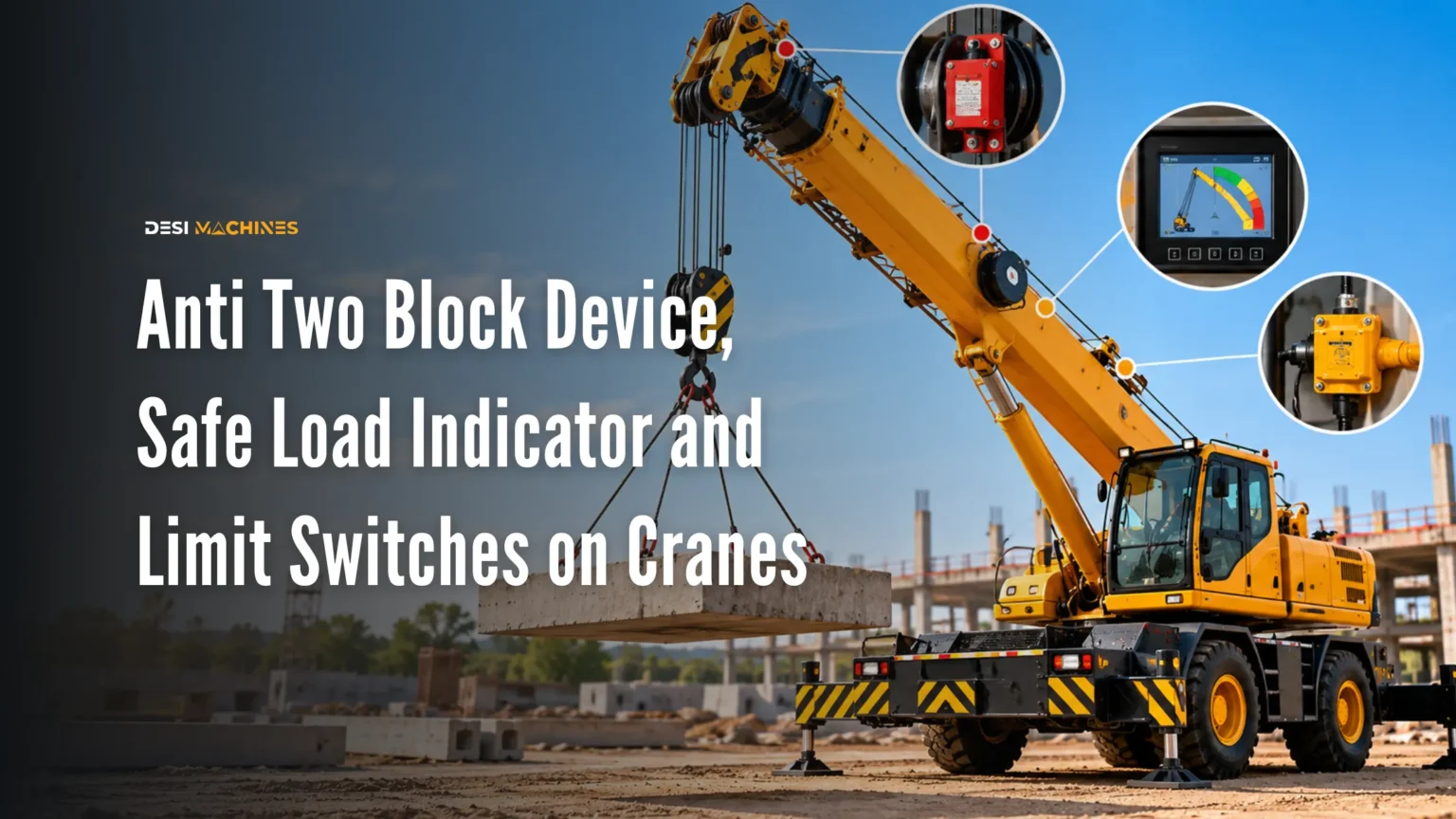
An anti-two-block device is a switch at the tip of a crane boom that stops the hook block from being pulled up into the boom head. A small weight hangs around the hoist rope on a chain; when the rising hook lifts that weight, the switch sounds an alarm in the cab and cuts the hoist-up and boom telescope-out movements before the rope can snap.
The most important of the other crane safety devices is the safe load indicator (SLI), also called a load moment indicator (LMI), which warns the operator and stops unsafe movements when a lift goes past the load chart.
What are the safety devices on a crane called?
Names change between makers, but the jobs stay the same. These are the devices you will see on Indian hydra, Farana and truck-mounted cranes.
| Device | Other names | What it watches | What it does |
|---|---|---|---|
| Safe load indicator | SLI, load moment indicator (LMI), automatic safe load indicator | Load on the hook, boom angle, boom length, radius | Warns near the limit and cuts the movements that would make the lift worse |
| Anti-two-block device | ATB, over-hoist switch, over-hoist warning, hoist upper limit | How close the hook block is to the boom tip | Alarm plus cut-out of hoist-up and telescope-out |
| Hoist lower limit | Over-lowering limit | Rope left on the winch drum | Stops lowering before the last turns of rope come off the drum |
| Boom angle and length limits | Boom limit switch, telescope limit | Boom at its highest angle or full extension | Stops the boom going past its design range |
| Overload alarm | Audio overload alarm, overload buzzer | Load against a set figure | Sounds an alarm; on its own it may not stop the crane |
| Hydraulic cut-off | Motion cut, dump valve | A signal from the SLI or a limit switch | Blocks oil to the cylinder or winch that must stop |
| Hose burst protection | Hose-failure valve, counterbalance valve | A sudden pressure loss in a boom or winch line | Holds the boom and load if a hose bursts |
How does an anti-two-block device work?
“Two-blocking” is when the hook block is pulled into the sheaves at the boom head. The rope then takes the full pull of the winch against a fixed stop, and it can break and drop the hook and load.
A weighted ring hangs around the hoist rope just below the boom tip, joined by a chain to a limit switch. When the hook block rises far enough to lift the weight, the switch trips, the alarm sounds and hoist-up and telescope-out stop. The operator can still lower the hook, which fixes the problem.
Telescoping the boom out also lifts the hook towards the head sheave, which is why telescope-out is cut along with hoist-up.
Hydra spec sheets in India rarely use the words “anti-two-block”. They say “over-hoist warning”, “over-hoist limit switch” or “hoist-failure protection”. Ask the dealer which one it is: an alarm only, or an alarm that also stops the winch.
What does a safe load indicator (SLI) do on a crane?
A safe load indicator keeps comparing the lift with the crane’s own load chart and steps in before the crane is overloaded or tips. A hydra lifts less as the boom goes out and down, so the same load can be safe at a short radius and dangerous at a long one. The guide to reading a crane load chart explains why capacity falls with radius.
How does an SLI read the load, boom angle and length?
A typical system uses three sensors:
- A boom angle sensor at the foot of the boom, which reads the boom’s angle from horizontal.
- A boom length sensor, usually a cable reel inside the base section, which reads how far the boom is telescoped out.
- A pressure transducer on the derrick (luffing) cylinder, which reads the hydraulic pressure holding the boom up. The computer converts that pressure into the load on the hook.
From angle and length it works out the radius, then checks the load against the chart for that radius.
What does the SLI display in the cab show?
Hydra SLI displays usually show the load in tonnes, the safe working load at that moment, radius, boom angle, boom length and the load as a percentage of what is allowed. Many also keep a log of lifts.
When does the SLI warn, and what does it cut?
Systems differ, but a common setting is a warning with a red display and continuous alarm from about 90% of rated capacity, and a cut-out at 100%. At cut-out the movements that increase the load moment stop: boom-down, hoist-up and telescope-out. The movements that reduce it keep working: boom-up, hoist-down and telescope-in. So the operator can always get out of trouble, but cannot make it worse.
What are the types of crane limit switch?
A limit switch stops a movement at a set point. By the movement they guard:
- Hoist upper limit, which is the anti-two-block job above.
- Hoist lower limit, which stops lowering while a few turns of rope are still on the drum, so the rope anchor never takes the load.
- Boom angle limit, at the top of the boom’s range.
- Telescope limit, at full extension.
- Slew limit, on cranes that turn on a slewing ring.
By how they are operated:
- Weight-operated switches, lifted by the hook block. This is the usual anti-two-block type.
- Lever-type switches, tripped when a moving part pushes a lever.
- Rotary geared switches, driven off the winch drum shaft, which count drum turns and set both the upper and lower hook limits.
Is a safe load indicator compulsory on a crane in India?
On construction sites, yes, where it can be fitted. Rule 57 of the Building and Other Construction Workers Central Rules, 1998 requires every crane whose safe working load changes as the jib is raised or lowered to carry an automatic safe load indicator that warns the operator of overload, and a cut-out that stops the lifting movements where possible. Only where an indicator cannot be installed is a table of safe loads by jib angle or radius accepted instead.
A hydra’s capacity changes with boom angle, so the rule covers it. The crane safety rules and operator training guide covers the other duties: yearly thorough examination, test certificates and who may operate a crane.
Which hydra cranes come with a safe load indicator?
We read the listed specifications and feature notes of the 68 pick and carry crane models in the DesiMachines catalogue on 29 September 2026 and counted which ones name each device. A model that does not mention a device may still carry it, so confirm with the dealer.
| Brand | Models checked | SLI or LMI listed as fitted | SLI listed as optional | Over-hoist warning or limit switch listed |
|---|---|---|---|---|
| Escorts Kubota | 18 | 10 | 1 | 2 |
| ACE | 30 | 5 | 0 | 13 |
| Indo Farm (Indo Power) | 16 | 1 | 4 | 3 (all optional) |
| TIL | 2 | 2 (LMI) | 0 | 0 |
| Terex Franna | 2 | 0 | 2 | 0 |
| Total | 68 | 18 | 7 | 18 |
None of the 68 uses the words “anti-two-block”. Escorts names an SLI on its F-series Farana and TRX models, ACE on the NX 360, F230, F270 and FP 210, and ACE lists an over-hoist warning on 13 of its hydra models. Compare hydra crane models and their specifications before you ask for a quote, and ask for the SLI in writing if the spec sheet calls it optional.
What should a hydra operator check before a lift?
- Switch on and watch the SLI start up. It should show no fault message, and the boom angle and length on screen should match what you see.
- Pick the right duty on the SLI. On a pick and carry crane, lifting on tyres and travelling with a load use different charts; on a crane with outriggers, set the outrigger mode you are really using.
- Look up at the boom tip. The anti-two-block weight should hang free around the rope, with the chain untangled and the cable to the switch undamaged.
- Check the alarm and cut-outs work the way your operator manual describes. Never test by running the hook into the boom head.
- Check the ground. A hydra’s chart assumes firm, level ground. The hydra and Farana guide explains why pick and carry cranes tip.
- If the SLI shows a fault, stop and get it repaired. Lifting with a disconnected or bypassed SLI removes the crane’s main protection.
The mobile crane guide and the complete crane guide cover other crane types, and the hydra boom sections guide explains which boom parts telescope under power.
Specifications and fitments are indicative, vary by maker, model, city and date, and should be confirmed with the manufacturer or an authorised dealer before buying. DesiMachines is not liable for decisions taken on the basis of information that may have changed after publication.