
 Excavator
294 models
Excavator
294 models  Backhoe Loader
51 models
Backhoe Loader
51 models  Crane
68 models
Crane
68 models  Concrete Mixer
79 models
Concrete Mixer
79 models  Wheel Loader
54 models
Wheel Loader
54 models  Compactor / Roller
45 models
Compactor / Roller
45 models  Motor Grader
42 models
Motor Grader
42 models  Concrete Pump
66 models
Concrete Pump
66 models  Skid Steer Loader
11 models
Skid Steer Loader
11 models  Telehandler
13 models
Telehandler
13 models 


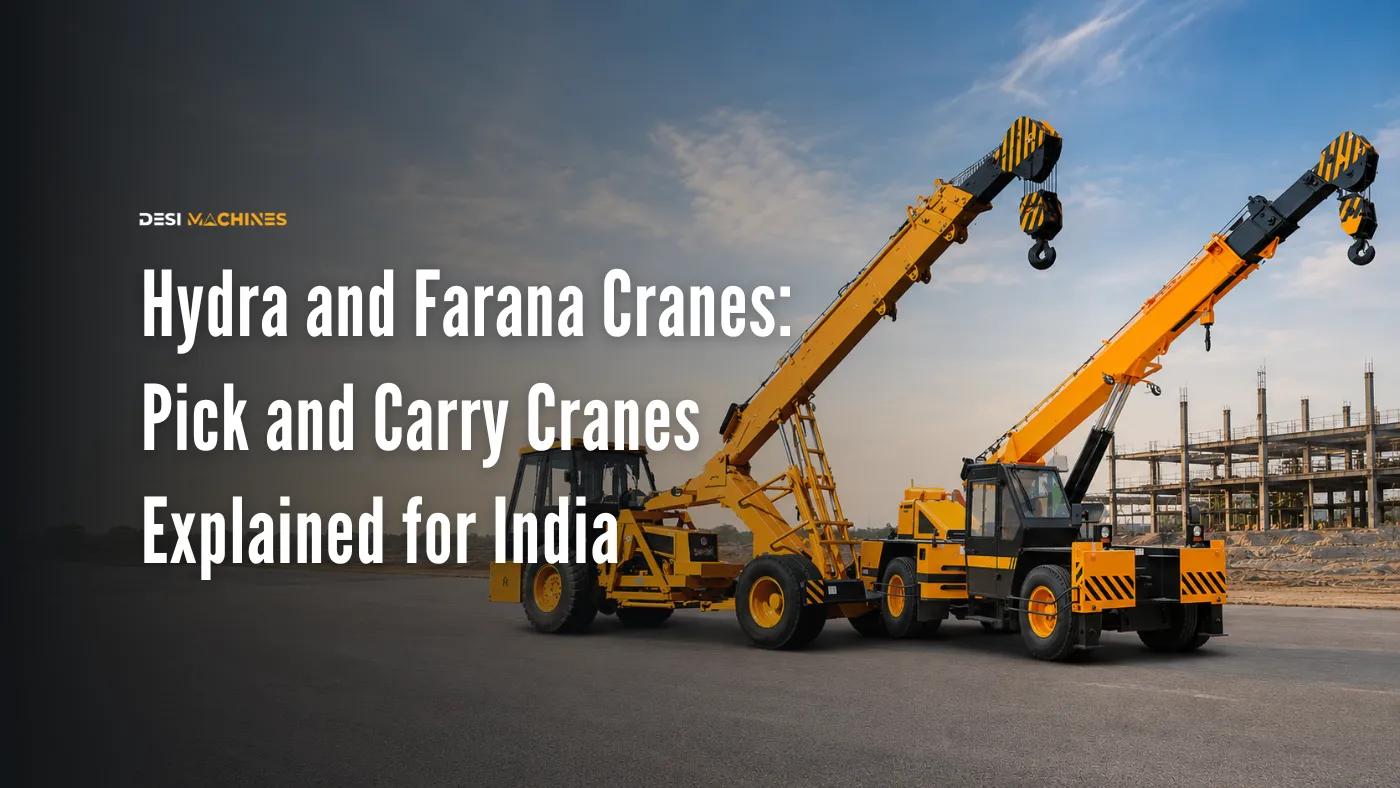
A pick and carry crane is a small wheeled crane that picks up a load, carries it across the site on its own tyres and sets it down — no outriggers, no assembly. On Indian sites the class goes by two names. Hydra is really a brand name, from the machines Escorts sold in India, and the word stuck to the whole class the same way JCB stuck to backhoe loaders. A Farana is what most sites call the articulated version, a name worn down from Terex Franna: it bends in the middle instead of steering with its front wheels, so it turns tighter and handles rough ground better.
Between them, hydra and farana cranes do most of the day-to-day lifting in India — precast segments, transformers, pipes, steel sections, machinery into a shed. They cost a fraction of a mobile crane, need no assembly and drive themselves between jobs. This guide explains the machine class itself — what each name actually means, what the machines lift, what they cost today, and the safety rules that matter most on Indian sites. If you are choosing between the two types by brand, model and current price, our Hydra vs Farana comparison settles that question.
What is a Hydra crane?
A Hydra crane is a rigid-chassis pick and carry crane on rubber tyres, usually rated between 9 and 17 tonnes, with a telescopic boom mounted behind the driver’s cab. The operator sits in one seat, drives the machine to the load, lifts it, drives it to the spot and lowers it. Nothing is assembled and no outriggers are set for a routine lift, which is exactly why sites reach for it.
The name comes from Escorts, whose Hydra models were the first pick and carry cranes many Indian contractors ever hired. Today several makers sell machines of the same shape, so on any site you will hear a 14-tonne machine from ACE called a Hydra as readily as an Escorts Hydra 14. Treat the word as the class, not the brand, when you are asking for a quote.
What defines the class in practice:
- It travels with the load. That single ability is the whole point, and it is also where the safety rules bite hardest. Note that every published hydra crane road speed is an unloaded figure, so it never applies while carrying.
- It works on tyres, not tracks or a fixed base, so ground condition decides what it can safely lift.
- One person operates and drives it, which keeps hire rates low compared with a crane that needs a crew.
- The boom is short. These are lifting-and-carrying machines, not high-reach machines. Height needs a different crane.
What is a Farana crane, and how is it different from a Hydra?
A Farana is an articulated pick and carry crane: the front and rear halves of the chassis are joined by a pivot, so the machine steers by bending in the middle. The name is the Indian pronunciation of Franna, the Australian-designed machine Terex sells here, and like Hydra it has become a generic word on site.
The practical differences a buyer feels:
- Turning. An articulated machine swings its rear end around a tighter circle, which matters in a congested yard or between building lines.
- Ground. Farana-type machines are usually four-wheel drive and cope with soft or broken ground that stops a rigid two-wheel-drive Hydra.
- Capacity. The articulated machines generally sit higher up the range, from about 20 tonnes to 35 tonnes, so they cover lifts a 14-tonne machine cannot take.
- Price. They cost roughly twice what a small rigid machine costs, which is the trade-off for the first three points.
If your work is repetitive lifting in a settled yard on firm ground, the rigid machine is usually enough. If the load has to be carried over unmade ground, or the lift is above 20 tonnes, the articulated machine earns its extra cost. Both sit inside the wider family covered in our guide to types of cranes.
How much can a pick and carry crane lift?
Pick and carry cranes sold in India are rated from about 9 tonnes up to 35 tonnes, and the rated figure is the maximum at the shortest boom and the best working position — never the figure you get when the boom is out and the machine is moving. The table below lists machines currently on DesiMachines with their rated capacity, engine power and indicative price. Engine size is a poor guide to lifting capacity on these machines, as the hydra crane engine power guide shows: a 10 tonne crane on our list carries 102 HP while a 25 tonne one carries 74 HP.
| Model | Rated capacity | Engine power | Indicative price (Jul 2026) |
|---|---|---|---|
| ACE 12XW | 12 Tonnes (12,000 kg) | 47.5 HP (34.9 kW) | ₹16–18 Lakh |
| Escorts HYDRA 14 | 14 Tonnes (14,000 kg) | 50 HP (37 kW) | ₹20.5 Lakh onwards |
| ACE 14XW | 14 Tonnes (14,000 kg) | 48 HP (36 kW) | ₹18–20 Lakh |
| ACE HXP 150 | 15 Tonnes (15,000 kg) | 48 HP (36 kW) | ₹26–28 Lakh |
| ACE 20XW | 20 Tonnes (20,000 kg) | 74 HP (54 kW) | ₹28–30 Lakh |
| ACE NX 360 20T | 20 Tonnes (20,000 kg) | 101 HP (74 kW) | ₹40–42 Lakh |
| Terex Franna FR20 | 20 Tonnes (20,000 kg) | 101 HP (74 kW) | ₹45–50 Lakh |
| Escorts F23 | 23 Tonnes (23,000 kg) | 101 HP (74 kW) | ₹45–47 Lakh |
| Indo Power 30FNX | 30 Tonnes (30,000 kg) | 137 HP (102 kW) | ₹58–60 Lakh |
| ACE F350 | 35 Tonnes (35,000 kg) | 130 HP (95 kW) | ₹62–66 Lakh |
All figures indicative, as of July 2026, and taken from our listings at the time of writing.
Size the machine on the heaviest lift you actually do, at the radius you do it at. A 14-tonne rating with the boom extended over the side may leave you four or five tonnes of usable capacity, and that number comes off the machine’s load chart rather than off the badge. Reading one is a skill worth an hour of your time: our guide to crane load charts works through an example line by line.
The table above is not exhaustive: in the 17-tonne class the ACE F170 and Escorts F17 are two more common picks, the 20-tonne ACE F210 sits alongside the ACE 20XW above, and the 25-tonne ACE FX 250 fills the gap between the 23 and 30 tonne rows.
What does a Hydra or Farana crane cost in India?
A new pick and carry crane runs from about ₹12–14 Lakh for the 9 Tonne (9,000 kg) ACE Rhino 90C, the cheapest machine in the class, up to ₹62–66 Lakh for the 35 Tonne (35,000 kg) ACE F350 at the top (indicative, as of August 2026), with the bulk of the market between 14 and 20 tonnes. The price ladder follows capacity and drive layout more than it follows brand.
Three costs sit behind the sticker price and decide what the machine really costs you:
- Tyres. A pick and carry crane runs on its tyres all day under load, and a full set is a serious bill. Ask what the machine is fitted with and what a replacement costs before you buy.
- Operator. One trained operator runs the machine, and a trained one is cheaper over a year than an untrained one, because most damage on these machines comes from bad practice rather than bad parts.
- Utilisation. These machines earn by the hour and sit idle between jobs. Work out the hours you can genuinely fill before you decide between buying and hiring.
- The second-hand alternative. A well-kept used machine does the same work for less, provided the boom and rope check out; the used hydra crane buying guide covers what to inspect and what to pay.
If the machine is bought on finance, put the EMI next to those three numbers rather than beside the purchase price alone; the equipment finance and EMI options page sets out what lenders currently offer against construction equipment. For the hire-versus-buy arithmetic across crane types, see our crane buying and rental guide.
Comparing machines? See the current range of pick and carry cranes with capacities, prices and dealer contacts.
Where are pick and carry cranes used in India?
They are used wherever a load has to move a short distance and no fixed crane is worth setting up. That covers most Indian construction and industrial work below 20 tonnes.
The regular jobs are precast and pipe handling on road and water projects, unloading trucks at a yard gate, setting transformers and poles for the electricity board, moving steel sections around a fabrication shop, lifting machinery into position inside a factory, and general erection work on smaller building sites. In mining and quarrying they shift pumps, conveyor sections and spares around a working area that no truck-mounted crane could reach.
What they should not be used for is height. The boom on these machines is short, and a lift that needs to go up rather than across belongs to a truck-mounted crane or a mobile crane. Trying to make a pick and carry crane do a tall lift is where sites get into trouble.
What are the safety rules for a Hydra or Farana crane?
The rule that matters most: a pick and carry crane lifts far less while it is moving than it does standing still. Manufacturers publish a separate, much lower rating for travelling with a load, and ignoring that line is behind a large share of the tip-overs on Indian sites.
The habits that keep the machine upright:
- Read the load chart for the actual radius and boom length, not the badge on the side. Then take the travelling figure if the machine will move.
- Keep the load low while carrying. A load held high moves the machine’s centre of gravity to exactly the wrong place.
- Check the ground first. Soft fill, a covered trench or a fresh backfill will let one wheel sink, and the machine goes over sideways before the operator can react.
- Travel slowly and turn slowly. Most tip-overs happen during a turn, not during the lift.
- Watch tyre pressure. On a machine that lifts through its tyres, a soft tyre changes the geometry of every lift.
- Never carry people or use the hook as a work platform.
Give the machine the same daily walk-round any working machine gets: hydraulic hoses and cylinders for leaks, the hook and its safety catch, the wire rope for broken strands, the boom for cracks around the pivot, and every warning device for function. Ask the dealer for the operator’s manual in a language your operator reads, and keep the load chart in the cab where it can actually be consulted.
Hydra, Farana or a different crane: which should you choose?
Pick the machine by the shape of the work rather than by the price. Four situations cover most decisions.
- Repeated short lifts on firm ground, up to about 15 tonnes. A rigid pick and carry crane in the 12 to 15 tonne class is the cheapest way to do this work, and it is what most contractors buy first.
- Loads carried over rough or soft ground, or lifts of 20 tonnes and above. The articulated four-wheel-drive machines are built for it, and the extra cost buys ground clearance and traction you cannot add later.
- Height rather than distance. Neither machine is the answer. Go to a truck-mounted or mobile crane with the boom length the job needs.
- Occasional lifting, a few days a month. Hire. These machines only pay for themselves at reasonably steady utilisation, and hire rates in most Indian cities are competitive because so many machines are available.
Whichever way you go, buy the capacity you need at your working radius, not the biggest number your budget allows. An oversized machine costs more to buy, more to run and more in tyres, and it still cannot make a lift its load chart forbids.
Ready to compare? Browse pick and carry crane models and prices, or start with the wider complete guide to cranes if you are still deciding on the type.
Running one of these machines? The hydra crane fuel tank and oil capacities guide lists diesel, hydraulic oil and engine oil volumes model by model.
Prices, specifications and features are indicative, vary by variant, location and date, and should always be confirmed with the official OEM or authorised dealer before any purchase decision. DesiMachines is not liable for decisions taken on the basis of information that may have changed after publication.
Because these machines travel with the load suspended, they carry more of India’s tipping incidents than any other class. The crane safety rules and operator training requirements set out the checks that prevent most of them.
If you want to know what is actually inside the machine, our guide to Hydra and Farana crane parts names every component from the telescopic boom to the winch, and explains what each one does.
Before you book a machine, check that it physically fits the job: our guide to Hydra crane boom height and turning radius sets out reach, turning circle and width across all 67 pick and carry cranes listed.