
 Excavator
294 models
Excavator
294 models  Backhoe Loader
51 models
Backhoe Loader
51 models  Crane
68 models
Crane
68 models  Concrete Mixer
79 models
Concrete Mixer
79 models  Wheel Loader
54 models
Wheel Loader
54 models  Compactor / Roller
45 models
Compactor / Roller
45 models  Motor Grader
42 models
Motor Grader
42 models  Concrete Pump
66 models
Concrete Pump
66 models  Skid Steer Loader
11 models
Skid Steer Loader
11 models  Telehandler
13 models
Telehandler
13 models  Dozer
Dozer 


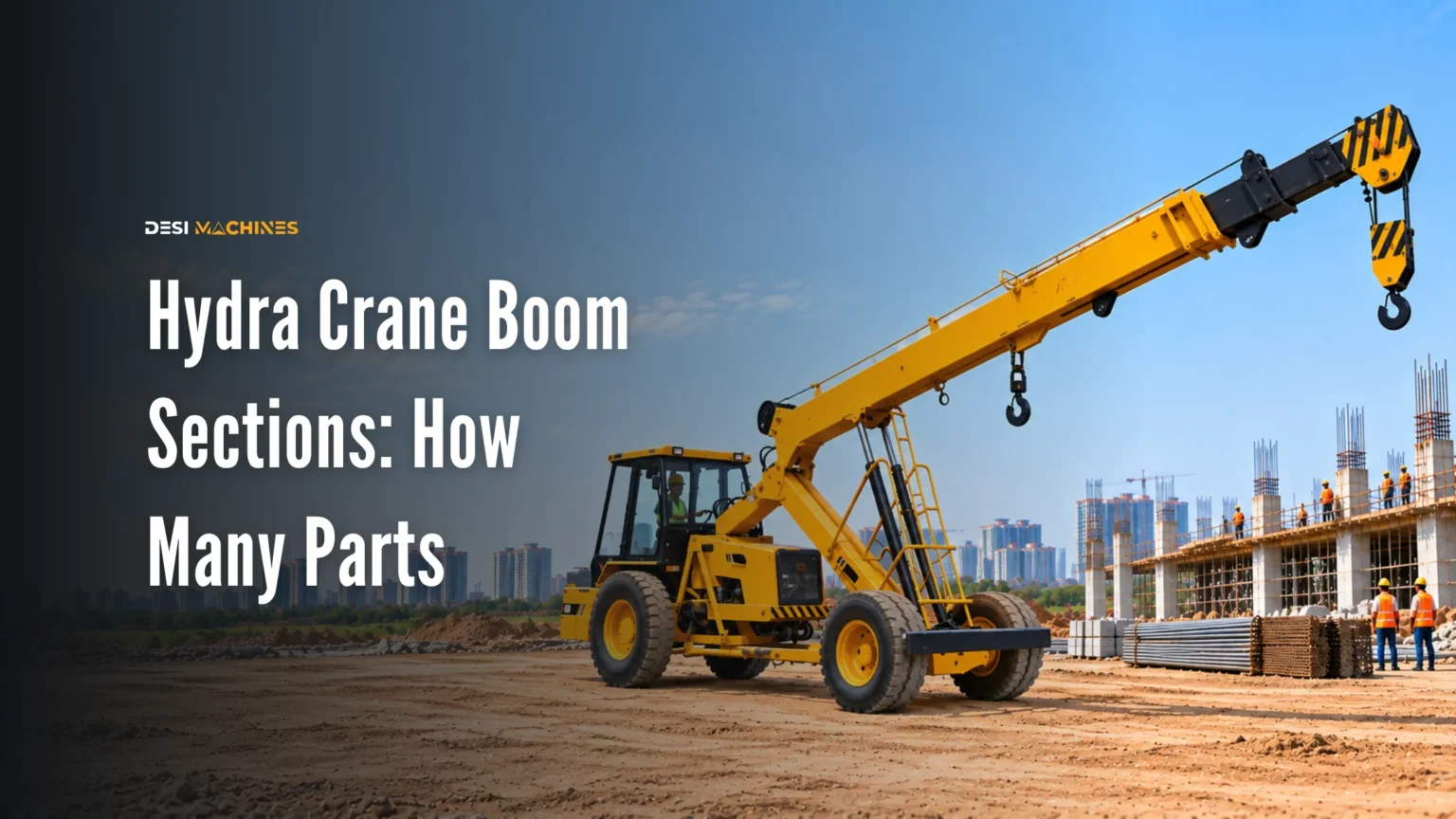
Pick and carry cranes sold in India are built with booms of two, three, four or five sections, and four is the common answer: of the 68 Hydra models listed on DesiMachines, 42 use a four-part boom, 19 use three, five use two and two use five, as per the current Sep 2026 specifications. The section count on its own tells you very little. What decides how the crane behaves on your site is which of those sections the hydraulics actually drive, and which one the operator has to climb up and pin by hand before the lift.
Some words first, because Indian spec sheets use them loosely. The boom is the long arm that does the lifting. Telescoping means the boom slides out in sections, one tube inside the next, like a folding umbrella. A section and a part mean the same thing here, so “4 part boom” and “4 section boom” are the same machine.
This guide reads the published boom specification of all 68 pick and carry cranes listed and answers what buyers ask at the dealership about Hydra crane boom sections: how many there are, whether a bigger crane gets more of them, and what actually happens at the top section. For how high the boom reaches, see the separate Hydra crane boom height guide. Reach and construction are two different questions, and this page deliberately does not repeat the first.
How many sections does a Hydra crane boom have?
Between two and five, with four covering just over 60 per cent of the machines listed. Every one of the 68 pick and carry cranes publishes a boom telescoping specification, which makes this one of the few figures you can compare across every brand without gaps.
| Boom sections | Models listed | Share | Examples |
|---|---|---|---|
| 2 part | 5 | 7% | ACE Rhino 90C, ACE 12XW, ACE HY130 |
| 3 part | 19 | 28% | ACE FX 150, TIL PIXEF 215, Escorts HYDRA 13 |
| 4 part | 42 | 62% | ACE F150, Escorts HYDRA 15, Indo Power 15FN |
| 5 part | 2 | 3% | Indo Power 30FNX, Indo Power 25T |
Section counts taken from the published boom telescoping specification of 68 pick and carry cranes, Sep 2026.
More sections buy you a longer boom out of a shorter folded length, because each tube nests inside the last. That is the whole trade. A two-part boom on the Rhino 90C stops at 9.0 m (29.5 ft), while the five-part Indo Power 30FNX reaches 24.31 m (79.8 ft) from a machine you can still drive down a village road. Against that, every extra joint is one more set of wear pads, one more place for play to develop, and a little more sag at the tip when the boom is out.
Does a bigger Hydra crane have more boom sections?
No, and this is where most buying mistakes start. Tonnage and section count are close to unrelated on the machines listed. You can buy a 15 tonne crane with a four-part boom and a 30 tonne crane with a three-part boom, and both are right for what their makers designed them to do.
| Lifting capacity class | 2 part | 3 part | 4 part | 5 part | Models |
|---|---|---|---|---|---|
| 9–12 Tonne | 3 | 2 | 0 | 0 | 5 |
| 13–15 Tonne | 1 | 8 | 17 | 0 | 26 |
| 16–20 Tonne | 0 | 5 | 13 | 0 | 18 |
| 21–25 Tonne | 1 | 3 | 6 | 1 | 11 |
| 27–35 Tonne | 0 | 1 | 2 | 1 | 4 |
Covers the 64 machines that publish a lifting capacity; four Escorts variants do not publish one and are left out of the class table.
Read across the rows, not down the columns. The 13–15 tonne class alone contains two-part, three-part and four-part booms. The 21–25 tonne class contains all four builds.
The clearest example sits inside one model name. The Indo Power 25T is offered with a five-part boom reaching 22.93 m (75.2 ft) or a four-part boom reaching 19.36 m (63.5 ft). Its stablemate the Indo Power 25T Mining Master lifts the same 25 tonnes on a two-part boom that stops at 10.53 m (34.5 ft). Same brand, same rated capacity, three different booms, because a mining crane wants a short stiff boom close to the machine and a yard crane wants reach.
So do not order by tonnage and assume the reach follows. Decide the lift first, then check the boom against the crane load chart, which is the only document that tells you what the machine can pick at a given radius and boom length.
Which boom sections are hydraulic, and which one do you pin by hand?
On most Hydra cranes the hydraulics drive all but the last section, and that last one is pushed out and then locked in place with a steel pin by hand. Thirty-seven of the 68 machines listed describe the top section exactly that way, usually in the words “power extended and manually pinned for safety”.
| How the outer section moves | Models | What it means on site |
|---|---|---|
| Power extended, then pinned by hand | 37 | The top section is set and pinned before the lift. Changing it mid-job means bringing the boom down again. |
| Fully powered, no pin stated | 25 | All sections move on the hydraulics from the cab. Quicker between lifts at different reach. |
| Rope or rope-assisted outer sections | 6 | A wire rope carries the outer section out and back. Adds rope inspection to the maintenance round. |
Classified from the published boom telescoping text of all 68 machines, Sep 2026; each machine counted once, by the mechanism stated for its outer sections.
This matters more than the section count, and almost nobody checks it before signing. If your work is one long lift a day, a pinned top section costs you nothing. If you are lifting at five different radii across a shift, every change means lowering the boom, retracting, pinning and raising again, and that is real time off the clock.
The six rope-actuated machines are all Indo Power or Escorts models. The Escorts TRX 1550, for one, publishes a slotted boom with rope compensation alongside its pinned fourth part. Rope is not a weakness — it is a lighter way to move an outer section — but wire rope wears, and it belongs on your inspection round. The Hydra and Farana crane parts guide covers what sits inside the boom and what wears.
What does a fully synchronised boom mean?
Synchronised means the powered sections extend together at the same rate rather than one after the other. Watch an unsynchronised boom and you see the second section run out fully, then the third start moving. A synchronised boom opens evenly along its whole length.
The benefit is a load that stays on a path you can predict. With sections coming out in sequence the hook drifts and the radius changes in steps, and on a tight site that is how a load meets a wall. Most of the four-part machines listed state that three parts are “hydraulically powered and fully synchronised” with the fourth pinned. That is the standard Indian build.
Two terms turn up beside it. A slotted boom has the tubes shaped so they carry load across a larger contact area, which several ACE and Escorts models publish. A fly jib is a short extra arm pinned onto the boom nose for extra height — the Escorts F23 2WD publishes 22 m (72.2 ft) with the fly jib fitted. A jib is not a boom section and is never counted as one, so a spec sheet quoting height “with fly jib” is not telling you the boom is longer.
How is a Hydra crane boom raised and lowered?
By one or two hydraulic cylinders under the boom, a movement the spec sheet calls derricking or luffing. Telescoping changes the boom’s length; derricking changes its angle. Separate controls, separate cylinders, and buyers mix the two up constantly.
Fifty-six of the 68 machines publish how derricking is done. Twenty-one use a single double-acting cylinder, twenty-seven use two, and the eight Escorts machines describe theirs as double acting jacks. A double-acting cylinder is one that oil pushes in both directions, instead of relying on the boom’s own weight to bring it down, and that is what gives you controlled lowering under load. Three of the ACE machines add a counterbalance safety valve, which holds the boom up if a hose lets go.
Forty-three machines publish a luffing range, the span of angles the boom can work through. The lowest the boom drops below horizontal is -10°, on several Escorts F and TRX models, and that is worth having when you are placing a load down a slope or into a foundation pit. The steepest top angle is +75°, on the ACE NXP 150, FX 150 and HXP 150. A steeper angle brings the hook closer in and higher up, which is what you want when you are working against a wall.
How long does a Hydra boom take to extend?
Where it is published, telescoping takes between six and twenty-one seconds, and raising the boom takes around eighteen to twenty-five. Only the ACE and Indo Power ranges publish these timings, so read them as a sample and not as a class average.
The ACE XW range states 18 seconds to telescope on the 16XW, 18XW, 20XW and 25XW, and 14 seconds on the 14XW and 15XW. The two-part ACE Rhino 90C moves its single powered section through an 1,800 mm (1.8 m) stroke in 10 seconds. The ACE SX 150 splits the figure honestly, publishing 6 to 9 seconds to telescope in against 13 to 16 seconds to telescope out, because retracting with gravity helping is always quicker than pushing out against it.
For boom raising, the Indo Power range publishes 18 to 20 seconds up to 20 tonnes and 22 to 25 seconds on the 25 tonne machines. Small numbers on paper. Multiply them by forty lifts a shift and the gap between a fast boom and a slow one is most of an hour.
What to check on the boom before you buy or hire
Ask for the boom telescoping line of the specification in writing, not just the tonnage. It gives you the section count and the actuation in one sentence, and it is the line dealers quote least often.
On the machine itself, extend the boom fully and walk its length. Look for scoring on the tube faces, which points to worn wear pads. With the boom out and level, watch for sag at the tip beyond what the operator calls normal, and watch whether it creeps down on its own over a minute, which points at the derricking cylinder or its holding valve. Check the pin and the pin holes on the top section for elongation — an oval hole means that section has been worked loose. If the machine has rope-actuated sections, run the rope through your hands and feel for broken wires.
On a used machine all of this matters more, because the boom is the single most expensive thing on a Hydra to put right. The used Hydra crane buying guide covers hours, papers and what else to look at, and the crane safety and training guide covers who is allowed to operate one and what site rules require.
One last thing that is not on any spec sheet. A pinned top section is only safe when it is actually pinned, and the commonest bad habit on Indian sites is working with that section part-extended and unpinned because it saved five minutes. Do not accept it on your own machine, and do not let it pass on a hire.
Browse Hydra and pick and carry cranes from every brand we list →
Read next
If you are still choosing a machine class, start with the Hydra and Farana crane guide, then read boom height and turning radius for how much reach and room each model needs. The operating weight guide and the engine power guide finish the spec picture by tonnage class.
Outside India this machine class is known as the pick and carry crane, and in Australia as the Franna. In India the names dealers and operators use are Hydra and Farana, and those are the machines listed here.
Specifications quoted on this page are taken from our listings at the time of writing (Sep 2026) and cover the 68 pick and carry cranes listed. No boom price is quoted here because a boom is not sold as a separate line item; ask your dealer to quote the boom build against the model. Prices, specifications and features are indicative, vary by variant, location and date, and should always be confirmed with the official OEM or authorised dealer before any purchase decision. DesiMachines is not liable for decisions taken on the basis of information that may have changed after publication.