
 Excavator
294 models
Excavator
294 models  Backhoe Loader
51 models
Backhoe Loader
51 models  Crane
68 models
Crane
68 models  Concrete Mixer
79 models
Concrete Mixer
79 models  Wheel Loader
54 models
Wheel Loader
54 models  Compactor / Roller
45 models
Compactor / Roller
45 models  Motor Grader
42 models
Motor Grader
42 models  Dozer
41 models
Dozer
41 models  Concrete Pump
66 models
Concrete Pump
66 models  Skid Steer Loader
11 models
Skid Steer Loader
11 models  Telehandler
13 models
Telehandler
13 models 


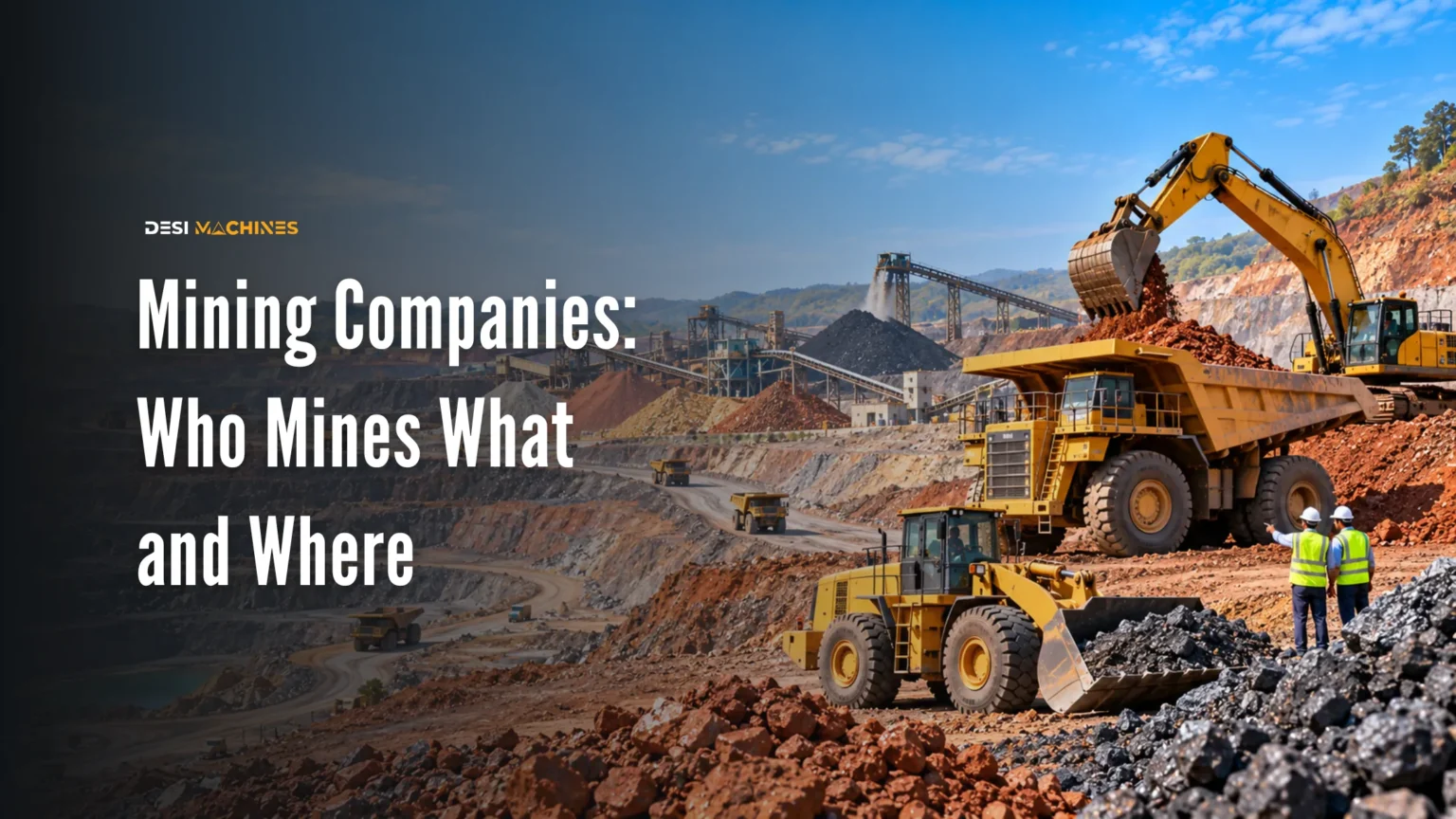
Mining companies in India fall into three groups. State-owned producers dig most of the coal and iron ore. Private companies mine to feed their own factories. And contract miners, called mine developers and operators, run somebody else’s mine for a fee.
The state-owned side is still much the biggest. Coal India produced 768.14 million tonnes of coal in 2025-26, against 781.06 million tonnes a year earlier, a fall of 1.65%. The growth is somewhere else. Captive and commercial mines lifted output 8.72% to 214.69 million tonnes over the same year. That shift is the part worth understanding if you own or hire out machines, because those blocks are largely worked by contractors and by the fleets they take on hire.
Who counts as a mining company in India?
Three different kinds of business get called a mining company, and they behave very differently as customers. Sorting the mining companies in India this way is more useful than ranking them by size, because it tells you which ones buy and hire machines.
A producer owns the mine and sells the mineral. Coal India and NMDC are producers, and so is Singareni Collieries. A captive miner owns a mine whose output goes into its own plant rather than to the open market, so a steel company digging its own iron ore is mining captively. A mine developer and operator, almost always shortened to MDO, owns nothing. It signs a long contract to build and run a mine for whoever holds the block, and gets paid per tonne raised.
The machines sit mostly with the second and third groups, and with the sub-contractors under them. That is why a fleet owner looking for work should read past the famous names.
A word you will meet constantly in tender papers is HEMM, meaning heavy earthmoving machinery. It is the buyer’s term for the excavators, dozers, loaders, graders and tippers a mine runs.
How this list was built. It covers companies that own or operate mines in India and that either appear in the Ministry of Coal’s official production returns or describe the work on their own websites, as of October 2026. Within each group the names are alphabetical, not a ranking. Production figures appear only where an official document or the company’s own published material carries them; where no such figure was reachable, the company is still listed with what it does, and no number is given.
Which companies produce the most coal in India?
Coal India is the largest producer by a wide margin, and it works through eight subsidiaries that are themselves large mining companies. Mahanadi Coalfields alone raised 218.31 million tonnes in 2025-26, more than South Eastern Coalfields and more than every captive miner in the country put together bar none.
The table below is coal production for the year to March 2026, with the previous year beside it. Figures are provisional and come from the Ministry of Coal’s monthly coal statistics for March 2026.
| Producer | 2025-26 (million tonnes) | 2024-25 (million tonnes) | Change |
|---|---|---|---|
| Mahanadi Coalfields (MCL) | 218.31 | 225.17 | down 3.05% |
| South Eastern Coalfields (SECL) | 176.29 | 167.49 | up 5.25% |
| Northern Coalfields (NCL) | 140.50 | 139.00 | up 1.08% |
| Central Coalfields (CCL) | 82.21 | 87.54 | down 6.09% |
| Western Coalfields (WCL) | 63.03 | 69.12 | down 8.81% |
| Eastern Coalfields (ECL) | 52.09 | 52.03 | up 0.10% |
| Bharat Coking Coal (BCCL) | 35.52 | 40.50 | down 12.30% |
| North Eastern Coalfields (NEC) | 0.20 | 0.20 | level |
| Coal India, all subsidiaries | 768.14 | 781.06 | down 1.65% |
| Singareni Collieries (SCCL) | 58.00 | 69.01 | down 15.94% |
| Captive and commercial mines | 214.69 | 197.46 | up 8.72% |
| All India | 1,040.83 | 1,047.52 | down 0.64% |
Two things in that table are worth a second look. Singareni Collieries, a government company that works the Godavari valley coalfields from its head office at Hyderabad, dropped nearly 16% in a single year. And the captive and commercial line, at 214.69 million tonnes, is now bigger than any one Coal India subsidiary. Read the full official sheet in the Ministry of Coal monthly coal statistics for March 2026. Subsidiary figures are provisional and may not add exactly to the group total because each is rounded.
Which companies mine iron ore and other minerals?
NMDC is India’s largest iron ore producer. It raised 53.15 million tonnes in 2025-26, a rise of about 21%, and sold 50.23 million tonnes, which made it the first company in the country’s mining history to pass 50 million tonnes in a year. Its biggest mines are Kirandul and Bacheli in Chhattisgarh and Donimalai in Karnataka. In the same year it commissioned Deposit 4 at Bailadila in Chhattisgarh and started its first coal mine, in Jharkhand. Those figures are from a Ministry of Steel announcement dated 2 April 2026.
Away from coal and iron ore, the pattern is a few large specialists. Hindustan Zinc states on its own website that it is the world’s largest integrated zinc producer and India’s largest lead producer, and that it also produces silver; it names its mines as Rampura Agucha, Rajpura Dariba, Sindesar Khurd, Zawar and Kayad, with smelters at Chanderiya, Debari, Dariba and Pantnagar. Hindalco and National Aluminium work bauxite for their own aluminium smelters. Odisha Mining Corporation is owned by its state government and works iron ore, chrome and bauxite.
Steel companies are the big captive miners. Tata Steel, JSW Steel and the Steel Authority of India each hold iron ore and in some cases coal blocks whose entire output goes to their own plants. No tonnage is published here for them, because their own figures were not reachable when this page was written. What matters for a machine owner is the shape of the work: a captive mine runs to a plant’s appetite, so it runs steadily, and it buys and hires on long contracts.
If you want the machine-side view of all this rather than the corporate one, the guide to mining equipment in India sets out the classes and sizes, and types of mines in India explains how open cast, underground and quarry work differ.
Who are the mine developers and operators (MDOs)?
An MDO is a contractor that takes a mine from paperwork to production and then runs it, usually for 20 to 30 years, for the company or state utility that holds the block. The block owner keeps the coal. The MDO brings the capital, the machines and the people, and is paid for each tonne it raises.
Thriveni Sainik Mining is a clear worked example, and it publishes its own details. It is a joint venture in which Thriveni Earthmovers holds 51% and Sainik Mining the remaining 49%. It was awarded the Pakri Barwadih coal block in Jharkhand as MDO for NTPC, the contract coming through between September and November 2015, running 27 years, with a stated goal of reaching a peak of 15 million tonnes of coal a year.
Several other firms work this way, among them Adani Enterprises, Essel Mining, Sainik Mining, BGR Mining and a number of civil contractors that moved into mining from road and earthwork packages. They are named here without figures, because the production numbers published about them sit in trade press rather than in their own filings or an official return.
For a fleet owner the MDO model is the most useful thing on this page. An MDO’s whole business is moving overburden and coal to a monthly target, it rarely owns every machine it needs, and it sub-contracts heavily. That makes it a likelier customer for a hired excavator or tipper than the block owner whose name is on the mine.
Why this is growing is visible in the official figures. While Coal India slipped 1.65%, captive and commercial mines rose 8.72%. Most of that coal is burnt for electricity. The table below is what those mines actually dispatched in 2025-26, by the industry that took the coal, from the same Ministry of Coal March 2026 statistics.
| Who took the coal | Dispatched 2025-26 (million tonnes) | Share |
|---|---|---|
| Power stations | 161.53 | 76% |
| Captive power plants | 22.37 | 11% |
| Steel | 12.22 | 6% |
| Cement | 2.57 | 1% |
| Sponge iron | 2.04 | 1% |
| Other users | 11.83 | 6% |
| All captive and commercial mines | 212.55 | 100% |
Dispatch is slightly below production because some coal stays at the pithead. Shares are rounded, so they do not add to exactly 100.
Who actually hires the machine
Reading that chain left to right is the point. The block owner’s name is the one in the news, the MDO is the one with a tonnage target every month, and the sub-contractor two steps down is usually the one who actually rings a machine owner.
Which machines do mining companies run?
A surface mine runs a small set of machine classes very hard, and the sizes are a step above construction work. The biggest difference is the excavator: site work tops out well below the classes a mine uses.
The mining-class excavators above 50 tonnes (50,000 kg) are the loading tools, and they work in a pair with rigid dumpers and tippers, which a mine buys through its own truck channel. Ahead of them, mining dozers push overburden and keep benches clean. Wheel loaders handle stock and rehandling, and motor graders keep the haul roads fast, which is where a mine quietly loses or saves its fuel bill.
Dumpers, tippers and haul trucks are named on this page but not listed, and no price is given for them.
The mining machinery page brings the current models, open tenders and recent news for these classes together in one place.
How do you get on a mining company’s vendor list?
There is no single register. Each buyer publishes its own requirements, and the route differs by who owns the block.
State-owned producers and utilities buy through e-procurement portals and publish hire and work packages as tenders, so the practical method is to watch the portals for the coalfield you can reach and bid the small packages first. Private captive miners and MDOs run their own empanelment, which usually means registering as a vendor, then being assessed on machine age, maintenance records, operator strength and your ability to hold a monthly output commitment.
Two things decide most of these assessments, and neither is the machine. One is documentation: insurance, fitness, operator certificates and a clean service history. The other is whether you can survive the payment cycle, which on mining contracts runs long. The piece on how EPC contractors actually hire your machine goes through vendor-list mechanics in detail, and it applies closely here.
Live packages from the government mining and earthwork desks are collected under opportunities. If the gap is working capital or cover rather than work, the finance options and hiring a machine in or out are the two levers most owners use to take on a mining contract they could not otherwise fund.
Where is the mining work, state by state?
Mining follows the mineral, so the work sits in belts. Coal India’s own royalty returns for 2025-26 show it paying in eight states, which is a fair map of where the coal work is: Chhattisgarh, Jharkhand, Madhya Pradesh, Odisha, Maharashtra, Uttar Pradesh, West Bengal and Assam. Singareni’s field adds Telangana.
Iron ore puts NMDC’s mines in Chhattisgarh and Karnataka, with captive steel mines in Odisha and Jharkhand, and older iron ore and manganese country in Goa. Hindustan Zinc’s mines and smelters sit in Rajasthan, and lignite work runs in Tamil Nadu.
The belt matters more than the company name. That is where the contracts are let, where hire demand is steady, and where a used machine finds a buyer. Each state page lists the machines, dealers and open tenders for that state.
What this means if you own or hire out machines
Chase the operator, not the owner. The name on a coal block is often a power utility or a steel company that will never hire your excavator, while the MDO and its sub-contractors are buying and hiring every season to hold a tonnage target.
Go where the growth is. Captive and commercial blocks grew while Coal India’s own output fell, and those are the blocks run on contract.
Finally, get the paperwork ahead of the bid. Most owners lose mining work on documents and payment capacity, not on the machine. Before you commit a machine, read what a quarry lease and the royalty on minerals actually require of an operator, because those obligations land on whoever is working the pit.
Production figures on this page are provisional and taken from the Ministry of Coal and Ministry of Steel releases named above, for the year to March 2026. Company facts are taken from each company’s own published material at the time of writing. Specifications and features are indicative, vary by variant, location and date, and should always be confirmed with the official OEM or authorised dealer before any purchase decision. DesiMachines is not liable for decisions taken on the basis of information that may have changed after publication.
Machines, tenders and news for this industry: Quarry
