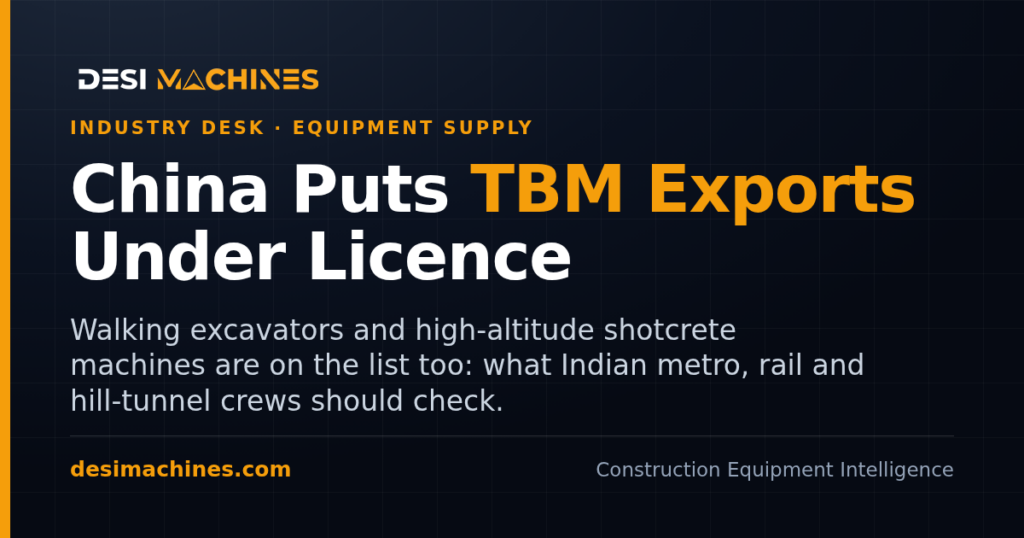
China will require export licences for tunnel boring machines from 18 November 2026, and the list goes past TBMs to walking excavators and wet shotcrete machines built for high-altitude work. For Indian tunnel contractors using Chinese-built plant, the risk now is whether a machine, or a spare part for one, ships on time.
The quick facts
- China’s Ministry of Commerce and its customs administration announced the controls on Monday, 19 October 2026. They take effect on 18 November.
- Covered: shield TBMs and rock TBMs, their key components and related technology, walking excavators built for difficult terrain, and wet shotcrete machines meant for high-altitude sites.
- Dredger slurry pumps, dragheads and cutterheads above set technical limits are also covered.
- Exporters must apply for a licence under China’s dual-use export rules, and customs will hold shipments while it checks declarations.
What China announced
The commerce ministry issued the decision jointly with the customs administration and described the items as dual-use (military as well as civilian), according to the Xinhua report carried by CGTN. A ministry spokesperson said applications that meet the requirements will be approved. PTI’s Beijing report, carried by The Economic Times, adds that machines resembling listed items must be backed by technical data, and that shipments stay held during verification. Singapore’s Lianhe Zaobao and Reuters, through Business Today, carried the same scope and start date. None of the texts we read names India or any other destination.
Which Indian jobs feel this first?
TBMs are the obvious exposure. Underground metro lines, high-speed rail tunnels and border-area tunnels all depend on them, and Business Today notes India still relies heavily on imported machines for underground work. Beijing has held up TBMs bound for India before: PTI recalls that Commerce Minister Piyush Goyal told Germany’s vice chancellor in 2024 that a German company making TBMs in China was not being allowed to ship them here. A licence system swaps a political hold for a paperwork one: easier to plan around, slower by design.
The less obvious exposure is parts. The control covers key components, not just complete machines. A Chinese-built TBM already working under an Indian city still needs drive and wear parts, and if those come from the Chinese plant they now need a licence too. Our take: contractors running Chinese-built TBMs should check this week which parts come from China and how much stock is already in India before 18 November. We expect the first delays to show up in spares, not in new machine orders.
Walking excavators and high-altitude shotcrete machines matter to a smaller group: border-road and hill-tunnel crews working slopes that tracked machines cannot reach. Ordinary crawler and wheeled excavators do not appear in any description of the list we read. The curbs also raise the stakes for the Make in India push in construction equipment, since TBMs remain one of the machine classes India mostly imports.
The surface plant around a tunnel is mostly local: cranes lowering segments into the shaft, excavators digging it, tippers hauling muck. None of it is controlled, but a late TBM leaves that fleet idle. On metro and rail tunnel jobs with a TBM still to come from China, hire that fleet rather than buy against a launch date that may slip.
What to watch
- Whether licences for India-bound TBMs and TBM parts are granted in the weeks after 18 November.
- Whether Indian metro and rail clients relax TBM delivery deadlines in contracts now being awarded.
- Any non-Chinese TBM maker announcing India assembly or larger parts stocks here.
FAQ
When do China’s TBM export controls start?
On 18 November 2026. China’s commerce ministry and customs administration announced them on 19 October 2026.
Has China banned TBM exports to India?
No ban was announced. Exporters must apply for a licence, and the ministry said applications that meet the rules will be approved. The texts we read name no destination country, so how India-bound applications will be handled is not yet known.
Are ordinary excavators covered?
The list names walking excavators built for difficult terrain. Ordinary crawler and wheeled excavators do not appear in any description of it that we read.
Related on DesiMachines: Bridge and tunnel construction equipment in India
Source: Business Today

 Excavator
294 models
 Backhoe Loader
51 models
 Crane
68 models
 Concrete Mixer
79 models
 Wheel Loader
54 models
 Compactor / Roller
45 models
 Motor Grader
42 models
 Dozer
41 models
 Concrete Pump
66 models
 Skid Steer Loader
11 models
 Telehandler
13 models