
 Excavator
294 models
 Backhoe Loader
51 models
 Crane
68 models
 Concrete Mixer
79 models
 Wheel Loader
54 models
 Compactor / Roller
45 models
 Motor Grader
42 models

 Concrete Pump
66 models
 Skid Steer Loader
11 models


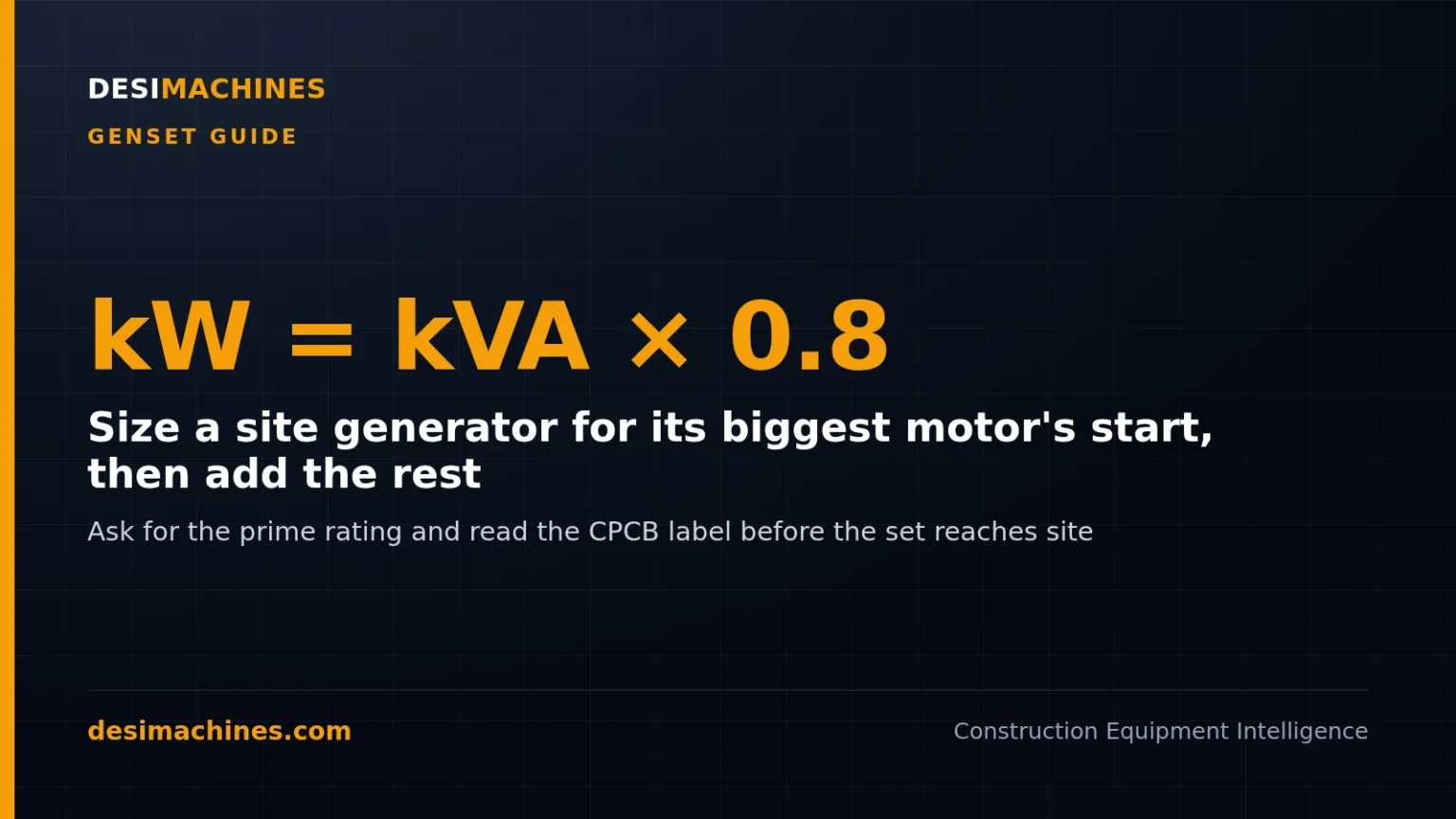
Choosing a diesel generator for a construction site comes down to three checks. The set needs enough kVA to start your largest motor as well as run it, a prime power rating if it will be the only supply on site, and a CPCB type-approval label for emissions and noise. Once those three are settled, the canopy, the size and the maker are much easier calls.
A diesel generator, also called a genset or a DG set, is a diesel engine and an electrical generator bolted to one frame with a control panel. On an Indian site it runs whatever cannot plug into the grid yet: the site office, lights for night work, dewatering pumps, welding sets, bar-bending and cutting machines, an electric concrete pump, or the charger for a battery machine. Hand-held breakers and rock drills are the exception: they run on air from a separate diesel compressor, sized as shown in air compressor for construction. This guide covers the types you will meet, what kVA and kW mean, how to size a set, which rating to ask for, how heat, height and dust cut the output, the rules a set must meet, and who makes them in India.
What does a diesel generator do on a construction site?
It makes electricity where the work is, from the first day of the job until the permanent connection is switched on, and sometimes for the whole contract. The Indian standard for these machines, IS/ISO 8528-1:2005, describes a generating set as one or more engines that produce mechanical energy and one or more generators that turn it into electrical energy, together with the couplings and the frame that hold them.
In plain words, the engine spins and the alternator turns that spin into current. The control panel starts the set, watches it, holds the voltage and frequency steady, switches the output and stops the set. Around those three parts sit the helpers the standard lists as auxiliaries: the starting system, the air intake and exhaust, cooling, lubricating oil and the fuel system.
How a genset turns diesel into site power
1 The fuel tank, usually built into the base frame of a canopy set. 2 The diesel engine, with its own cooling, oil and air systems. 3 The alternator, a much larger cousin of the one on a machine’s engine; how a machine alternator works and fails is covered in self motor and alternator failure signs. 4 The control panel, which carries the voltage regulator, the meters and the main breaker. From there a cable runs to the site distribution board and out to the loads.
What types of diesel generator are used on sites?
Site sets differ mainly in how they are mounted and moved. IS/ISO 8528-1 sorts them into fixed sets that are permanently installed, transportable sets that are not, and mobile sets with their own wheels. It also lists build configurations, from a bare engine and alternator up to a complete set inside an enclosure (configuration D) and a complete set on wheels or a trailer (configuration E).
| Type of set | What it looks like | Where it fits on an Indian site |
|---|---|---|
| Mobile set on wheels or a trailer | A canopy set on an axle, towed from one stretch of work to the next | Road jobs, pipelines, repair gangs and short stays; Atlas Copco’s mobile QAX range, for example, runs up to 100 kVA |
| Transportable canopy set on a skid | A sound-proofed box on a base frame, lifted on and off a truck by crane | Building sites, batching yards and quarries where the set stays for months |
| Fixed set | A set bolted to its own foundation, often in a room or shed | Crusher plants, labour camps and plants that run for years |
| Open set | Engine and alternator on a frame with no enclosure | Mostly sets above 1,000 kVA, where the owner must build the noise control around it |
This guide is about diesel sets, but diesel is not the only fuel. Mahindra Powerol lists gas and dual-fuel gensets beside its diesel range, and Kirloskar Oil Engines lists PNG and hybrid power products. A gas set needs a gas supply on the plot, which a greenfield site rarely has, so diesel stays the default for construction work.
For the sizes most sites use, “silent or open” is not really a choice. Under the CPCB noise limits for diesel generator sets, every diesel set up to 1,000 kVA made on or after 1 January 2005 must come with an acoustic enclosure fitted at the factory and must not exceed 75 dB(A) at 1 metre from that enclosure. So a new site set in that range is a silent set by law.
What do kVA and kW mean on a generator?
kW is the power that does work: it turns a pump, heats a weld or lights a lamp. kVA is the total the alternator has to carry, including current that motors draw only to build their magnetic field. The ratio between the two is the power factor. IS/ISO 8528-1 says a set’s power rating is given at a power factor of 0.8 lagging unless the maker states otherwise, so the working rule is simple: kW = kVA × 0.8.
That is why a set sold as 125 kVA is a 100 kW machine. It is also why you should never compare a genset’s kVA figure directly with a pump’s kW figure, or with an engine’s horsepower (1 HP is 0.746 kW).
| Set size (kVA) | Usable power at 0.8 power factor (kW) |
|---|---|
| 15 kVA | 12 kW |
| 25 kVA | 20 kW |
| 62.5 kVA | 50 kW |
| 125 kVA | 100 kW |
| 250 kVA | 200 kW |
| 500 kVA | 400 kW |
The sizes in the table are ones Indian makers list as standard models; Mahindra Powerol’s range, for one, includes all six. The kW column is plain arithmetic.
How do you work out the genset size for your site?
Size a diesel generator for construction site work around the moment your biggest motor starts, then add everything else that runs with it. Running load alone gives a number that looks right on paper and trips on the first morning.
- List every load that will run at the same time, with the kW on its nameplate. Lights, the site office, pumps, welding sets, a concrete pump, a charger.
- Add the running kW and divide by 0.8 to get kVA.
- Find the largest motor and plan for its start. Atlas Copco’s India generator pages put the inrush current of a starting motor or transformer at typically six times its full-load current. How much of that the set actually sees depends on how the motor is started, so give the genset supplier the motor’s kW and its starter type, never the kW alone.
- Start the biggest motor first and add the smaller loads after it. The standard explains why: a sudden load causes a dip in voltage and frequency, and the dip grows with the size of the step compared with the set.
- Check for sensitive loads. IS/ISO 8528-1 has four performance classes. Class G2 covers lighting, pumps, fans and hoists; class G3 covers telecom and thyristor-controlled loads; class G4 covers computers. A site office full of computers, or a machine with electronic drives, needs a set and supply suited to it.
An electric concrete pump shows why step 3 matters. Its motor power is on its spec sheet, and the kVA in the table below is only what the set needs to keep that motor running at full output.
| Electric stationary pump | Motor power | Set kVA just to run it (motor kW ÷ 0.8) |
|---|---|---|
| Schwing Stetter SP 1200 E | 45 kW (60.3 HP) | about 56 kVA |
| Schwing Stetter BP 350 E | 45 kW (60.3 HP) | about 56 kVA |
| Schwing Stetter SP 1800 E | 75 kW (100.6 HP) | about 94 kVA |
| Aquarius 1406 E | 75 kW (100 HP) | about 94 kVA |
| Aquarius 1405 E | 90 kW (120 HP) | about 113 kVA |
Motor powers are from each pump’s specification as of November 2026; the kVA column is our own arithmetic. Take the first row. A 62.5 kVA set gives 50 kW, which covers 45 kW on paper. But a motor draws a little more power than its rated output, the start pulls several times its running current, and the lights and the site office are on the same set. That set is too close to its limit before the first pour begins. What the motor size means for the pump’s output is explained in concrete pump engine power.
If the pump is not yet chosen, compare electric and diesel stationary concrete pumps side by side and match the drive to the power you can actually supply. The same arithmetic applies to battery machines; the sizes needed for an excavator charger are worked through in charging an electric excavator on site.
Should a site generator be prime rated or standby rated?
If the set is the only power on site, ask for its prime power rating. A standby rating is meant for power cuts, not for a working day. IS/ISO 8528-1 defines four ratings, and the same set carries a different figure under each, so a kVA number on a quote means little until you know which rating it is.
| Rating (IS/ISO 8528-1) | Hours allowed | What it suits on a site |
|---|---|---|
| Continuous power (COP) | Unlimited, at a constant load | Loads that hardly change, such as dewatering pumps running day and night |
| Prime power (PRP) | Unlimited, at a varying load; the 24-hour average must stay within 70 per cent of the rating unless the engine maker agrees otherwise | A site with no grid, where loads start and stop all day |
| Limited-time running power (LTP) | Up to 500 hours a year | Planned short-term supply |
| Emergency standby power (ESP) | Up to 200 hours a year, during a utility outage or a test; 24-hour average also within 70 per cent | A site on grid power that only needs cover for cuts |
The standard is blunt about running outside these limits: “the generating set life will be reduced.” It also says that when the average load is worked out, any spell below 30 per cent of the prime rating is counted as 30 per cent. A set chosen far bigger than the load is therefore no free safety margin; ask the maker what minimum load it recommends. How hire firms match these ratings to jobs, and why they write the rating and running hours into the agreement, is set out in generator rental business in India.
How do heat, altitude and dust change genset output?
A set’s rating holds only at the conditions it was rated under. IS/ISO 8528-1 rates sets at 25 °C, 100 kPa of air pressure and 30 per cent relative humidity. Where a site differs, the standard says the power must be adjusted to find the “site rated power”, and it asks the buyer to tell the maker the highest and lowest temperatures, the altitude, the humidity and whether the air carries sand or dust.
Most Indian sites differ on at least one count. A May afternoon in the plains runs well above 25 °C, a hill road site sits in thinner air, and a quarry or crusher yard is full of dust that chokes filters and radiators. The standard gives no derating figures of its own, so ask for the maker’s derating data for your site and size the set on the reduced figure. For a dusty site, also ask what extra maintenance the maker requires.
Cold matters at the other end. The standard asks the engine maker to state the lowest temperature at which the set will start with its fitted starting system. On a winter site in the hills, check that figure, and the cold-start aids such as heater plugs, before the set is sent up.
What rules must a DG set meet in India?
Two central rules travel with the set itself, and both show on its label.
Emissions. The Environment (Protection) Third Amendment Rules, 2022, notified as GSR 804(E) on 3 November 2022, set emission limits for new genset engines up to 800 kW from 1 July 2023. Sets built to these limits are sold as CPCB IV+ sets. The rules bind the user as well as the maker: “No person shall sell, import or use an engine and genset for power generation application which is not having a valid Type Approval certificate and certificate of Conformity of Production.”
Noise. A diesel set up to 1,000 kVA made on or after 1 January 2005 must not exceed 75 dB(A) at 1 metre from its enclosure, and the enclosure must be fitted at the factory. Its label must show the maker’s name, a statement that it conforms to the Environment (Protection) Rules, 1986, the 75 dB(A) limit, the type approval certificate number and the date of manufacture. Sets outside that rule, including those above 1,000 kVA, need an acoustic enclosure or an acoustically treated room with at least 25 dB(A) insertion loss, plus an exhaust muffler of at least 25 dB(A), and the State Pollution Control Board checks them. A set above 250 kVA may travel dismantled, with its genset number on the enclosure and silencer, and its noise is checked again once it is put back together on site.
So read the label before the set leaves the yard, bought or hired. An older set with no type approval number is a problem you inherit. The site-level approvals come on top: the state electrical inspectorate, the pollution control board’s consent and the stack height. Who approves what is laid out in DG set permission on a construction site.
Who makes diesel generators sold in India?
Many makers sell diesel sets in India. The four below are makers whose own websites we read in November 2026, listed alphabetically. This is not a ranking and not a full list.
| Maker | What its own site lists | Site use it names |
|---|---|---|
| Atlas Copco (India) | Mobile diesel generators, including the QAX range up to 100 kVA, hybrid generators and light towers, from its Power Technique business in Pune | Construction, infrastructure projects, concrete batching and tower cranes |
| Jakson | Diesel gensets and CPCB IV+ sets; it says it began making gensets in 1979, partnered Cummins in 1982 and introduced acoustic enclosures in 1998 | Power backup and distributed energy |
| Kirloskar Oil Engines | CPCB IV+ gensets from 7.5 kVA to 750 kVA, and larger high-horsepower sets | Construction sites, mining and infrastructure projects |
| Mahindra Powerol | Diesel, gas and dual-fuel gensets in models from 5 kVA to 625 kVA, with 700 kVA to 3,500 kVA on enquiry | Construction sites, stone crushers and quarries |
Ranges change as makers add and drop models, so treat the table as a starting point. Ask the maker’s authorised dealer for the prime and standby ratings, the derating data for your site, and copies of the type approval and noise certificates along with any quote.
Should you rent or buy a generator for a project?
Rent when the set is needed for a few months, or only until the grid connection arrives. Buy when it will run most days for years, or move with your machines from one contract to the next. A hired set still has to suit the job, so the rating, the running hours, who pays for diesel, who services it at the hour mark and who earths the installation should all be written into the hire terms. How construction equipment hire works more generally is covered in the equipment rental guides.
If you buy, a genset is a capital purchase like any machine, and the same equipment finance options apply. Either way, run the size check above against the machines you will actually power, and read the label before the set reaches the site. More on gensets is collected in the genset guide.
The rating and site-condition rules on this page are from IS/ISO 8528-1:2005, Reciprocating internal combustion engine driven alternating current generating sets, Part 1: Application, ratings and performance, clauses 5, 7, 8, 10 to 14. The emission and noise rules are from GSR 804(E) of 3 November 2022 and the CPCB noise limits for diesel generator sets, both on the CPCB genset notifications page. Maker ranges are from each maker’s website, and motor powers from each pump’s specification, all read in November 2026.
Prices, specifications and features are indicative, vary by variant, location and date, and should always be confirmed with the official OEM or authorised dealer before any purchase decision. DesiMachines is not liable for decisions taken on the basis of information that may have changed after publication. Emission, noise and approval rules can be stricter in your state or city; confirm them with the State Pollution Control Board and your state electrical inspectorate.