
 Excavator
294 models
Excavator
294 models  Backhoe Loader
51 models
Backhoe Loader
51 models  Crane
68 models
Crane
68 models  Concrete Mixer
79 models
Concrete Mixer
79 models  Wheel Loader
54 models
Wheel Loader
54 models  Compactor / Roller
45 models
Compactor / Roller
45 models  Motor Grader
42 models
Motor Grader
42 models  Concrete Pump
66 models
Concrete Pump
66 models  Skid Steer Loader
11 models
Skid Steer Loader
11 models  Telehandler
13 models
Telehandler
13 models 


Concrete pumps sold in India carry engines from 46 HP (34.6 kW) at the small end to 590 HP (440 kW) at the top, and the middle of the range sits at about 100 HP (75 kW). Those are the figures published across the 66 concrete pumps listed in India today, and every one of them publishes an engine power rating.
Here is the part that surprises most first-time buyers. On a concrete pump, engine power does not buy volume. It buys pressure — the force that pushes concrete up a tall building or along a long pipe. Two pumps from the same maker, with the same size cylinders, can have the bigger engine delivering the smaller hourly output. This page shows the published power figures class by class, explains what the engine is actually doing, and helps you work out how much of it you need.
How much engine power does a concrete pump have?
Most concrete pumps in India sit in the 50 to 200 HP band. The very small line pumps start at 46 HP (34.6 kW) and the largest high-rise machines reach 590 HP (440 kW), but those are the two ends of a long tail. The table below groups every listed pump by its published engine rating.
| Engine power band | Number of machines | What sits here |
|---|---|---|
| Under 50 HP (under 37 kW) | 4 | Small line and trailer pumps for low-rise work |
| 50–99 HP (37–74 kW) | 27 | The workhorse class — most Indian site pumps |
| 100–199 HP (75–148 kW) | 21 | Taller buildings and longer pipe runs |
| 200–299 HP (149–223 kW) | 10 | High-rise and continuous ready-mix work |
| 300 HP (224 kW) and above | 4 | Specialist high-rise and very long delivery lines |
The single most common rating is 66 HP (49 kW), which eight different machines carry, followed by 177 HP (132 kW) on seven machines and 100 HP (75 kW) on five. If you are buying a first pump for ordinary building work, the 66 HP class is where most of the market has settled, and it is not an accident — it is the smallest engine that will drive a full-size 200 mm delivery cylinder at a useful rate.
Why does more horsepower not always mean more concrete?
A concrete pump does not blow concrete down a pipe. It pushes a solid plug of it, using two hydraulic cylinders that take turns. The diesel engine turns a hydraulic pump, the hydraulic pump makes oil pressure, and that oil pressure drives the delivery cylinders that shove the concrete forward. The engine never touches the concrete.
So the engine’s job is to make hydraulic power, and that power splits two ways: how fast the cylinders stroke, which gives you cubic metres per hour, and how hard they push, which is measured in bar (a unit of pressure — roughly the squeeze of one atmosphere). A machine can spend its power on either. It cannot spend it twice.
How engine power reaches the concrete
Two pumps from the same maker show this exactly. Both use a 200 mm delivery cylinder with a 1,400 mm stroke, so the hardware is the same size:
- The Aquarius 1410 D has a 221 HP (165 kW) engine and delivers 93 m³/hr at 71 bar.
- The Aquarius 1400 HPD Plus has a bigger 279 HP (208 kW) engine and delivers less — 58 m³/hr — but at 116 bar.
The HPD has 58 more horsepower and produces 35 m³/hr less concrete. All of that extra power, and more besides, has gone into raising the pressure from 71 to 116 bar. That is what “HPD” means: high pressure. You would choose it not because you want more concrete per hour, but because you need to push concrete higher up a building than the 1410 D can manage.
This is why reading the engine figure on its own tells you very little. The number that answers “how much concrete, how high” is the output-and-pressure pair, and we have set that out separately in the guide to concrete pump output and pressure. Read the engine rating as the budget the machine has to spend, and the pressure figure as how the maker chose to spend it.
Concrete pump engine power and output by model
The table below runs from the smallest listed pump to the largest, with the published output and pressure beside each engine rating. Read across the rows rather than down one column — the relationship between the three numbers is the useful part.
| Model | Engine power | Max output | Max pressure |
|---|---|---|---|
| Aquarius 703 D | 46 HP (34.6 kW) | 30 m³/hr | 65 bar |
| Schwing Stetter SP 1000 | 46.9 HP (35 kW) | 36 m³/hr | 65 bar |
| Ajax ASP 5009 | 66 HP (49.2 kW) | 50 m³/hr | 61 bar |
| Ajax ASP 7011 | 100 HP (75 kW) | 70 m³/hr | 71 bar |
| Schwing Stetter SP 1800 D | 108.6 HP (81 kW) | 73 m³/hr | 62 bar |
| Venus VCP 1470 HR | 177 HP (132 kW) | 65 m³/hr | 71 bar |
| Aquarius 1410 D | 221 HP (165 kW) | 93 m³/hr | 71 bar |
| Putzmeister BSA 2109 HD | 268 HP (200 kW) | 95 m³/hr | 103 bar |
| Aquarius 1400 HPD Plus | 279 HP (208 kW) | 58 m³/hr | 116 bar |
| Schwing Stetter SP 8800 | 590 HP (440 kW) | 116 m³/hr | 104 bar |
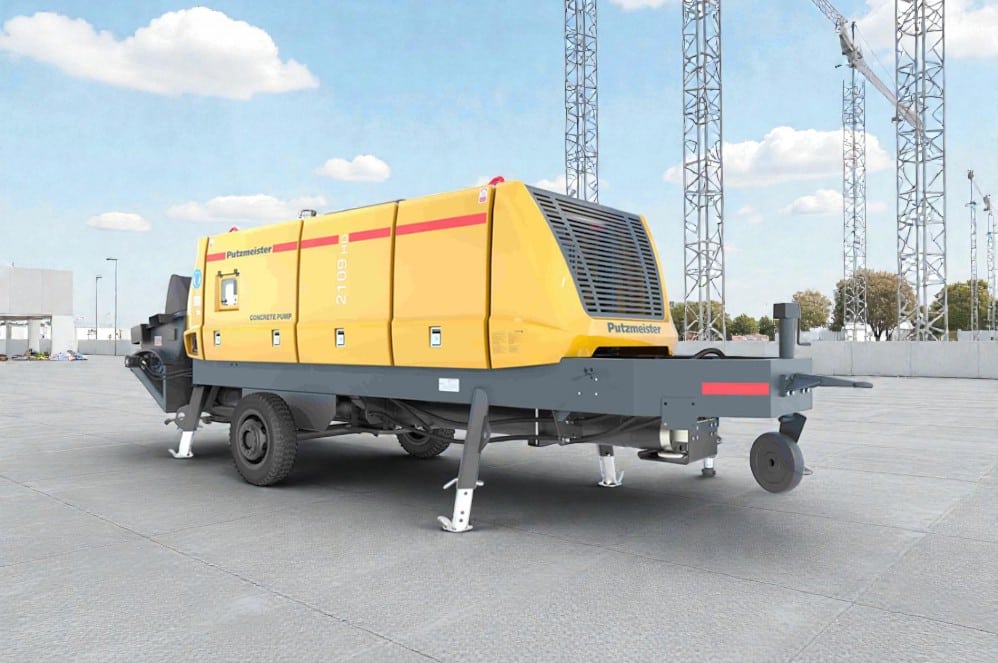
Look at the 108.6 HP Schwing Stetter SP 1800 D against the 177 HP Venus VCP 1470 HR. The Venus has 69 more horsepower and produces less concrete per hour — 65 m³/hr against 73. Both are honest machines; they are simply built for different pipe runs. Judging either one by its engine badge alone would point you the wrong way.
One thing the spec sheet will not tell you is that these are theoretical outputs, measured with the cylinders stroking at full rate and nothing restricting the line. A real pour with bends, a vertical rise and a waiting mixer runs well below the printed figure.
Diesel or electric: what changes?
Of the 66 pumps listed, 13 are electric-driven and most of the rest run a diesel engine. An electric pump replaces the diesel engine with an electric motor, and everything downstream — the hydraulics, the cylinders, the pipeline — is unchanged.
The interesting part is what happens to the power rating when a maker offers the same pump both ways.
| Model | Drive | Rated power | Max output | Max pressure |
|---|---|---|---|---|
| Schwing Stetter SP 1800 D | Diesel | 108.6 HP (81 kW) at 2,100 rpm | 73 m³/hr | 62 bar |
| Schwing Stetter SP 1800 E | Electric | 100.6 HP (75 kW) at 2,100 rpm | 73 m³/hr | 62 bar |
| Schwing Stetter SP 4800 | Diesel | 443 HP (330 kW) at 2,100 rpm | 66 m³/hr | 156 bar |
| Schwing Stetter SP 4800 Electric | Electric | 268 HP (200 kW) at 1,500 rpm | 66 m³/hr | 156 bar |
| Schwing Stetter BP 350 D | Diesel | 65.7 HP (49 kW) at 2,100 rpm | 46 m³/hr | 60 bar |
| Schwing Stetter BP 350 E | Electric | 60.3 HP (45 kW) at 1,450 rpm | 38 m³/hr | 60 bar |
The SP 4800 pair is the one worth studying. Both versions publish exactly the same output and the same pressure, from the same 180 mm cylinders — yet the diesel is rated at 330 kW and the electric at 200 kW. The electric motor does the identical job on 130 kW less on paper.
That is not a misprint, and it is not magic. A diesel engine’s rating is its peak output at the crankshaft at 2,100 rpm. A good share of it never reaches the hydraulic pump: it goes to the radiator fan, the air cleaner, the alternator and the losses that come with running an engine hot and hard all day. An electric motor is rated at the shaft and holds that rating continuously, and at 1,500 rpm it is turning slowly enough to be running comfortably. So the smaller electric figure and the bigger diesel figure are describing the same real work.
Which should you buy? It comes down to where the machine will stand. An electric pump needs a reliable three-phase supply at the pour, so it suits a batching plant, a precast yard or a long city project with a proper connection. It is quieter, it has no fuel to buy or lose, and there is far less to service. A diesel pump goes anywhere and starts on its own, which is why it still accounts for most of the market on ordinary Indian sites. If your site has no dependable power — and many do not, especially outside the metros — the choice makes itself.
Both types are worth comparing side by side before you commit. You can see the current range of concrete pumps and prices and talk to a dealer about the supply you actually have at the site.
What engine power do you actually need?
Work backwards from the pour, not from the spec sheet. Three things decide it.
How high you are pumping. Vertical rise is what eats pressure, and pressure is what the engine pays for. A ground-floor raft or a two-storey slab asks very little. A tower going up fifteen floors asks a great deal, and it is the pressure rating you check first, with the engine rating following behind it.
How far the concrete travels. A long horizontal pipe run costs pressure too, though far less per metre than going up. Bends cost more than straight pipe. A pump that is comfortable at 40 metres of straight line can struggle at 40 metres with six bends in it.
How much you need per hour. This is the one buyers usually start with, and it matters least of the three, because the pump is rarely the slow part. If your mixers can only deliver 20 m³ in an hour, a pump rated at 90 m³/hr will spend most of the morning waiting. Match the pump to the supply reaching it, not to the biggest number you can afford.
For most low-rise building work in India — up to about four or five floors, with a sensible pipe layout — a machine in the 50 to 99 HP band does the job, which is exactly why 27 of the 66 listed pumps sit there. Go above 100 HP when the building is genuinely tall or the line is genuinely long. If your work is small and occasional, look at a mini concrete pump before a full-size machine, and if the concrete has to reach across a site rather than straight up, a boom pump on a truck may save you more in pipe handling than it costs in hire.
Buying outright is not the only route. Pumps sit idle between pours on most sites, so it is worth pricing concrete pump hire against ownership, and if you are buying, a used concrete pump with verified hours can be sound value. Where the purchase needs funding, our equipment finance options set out what lenders look for.
What makes the engine work harder on site?
The published rating assumes good conditions. Several everyday things push the engine towards its limit, and knowing them saves both diesel and breakdowns.
- A stiff mix. Concrete with low slump — less workable, drier — needs far more pressure to move. This is the biggest single load the engine sees, and it is the most common cause of a choked delivery line.
- Bends and reducers. Every bend and every step down in pipe diameter adds resistance. Plan the shortest sensible route before the pour rather than during it.
- Worn parts. A worn S-valve, wear plate or delivery cylinder lets concrete slip backwards on each stroke, so the pump works harder for less. The wear parts on a concrete pump are consumable by design and their condition shows up directly in fuel use.
- Long idling. A pump ticking over while a mixer is late is burning diesel and adding hours to the meter with nothing to show for it.
- Heat. Hydraulic oil that gets too hot thins out, which means more internal leakage and more engine work for the same concrete.
If fuel use climbs while the work stays the same, the machine is telling you something. Check the mix and the wear parts before assuming the engine is at fault.
What to check before you buy
Five checks, in the order worth doing them.
- Read the pressure figure before the power figure. It is the one that decides whether the pump can reach your top floor.
- Ask which output figure you are being quoted. Most makers publish two — a higher rod-side figure and a lower piston-side one. Compare like with like across brands.
- Check the engine make, not only the rating. Parts availability and service reach matter more over ten years than five horsepower. Who builds the engine in a given machine is covered in our guide to engine brands in Indian construction machines.
- Confirm the emission norm. Diesel pump engines fall under India’s BS-CEV emission norms, which affect what you can buy new and what a machine is worth later.
- For an electric pump, confirm the supply. Check the connected load and that the site can actually hold it during a pour, not just on paper.
If you are still deciding what type of pump suits the work, start with the overview of boom, line and stationary concrete pumps, then work through the rest of the concrete pump guide, compare the concrete pump models available in India and speak to a dealer about your site layout. The general working principle behind all of them is set out in the background on concrete pumps.
Prices, specifications and features are indicative, vary by variant, location and date, and should always be confirmed with the official OEM or authorised dealer before any purchase decision. DesiMachines is not liable for decisions taken on the basis of information that may have changed after publication.