
 Excavator
294 models
 Backhoe Loader
51 models
 Crane
68 models
 Concrete Mixer
79 models
 Wheel Loader
54 models
 Compactor / Roller
45 models
 Motor Grader
42 models

 Concrete Pump
66 models
 Skid Steer Loader
11 models


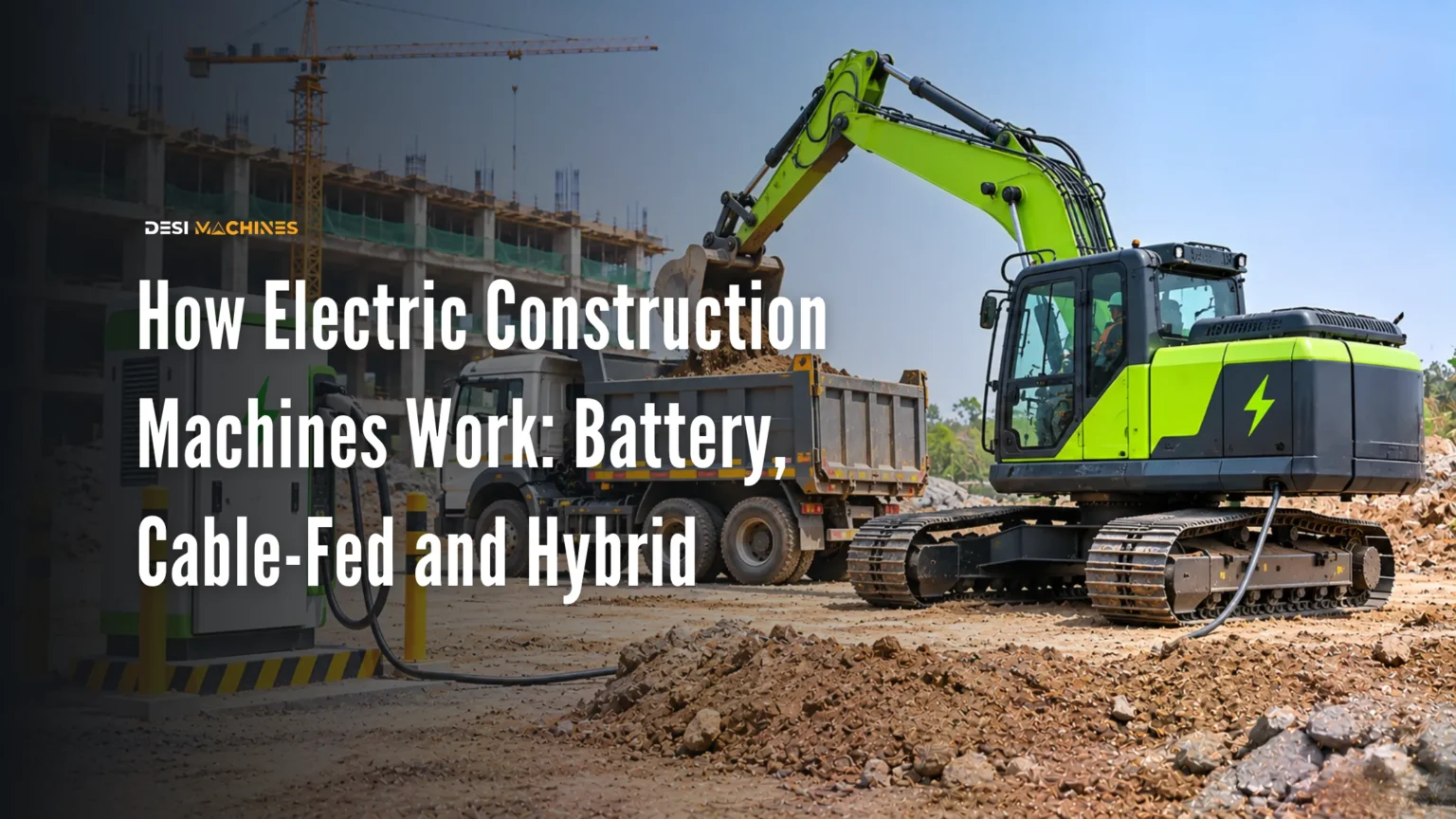
An electric construction machine is one whose hydraulic pumps are turned by an electric motor instead of a diesel engine, and it is built in three forms: a battery machine that carries its own energy, a cable-fed machine that draws power from the grid while it works, and a hybrid that keeps a diesel engine but stores and reuses energy the machine would otherwise throw away. Behind the pump, nothing changes. The boom, the arm, the bucket, the swing gear and the tracks are the same machinery the diesel version uses.
The excavator is where the demand sits in India, so the examples on this page come off the spec tables of the 14 electric excavators listed on DesiMachines, read on 5 November 2026, and off the maker’s own published guide where our catalogue is silent. If you want the money side rather than the mechanism, that is in electric against diesel construction machines. This page is about what the parts are and where the power goes.
What are the three kinds, in one line each?
A battery machine carries a pack of cells on board, works away from any supply, and stops when the pack is empty. The LiuGong 922FE Battery is listed this way, with LFP as the cell chemistry. LFP is lithium iron phosphate, a cell type that gives up some energy per kilogram in exchange for tolerating heat and long life better than the alternatives.
A cable-fed machine has no pack worth speaking of. A power cable runs to it from a site transformer and stays connected while it digs, so the machine never needs charging and never runs flat. It also cannot wander. Volvo’s own page for the EC500 Electric calls it a continuous cable connection and describes the machine as built for static applications such as river port material handling, with the cable coming from the ground and connecting under the superstructure. That is the machine we list as the Volvo EC500 Electric, and its product guide adds a 360 degree turning joint carrying both the hydraulic and the electric cables.
A hybrid is a diesel machine with somewhere to put recovered energy. The engine stays. What gets added is a store, usually a capacitor or a small battery, plus a motor-generator that can both absorb energy and give it back. How that is done on an excavator, and what to check on one, is covered in the hybrid excavator guide.
Ask which of the three you are being shown before you ask anything else. The three answer the shift question in completely different ways, and a dealer who says only “electric” has told you very little.
Where does the power actually go, from the supply to the bucket?
Through five or six boxes, and only the first two or three of them change between a battery machine and a cable machine. Everything from the motor onward is shared.
Two routes bring power on board. A cable-fed machine goes grid supply, site transformer, then motor starter or inverter. A battery machine goes grid supply, charger, battery pack, then inverter. From that point both routes share the same chain: electric motor, hydraulic pump, main control valve, then the boom, arm, bucket, swing and tracks. A cooling circuit serves the pack, the inverter and the motor. Oil regeneration returns flow from the cylinders to the main control valve.
Route 1: cable-fed machine
Grid supply
380 to 415 V AC
Site transformer
Motor starter, or
inverter
Route 2: battery machine
Grid supply
Charger
Battery pack
direct current
Inverter
Shared by both routes, and by a diesel machine
Electric motor
Hydraulic pump
Main control
valve
Boom, arm, bucket,
swing, tracks
oil regeneration, back to the valve
Cooling circuit, serving the pack,
the inverter and the motor
24 V control system: monitor, lights,
horn, joysticks, as on a diesel machine
Reading the diagram
The grid supply is the same on both routes, because a battery machine is charged from the grid too. On the cable route the power goes through a site transformer and then either straight into the motor or through an inverter, and the machine keeps working as long as the cable is live. On the battery route the grid fills a pack through a charger, and the pack then feeds an inverter. From the motor rightward the two routes are identical, and so is a diesel machine, except that a diesel machine has an engine where the motor is. The dotted line is hydraulic, not electrical, and it matters more than most buyers expect. There is more on the site supply side in charging an electric excavator on site.
What does each part do, and which parts has a diesel machine never had?
Four of the parts in the chain are genuinely new. The rest are the same components, doing the same job, with a different thing spinning them.
| Part | What it does | Its counterpart on a diesel machine |
|---|---|---|
| Battery pack | Holds the shift’s energy as direct current. Its size in kWh, not its voltage, decides the hours. | The diesel tank |
| Charger | Turns grid alternating current into the direct current the pack takes, at a rate the pack will accept | The fuel bunk or the bowser |
| Power cable and turning joint | Carries grid power on board while the machine slews, on a cable-fed machine | No counterpart |
| Inverter | Converts direct current to alternating current at whatever frequency the motor needs. Changing that frequency is how motor speed is controlled. | The injection system and the governor |
| Electric motor | Turns the hydraulic pumps, and nothing else | The diesel engine |
| Battery management system | Watches every cell’s voltage and temperature and reduces or cuts power to protect the pack | No counterpart |
| Cooling circuit | Holds the pack, the inverter and the motor inside their temperature window. It still uses coolant and still has a radiator. | The engine radiator and water pump |
| Hydraulic pump, main control valve, cylinders, swing motor, final drives | Unchanged. Oil at pressure moves the boom, the arm, the bucket and the machine. | The same parts |
| 24 V control system | Monitor, lights, horn, joysticks and relays. Volvo’s guide for the EC500 Electric lists the machine’s voltage as 380 and 24, so the low-voltage side survives intact. | The same 12 V or 24 V system |
Sources: the part functions are general to the drive type; the 380 and 24 V figure is from Volvo’s own published product guide for the EC500 Electric, read 5 November 2026.
The practical consequence is in the last three rows. A workshop that can rebuild a pump or reseal a cylinder can still work on an electric machine, because those parts did not change. The pack, the inverter, the battery management system and the charger are the four that need somebody trained on that specific drive, which is why service reach is the question it is in the electric machine buying checklist.
How can you tell a cable machine from a battery machine off the spec sheet?
By the motor’s rated speed, and it is a reliable tell. Across the 14 electric excavators listed on DesiMachines, six publish a rated speed and every one of those six sits between 1,483 and 1,500 rpm. The other eight publish either no speed at all or a speed nowhere near that band.
| Machine | Motor, as the spec table names it | Rated power and speed | Source |
|---|---|---|---|
| Liebherr R 9250 G6 | 3-phase AC squirrel cage motor | 1,408 HP (1,050 kW) at 1,500 rpm | its own spec table |
| Liebherr R 992 E | Asynchronous, squirrel cage rotor | 544 HP (400 kW) at 1,491 rpm | its own spec table |
| Liebherr R 998 SME-E | Asynchronous, squirrel cage rotor | 544 HP (400 kW) at 1,491 rpm | its own spec table |
| BEML BE1000E-1 | Totally enclosed squirrel cage induction motor, class F insulation | 536 HP (400 kW) at 1,483 rpm | its own spec table |
| BEML BE1800E | Squirrel cage induction motor | 2 x 402 HP (2 x 300 kW) at 1,500 rpm | its own spec table |
| Volvo EC500 Electric | Electric motor, no family named | 250 kW at 1,500 rpm, on an AC 380 V grid connection | Volvo’s own product guide, our spec table carries no motor row |
| SANY SY375EP | Permanent magnet synchronous motor, AC, water cooled | 269 HP (200 kW) at 1,650 rpm | its own spec table |
| SANY SY215EP | Permanent magnet synchronous motor, water cooled | 201 HP (150 kW) at 1,800 rpm | its own spec table |
| LiuGong 939FE EV | Interior permanent magnet synchronous motor | 325 HP (250 kW), no speed given | its own spec table |
| LiuGong 926FE EV | Interior permanent magnet synchronous motor | 201 HP (150 kW), no speed given | its own spec table |
| LiuGong 922FE Battery | Interior permanent magnet synchronous motor, LFP cells | 140 HP (105 kW), no speed given | its own spec table |
| LiuGong 922FE Cable | Interior permanent magnet synchronous motor | 140 HP (105 kW), no speed given | its own spec table |
| LiuGong 908FE EV | Interior permanent magnet synchronous motor | 63 HP (47 kW), no speed given | its own spec table |
| LiuGong 9027FE EV | Listed only as SYR, which is not a motor family a buyer will recognise | 21.1 HP (16.5 kW), no speed given | its own spec table |
Why 1,500 rpm gives the game away
Indian grid power alternates 50 times a second. An AC motor with four poles turns once for every two of those cycles, so its fastest possible speed is 50 x 60 / 2, which is 1,500 rpm. An induction motor can never quite reach that figure under load, because it works by lagging slightly behind, and that lag is called slip. The 1,483 rpm on the BEML BE1000E-1 is 17 rpm of slip, about 1.1 per cent. The 1,491 rpm on both Liebherr machines is 9 rpm, about 0.6 per cent. Those are not round brochure numbers. They are the fingerprint of a motor bolted straight to the mains, which means a cable, a transformer and a machine that stays where it is put. That arithmetic is ours; the speeds and motor types are each machine’s own.
The eight machines with no speed, or with 1,650 and 1,800 rpm, have an inverter between the supply and the motor. An inverter can make any frequency it likes, so the motor is no longer tied to the grid’s 50 Hz and the sheet has no single speed worth printing. That buys variable speed and instant torque, and it is what both a battery machine and a cable machine with an inverter use. The 922FE proves the point inside one model: the 922FE Cable and the 922FE Battery share the same motor, the same 2 x 224 L/min hydraulic flow and the same 34.3 MPa implement circuit. Only where the electricity comes from is different. What that difference does to weight and ground pressure is worked out in electric excavator weight, tyres and tracks, and the full reading of the motor and battery lines is in reading an electric machine spec sheet.
What is exactly the same as on a diesel machine?
More than the word “electric” suggests. The hydraulic system does the work on both, and it is untouched: the same pumps, the same main control valve, the same cylinders, the same swing motor and final drives, the same excavator components a mechanic already knows. Oil at pressure still moves the boom. The undercarriage, the front linkage and the cab are ordinary machinery.
So are most of the consumables. Grease, filters, hydraulic oil and coolant all stay, and on one listed pair the electric version takes more hydraulic oil than the diesel one did while the engine oil and the diesel tank disappear. That comparison, between the LiuGong 908FE EV and the LiuGong 908E diesel, is set out in full in the buying checklist.
The coolant row is worth a second look, because people assume no engine means no cooling. The pack, the inverter and the motor all have a temperature window, and keeping them inside it is a liquid circuit with a radiator and a pump, exactly like the one an engine had. It is just cooling different things.
And the small electrics stay. Volvo lists the EC500 Electric’s voltage as 380 and 24: a 380 V traction supply and the ordinary 24 V system for the monitor, the lights and the controls. The low-voltage battery on an electric machine is not the traction pack, and a flat one strands the machine just as it would a diesel.
Does an electric machine put energy back?
Sometimes, and the word used for it covers two completely different things, so it pays to ask which one a dealer means.
On many machines “regeneration” is hydraulic. Oil leaving one side of a cylinder is routed to where it is useful instead of back to tank. Volvo’s published India product guide for the EC500 Electric lists boom, arm and bucket regeneration valves, and describes the regeneration system as preventing cavitation and providing flow to other movements during simultaneous operations. That is oil being reused to speed up a cycle. No electricity goes anywhere, and a diesel machine of the same vintage has the same valves.
Electrical recovery is the other meaning: the motor is run backwards as a generator while the boom comes down or the house slows from a slew, and the energy goes into a pack or a capacitor instead of into heat. That is what a hybrid is built around, and it needs somewhere to store the energy, which a cable-fed machine does not have. The mechanism, the fuel savings makers claim for it, and what to check are in the hybrid excavator guide.
Two questions settle it on site. Does the machine have a store, and does the spec sheet list regeneration valves? A machine with valves and no store is recovering oil. A machine with a store is recovering electricity, and the claimed saving belongs to whoever published it.
So which one should you be looking at?
Match the power route to how the machine will stand, not to the brochure. A machine that works all day in one spot, loading at a port, feeding a crusher, digging a quarry face, is the case a cable makes: no charging window to plan, no runtime limit, and the supply problem solved once. A machine that has to move between faces or sites needs a pack, and then the pack size and the charging window decide whether it finishes your shift. A hybrid keeps the diesel engine and the fuel bill and simply wastes less of it.
Browse the electric excavators listed with prices and specifications, or the wider range of excavators if you want the diesel equivalent beside it. Where a machine is quote-only, the listing says price on request, and equipment finance options work the same on an electric machine as on a diesel one.
Where to read next
The rest of this subject is split across pages so that each one goes deep rather than wide. The electric machines guide is the hub. For the supply and the charger, read charging an electric excavator on site. For the trade-offs with a diesel machine, read electric against diesel construction machines. For energy storage on a machine that keeps its engine, read the hybrid excavator guide. For what is on the market at the top end, our list of the 10 most advanced electric excavators is a useful tour.
Specifications on this page come from each machine’s own listing and from the makers’ published documents, named above, and were read on 5 November 2026. Prices, specifications and features are indicative, vary by variant, location and date, and should always be confirmed with the official OEM or authorised dealer before any purchase decision. DesiMachines is not liable for decisions taken on the basis of information that may have changed after publication.