
 Excavator
294 models
 Backhoe Loader
51 models
 Crane
68 models
 Concrete Mixer
79 models
 Wheel Loader
54 models
 Compactor / Roller
45 models
 Motor Grader
42 models

 Concrete Pump
66 models
 Skid Steer Loader
11 models


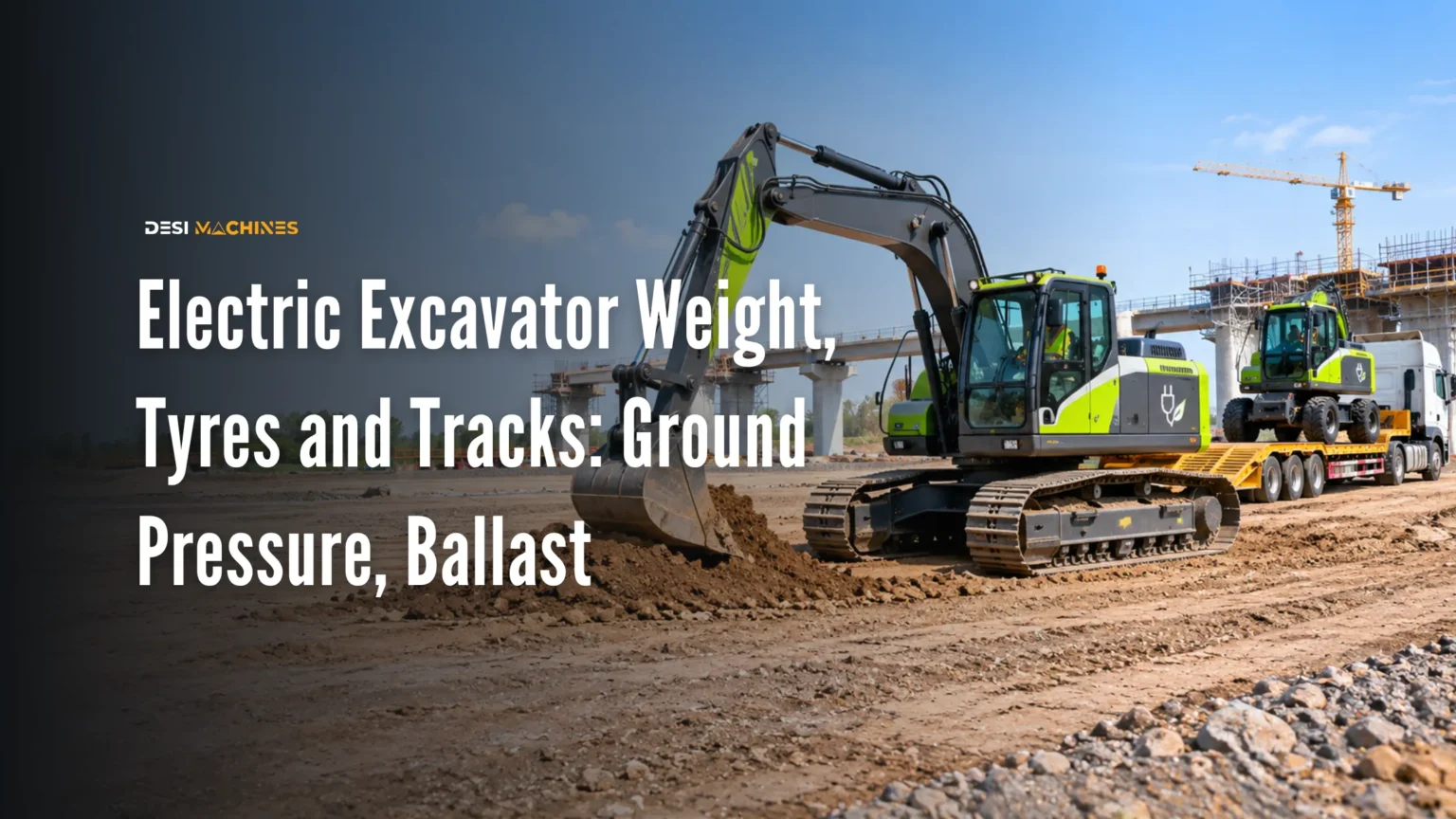
Operating weight is what a machine weighs when it is ready to work: the machine itself, all its fluids, its standard tracks or tyres, and an operator in the seat. On an electric machine that figure includes the battery pack, and the pack is heavy enough to move the number, though usually by less than owners expect.
On the one compact excavator where a maker publishes both versions, the electric comes out 230 kg heavier than the diesel. On a compact wheel loader from the same maker, the electric is slightly lighter. Weight is the first thing a battery changes, and it runs on into ground pressure, track and tyre wear, ballast and the trailer that brings the machine to site. This guide takes those one at a time, using figures read off makers’ own spec sheets and off the electric machines listed on DesiMachines.
What operating weight means, and where the battery sits inside it
Both Volvo product guides used below give operating weight “according to ISO 6016”. That standard is why the figure is comparable at all: it fixes what gets counted, so one maker cannot quietly leave out the fluids or the operator to publish a lighter machine.
Two weights appear on a spec sheet and they are not the same number.
- Operating weight is the working weight, fluids and operator included. This is the figure that decides ground pressure.
- Transport weight is the machine as it travels, with the parts that come off removed. It is the figure your trailer cares about.
A battery pack adds to both. It is also a dead weight that never gets lighter, which a fuel tank does over a shift. Against that, going electric takes out the diesel engine, the fuel tank, the radiator pack, the exhaust and the after-treatment can. Whether the machine ends up heavier depends on which of those two lists is longer, and that changes with machine size.
How much weight does a battery actually add?
Very few makers publish an electric and a diesel version of the same machine in the same size class, which is what you need for an honest comparison. Volvo CE does, on two pairs. The figures below were read from the four product guides on 3 November 2026.
| Machine | Operating weight | Ground pressure | Source document |
|---|---|---|---|
| Volvo ECR25 Electric (2.7-tonne tracked excavator) | 2,720 kg | 27 kPa with cab | Volvo ECR25 Electric product guide, EN 21 20066710-C |
| Volvo ECR25D (diesel, same size class) | 2,490 kg | 30.5 kPa with cab | Volvo ECR25D Stage V brochure, EN 21 20058005-A |
| Volvo L25 Electric (wheeled loader) | 4,850 to 5,000 kg | not published; 335/80 R18 tyres | Volvo L25 Electric product guide, EN 21 20066343-C |
| Volvo L25H (diesel, same size class) | 4,920 to 5,090 kg | not published; 335/80 R18 tyres | Volvo L25H product guide, EN 22 20062766-A |
Read the two pairs together and the pattern is clear enough. On the 2.7-tonne excavator the battery wins: 230 kg more, about 9% on top. On the 5-tonne wheel loader it does not. The electric loader’s published range sits at or just below the diesel’s, because on a machine that size the engine, tank, cooling pack and exhaust that came out weigh about as much as the pack that went in.
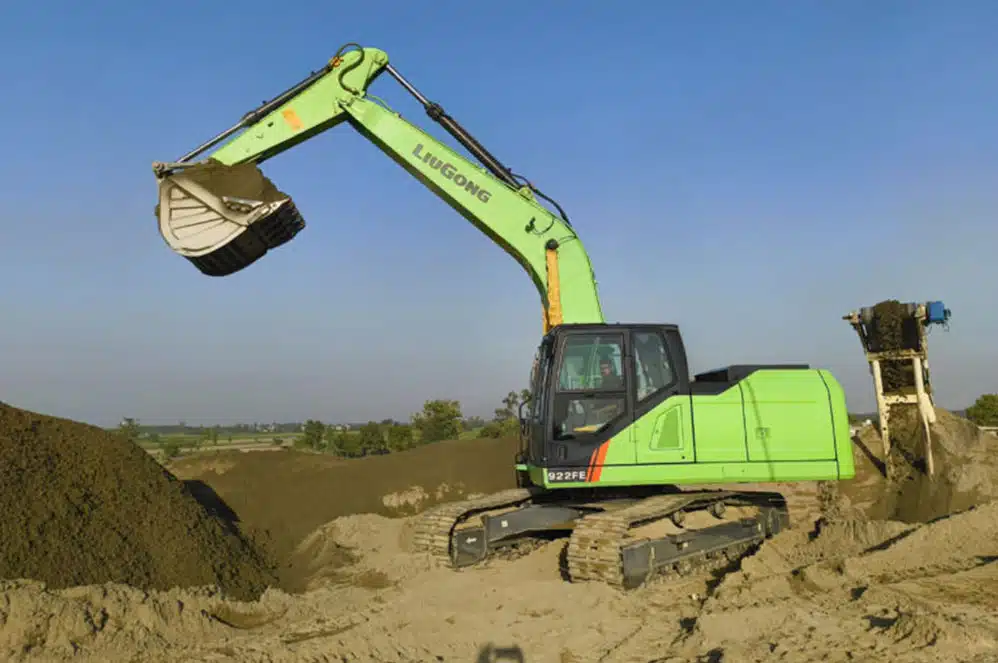
Our own catalogue shows the same thing from a different angle. The LiuGong 922FE Battery is listed at 24,100 kg. The LiuGong 922FE Cable, the same base machine fed by a trailing mains cable instead of a pack, is listed at 22,000 kg. The pack on that 22-tonne class machine is worth about 2,100 kg. If a site can take a cable, that is 2,100 kg you do not have to carry, charge or haul.
A small note on a machine we do not stock: JCB lists its 19C-1E electric mini excavator at 2,037 kg operating weight in cab form. It is a useful reminder that “two-tonne electric” is a real class, not a prototype.
Why can a heavier machine press the ground more softly?
Ground pressure is the machine’s weight spread over the patch its tracks actually rest on. It is written in kilopascals (kPa), and it is what decides whether a machine floats across soft paddy soil or sinks into it. Weight is only half of the sum. Contact area is the other half, and it is the half you can specify.
The ECR25 pair proves the point. The electric is 230 kg heavier and its published ground pressure is lower: 27 kPa against 30.5 kPa. The reason sits in the undercarriage lines of the two guides. The electric comes on 300 mm rubber tracks as standard. The diesel’s standard rubber track is 250 mm, with 300 mm rubber available at an extra 78 kg and 300 mm steel tracks at an extra 163 kg.
So a 20% wider track more than cancelled a 9% heavier machine. That is the single most useful thing on this page: if soft ground is your problem, track width is the lever, not the fuel. A diesel ordered on 300 mm tracks and an electric on 300 mm tracks land in much the same place.
The patch a tracked machine rests on, seen from above
shoe width
track length
on the ground
Contact area =
2 x shoe width x track length
Ground pressure =
weight x 9.81 / contact area
Widen the shoe and the area grows
in step, so the pressure falls.
Ground pressure by excavator size class, electric or not, is covered in more depth in our guide to excavator ground pressure in kPa by size class.
How to work out ground pressure from a spec sheet
Many spec sheets give the weight and the undercarriage dimensions but leave the ground pressure blank. You can get close with three numbers off the same sheet.
Take the operating weight in kg, multiply by 9.81 to turn it into newtons of force. Then work out the contact area: two tracks, so twice the track shoe width multiplied by the length of track resting on the ground, both in metres. Divide the force by the area and divide again by 1,000 to read the answer in kPa.
Worked on the LiuGong 926FE EV, listed at 26,000 kg on 600 mm shoes with 3,840 mm of track on the ground:
- Force: 26,000 x 9.81 = 255,060 newtons.
- Area: 2 x 0.6 m x 3.84 m = 4.61 square metres.
- Pressure: 255,060 / 4.61 = about 55,300 N per square metre, which is roughly 55 kPa.
How good is that sum? We checked it against the five electric machines in our own catalogue that publish both a weight and a maker’s ground pressure figure. The arithmetic came out between 3.8% and 13.2% above the published number, about 9% high on average. The gap is real: makers measure the contact patch rather than assume a perfect rectangle. So treat this as a close estimate on the cautious side, and use the maker’s figure wherever one exists.
| Machine | Operating weight | Track shoe width | Ground pressure |
|---|---|---|---|
| LiuGong 9027FE EV | 2,750 kg | 300 mm | about 29 kPa (our calculation) |
| LiuGong 908FE EV | 7,600 kg | 450 mm | about 37 kPa (our calculation) |
| SANY SY215EP | 21,900 kg | 600 mm | 47.3 kPa (catalogue) |
| LiuGong 922FE Cable | 22,000 kg | 600 mm | about 41 kPa (our calculation) |
| LiuGong 922FE Battery | 24,100 kg | 600 mm | about 54 kPa (our calculation) |
| LiuGong 926FE EV | 26,000 kg | 600 mm | about 55 kPa (our calculation) |
| SANY SY375EP | 37,800 kg | 600 mm | 68.8 kPa (catalogue) |
| LiuGong 939FE EV | 39,000 kg | 600 mm | about 77 kPa (our calculation) |
| Volvo EC500 Electric | 47,846 kg | 600 mm | 84.3 kPa (catalogue) |
| Liebherr R 992 E | 90,550 to 97,100 kg | 500 mm | 171.6 kPa (catalogue) |
| Liebherr R 998 SME-E | 90,550 to 97,100 kg | 500 mm | 187.3 kPa (catalogue) |
| BEML BE1000E-1 | 95,000 kg | 710 mm | 120 kPa (catalogue) |
| BEML BE1800E | 175,000 kg | 810 mm | 162 kPa (catalogue) |
Two things stand out. Every electric machine we list runs on tracks, so for this catalogue the tyre question does not arise yet. And the biggest machines on the list are cable-fed mains machines for quarry and mine faces, where the weight is driven by the dig, not by any battery. You can see the full set on the electric excavator listings, and the same ground is covered model by model in our blog roundup of the most advanced electric excavators.
What does the extra weight do to tracks, rollers and pads?
No maker we could find publishes track life in hours against machine weight, for an electric machine or a diesel one. Anybody who quotes you such a figure is estimating, so treat it that way. What the spec sheets do give you is the hardware the weight passes through, and that is worth reading.
On the ECR25 pair, both guides list the same undercarriage count: three bottom rollers and one top roller per side, with track tension by grease piston. The electric’s extra 230 kg therefore travels through the same number of rollers as the diesel’s, but spread along a wider and better supported track. That is a reasonable trade, and it is also why the wider shoe matters for more than just soft ground.
Three things genuinely do change wear on an electric machine, and none of them is the battery. Rubber tracks wear on hard, abrasive surfaces, so a machine doing yard and road work eats pads faster than one in soil, whatever drives it. Track tension matters more as weight rises. And an electric machine is quiet enough that operators often work it longer in a shift, which puts hours on the undercarriage faster than the calendar suggests.
What to watch and when to change parts is set out in our guides to the excavator undercarriage and its wear parts and to mini excavator rubber track sizes, links and tension.
Tyres and axle load on a wheeled electric machine
Wheeled machines carry their weight on four contact patches instead of two long ones, so the numbers get smaller and the tyre does more of the work.
The Volvo compact loader pair is instructive again. The L25 Electric guide lists wheels and tyres at 335/80 R18 on an 11 x 18 rim. The diesel L25H guide lists 335/80 R18 as well. Same class, same weight, same tyre: going electric did not force a bigger tyre on this machine. Where the electric guide does offer a choice, it is a 500/45 22.5 low ground pressure tyre, and that option exists for soft ground rather than for extra weight.
A tyre’s permitted load is not a single number. It is set against inflation pressure, which is why tyre makers publish load tables rather than one figure. BKT’s EARTHMAX SR LOADER range, to take one example, states its load capacity across a pressure band of 4.00 to 5.25 bar. If an electric machine does end up heavier in your spec, the first question is not “bigger tyre” but “what pressure does this tyre need at this load”.
On axle load, be careful what you expect from a brochure. Neither Volvo loader guide publishes a front and rear axle split. What they publish is operating weight and tipping load measured to ISO 14397-1. So if a weighbridge limit, a village bridge or a basement slab means you need the axle loads, you have to ask the dealer for them in writing. Do not work them out from the operating weight and a guess.
One more sourced detail worth knowing: the L25H guide credits its 100% differential lock on both axles with keeping tyre wear down. Drivetrain behaviour, not weight, is often what shreds tyres on a loader.
The wheeled side of the electric range has its own pages: electric wheel loaders and where they fit, and electric dumpers and tippers, where payload and road weight matter most. How to read a tyre’s size code and ply rating is covered in the guide to OTR tyre sizes and markings.
Does an electric machine need less ballast?
It is a fair question. The battery sits low in the frame, so it ought to do some of the counterweight’s job. The spec sheets say otherwise.
Both Volvo guides offer the same extra ballast option: an additional counterweight of 100 kg. The electric version did not drop it. That makes sense once you look at what a counterweight is for. It balances the load hanging at the end of the arm, which is a turning force about the slew ring. Mass sitting low in the middle of the machine steadies it, but it does not sit far enough back to balance the arm’s reach. Volvo states its lifting capacities for both machines with a standard counterweight fitted, to ISO 10567, which tells you the figures assume that ballast is there.
The practical reading: if you need the extra 100 kg of counterweight for the lifts you do, you need it on the electric machine too. Order it with the machine rather than bolting something on later.
Getting it to site: transport weight and the trailer
Transport weight is the number your trailer and your permit care about, and it is lower than operating weight because fluids and fittings come off. The ECR25 Electric travels at 2,640 kg against the diesel ECR25D’s 2,412 kg. The 228 kg gap tracks the operating weight gap almost exactly, so there is no hidden saving here.
Volvo makes the transport case directly in its own product guide for the electric machine, saying it “can be hauled on a 3.5-ton trailer with 3 buckets”. That is the useful way to think about it. The question is never the kilograms on their own; it is whether the loaded machine plus its buckets still fits under the rating of the trailer you already own.
At the other end of the range the question disappears. A machine like the BEML BE1800E at 175,000 kg, or a Liebherr mains-fed shovel at up to 97,100 kg, travels in pieces on multi-axle trailers whatever powers it. Which trailer suits which machine is set out in our note on choosing a trailer for excavator transport.
One charging-related point belongs here. A battery machine has to reach site with enough charge to work, or the site needs power ready on arrival. That is a planning job, not a weight one, and it is covered separately.
What to check before you buy
Take this list to the dealer and ask for the answers on the spec sheet rather than in conversation.
- Operating weight and the standard behind it. ISO 6016 for excavators. Without a named standard, two makers’ figures are not comparable.
- Track shoe width as standard, not as an option. A quoted ground pressure means nothing if it belongs to a wider track you were not quoted.
- The maker’s own ground pressure figure. Use the arithmetic above only to sanity-check it, or where the sheet leaves it blank.
- Transport weight. Check it against the trailer you own, with the buckets you will carry.
- Whether the counterweight is standard or extra. Match it to the lifts you actually do.
- Tyre size, and whether a low ground pressure option exists if any of your sites go soft in the monsoon.
- Axle loads in writing if a bridge, a slab or a weighbridge limit is in the way.
If the choice between the two power routes is still open, the trade-offs beyond weight are set out side by side in our guide to electric versus diesel construction machines, and the money side is worked through in our analysis of electric and diesel excavator running cost. For the rest of the range, start at the electric machines and vehicles guide.
When you have settled on a size class, compare the machines themselves and talk to a dealer through the electric excavator range, or browse the wider set of excavators to see where the diesel equivalents sit.
Prices, specifications and features are indicative, vary by variant, location and date, and should always be confirmed with the official OEM or authorised dealer before any purchase decision. DesiMachines is not liable for decisions taken on the basis of information that may have changed after publication.