
 Excavator
316 models
 Backhoe Loader
54 models
 Crane
68 models
 Concrete Mixer
79 models
 Wheel Loader
65 models
 Compactor / Roller
45 models
 Motor Grader
42 models

 Concrete Pump
66 models
 Skid Steer Loader
11 models


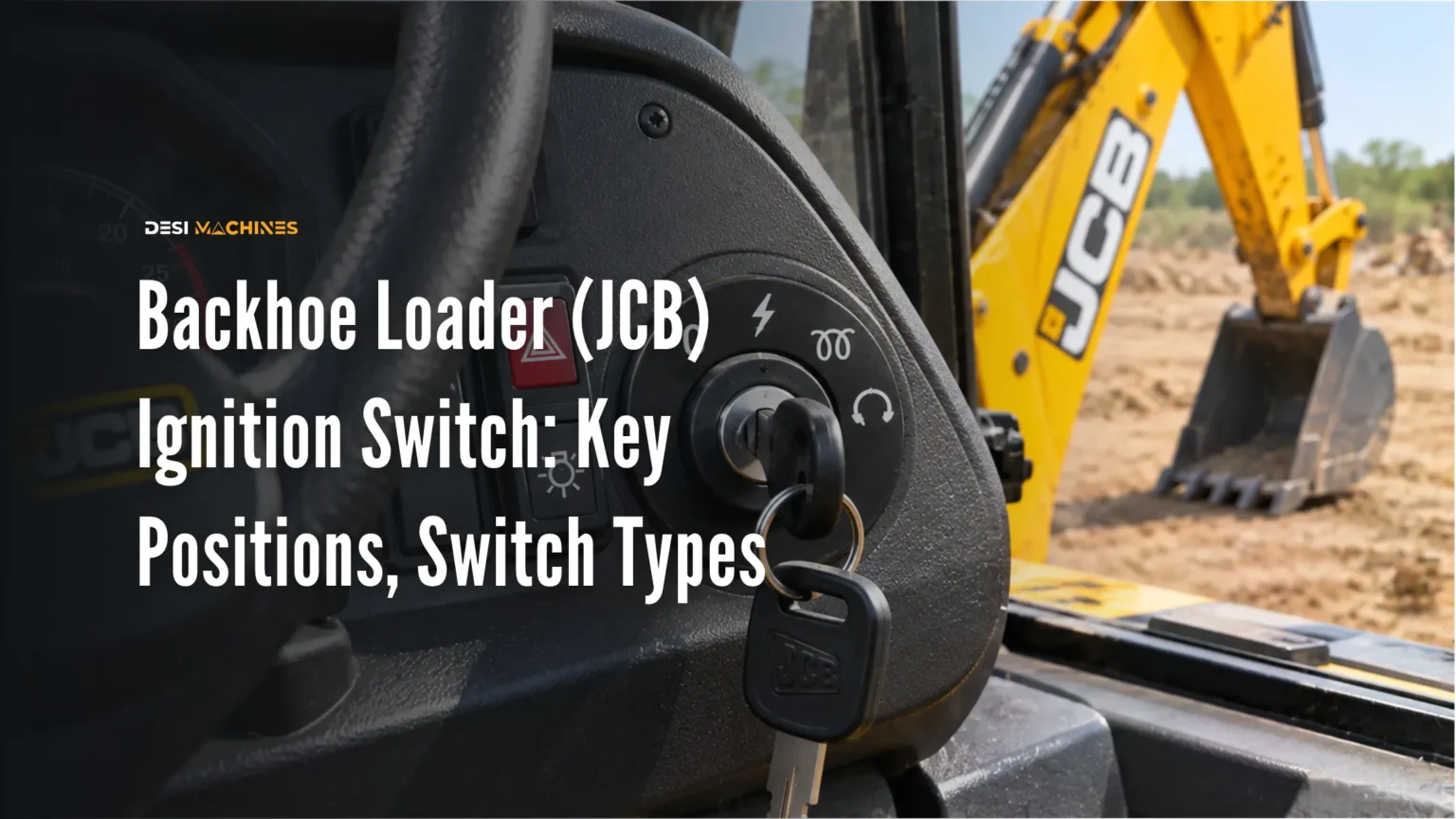
Count the stops on a backhoe loader’s key barrel and you get four on some machines and three on others. The ignition switch, which most handbooks call the starter switch, is a rotary selector rather than an on-off tap: every stop connects the battery to a different set of circuits, and on the machines with a fourth stop one of those circuits is a heater.
A backhoe loader, which most people in India simply call a JCB, carries the same kind of switch as an excavator of similar age. One click wakes the dashboard. A further turn either warms the engine or spins the starter, depending on the make.
This guide covers what each position feeds, the three start arrangements sold in India today, the battery isolator that sits behind all of them, how a small switch reaches a starter motor that draws hundreds of amps, the faults that point at the switch rather than the battery, and what moves the price of a replacement. Position labels below are quoted from two makers’ own handbooks. Because the right switch depends on the exact machine, a backhoe loader spare parts request starts from the serial number rather than from a part name.
What do the positions on a backhoe loader ignition switch do?
Each position connects the battery to a different group of circuits, and the two patterns in use differ over where preheating lives. JCB’s operator handbook for the 4CX backhoe loader describes a starter switch with four positions, marked O, I, II and III, and says the key can be removed only with the switch set to O. Caterpillar’s Operation and Maintenance Manual for the E-series backhoe loaders describes an engine start switch with three, marked OFF, ON and START, and keeps preheating on a separate starting aid switch on the right-hand console.
| What the position is for | JCB 4CX handbook | Cat E-series backhoe handbook | What happens there |
|---|---|---|---|
| Stop the engine | O, Off/Stop Engine | OFF | The engine stops. The key goes in and comes out only here. All instruments power down apart from the hazard warning light indicator. |
| Run and accessories | I, marked IGN | ON | The battery is connected to all the electrical circuits except the lights and the four-way flashers, which stay permanently live. The key springs back here when released from the positions beyond it. |
| Warm a cold engine | II, Heat Position | Not on the key. A separate starting aid switch does this job. | On the JCB machine, holding the key here warms the engine induction manifold for cold-weather starting. The handbook says not to hold it for more than 15 seconds. |
| Turn the engine over | III, Start Position | START | The starter motor turns the engine. JCB’s handbook says not to operate the starter for more than 20 seconds at a time, and to let it cool for at least two minutes between attempts. |
Two behaviours in those handbooks are worth knowing before you call a switch faulty. On the Cat machine, with the engine not running, the indicator lights and the fault alarm stay on until the switch is turned to OFF, so a dash that will not go quiet is doing what it was designed to do. And if the engine fails to start, that manual says the key must be returned to OFF before the next attempt, not held or wiggled at START.
The running position is also what powers the everyday controls. On the JCB machine the horn, the direction indicators, the windscreen wiper, the washer and the cab heater fan all work only with the starter switch at position I, so when several of those die together the switch or its feed is the better suspect than each item in turn. What the panel records while all this happens is covered in the guide to the hour meter.
Labels change by model and by year. The other makes sold in India, among them ACE, Bull, CASE, Escorts, Mahindra, Manitou, Tata Hitachi and BEML, follow one of these two patterns, but the markings are not interchangeable and the machine’s own handbook is the authority.
Why does the key spring back on its own?
Because the positions past the running stop are momentary, held only while your hand holds them. The running position is a detent, a notch the barrel rests in. Heat and Start are spring-loaded, and JCB’s handbook notes that the key springs back to IGN when released from either.
That is a protection, not a convenience. A starter motor is built to run for seconds at a time, and the handbook’s two limits, 15 seconds on heat and 20 on crank, exist because both circuits make heat faster than they lose it. A key that stays at START after you let go is a failed return spring or a worn barrel, and it is one of the few switch faults that damages other parts while you decide what to do about it.
What is the difference between a key switch, push-button start and a keypad system?
The key switch is the arrangement on nearly every backhoe loader and excavator working in India, and the other two change who is allowed to start rather than how the engine starts. A push-button layout splits the job: a button handles cranking while the ignition feed comes from a separate switch or from the machine’s electronics. A keypad adds a code to the same circuit, so the key can be correct and the machine will still refuse to start until the code is entered. Caterpillar’s own 2024 specalog for the Cat 416 backhoe loader, document AEHQ8332-03, lists a security system keypad among the machine’s optional equipment.
| Arrangement | What the operator does | Where the fault usually sits |
|---|---|---|
| Key switch, three or four positions | Turns one key through every stage | Worn contacts inside the barrel, a loose connector block behind the dash, water in the barrel |
| Push-button start with a separate ignition feed | Switches on, then presses a button | The button itself, or the relay it drives; the ignition feed is a separate fault to chase |
| Keypad or immobiliser in the start circuit | Switches on and enters a code | A forgotten or changed code, a flat battery that cleared the module, or the module’s own wiring |
An immobiliser is an electronic lock sitting inside the start circuit, so a machine fitted with one and refusing to crank may be locked rather than broken. Establish which arrangement a machine has before pulling the dash apart, and on a used machine ask for the codes in writing at handover.
Is the battery isolator switch the same as the ignition switch?
No. They sit at opposite ends of the same supply and do opposite jobs. The battery isolator, also called the battery disconnect or master switch, is a heavy mechanical switch in the battery cable itself, usually beside the battery box or under a side panel. Turning it off cuts the whole machine off from the battery. Caterpillar’s manual puts its purpose plainly: with the battery disconnect switch at OFF, disconnecting the battery will remove the ignition source in the event of an electrical short. Use it for storage, before removing a battery, and before any electrical work.
The ignition switch carries no such current. It is a light-duty control switch on the dash that chooses which circuits the supply reaches. Cut the isolator and the ignition switch does nothing at any position, which is why a machine that shows no lamps at all is often an isolator or a main fuse rather than a switch. A machine running on 12 volts needs different parts on both sides of that supply from one running on 24, a question settled in the guide to machine batteries.
One warning from the JCB handbook belongs here. Even with the starter switch set to off, some circuits are energised once an external power supply is connected, so every switch in the cab should be set to off before booster cables go on. Jump-starting a machine with the key left at the running position is how an otherwise healthy switch and its fuses get damaged.
How does the ignition switch reach the starter motor?
Through a relay, because the switch is not built to carry starter current. A starter on a backhoe loader draws hundreds of amps for a few seconds. The wires behind the key handle a few. So at the crank position the switch closes a small circuit to the starter solenoid, and that solenoid closes the heavy contacts between the battery and the self motor, the name Indian mechanics use for the starter. One thin wire commands a very thick one.
The battery feeds a mechanical isolator switch. A thick heavy-current path runs from the isolator through the starter solenoid to the starter motor. A thin control path runs from the isolator to the ignition switch, which feeds the instruments and engine control unit, the preheat relay, the fuel stop solenoid, and a thin command wire to the starter solenoid. Safety interlocks sit in that command wire.
Battery12 V or 24 V
Ignitionswitch
Batteryisolator
Instruments and ECU
Preheat relay
Fuel stop solenoid
Startersolenoid
Starter motor(self)
Safety interlocks sit in this command wire
Heavy current
Control current
Reading that flow in the right order saves hours of guessing. The thick path exists whether the key is in the machine or not, which is why a loose battery earth or a dead isolator produces a machine with no lamps and no click. The thin path only lives when the key is turned, which is why a switch fault shows up as a dash that behaves differently depending on how the key sits.
The running position feeds a longer list. It powers the instrument panel and the warning lamps. On an older mechanical diesel it energises the fuel stop solenoid, which has to be held open for fuel to reach the injectors, so a switch that loses its running feed stops the engine as surely as turning the key off. On an electronic engine it wakes the engine control unit and the sensors that report to it. Where a fourth position exists, it feeds the preheat circuit and its relay, explained in the guide to the heater plug.
Safety interlocks sit in series with the crank circuit, and this is the part that catches people out. JCB’s handbook states the engine will only start if the forward and reverse lever is at neutral. Caterpillar’s manual requires the transmission control lever at NEUTRAL and the hydraulic control levers at HOLD before the switch is turned at all. A neutral switch or a seat switch that has failed therefore behaves exactly like a dead ignition switch: lamps on, nothing at crank. Test the interlocks before condemning the barrel.
Everything in that chain travels through a harness, its fuses and its relays, and on an older machine the harness is the likelier culprit of the two. Loom faults and how they differ from a switch fault are covered in the guide to the wiring kit. Before a machine change, compare backhoe loaders and excavators listed in India by engine and electrical specification.
What are the signs of a failing ignition switch?
A switch fault changes with how the key sits, and that is what separates it from a battery or starter fault. If the engine dies when the key or the steering column is knocked, or the lamps dim as the key moves through its travel, the contacts inside the barrel are worn. A battery fault dims the lamps and slows the starter instead. A starter fault gives you healthy lamps and one solid click with no rotation.
| What you notice | What it points to | First check |
|---|---|---|
| Nothing at all at any position, no lamps | The supply to the switch, not the switch | Battery isolator, main fuse, battery terminals and earth strap |
| Lamps come on at the running position, nothing at crank | The crank leg of the switch, the starter solenoid, or a safety interlock | Gear lever in neutral and levers at hold, then the interlock switches, then the relay |
| Engine cuts out when the key or the column is knocked | Worn contacts, or a loose connector block behind the barrel | Grip the connector and wiggle it with the engine idling |
| Warning lamps flicker or dim as the key moves | Poor contact inside the switch | Voltage at the switch output while turning the key |
| Key will not spring back from crank | Broken return spring or a worn barrel | Stop using the machine; the starter can stay engaged |
| Key will not come out at off | Barrel wear, or the switch not reaching its off stop | Whether the dash goes fully dead; the machine may stay partly live |
| Engine starts but the dash stays dead | The running leg has failed while the crank leg still works | Fuses on the instrument feed, then the switch output |
| Cranks only while the key is pressed hard into position | Contacts worn to the point of needing pressure | Replace the switch; this one does not come back |
Three of those rows are not switch faults at all, which is the reason to work through them in order. For the full walk through of a machine that will not start, including fuel and compression, see the guide to a backhoe loader starting problem.
Why do ignition switches fail on Indian sites?
Dust and water reach the barrel, and vibration reaches everything behind it. Fine grit blown into a cab works into the keyway and grinds the barrel oval over a few thousand hours. Washing a cab down with a hose, or a monsoon through an open window, puts water on contacts that were only ever protected against splashes. Neither failure is sudden, which is why a switch usually gets worse for months before anyone replaces it.
Four habits shorten its life further. A heavy keyring hanging off the key levers the barrel every time the machine crosses rough ground. Long repeated cranking heats the crank contacts, which is what the handbook’s 20-second limit is protecting. Jump-starting with switches left on puts current where the switch did not expect it. And accessories spliced into the ignition feed, a music system or extra lamps taken off the nearest live wire, load a switch rated for instruments and nothing more. Give accessories their own fused feed.
Which switch fits your machine, and what moves its price?
Fitment is decided by the machine, not by the part’s appearance, and two switches that look identical can have different terminals behind them. Before ordering, have ready the make, model and variant, the machine serial number, the system voltage of 12 or 24 volts, the number of terminals on the back of the existing switch, whether the machine has a preheat position on the key, whether the barrel and the electrical block are sold as one assembly or separately, and whether a keypad or immobiliser module sits in the circuit. Sizes and fitments quoted in any guide are indicative and vary by variant, model year and market, so confirm the part against the machine’s own serial number with the OEM or an authorised dealer before ordering.
The cost moves with the number of positions and terminals, whether the part is a bare barrel or a complete assembly supplied with keys and connector, whether it is specific to one engine family or shared across a maker’s range, whether a security module forms part of it, and whether the connector block or a length of harness has to be renewed alongside it. A dealer quotes against the machine details listed above.
Two choices are worth making deliberately. Where the barrel is worn but the electrical block tests clean and the maker sells them separately, replacing the barrel alone is the quicker repair. Where the machine dies when the column is knocked, replace the switch rather than re-crimping the connector. Cleaning a contaminated barrel buys weeks, not seasons.
When a machine change is the better answer than another repair, compare how two common backhoe loaders are equipped in the JCB 3DX vs CASE 770 NX comparison, or look at the JCB 3DX, the JCB 2DX and the Tata Hitachi EX 210 Infra by engine and electrical specification. Other electrical parts, from the sensors to the starter and alternator, sit together in the parts guide, alongside the wider range of spare parts by machine.
Where the facts in this guide come from
Position labels, the 15-second heat limit, the 20-second cranking limit, the neutral requirement and the jump-starting warning are quoted from JCB’s operator handbook for the 4CX backhoe loader. The OFF, ON and START labels, the fault-alarm behaviour, the return-to-off rule, the lever positions required before starting and the battery disconnect wording are from Caterpillar’s Operation and Maintenance Manual SEBU8475-10 for the 422E, 428E and 434E backhoe loaders. The security system keypad is listed as optional equipment in Caterpillar’s specalog AEHQ8332-03. Handbooks for individual models differ, and your own machine’s handbook outranks anything written here.
Sources: Caterpillar, Operation and Maintenance Manuals (SEBU8475-10, backhoe loaders); Caterpillar, Cat 416 Backhoe Loader specalog AEHQ8332-03 (08-2024). JCB 4CX operator handbook, machine section. Machine and electrical details are taken from our listings at the time of writing. Specifications and features are indicative, vary by variant, location and date, and should always be confirmed with the official OEM or authorised dealer before any purchase decision. DesiMachines is not liable for decisions taken on the basis of information that may have changed after publication.
Get an ignition switch price from a dealer near you
Tell us your machine and what you need, and we will ask the nearest dealer to reach out to you with a price.