
 Excavator
294 models
Excavator
294 models  Backhoe Loader
51 models
Backhoe Loader
51 models  Crane
68 models
Crane
68 models  Concrete Mixer
79 models
Concrete Mixer
79 models  Wheel Loader
54 models
Wheel Loader
54 models  Compactor / Roller
45 models
Compactor / Roller
45 models  Motor Grader
42 models
Motor Grader
42 models  Dozer
41 models
Dozer
41 models  Concrete Pump
66 models
Concrete Pump
66 models  Skid Steer Loader
11 models
Skid Steer Loader
11 models  Telehandler
13 models
Telehandler
13 models 


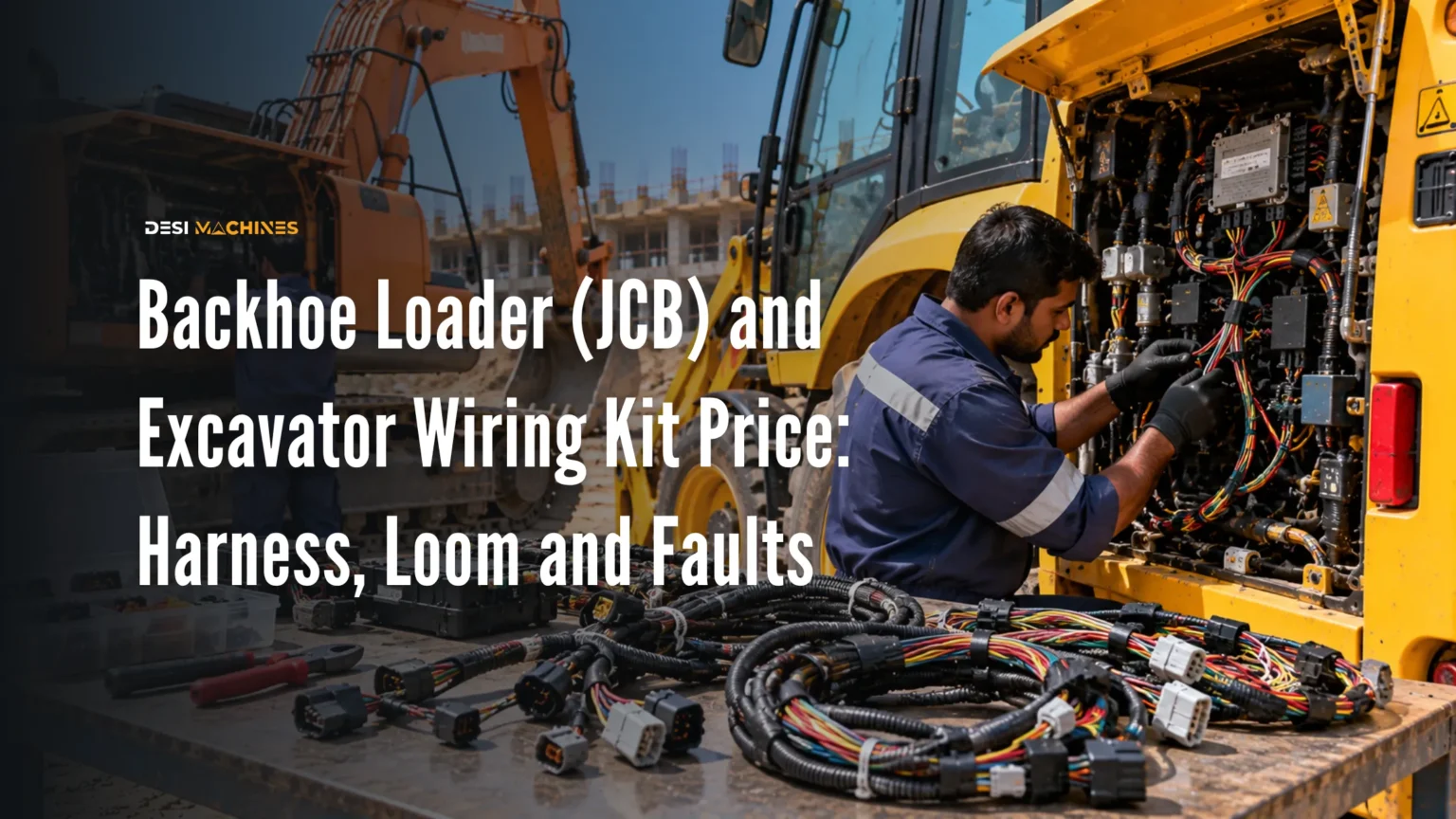
A backhoe loader whose dash lights flicker when the boom swings, whose fuse blows again a week after it was changed, or whose gauges go dead after a night of rain, has a wiring fault and not a battery fault. The JCB wiring kit price a seller quotes for such a machine is a price for one whole bundle: the wiring kit, also called the wiring harness or simply the loom, is the set of cables, connectors and fuse box that carries power and signals from the battery to every lamp, gauge, switch and sensor.
Most people say “JCB” when they mean any backhoe loader, and that is how this guide uses the word. It covers backhoe loaders and excavators of every make: what a harness is, what is inside a kit, why machine wiring fails on Indian sites, how to separate a wiring fault from a battery or starter fault, which cable belongs on a machine, and what moves the cost.
What is a wiring harness on a machine?
It is a bundle, not a set of loose wires. A cable harness is an assembly of cables bound together with tape, sleeving or conduit so they run as one piece and can be fitted as one piece. The same object has five or six names in the trade, and all of them mean this bundle: wiring harness, wire harness, wiring loom, cable assembly, wiring kit.
On a machine the bundle is not one single harness either. It is usually built in sections that plug into each other, and the names below are the names a parts counter will use:
- The main harness, which runs from the battery box through the chassis to the fuse box and the dashboard.
- The engine harness, which feeds the starter, the alternator and, on newer machines, the engine sensors and the control unit.
- The dash or cab harness, which serves the key switch, gauges, switches, horn, wipers and the blower.
- The rear or backhoe harness, which carries the rear work lamps, the beacon and the reverse horn.
- The earth straps, the thick braided cables that bond the engine and the frame back to the battery negative.
Two more items sit inside the bundle rather than beside it. The fuse box is the plastic block where the circuits split and each one gets its own fuse. The relays are small switches that let a thin dashboard wire control a heavy load, so the heavy current never passes through the switch in your hand.
What is inside a wiring kit?
What a seller means by “full wiring kit” varies, and that is the first question to settle. Some kits are one named section, such as the engine harness alone. Others are the whole machine. Ask for the list before anything else.
How power reaches each part of a backhoe loader
Battery
+ and earth
Isolator and
main fuse
Fuse box
and relays
circuits split here
Engine: starter, alternator, sensors
Dashboard: gauges, switches, horn
Front: loader lamps, road lights
Rear: backhoe lamps, beacon, horn
Earth strap: every circuit returns through the frame to the battery negative
Reading the figure: current leaves the battery, passes the isolator and the main fuse, and splits at the fuse box into separate circuits, each with its own fuse. Every circuit returns through the frame to the battery negative by way of the earth strap. A break on that return path stops a circuit just as surely as a break on the supply side, which is why a rusted earth bolt imitates almost every other electrical fault.
A kit is more than cable. It should carry the connectors and their seals, the rubber grommets that protect a cable where it passes through a steel panel, the P clips that fix the bundle to the chassis, the sleeving, and the fuse box with its fuses and relays. Those small parts decide whether a harness lasts years or chafes through in a season, so check they are in the box.
Why does machine wiring fail in India?
Rarely because the copper wore out. Machine wiring fails at the places where it is rubbed, cooked, soaked or disturbed, and five causes cover most of what a workshop sees.
Rubbing. A backhoe loader bends in the middle and swings at the rear, so parts of the bundle move every time the machine works. Where a clip has gone missing the cable rests against a sharp edge, the insulation wears away over a few thousand cycles, and the bare copper finally touches steel.
Heat. The exhaust manifold and the turbo run far hotter than anything else under the bonnet. A cable that has slipped out of its clip and come to rest against the manifold hardens, cracks and lets go, usually in the middle of the hottest week of the year.
Water and dust. Connectors are sealed when they are new. After a few monsoons, a few pressure washes aimed straight at the engine bay, and a season of dust, the seals harden and water sits on the pins. A corroded pin passes enough current for a lamp and not enough for a solenoid, which produces faults that come and go with the weather.
Animals. A machine standing idle for weeks in a yard or at the edge of a field is a dry, sheltered place to nest. Lift the bonnet after any long stand and look for droppings, nesting material and chewed insulation before you turn the key.
Earlier repairs. This is the one that turns a small fault into a full kit. Joints twisted together and wrapped in tape let water in. A fuse replaced with a larger one, or with a piece of wire, removes the protection the circuit was designed around. Each shortcut works for a while and leaves the next person a harder job.
| What you see | What it usually means | Where to look first |
|---|---|---|
| Lights or gauges flicker when the machine moves or the boom swings | A cable is being pulled or rubbed as the machine articulates | Clips and grommets at the centre pivot, the loader arms and the rear frame |
| The same fuse blows again within days | A wire is shorting to the frame somewhere on that circuit | The circuit the fuse serves, at its rubbing points, not the fuse box |
| The fault appears after rain or a wash and clears when dry | Water is sitting on connector pins | Connectors low on the machine, and any with a hardened or missing seal |
| Gauges or lamps dead but the engine runs normally | A broken or corroded earth on that part of the machine | Earth strap ends, and the earth points behind the dash |
| A smell of hot plastic, or insulation gone brown and stiff | A circuit is carrying more current than its cable size allows | Any accessory added later, and the fuse rating protecting it |
| Several unrelated circuits playing up at once | A shared feed, a shared earth, or past repairs through the bundle | The main feed, the main earth, and every taped joint you can find |
How do you tell a wiring fault from a battery or starter fault?
By whether the fault moves. A flat or loose battery makes everything weak at the same time, every time. A wiring fault is selective and it comes and goes: one circuit affected and the rest fine, or the whole machine fine until the boom reaches a certain position.
Check the cheap things first, because they are the common answers and they are not harness work. On a backhoe loader that will not turn over at all, the shuttle lever and the battery terminals solve most calls, which the guide to a backhoe loader that will not start works through step by step. The same ground for tracked machines is covered in excavator fault-finding by symptom. If the machine is fine on the key but a charge lamp stays on, that is the charging circuit rather than the loom, and the guide to 12 volt and 24 volt machine batteries explains what the alternator and the battery each do. A coded fault on the display belongs with the dashboard warning lights, which name the circuit for you.
Only when those come back clean is it worth opening the bundle. Before anyone cuts anything, ask which single circuit is affected and what the machine was doing when the fault appeared. That pair of answers usually points at one metre of cable.
Which cable belongs on a machine?
India has a standard for it, and almost nobody asks about it. IS 2465:1984, Cables for Motor Vehicles, published by the Bureau of Indian Standards and reaffirmed in 2006, sets out what automotive cable has to be made of and what it has to survive. It covers general wiring cable for systems up to 100 V, which takes in every 12 volt and 24 volt machine on an Indian site.
Four of its requirements matter when you are looking at a kit. The conductor must be copper built to flexibility Class 5, which means many fine strands rather than one solid wire, because a stiff cable breaks where a machine flexes. The insulation is PVC or elastomer, applied so it grips the conductor yet strips off without nicking the copper. Cores are identified by colour, and the standard lists the scheme: a single-core cable in black, blue, brown, green, grey, orange, red, violet, white or yellow, a two-core in red and black, a three-core in red, white and blue. And the cable is tested in ways that match its working life: twelve hours immersed in water and then 3 kV applied for five minutes without breakdown, plus a type test for the effect of lubricating oil, brake fluid, diesel and petrol.
That last test is the useful one for a buyer. Cable on a machine lives in diesel mist and oil spray, and cable never tested against them goes soft and sticky.
| Nominal cross-section | Approximate conductor diameter | Nominal insulation thickness |
|---|---|---|
| 0.5 mm² | 0.93 mm | 0.6 mm |
| 0.75 mm² | 1.14 mm | 0.6 mm |
| 1.0 mm² | 1.32 mm | 0.7 mm |
| 1.5 mm² | 1.6 mm | 0.7 mm |
| 2.5 mm² | 1.6 mm | 0.7 mm |
| 4 mm² | 2.6 mm | 0.8 mm |
| 6 mm² | 3.6 mm | 0.8 mm |
That is the small end of the standard’s list, which continues up through the heavy sizes used for starter and earth cable. Cross-section is the amount of copper in the wire, written in square millimetres, and it sets how much current the wire carries without heating. It is why a lamp circuit and a starter circuit never share a cable size, and why fitting whatever was on the shelf is a fire risk rather than a saving.
Repair one wire, or fit a full kit?
Repair when you know where the fault is and the rest of the bundle is sound. A single break at an identified point deserves a proper joint: the ends crimped in a metal sleeve, covered with heat-shrink sleeving rather than tape, and the cable clipped back on its original route so it does not rub through again next to the old scar.
Fit a kit when the bundle itself has stopped being trustworthy. Three signs say so. Insulation that is brown, hard or cracked along a length, rather than at one point, has been cooked and will fail again elsewhere. More than a handful of taped joints means somebody has already been hunting faults through this harness. And a harness with lengths missing, circuits re-routed or connectors cut off cannot be fault-found at all, because the machine no longer matches any diagram.
There is a middle answer that often gets missed. Because the wiring is built in sections, you can usually replace one section, such as the engine harness, and keep the rest. Ask whether your machine’s loom is available in parts before accepting a quote for all of it. Either way the labour counts as much as the part, because fitting a harness means stripping panels, releasing every clip, threading the bundle through the chassis and proving each circuit afterwards.
What decides the price of a wiring kit?
Six things, and none of them is printed on a spec sheet.
How much of the machine the kit covers. One sub-loom and a whole-machine kit are different orders of work and different bills.
The model, the year and the serial number. A dealer cannot pick a harness from the model name alone. Looms change within a model’s life, and a JCB 3DX, a JCB 4DX and a tracked machine such as the Tata Hitachi EX 210 Infra each carry their own. Give the serial number when you ask.
What was fitted at the factory. A closed cab with a blower, wipers and air conditioning, work lamps and a beacon needs more branches, more connectors and more fuses than a plain canopy machine. A fitted telematics unit adds its own.
The emission stage. An older mechanical engine needs little more than a starter and charging circuit. A machine built to the newer CEV emission norms carries an engine control unit with sensors on fuel, air, temperature and exhaust, and the harness that serves them has many more pins and sealed plugs.
The connectors. Sealed multi-pin connectors cost more than open spade terminals, and they are the reason a properly made harness survives a monsoon.
The current the machine has to carry. The alternator sets the ceiling on everything the wiring feeds. Eighteen of the 51 backhoe loaders listed in India publish an alternator output, and those figures run from 90 A to 130 A. Load a circuit past what its cable size allows and the cable, not the alternator, is what gives way.
This is a general guide to how machine wiring is built and priced. Always confirm the correct harness and part numbers for your machine with your operator manual, the dealer or the manufacturer before buying or fitting.
On a used machine the wiring is the cheapest thing to check and one of the dearest to put right, so read the used equipment inspection checklist before you pay.
How do you keep a harness alive?
Habits decide most of a harness’s life, not parts.
- Put every clip and grommet back after any job that disturbs the bundle. A cable left hanging is a cable that will chafe.
- Use the fuse rating printed on the box. A larger fuse cures nothing, it only moves the damage from the fuse to the cable.
- Feed anything you add, such as extra lamps or a charging socket, through its own fuse, never straight off a battery terminal.
- Keep the earth strap ends clean and tight. A wire brush and a spanner prevent faults that otherwise cost a day of diagnosis.
- Do not aim a pressure washer into the engine bay or at a connector. Wash the machine, not its electrics.
- Turn the isolator off when a machine will stand for weeks, and look for nesting before the next start.
- Put a torch over the bundle at each service, alongside the rest of the spare parts checks. Five minutes finds chafe before it finds you.
Where the wiring sits in relation to everything else is set out in the guides to backhoe loader parts and excavator parts. And if the machine is old enough that one fault follows another, weigh the cost of chasing them against replacing it: the backhoe loaders and excavators listed in India are a phone call from a dealer quote.
A note on the figures in this guide
The machine counts come from the specification sheets on the backhoe loader and excavator listings on this site, read in October 2026: 51 backhoe loaders and 294 excavators. Eighteen of the backhoe loaders publish an alternator output in amps, between 90 A and 130 A, and 32 more name the alternator without giving a figure.
One absence explains why a dealer asks for your serial number. Not one of those 345 machines publishes a wiring, harness, fuse, lamp, sensor or control-unit entry in its specification; the battery and the alternator are the only electrical items listed anywhere. A harness is identified from the machine’s own records, never from a published spec sheet.
The cable requirements, sizes, colour scheme and tests are quoted from IS 2465:1984, Cables for Motor Vehicles, clauses 1.1, 3.1, 6.1, 6.1.1, 7.3, 8.1, 12.1 and 14.1 to 14.3, and Table 1.
This guide gives no part prices. A harness is priced against a machine’s model, year, serial number and option fit, so a printed figure would be wrong for most readers on the day they read it.
Prices, specifications and features are indicative, vary by variant, location and date, and should always be confirmed with the official OEM or authorised dealer before any purchase decision. DesiMachines is not liable for decisions taken on the basis of information that may have changed after publication.
Get a wiring harness price from a dealer near you
Tell us your machine and what you need, and we will ask the nearest dealer to reach out to you with a price.