
 Excavator
294 models
 Backhoe Loader
51 models
 Crane
68 models
 Concrete Mixer
79 models
 Wheel Loader
54 models
 Compactor / Roller
45 models
 Motor Grader
42 models

 Concrete Pump
66 models
 Skid Steer Loader
11 models


A backhoe loader, which most people in India call a JCB, that cranks but will not start, or starts and then drops to low power with a warning light on, very often has a sensor fault rather than a broken engine. Sensors are the small electrical parts that measure speed, temperature and pressure and report them to the engine’s computer (the ECU) and to the dashboard, and on a modern machine the engine will not run properly without them.
How many sensors a machine carries depends on its engine. An older mechanical engine has a handful of simple switches and gauge senders. An electronic common-rail engine has many more, because the ECU decides how much fuel to inject from what the sensors tell it, many times every second.
This guide covers the sensors found on backhoe loader and excavator engines and hydraulics, what each one reads, the signs that one has failed, how a mechanic tells a bad sensor from a bad part, and what decides which sensor fits your machine. It carries no prices; the part number depends on the exact engine, and a dealer quotes against that.
Which sensors does a backhoe loader or excavator have?
The table lists the common ones. Not every machine has all of them: the bottom rows appear only on electronic engines, and the last two only on engines with an exhaust after-treatment system.
| Sensor | Where it sits | What it tells the machine | Usual sign when it fails |
|---|---|---|---|
| Crankshaft speed and position sensor | Facing a toothed wheel on the flywheel or crankshaft | Engine speed and where each piston is, so the ECU can time injection | Electronic engine cranks but will not start, or cuts out when hot |
| Camshaft position sensor | Front or top of the engine, near the camshaft | Which cylinder is on its firing stroke, used to synchronise at start | Long cranking before it fires, engine warning light |
| Coolant temperature sensor | Thermostat housing or cylinder head water jacket | Engine temperature, for cold-start fuelling, the gauge and overheat protection | Hard cold start, black smoke, false overheat warning or a gauge stuck at one end |
| Oil pressure switch or sensor | Engine block, on the main oil gallery | Whether the engine has oil pressure (a switch) or how much (a sensor) | Oil warning lamp on while the oil level and pressure are fine, or no lamp at all |
| Fuel level sender | Inside the fuel tank | How much diesel is left | Gauge reads empty or full whatever is in the tank |
| Water-in-fuel sensor | Bottom of the fuel filter or water separator bowl | That water has collected in the fuel | Lamp stays on after the bowl is drained, or never comes on |
| Boost pressure and intake air temperature sensor | Intake manifold, after the turbo (turbocharged engines) | How much air the turbo is pushing in and how hot it is | Low power, black smoke, engine warning light |
| Fuel rail pressure sensor | On the common rail (common-rail engines only) | Fuel pressure in the rail, which the ECU holds at its target | Loss of power, stalling, engine running in reduced-power mode |
| Exhaust temperature sensors | In the exhaust, before and after the filter (engines with DOC and DPF) | Exhaust heat, used to manage filter cleaning | Filter cleaning warnings that do not clear |
| DPF differential pressure sensor | Pipes either side of the diesel particulate filter | How blocked the soot filter is | Frequent cleaning requests, reduced power |
Figure 1: where the sensors sit, grouped by what they watch (illustrative, not a wiring diagram)
An older mechanical engine has no ECU box: its few switches and senders wire straight to the dashboard.
Two words in that table need explaining. DOC (diesel oxidation catalyst) and DPF (diesel particulate filter) are parts in the exhaust that clean it before it leaves the machine; the DPF traps soot and burns it off from time to time. Reduced-power mode, often called derate or limp mode, is what the ECU does when a reading goes missing or makes no sense: it cuts power to protect the engine until the fault is fixed.
The machine has gauges and lights for some of these readings, and the instrument cluster and hour meter guide covers what to do when the fuel or temperature gauge reads wrong.
What does the crank sensor do, and why does the engine stop without it?
The crank sensor is the one sensor an electronic engine cannot run without. It faces a toothed wheel that turns with the crankshaft, and each tooth passing it produces a pulse. From those pulses the ECU works out the engine speed in rpm and the exact position of every piston, and it uses that to decide the moment to fire each injector.
Lose that signal and the ECU has no idea when to inject, so it injects nothing. That is why a crank sensor fault so often shows up as an engine that turns over strongly on the starter but never fires, or one that runs fine when cold and cuts out once it is hot, which is when a cracked sensor or a loose wire tends to open up.
The camshaft sensor works alongside it. A four-stroke engine turns the crankshaft twice for every firing, so the crank sensor alone cannot tell the ECU whether a piston at the top is on its firing stroke or its exhaust stroke. The cam sensor settles that at start-up. These roles are standard across diesel and petrol engines, and the reference article on the crankshaft position sensor describes the sensor types (inductive, Hall-effect and others) and the same failure signs.
An older mechanical engine is different. Its injection pump is driven and timed by gears, so it has no crank sensor to lose, and it keeps running even with every gauge dead. That simplicity is one reason some contractors still prefer older machines for remote work.
Which engines carry more sensors?
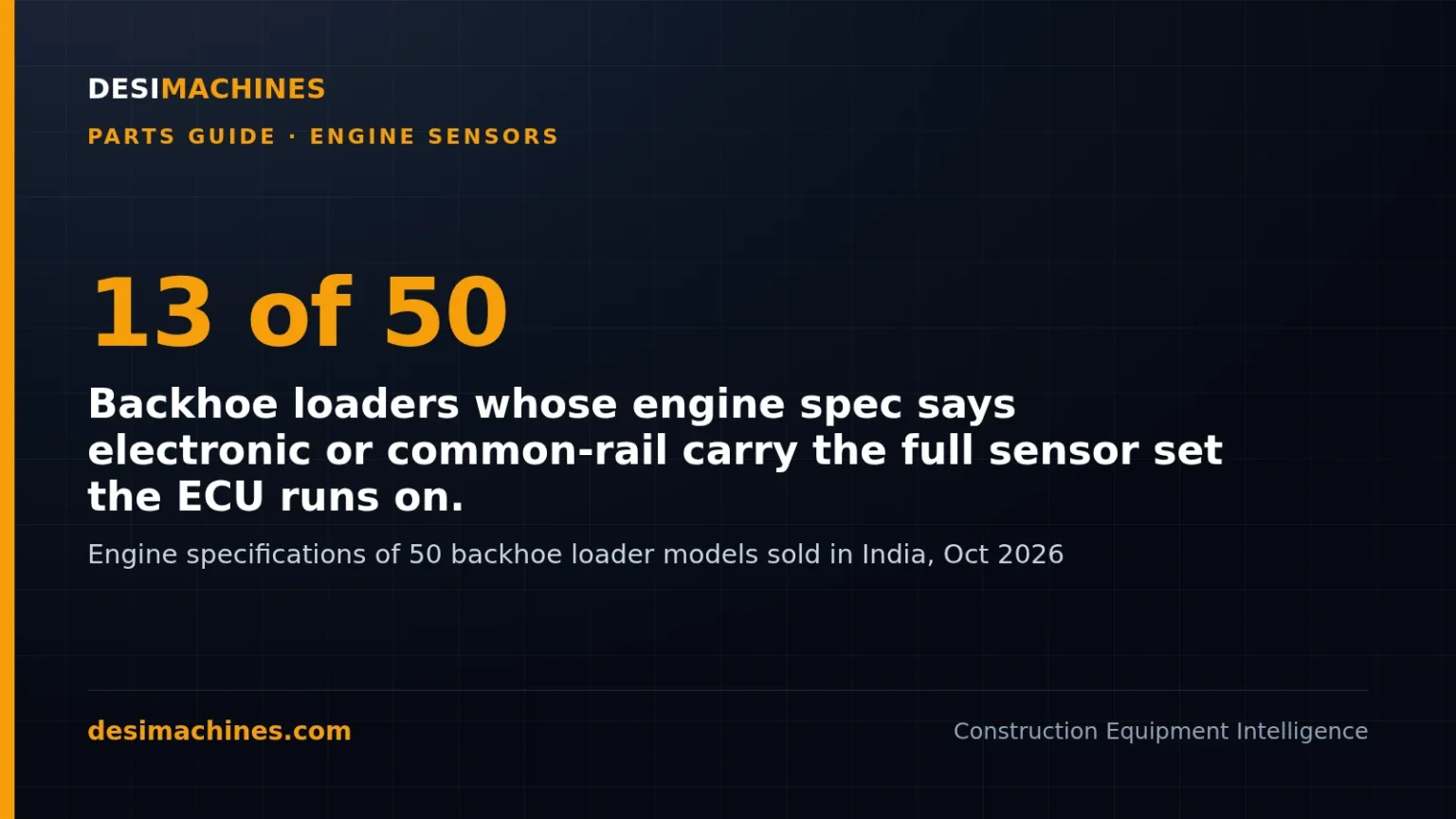
The ones described as electronic or common-rail. We checked the engine specification of 50 backhoe loader models sold in India in October 2026, and 13 of them state that the engine is electronic or common-rail (CRDi). Those are the machines carrying the full set in Table 1.
| Engine type | Examples | Sensors to expect |
|---|---|---|
| Older emission stage (BS-III), no electronic control stated | JCB 2DX (KOEL 4R810, BS-III), ACE AX 124 Eco Master (BS-III) | Usually simple switches and gauge senders: oil pressure, coolant temperature, fuel level |
| Electronic common rail, CEV BS-IV | CASE 770 EX (Ashok Leyland engine, electronic common rail) | Full engine set: crank, cam, coolant, oil, boost, rail pressure, water-in-fuel |
| Electronic common rail, CEV Stage V | CASE 770 NX, Tata Hitachi Shinrai Pro (CRDI), CAT 424 (electronic) | Full engine set, plus whatever after-treatment the engine uses |
| CRDi Stage 5 with EGR, DOC and DPF | JCB 3DX, JCB 4DX (JCB 430 engine) | Full engine set, plus exhaust temperature and DPF pressure sensors |
This is a general guide based on machine size class. Always confirm the fit with your machine’s operator manual or the manufacturer before buying or fitting.
The JCB 3DX family is the clearest case: all five JCB 430 machines listed (3DX, 3DX Plus, 3DX Xtra, 3DX Super and 4DX) describe the engine as turbocharged with EGR (exhaust gas recirculation) and an after-treatment system of DOC and DPF. Each of those systems adds sensors of its own. For how the fuel system itself differs between these engines, see the fuel injector and injection pump guide.
What sensors does an excavator have that a backhoe does not?
An excavator carries the same kind of engine sensors, and then a second group on the hydraulics.
Excavators with an auto-idle feature have pressure switches or sensors on the pilot lines, the small low-pressure lines that carry the operator’s lever movements to the main valve. When every lever is in neutral for a few seconds, the controller reads that through these sensors and drops the engine to idle on its own (auto-idle). Touch a lever and the engine speeds up again. If auto-idle stops working, or the engine stays at idle when a lever is moved, these sensors and their wiring are the first suspects.
Electronically controlled excavators also use sensors on the main pump pressure, which the controller uses to match engine load to the hydraulic demand, and a hydraulic oil temperature sensor that warns before the oil gets hot enough to thin out. The excavator hydraulic pressure and flow guide explains the circuits these sensors watch.
How do you know a sensor has failed, and not the part it watches?
This is the question that saves the most money, because a sensor reporting a fault and the fault itself look the same on the dashboard. A mechanic works through it in this order.
- Read the fault code. Electronic engines store a code for the reading that went wrong. Most dealers and many field mechanics carry a diagnostic tool that reads it. The backhoe loader warning lights guide explains what the dashboard lights mean before you reach that point.
- Check the wiring and the plug before the sensor. On a working site, most sensor faults are not the sensor at all: a plug full of mud or wash water, a corroded pin, a wire rubbed through against the frame, or wiring chewed by rats in a machine parked for weeks.
- Check the real value another way. Fit a mechanical gauge to test oil pressure. Use an infrared thermometer on the thermostat housing to test the temperature reading. Dip the tank to test the fuel gauge. If the real value is fine and the reading is wrong, the sensor or its wiring is at fault.
- Test the sensor against the manual. Many sensors can be checked with a multimeter for resistance or voltage, but the correct value is different for every engine. Use the figure in the engine’s service manual, never a number from another machine.
One warning. Never clear an oil-pressure or overheating warning by unplugging the sensor and carrying on working. If the reading was true, the engine pays for it.
What damages sensors on a construction machine?
Mostly the site, not age. The common causes:
Water. High-pressure washing straight at connectors drives water into the plugs, and water in a plug gives readings that come and go. Wash around them, not at them.
Heat and vibration. Exhaust sensors live at high temperature, and every sensor on the engine shakes for every working hour. Loose mounting bolts and unsupported wires crack sooner.
Rodents. Machines parked on village sites or in yards for weeks are a regular target, and the wiring loom is what gets chewed.
Welding on the machine. Welding on a bucket or boom without disconnecting the battery and following the maker’s procedure can damage the ECU and sensors. The operator manual gives the steps.
Wrong part. A sensor that looks the same and fits the same hole can still have a different range or signal. The ECU then reads a temperature or pressure that is not true.
What decides which sensor fits your machine, and its price?
The engine, not the machine name. Two backhoes from one brand can carry different engines across model years and emission stages, and so different sensors. Before asking for a part, note:
The engine model and serial number from the engine plate, not only the machine model. The emission stage (BS-III, CEV BS-IV or CEV Stage V), since it decides whether the engine is electronic. The part number printed on the old sensor, if it can still be read. Whether the sensor comes with its plug and a short length of wire (a pigtail) or on its own.
The price moves with the type of sensor (a simple on-off pressure switch is a cheaper part than a pressure sensor that reports an exact value), with whether it is made for one engine family only, and with dealer stock for your engine. An ECU is a different matter: replacing or reprogramming one is covered in our guide to JCB ECU repair.
For the full list of backhoe loader models and their engine specifications, browse all backhoe loaders, or see excavators listed in India. Other engine and machine parts are covered in the parts guide.
Engine descriptions are taken from our listings at the time of writing. Specifications and features are indicative, vary by variant, location and date, and should always be confirmed with the official OEM or authorised dealer before any purchase decision. DesiMachines is not liable for decisions taken on the basis of information that may have changed after publication.
Get an engine sensor price from a dealer near you
Tell us your machine and what you need, and we will ask the nearest dealer to reach out to you with a price.