
 Excavator
316 models
 Backhoe Loader
54 models
 Crane
68 models
 Concrete Mixer
79 models
 Wheel Loader
54 models
 Compactor / Roller
45 models
 Motor Grader
42 models

 Concrete Pump
66 models
 Skid Steer Loader
11 models


A white powder or fluffy crust that shows up on a new brick wall after the first rains is almost always efflorescence: salt that was inside the bricks, mortar or sand, carried to the face by water and left behind when the water dried. On a new wall it is usually harmless and brushes off dry. When it keeps coming back, it is telling you that water is getting into the wall from somewhere.
This guide explains what efflorescence is, where the salt and the water come from, when it is only a stain and when it is damaging the wall, how to remove it the way the Indian codes for brickwork and plaster say, and how to stop it in new work.
What is efflorescence in bricks?
Efflorescence is a powdery layer of salt crystals left on a brick, mortar or plaster surface when salty water inside the wall evaporates. IS 2212:1991, the Indian code of practice for brickwork, defines it as “a powdery encrustment of salts left by evaporation”. IS 1661:1972, the code for cement and cement-lime plaster, calls it “a deposit of soluble salts on the surface of the plaster or background”.
Three things have to happen together. There must be salt that dissolves in water somewhere in the wall. There must be water to dissolve it and carry it. And the water must travel to a face and evaporate there. Take away any one of the three and the white deposit cannot form, which is why every cure in this guide works on the salt, the water or the drying path.
The salt does not always reach the outside. IS 2212 notes that when the crystals form just below the surface, the effect is called crypto-florescence. You cannot see it at first, but crystals growing inside the pores push the face off, so the brick or plaster starts to flake and powder.
What causes efflorescence on walls?
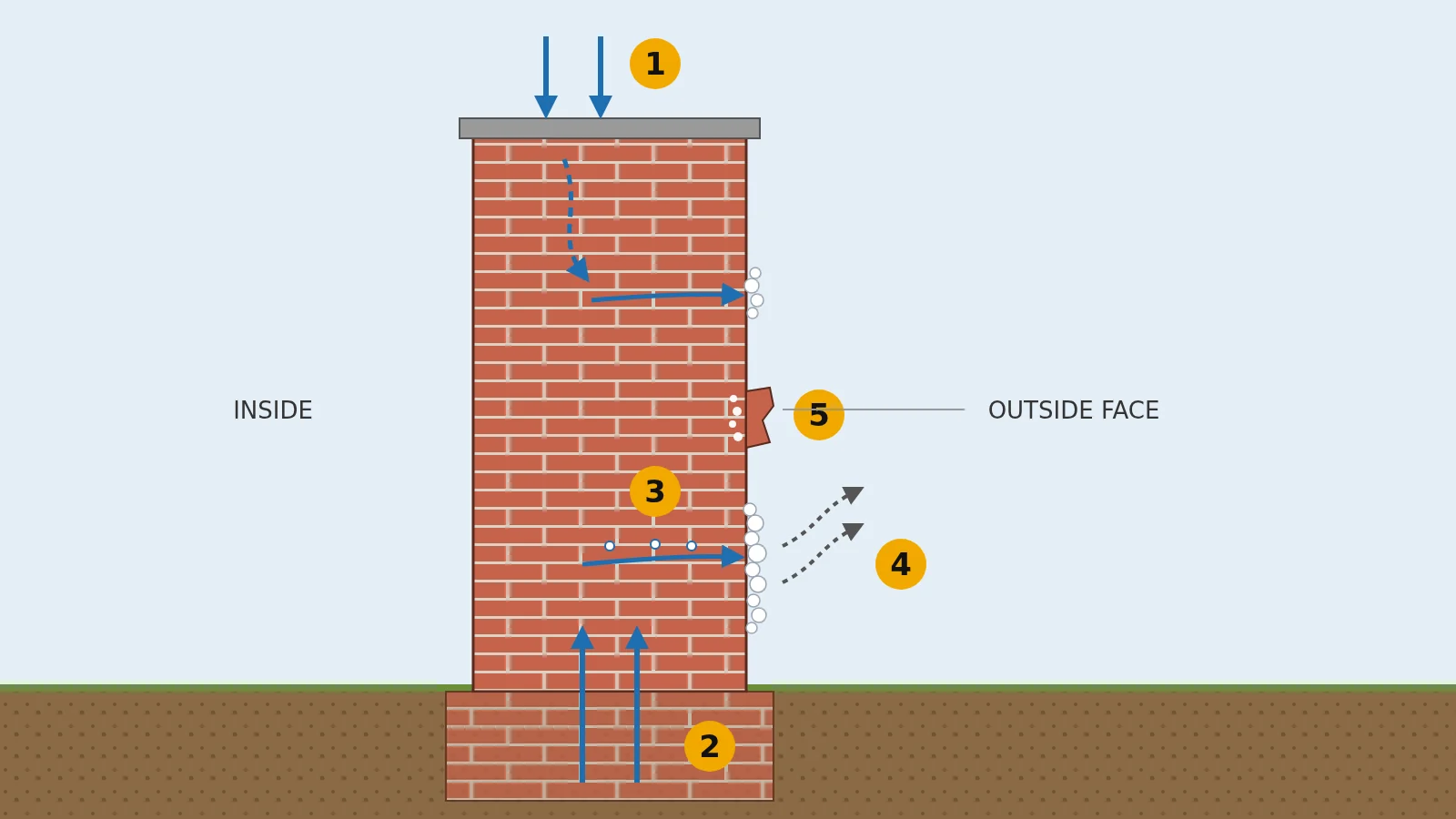
Efflorescence on walls is caused by soluble salts in the bricks, sand, water or cement, moved to the surface by water from construction, rain, the ground or a leak. IS 1661 names the usual salts as sulphates of sodium, calcium and magnesium, “normally in the background”, meaning the brickwork or blockwork behind the plaster.
To fix it you need to know both halves: where the salt came from and where the water is coming from. The table puts the common sources side by side.
Table 1: Where the salt and the water come from
| Source | What happens | What the code says |
|---|---|---|
| The bricks | Bricks that contain soluble salts, mostly sulphates of alkalis, give them up every time water passes through the wall | IS 2212 clause 13.5.1 and Note 1 to clause 6.6.8 |
| Sand | Unwashed sea or river-mouth (estuary) sand brings sea salt into mortar and plaster, which keeps the wall damp because the salt pulls moisture from the air | IS 1661 clauses 7.6.2 and 18.1.1; IS 2116 and IS 1542 rule out harmful amounts of salt in masonry and plaster sand |
| Mixing water | Brackish or sea water used for mortar or curing adds salt directly | IS 1661 clause 4.2: no sea, tidal or brackish water; drinking water is normally suitable |
| Cement and lime | Lime freed as cement and lime mortar harden is carried out and turns white on the face; with time it changes to chalk, which no longer dissolves | IS 2212 clause 13.5.2, Note |
| Construction water | A new wall dries out for weeks and pushes out salts as it does | IS 2212 clause 13.5.2: “a common phenomenon with new construction” |
| Rain | Water enters through parapet tops, cracked copings, open joints and cracks in a rich cement render | IS 2212 clauses 13.2.1 and 13.5.3 |
| The ground | Water with salts rises through the foundation and lower courses where there is no damp proof course | IS 1661 clause 18.2.5.1 |
| Leaks | Bathroom walls, kitchen sinks, water tanks and pipes inside a wall keep one patch wet | IS 2212 clause 13.5.3 |
The same thing happens on concrete, paver blocks and tile grout. Water that moves through any cement-based material can bring lime and salts to the surface, which is why a new floor or a block pavement can turn white in patches during its first few months.
Is efflorescence on a brick wall dangerous?
Efflorescence on a new wall is usually a stain, not damage, and it fades as the wall dries out. IS 2212 says it will be common on new construction, because the water used in building dissolves salts from the bricks and leaves them on the face.
It becomes a warning in three cases.
- It keeps coming back after the first year. IS 2212 clause 13.5.3 says continued efflorescence means water from leaks or similar sources is finding its way into the brickwork, and the entry of water has to be found and stopped.
- The surface is flaking or turning to powder. That is salt crystallising inside the pores. IS 2212 clause 13.5.4 says salts such as magnesium sulphate can make the brick face crumble to dust, and suggests a chemical analysis of the scrapings to find out which salt it is.
- The mortar joints are going soft, cracking or swelling. IS 2212 clause 13.2 describes sulphate attack: sulphates from the bricks react with the cement or lime in wet mortar and render, form new compounds that take up more room, and crack the joints and chip the bricks. Water is essential for this to happen.
Plaster tells the same story. IS 1661 lists blistering, efflorescence, flaking and complete breakdown of plaster as results of water getting through an outside wall, and says that patching or re-plastering without first stopping the water is useless.
Table 2: What you see, what it usually means and what to do
| What you see | Usually means | What to do |
|---|---|---|
| Light white powder on a wall less than a year old, fading each month | New-construction efflorescence as the wall dries | Brush it off dry as it appears; wait before final plaster or paint |
| White powder that returns every monsoon in the same place | A steady water entry: parapet top, crack, roof spout, pipe or bathroom | Find and stop the water, then brush off |
| A white band along the lower part of the wall that fades with height | Rising damp from the ground | Check for a damp proof course; IS 1661 asks for a barrier above ground level |
| Hard white crust or run marks below joints that will not brush off | Lime that has turned to chalk | Treat as lime, not salt (see the cleaning section below) |
| Paint bubbling or peeling with white powder behind it | Salt pushing through from the plaster or brick | Remove loose paint, dry the wall, stop the water, then repaint |
| Brick face or plaster crumbling to powder | Salt crystallising under the surface, or sulphate attack | Stop the water; get the salt tested; cut out and replace badly damaged work |
How do you tell efflorescence from other white marks?
Fresh efflorescence is dry, soft and powdery, sometimes fluffy like cotton, and it comes off with a dry brush. Two other white marks get mistaken for it.
Lime that has had time to react with the air turns into chalk (calcium carbonate). It forms a hard white crust or streaks that run down from the joints, and a dry brush barely touches it. IS 2212 describes this case separately because it needs a different cleaning method.
Grey, green or black spots in damp corners are mould or algae, not salt. They grow in the same damp walls, so they often appear alongside efflorescence.
A simple check: drop a pinch of the white powder into a glass of clean water and stir. Most efflorescence salts dissolve. Chalk from lime settles to the bottom.
How to remove efflorescence from a wall
The method both Indian codes give is dry brushing. IS 2212 clause 13.5.2 says that when the structure dries, efflorescence “shall be scrubbed out dry with brushes”, and IS 1661 clause 18.2.5.1 calls dry brushing of the growth as it appears “the only remedy”.
- Let the wall dry. Brushing a damp wall smears the salt back into the surface.
- Brush the deposit off with a stiff dry brush, working from the top down.
- Sweep up or vacuum the powder from the floor and the base of the wall and throw it away, so the next rain does not wash it back in.
- Repeat each time it reappears. On a new wall it can come back a few times while the wall dries out.
Two things not to do. Do not wash it off with water: IS 2212 says the solution will be absorbed back into the brickwork, and IS 1661 warns that on redrying the efflorescence may be even worse than before. And do not clean ordinary efflorescence with acid, because IS 2212 says new salts are formed by it.
There is one exception for acid. When the white deposit is mainly lime that has already turned to chalk, the Note to IS 2212 clause 13.5.2 allows this method: protect any metal or other work the acid could damage, wet the surface first so it does not soak up the acid, scrub with one part commercial hydrochloric (muriatic) acid in 20 parts water, then wash down until every trace of acid is gone. Wear rubber gloves and eye protection, and always pour acid into water, never water into acid.
Before plastering, the background has to be clean. IS 1661 clause 12.1.1 asks for brickwork with soluble salts, particularly sulphates, to be plastered only after the efflorescence is complete and has been thoroughly removed, and for old brickwork to be brushed down to remove efflorescence where it has occurred. The gypsum plaster vs cement plaster guide covers the other checks before plastering.
How to stop efflorescence coming back
Efflorescence stops when the water stops, because the salt only moves when water moves it. IS 1661 puts it plainly: efflorescence will continue as long as there is enough water in the structure to carry the salts forward, and it is useless to try to seal that water in with a paint film.
Start by finding the water. Walk the wall in the rain or just after it.
- Look at parapet tops, copings, sunshades and window sills for cracks and missing slopes.
- Check where roof rainwater pipes and spouts discharge, and whether water splashes onto the lower wall.
- Check the other side of the wall for a bathroom, kitchen sink, tank or concealed pipe.
- See whether the white band starts at the ground and fades with height. That points to rising damp.
For rising damp, IS 1661 says the only remedy is a bitumen or metallic barrier in the wall above ground level that cuts off the capillary rise. In new work that barrier is the damp proof course laid at plinth level.
For walls that get wet from rain, a clear silicone water repellent is the treatment the codes recognise. IS 1661 says treating an old wall with a silicone solution will frequently stop efflorescence, because it blocks the passage of moisture. IS 12027:1987, the standard for silicone-based water repellents, says they protect masonry from spalling, cracking and efflorescence, soak into the pores only about 1.5 to 3.0 mm, and leave the wall able to breathe out water vapour. The same standard also sets their limits: they do not seal cracks, and they are not recommended for waterproofing roofs or tanks. Brush off all the salt and let the wall dry before applying one. The waterproofing chemicals guide explains which product family suits which part of a building.
A thick sealing coat or paint over a salty wall is not a fix. IS 1661 says sealing coats may not hold back strong efflorescence; the salt then collects behind the film and lifts it.
How to prevent efflorescence in new brickwork and plaster
Most of the prevention happens before and during construction, when it costs very little.
- Buy bricks that pass the efflorescence test. IS 1077 allows no worse than “moderate” efflorescence for common burnt clay bricks up to class 12.5, and no worse than “slight” for stronger classes. The test method and the five ratings, from nil to serious, are explained in fly ash bricks vs red bricks, and the brick classes in types of bricks.
- Use low-sulphate bricks where walls stay wet or exposed. IS 2212 clause 13.2.1 asks for bricks of low sulphate content in parapets, boundary walls and chimney walls, and below the damp proof course, in manholes and in retaining walls.
- Soak clay bricks in water that is changed often. Note 2 to IS 2212 clause 10.1 says this leaches the soluble salts out of the bricks, so later efflorescence is reduced. Lay them skin-dry, not dripping. Concrete blocks are different and are not soaked, as the solid block size guide explains.
- Use clean, washed sand and clean water. Never unwashed sea or estuary sand, and never sea or brackish water, for mortar, plaster or curing.
- Do not give exposed brickwork a very rich cement render. IS 2212 clause 13.2.1 warns against renders richer than 1 cement to 4 sand on exposed brickwork, because their shrinkage cracks let water in while their dense skin stops it drying out.
- Give each plaster coat time. IS 1661 clause 8.5 says the right interval between coats reduces the chance of efflorescent salts reaching the final plaster surface. For coloured cement plaster it asks for an integral waterproofer in the undercoats.
- Let a new wall dry and finish its efflorescence before the final coat of paint. Brushing off what appears in the first months is cheaper than repainting.
If you are mixing mortar, plaster and concrete in bulk for a building, compare concrete mixer models and prices and talk to a dealer near you.
Sources and standards used
The definition, the causes in brickwork, dry brushing, the acid exception, brick soaking and the low-sulphate rule come from IS 2212:1991, code of practice for brickwork. The plaster definition, the salts named, the water rule, the coat interval and the rising-damp and silicone remedies come from IS 1661:1972, cement and cement-lime plaster finishes. Silicone water repellents are from IS 12027:1987, brick efflorescence limits from IS 1077:1992, and the sand rules from IS 2116:1980 and IS 1542:1992. Efflorescence on concrete and other cement-based work follows the Wikipedia entry on efflorescence. For the other common defect on new work, see honeycombing in concrete, and more guides on bricks, cement and plaster sit on the building materials guide hub.
Prices, specifications and features are indicative, vary by variant, location and date, and should always be confirmed with the official OEM or authorised dealer before any purchase decision. Treatments, test limits and code clauses should be confirmed against the current edition of the Indian Standard and with your engineer before work starts. DesiMachines is not liable for decisions taken on the basis of information that may have changed after publication.
Machines, tenders and news for this industry: Building Construction