
 Excavator
294 models
 Backhoe Loader
51 models
 Crane
68 models
 Concrete Mixer
79 models
 Wheel Loader
54 models
 Compactor / Roller
45 models
 Motor Grader
42 models

 Concrete Pump
66 models
 Skid Steer Loader
11 models


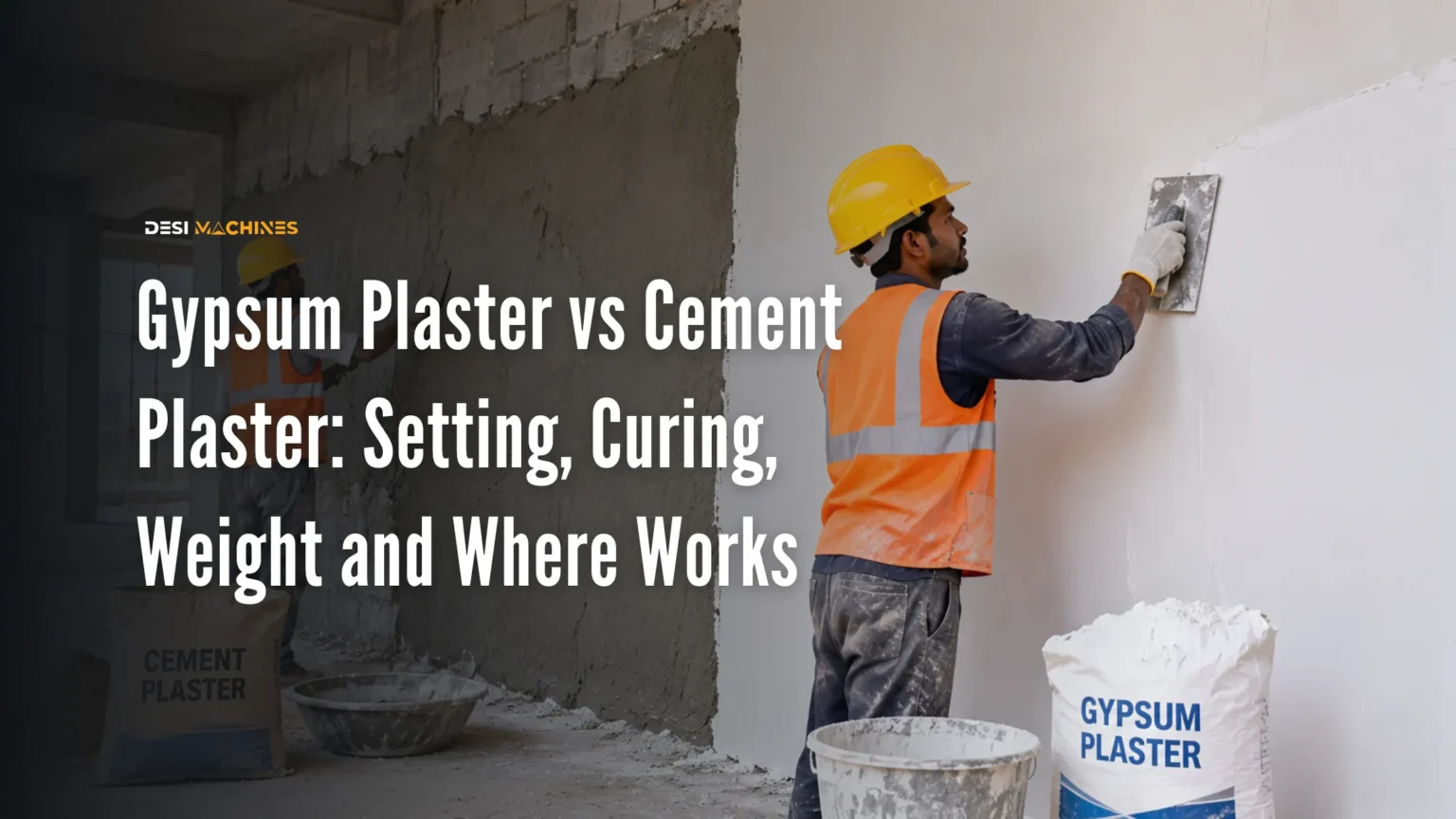
For the inside walls and ceilings of an Indian house, gypsum plaster gives a smooth, paint-ready finish in one coat and needs no water curing. For outside walls, bathrooms, the wet corner of a kitchen and anything that stays damp, cement plaster is still the right choice, because gypsum softens when it keeps getting wet.
Most houses end up with both: cement plaster outside and in the wet areas, gypsum on the dry rooms inside. The sections below explain what each one is, how long each takes to set and cure, how thick each goes on, and how to decide room by room.
Key points
- IS 2547 gives retarded gypsum plaster a neat setting time of 60 to 180 minutes, against 20 to 40 minutes for plaster of Paris.
- Under IS 1661, cement plaster should be kept wet for at least seven days after the finishing coat. Gypsum plaster gets no water curing at all.
- A 12 mm coat weighs about 21.1 kg per square metre in cement plaster and about 13.4 kg in gypsum plaster, using the densities in the National Building Code.
- Gypsum plaster is sold for internal walls and ceilings only. Outside walls and wet areas take cement plaster.
What is the difference between gypsum plaster and cement plaster?
The difference starts with the binder, the powder that hardens and holds the coat together. Gypsum plaster is calcium sulphate that has been heated to drive off most of its water. Add water back on site and it turns into gypsum again and sets hard within hours. Cement plaster is cement, sand and water. It hardens by a slower chemical reaction with water, called hydration, which carries on for days and needs the wall kept wet while it does.
That one difference drives everything else on this page: setting time, curing, weight, finish and where each can go.
| Point | Gypsum plaster | Cement plaster |
|---|---|---|
| What it is made of | Calcium sulphate hemihydrate with setting retarders, often premixed with light aggregate such as perlite | Cement and sand, mixed 1:3 to 1:6 by volume (IS 1661) |
| Indian Standard | IS 2547 Part 1 (plaster) and Part 2 (premixed lightweight plaster) | IS 1661 (code of practice for cement and cement-lime plaster) |
| Coats | Usually one coat, ready for putty or paint | One coat of 10 to 15 mm, or two or three coats on rough walls |
| Setting | Neat retarded plaster: 60 to 180 minutes under IS 2547 | Cement-lime mixes stay workable for up to 2 hours (IS 1661); strength builds over days |
| Water curing | None | At least 7 days after the finishing coat |
| Density (NBC 2016) | 1,120 kg/m³ | 1,762 kg/m³ |
| Finish | Smooth and white straight off the trowel | Sand-textured; needs putty or a thin skim coat for a smooth paint finish |
| Where it works | Dry internal walls and ceilings | Everywhere, including outside walls, bathrooms and parapets |
What is gypsum plaster made of, and is it the same as POP?
Both come from the same mineral. Gypsum rock is heated until it loses most of its water and becomes a white powder called calcium sulphate hemihydrate. That powder, with nothing added, is plaster of Paris, or POP. It sets fast: IS 2547 Part 1 gives neat plaster of Paris a setting time of 20 to 40 minutes.
Gypsum plaster for walls is the same powder with a retarder mixed in to slow the set, so a mason can spread and level a whole wall before it hardens. IS 2547 Part 1 calls this retarded hemihydrate gypsum plaster and gives it a neat setting time of 60 to 180 minutes. The standard splits it into undercoat plasters (browning and metal lathing plaster) and final coat plasters (finish and board finish plaster).
Most bagged gypsum plaster sold for houses today is the premixed lightweight kind covered by IS 2547 Part 2. It is retarded gypsum plaster blended at the factory with a light aggregate. The standard caps the dry set density of its browning undercoat at 850 kg/m³, well under half the weight of cement plaster.
So POP and gypsum plaster are close cousins, not the same product. POP is mostly used for thin work: false ceilings, cornices, and the thin smooth skim over cement plaster that Indian masons call punning. Gypsum plaster is made to go straight onto brick, block or concrete as the full plaster coat, which removes the need for a separate POP punning layer on top.
What is cement plaster made of, and how thick does it go?
Cement plaster is cement, sand and water, sometimes with lime added for workability. IS 1661:1972, the Indian code for cement and cement-lime plaster, lists cement to sand mixes of 1:3, 1:4 and 1:6 for single-coat work, and 1:1:6 and 1:2:9 cement-lime-sand mixes. Richer mixes, with more cement, set harder. IS 1661 notes that mixes with lime are easier to work, and that this ease fades as the share of cement goes up.
On thickness, IS 1661 says:
- single-coat plaster, inside or outside, goes on 10 to 15 mm thick;
- two-coat work should not normally exceed 20 mm in total, and 15 mm on a concrete ceiling;
- three-coat work, for very rough walls, should not normally exceed 25 mm.
The sand matters as much as the cement. For single-coat plaster the code asks for fine sand in grading zone IV, and it warns that plaster strength drops as the sand gets finer. That is one reason the same 1:6 mix can perform differently on two sites. How much cement, sand and water each thickness needs per square metre is worked out in the plaster quantity calculation guide, and the quarry dust and M-sand guide covers the manufactured sand most sites now use.
Does gypsum plaster need curing? Setting and drying time compared
No. Gypsum plaster sets by taking back the water that was driven off in the factory, and once it has set it only needs to dry. Spraying water on it does nothing useful. Saint-Gobain Gyproc India lists “no water curing” for every gypsum plaster in its range, and gives an initial setting time of 20 to 25 minutes for its one-coat wall plaster. So mix only as much as the team can spread and level in that time, and never add water to a batch that has started to stiffen.
Cement plaster is the opposite. It needs water to keep hardening. IS 1661 says each coat should be kept damp until the next coat goes on, and the finished plaster should be kept wet for at least seven days and protected from heat and weather in that time. The water should go on as a fine spray, not by soaking the wall. On sunny or windy sides in hot weather the code suggests hanging wet gunny bags over the plaster.
Plaster that dries out too early is weak, powdery on the surface and full of fine cracks. IS 1661 calls that network of hair cracks crazing. The same curing rules that apply to concrete are explained in the guide to curing compound for concrete.
In practice this means the gypsum room can go to putty and paint as soon as it is dry, while the cement-plastered room waits a week of curing and then more days to dry out. On a tight handover date that gap is often what decides the choice.
Can gypsum plaster be used on exterior walls or in bathrooms?
Not on exterior walls. Gypsum is moderately soluble in water, about 2 to 2.5 grams per litre at 25 °C, so a coat that gets rained on or stays damp slowly softens, loses its bond and starts to powder. Gyproc answers the question directly on its gypsum plastering page: gypsum plaster can only be used on internal walls.
Bathrooms and the wall behind a kitchen sink sit in between. They are inside, but they get wet every day. The safe choice there is cement plaster, with waterproofing where water collects. Some makers sell a moisture-resistant gypsum grade, but read that product’s own sheet for where it is allowed before you use it in a wet room. The waterproofing chemicals guide covers what goes on bathroom walls and floors.
A dry room can also turn into a wet one from below. If a ground-floor wall has rising damp because the damp proof course is missing or bridged, gypsum plaster on that wall will soften and stain within a monsoon or two. Fix the damp first, or use cement plaster on the lower part of that wall.
Which is lighter, and does it make the house cooler?
Gypsum plaster is clearly lighter. The National Building Code of India 2016, Part 11, Table 4, gives cement plaster a density of 1,762 kg/m³ and gypsum plaster 1,120 kg/m³. At the same 12 mm thickness that works out to:
Figure 1: Weight of a 12 mm plaster coat per square metre
Cement plaster (1,762 kg/m³)
Gypsum plaster (1,120 kg/m³)
Premixed lightweight browning plaster, upper limit (850 kg/m³)
Densities from NBC 2016 Part 11 Table 4 and IS 2547 Part 2 Table 1; weight = density × 0.012 m.
For a 3 m × 3 m (about 10 ft × 10 ft) ceiling, that is roughly 190 kg of cement plaster against 121 kg of gypsum plaster hanging overhead. Less weight on a ceiling is less to come loose if the bond is poor, which is one reason gypsum is popular for ceilings.
On heat, the same NBC table gives gypsum plaster a thermal conductivity (how easily heat passes through) of 0.512 W/mK against 0.721 for cement plaster, about 29 percent lower. Be careful with what that means. A 12 mm layer is thin. Its resistance to heat is about 0.023 m²K/W in gypsum and 0.017 in cement plaster, while a 230 mm burnt brick wall alone gives about 0.28. Swapping the plaster changes how hot a room gets by very little. Roof insulation and shading do far more.
Which lasts longer: gypsum plaster or cement plaster?
In a dry room, both last for the life of the building if they are applied well. They fail in different ways.
Cement plaster is harder. It takes knocks from furniture, ladders and cycles in a passage without denting, and it copes with water. Its usual weakness is cracking. When it dries out too early or is laid too thick in one go, it shrinks and craze cracks appear, and these show through the paint.
Gypsum plaster has a softer surface. A sharp knock can dent it, and it is ruined by damp. In return it does not shrink the way cement plaster does, so the fine cracks that are so common in new cement-plastered walls are much less likely on gypsum; Gyproc lists “no shrinkage cracks” among its plaster features. Its other strength is fire: gypsum gives off water vapour when heated, which slows the spread of heat through the coat.
So “which is stronger” is the wrong question for a house. The right one is “will this wall stay dry and will it take knocks?” A dry bedroom wall suits gypsum. A staircase wall that gets hit, a parapet, or a wall that gets wet needs cement plaster.
How do you choose between gypsum and cement plaster for an Indian house?
Go room by room and surface by surface. This table is a starting point; your engineer’s drawing and the maker’s sheet for the actual product come first.
| Surface | Usual choice | Why |
|---|---|---|
| Outside walls, parapets, boundary walls | Cement plaster | Rain and sun; gypsum is for internal use only |
| Bathroom walls, wall behind the kitchen sink | Cement plaster plus waterproofing | Wet every day; tiles usually go on top |
| Bedrooms, living room, dry kitchen walls | Gypsum or cement plaster | Gypsum is faster and smoother; cement is harder |
| RCC ceilings | Gypsum plaster, or cement plaster up to 15 mm | Lighter overhead; IS 1661 caps two-coat cement plaster on a concrete ceiling at 15 mm |
| Ground-floor walls with any sign of damp | Cement plaster, after fixing the damp | Gypsum softens on a damp wall |
| Staircase walls, passages, godown walls | Cement plaster | Takes knocks better |
Then look at the job itself. Gypsum saves the curing water and the curing week, uses no sand on site, and gives a finish that is ready for putty and paint without a POP skim. Cement plaster uses materials every mason and hardware shop already has and forgives a rougher wall. Where tiles will go on the plaster, check what the tile adhesive needs from the surface underneath; the tile adhesive types guide covers that. Putty and primer quantities for either finish are in the paint quantity calculation guide.
Cost depends on the city, the sand rate and who applies it, and it changes month to month. Current per-square-foot figures for cement plaster are in the separate article on plaster rate per sq ft. When you compare quotes for gypsum, put them against cement plaster plus the POP or putty skim it would need, and the curing, not cement plaster alone.
On a larger building, sand-cement plaster mortar is mixed in bulk at site, often in a drum mixer next to the cement store. If you are planning that kind of job, compare concrete mixer models and talk to a dealer near you.
What goes wrong with each plaster, and how do you avoid it?
Most plaster complaints trace back to a few causes.
Hair cracks all over new cement plaster. The plaster dried too fast. It was not kept wet for the seven days IS 1661 asks for, it was laid too thick in one coat, or the sand was too fine. Fine craze cracks are a surface fault and are usually filled at the putty stage. Cracks that are wide or keep growing need an engineer’s look.
Gypsum plaster that turns soft, stained or powdery. Water is getting in, through a leaking pipe, rising damp or a wet wall behind. Find and stop the water, cut out the soft area and replaster once the wall is dry.
Gypsum plaster that hollows or falls from a ceiling. Usually a bond problem: the concrete was too smooth, dusty or oily. Makers sell a bonding coat for smooth RCC so that the slab does not have to be hacked. Use it as the product sheet says.
A batch of gypsum that sets in the bucket. More was mixed than the team could spread inside the setting time. Mix small batches in clean buckets with clean water, and never add water to a batch that has started to stiffen.
White salt deposits coming through cement plaster. That is efflorescence, salts carried out of bricks or sand by water. IS 1661 says leaving proper time between coats reduces the chance of these salts reaching the finished face. The types of bricks guide explains the efflorescence limit for bricks.
In most houses the two plasters share the work. Use gypsum where the wall stays dry and you want speed and a smooth finish, and cement plaster wherever water or knocks are part of daily life. More topics on cement, bricks, blocks and finishes are in the building materials guides.
The plaster classes and test limits on this page are from IS 2547 (Part 1):1976, Gypsum Building Plaster (reaffirmed 2002), Table 2, and IS 2547 (Part 2):1976, Premixed Lightweight Plaster, Table 1; the cement plaster mixes, thicknesses and curing rules from IS 1661:1972, Code of Practice for Application of Cement and Cement-Lime Plaster Finishes, clauses 7.1, 7.3, 7.4 and 16; densities and thermal conductivity from the National Building Code of India 2016, Part 11, Table 4; the internal-use-only rule, the no-curing claim the no-shrinkage-crack claim, the bonding coat for smooth concrete and the 20 to 25 minute setting time from the gypsum plastering pages of Saint-Gobain Gyproc India; and the solubility of gypsum and its behaviour in fire from Wikipedia’s articles on gypsum and plaster. All were read in November 2026. These are older standards; check for a newer edition before using a figure in a contract.
Prices, specifications and features are indicative, vary by variant, location and date, and should always be confirmed with the official OEM or authorised dealer before any purchase decision. DesiMachines is not liable for decisions taken on the basis of information that may have changed after publication. Mixes, thicknesses and test limits on this page are as published in the Indian Standards and the National Building Code named above; follow your engineer’s specification and the plaster maker’s product sheet for your own building.
Machines, tenders and news for this industry: Building Construction