
 Excavator
316 models
 Backhoe Loader
54 models
 Crane
68 models
 Concrete Mixer
79 models
 Wheel Loader
65 models
 Compactor / Roller
45 models
 Motor Grader
42 models

 Concrete Pump
66 models
 Skid Steer Loader
11 models


A 30 m³/hour batching plant needs about 46 to 52 kW of electricity with its motors working together, which is roughly 58 to 65 kVA from a diesel generator. A 120 m³/hour plant needs about 200 kW, or 250 kVA. Those figures come from the makers’ own spec sheets, and the part that decides the generator is the mixer: it is the biggest motor on any plant, and the current it pulls as it starts catches out more sets than the running load does.
This guide sets out batching plant power consumption by plant size, which motors draw the power and when, how many units of electricity a cubic metre of concrete takes, and how to turn the plant’s load into a generator size when the site has no grid supply yet. Every kVA and kWh figure marked “our arithmetic” is worked from a published rating, so you can redo it for the plant you are being quoted.
How much power does a batching plant need?
A batching plant needs about 1.4 to 1.7 kW of electric load for every cubic metre an hour of rated output. That is the band Ajax Engineering’s published figures for its CRB range of compact plants fall in, from the 20 m³/hour CRB 20 to the 120 m³/hour CRB 120. Ajax calls its figure the plant’s maximum operational load.
Divide the kW by 0.8 and you have the running load in kVA, the unit generators are sold in. The 0.8 is the power factor a generator’s rating assumes unless its maker states another one, as the guide to a diesel generator for a construction site explains.
Table 1: Power by plant size, Ajax CRB batching plants (maker’s model pages, read November 2026)
| Model | Rated output | Mixer (dry fill / concrete per batch) | Maximum operational load | Running load at 0.8 power factor* | kW per m³/hour of output* |
|---|---|---|---|---|---|
| CRB 20 | 20 m³/hour | Planetary, 500 / 330 litres | 34 kW | 42.5 kVA | 1.70 |
| CRB 30 | 30 m³/hour | Planetary, 750 / 500 litres | 46 kW | 57.5 kVA | 1.53 |
| CRB 45 | 45 m³/hour | Twin-shaft, 1,250 / 750 litres | 63 kW | 78.8 kVA | 1.40 |
| CRB 60 | 60 m³/hour | Planetary or twin-shaft, 1,500 / 1,000 litres | 85 kW | 106.3 kVA | 1.42 |
| CRB 90 | 90 m³/hour | Twin-shaft, 3,000 / 2,000 litres | 143 kW | 178.8 kVA | 1.59 |
| CRB 120 | 120 m³/hour | Twin-shaft, 4,500 / 3,000 litres | 200 kW | 250 kVA | 1.67 |
*Our arithmetic: kW divided by 0.8, and kW divided by rated output.
Other makers land in the same band. SANY gives a rated power of 52 kW for its HZS30G, a 30 m³/hour plant fed by a skip, which works out at 1.73 kW per m³/hour. So for a 30 m³/hour plant, plan on 46 to 52 kW until the maker you are buying from gives you its own figure.
How big a plant you need in the first place is a separate question, worked through in the guide to types of batching plant along with how rated and real output differ. Power follows that choice, so settle the size first.
Connected load, running load or maximum load: which figure should you ask for?
Ask for two figures: the connected load and the running or maximum load, and make sure you know which one a quote is giving you. They can differ a lot.
Connected load is the sum of the nameplate ratings of every motor on the plant. Schwing Stetter’s data sheet for its M 3.0 mobile plant, dated March 2019, gives a connected load of about 350 kVA for a plant rated at 135 m³/hour, with a twin-shaft mixer driven by two 55 kW motors. That is 2.6 kVA per m³/hour, well above the running figures in Table 1. The reason is that a connected load counts motors that never all run together. The cement screw runs only while cement is being weighed, and the compressor switches on and off to keep its air tank topped up.
The running load is what the plant draws while it works batch after batch, and a maker’s “maximum operational load” or “rated power” is its own figure for the plant at work. Size the generator, or the grid connection, from the running figure and the start of the biggest motor. Keep the connected load for the electrician who sizes the cables and the main panel.
The buyer is expected to start this conversation. IS 4925:2004, the Indian Standard for concrete batching and mixing plants, says the customer shall tell the maker in advance what electric supply is available at the project (clause 11.8). The same clause covers the air pressure on site when the compressor is not part of the maker’s supply. Clause 11.2 asks for totally enclosed, fan-cooled induction motors that hold their rating at air temperatures up to 50°C, which matters for a plant standing through a summer in Rajasthan or Vidarbha.
Which motors in a batching plant use the most power?
The mixer motor is the largest single load on every batching plant, and it works through every batch. On a 30 m³/hour plant it is 18.5 kW in SANY’s HZS30G and in MEKA’s C30 and MB-S30 plants. Against SANY’s 52 kW total, that is about a third of the plant. The aggregate conveyor or skip, the cement screw, the compressor, the water and admixture pumps, the bin vibrators, the control panel and the lights share the other 33.5 kW.
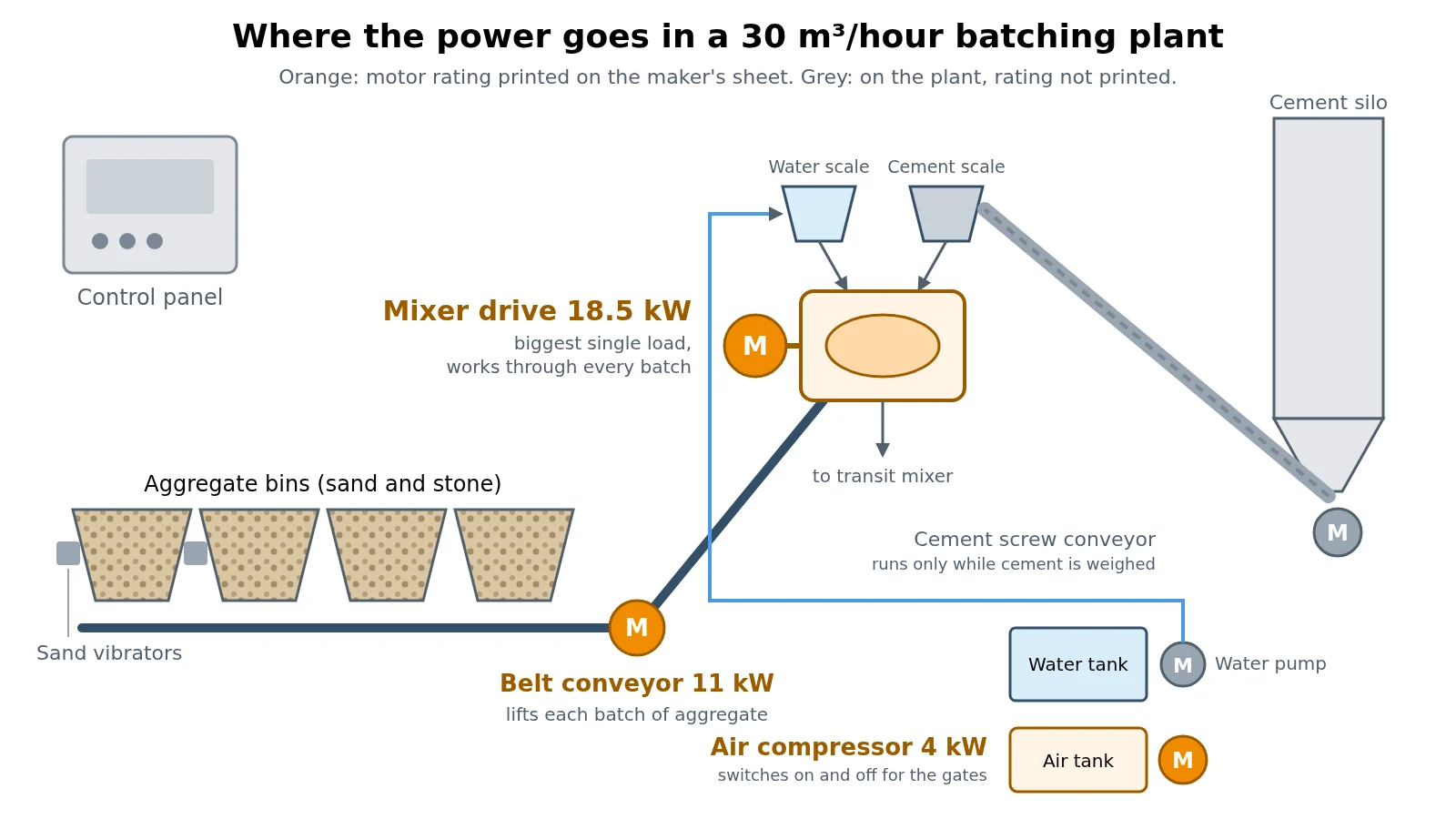
Table 2: Loads on a 30 m³/hour plant, and when each one draws power
| Load | What it does | Rating on the maker’s sheet | When it draws power |
|---|---|---|---|
| Mixer drive | Turns the pan, planetary or twin-shaft mixer | 18.5 kW (SANY HZS30G; MEKA C30 and MB-S30) | Through every batch; after a power cut it has to restart full of concrete |
| Aggregate transfer | Belt conveyor or skip that lifts sand and stone to the mixer | 11 kW belt conveyor (MEKA MB-S30); skip winch not listed separately | Once a batch, while the aggregate goes up |
| Air compressor | Air for the gates and cylinders that open bins and hoppers | 4 kW piston type (MB-S30); 5.5 kW (C30) | On and off, to keep the air tank at pressure |
| Cement screw conveyor | Carries cement from the silo or bag hopper to the cement scale | Not listed; MEKA gives only its size (193 mm diameter) | Only while cement is weighed |
| Water pump, admixture pump, vibrators, control panel | Fill the water and admixture scales, shake damp sand loose, run the plant | Not listed; the MB-S30 carries two sand vibrators | Short bursts each batch; the panel all shift |
The mixer motor climbs fastest as plants get bigger. Bigger mixers also move to two motors, which matters for a generator because the panel can start them a few seconds apart.
Table 3: Mixer motor and compressor by plant size (MEKA concrete batching plant catalogue, 2022)
| Rated output | Concrete per batch | Mixer motor | Air compressor |
|---|---|---|---|
| 30 m³/hour (C30) | 0.5 m³ | 18.5 kW | 5.5 kW, piston |
| 60 m³/hour (C60, M60, K60) | 1.0 m³ | 37 kW, 2 × 18.5 kW or 45 kW, by mixer type | 5.5 kW, piston |
| 100 to 117 m³/hour (C100, M100, K110) | 2.25 m³ | 2 × 37 kW | 7.5 kW, piston |
| 120 to 147 m³/hour (C120, M120, K140) | 3.33 m³ | 2 × 55 kW | 7.5 kW, piston |
| 160 m³/hour (160W) | 4.0 m³ | 2 × 75 kW | 7.5 kW, piston |
| 200 m³/hour (200W) | 5.0 m³ | 2 × 90 kW | 11 kW, screw |
If the plant maker does not supply the compressor and you plan to run the gates off a site compressor, count that machine in your load list. The air compressor guide for construction covers sizing one by air demand.
What is batching plant power consumption per cubic metre?
Worked from the makers’ ratings, a batching plant uses at most about 1.4 to 2.3 kWh of electricity for each cubic metre of concrete. One kWh is one “unit” on an electricity bill. The real figure on your meter will be lower, because the ratings assume every motor works flat out for the whole hour, and Table 2 shows that several of them run only part of each batch.
Take the Ajax CRB 30. At its rated 30 m³/hour, 46 kW for an hour comes to 46 ÷ 30 = 1.53 kWh per m³. IS 4925 tells a buyer to plan on 75 percent of rated output (Annex A-1), which is 22.5 m³/hour, and at that rate the same hour gives 46 ÷ 22.5 = 2.04 kWh per m³. The slower the plant works, the more units each cubic metre carries, because the mixer and the panel keep running between trucks.
Table 4: Upper limit of electricity per cubic metre (our arithmetic from the makers’ kW figures)
| Plant | Load used | At rated output | At 75 percent of rated output |
|---|---|---|---|
| Ajax CRB 20 (20 m³/hour) | 34 kW | 1.70 kWh/m³ | 2.27 kWh/m³ |
| Ajax CRB 30 (30 m³/hour) | 46 kW | 1.53 kWh/m³ | 2.04 kWh/m³ |
| SANY HZS30G (30 m³/hour) | 52 kW | 1.73 kWh/m³ | 2.31 kWh/m³ |
| Ajax CRB 60 (60 m³/hour) | 85 kW | 1.42 kWh/m³ | 1.89 kWh/m³ |
| Ajax CRB 120 (120 m³/hour) | 200 kW | 1.67 kWh/m³ | 2.22 kWh/m³ |
For a whole shift, the same sums give a ceiling you can plan around. A CRB 30 working 8 hours at 22.5 m³/hour makes 180 m³ and can use at most 46 × 8 = 368 units.
To find your own plant’s figure, read the energy meter at the start and end of a shift and divide by the cubic metres in the plant’s batch record for that shift. Do it over a week of normal work, not a single busy day. On a generator, track diesel instead; the guide to genset fuel consumption per hour gives litres by set size and load.
What size DG set runs a batching plant?
For a 30 m³/hour plant with nothing else on the set, a diesel generator in the 75 to 82.5 kVA range carries the running load with room to start the mixer, on the arithmetic below. Confirm the start with the generator maker before you buy. Sets of that size are standard: Mahindra Powerol’s website, read in November 2026, shows its range in bands of 20 to 75 kVA and 82.5 to 200 kVA.
The method is the one in the generator size calculation guide: add the running load, then check the start of the biggest motor. Here it is applied once to the plant.
Step 1, running load. 46 kW ÷ 0.8 = 57.5 kVA for the Ajax CRB 30, and 52 kW ÷ 0.8 = 65 kVA for the SANY HZS30G. A 62.5 kVA set would carry the Ajax figure at 92 percent of its rating and could not carry the SANY figure at all.
Step 2, the mixer’s start. IS 12615:2018, the Indian Standard for three-phase motors, gives an 18.5 kW four-pole motor a full-load current of 36 A, and allows its locked-rotor current (the current at standstill, as it starts) up to 7.5 times that for an IE3 motor, the premium efficiency class. At 415 volts, 36 A is about 25.9 kVA running. Started direct on line, the motor can pull up to 270 A, about 194 kVA. A star-delta starter, which starts the motor on reduced voltage and then switches it to full, cuts that to about a third: about 65 kVA.
Step 3, the order of starting. Start the mixer first, empty, and the set sees about 65 kVA for a few seconds on star-delta. The hard case is a restart after a power cut or a trip, with the mixer full and the conveyor, compressor and pumps already running. The rest of the plant adds about 31.6 kVA (57.5 minus 25.9), so the set sees about 96 kVA on star-delta, or about 226 kVA if the mixer starts direct on line.
Step 4, choose the set. A 75 to 82.5 kVA set carries 57.5 to 65 kVA of running load at about 70 to 87 percent of its rating. Ask the generator maker whether it can take a 65 kVA star-delta start on top of about 32 kVA already running. Ask the plant maker how the mixer starts. A direct-on-line mixer is the case where the set has to grow, or where a soft starter on the mixer earns its cost.
Table 5: A 30 m³/hour plant on a diesel generator (our arithmetic)
| What the set must handle | kVA | Where it comes from |
|---|---|---|
| Running load, Ajax CRB 30 | 57.5 | 46 kW ÷ 0.8 |
| Running load, SANY HZS30G | 65 | 52 kW ÷ 0.8 |
| Mixer motor running | 25.9 | 18.5 kW, 36 A at 415 V (IS 12615) |
| Mixer start, star-delta, everything else off | about 65 | a third of the direct-on-line start |
| Mixer start, direct on line, everything else off | about 194 | 7.5 × 36 A at 415 V |
| Full mixer restarting, star-delta, rest of plant running | about 96 | 65 + 31.6 |
| Full mixer restarting, direct on line, rest of plant running | about 226 | 194 + 31.6 |
Then add everything else that shares the set: the site office, the lights, a borewell pump, and above all an electric concrete pump. The worked example in the generator size calculation guide puts a 20 m³/hour plant and a 45 kW stationary pump on one set and arrives at 160 kVA, with the pump’s start as the deciding load.
A 120 m³/hour plant is a different scale. Its running load is about 250 kVA (200 kW ÷ 0.8), and MEKA drives its mixer at that size with two 55 kW motors. IS 12615 gives a 55 kW four-pole motor a full-load current of 101 A, so each motor runs at about 73 kVA and could pull up to about 545 kVA starting direct on line, or about 180 kVA on star-delta. At this size, take the plant maker’s connected load and starting sequence to the generator maker or the electricity board before you settle anything.
How do you keep a batching plant’s power demand down?
Most of the saving is in how the motors start, not in how they run. A generator or a grid connection is sized for the worst few seconds of the day, so anything that flattens those seconds lets you buy or book less.
Start in sequence. Mixer first, empty, then the conveyor, compressor and pumps. Never start everything from one switch after a power cut. Put the sequence in writing beside the panel so a night-shift operator follows it.
Ask for the mixer starter in the quote. Star-delta, a soft starter (an electronic starter that raises the voltage gradually) or a variable-frequency drive each cut the starting current. Direct on line is the cheapest panel and the hardest on a set. On a twin-motor mixer, ask whether the panel starts the two motors together or a few seconds apart.
Ask about peak control on bigger plants. Liebherr says the process control on its latest Betomix plants smooths power peaks by up to 64 percent, which it says lowers the cost of the grid connection as well as the energy bill. It is a maker’s claim for its own plants, but it is the right question to put to any maker: what does the plant’s peak look like, and what does the control do to it?
Keep the plant from stopping mid-batch. A mixer that has to restart full of concrete is the heaviest start in Table 5. Belts, skip ropes, gates and mixer arms that are looked after on schedule stop fewer batches; the checks are in the batching plant maintenance guide. The same thinking applies to where the plant stands: the mobile vs stationary batching plant comparison covers set-up and moving, and the cement silo capacity guide works out how much cement the screw has to move each day.
Power for the rest of the concrete chain
The plant is only one load on an RMC site. A plant that makes concrete faster than the trucks can carry it away simply waits, with its mixer and panel still drawing power. The transit mixer productivity guide works out how many trucks keep a plant busy, and you can compare transit mixer models and prices once you know the number.
If the concrete goes into an electric stationary concrete pump on the same supply, that pump is often a bigger single motor than the plant’s mixer. The guide to concrete pump engine power explains the kW and HP ratings, and you can compare concrete pump models and prices side by side. Machines for the whole yard are listed on the RMC and batching plant equipment page, and more plant guides sit on the batching plant guide hub.
The power figures in this guide are from the makers’ own pages and sheets: Ajax Engineering’s CRB 30 model page and its CRB 20, 45, 60, 90 and 120 pages (read November 2026), SANY’s HZS30G specification sheet (June 2024), MEKA’s concrete batching plants catalogue (November 2022) and MB-S30 specification sheet (March 2022), Schwing Stetter’s M 3.0 data sheet (March 2019) and Liebherr’s Betomix brochure. The motor currents are from IS 12615:2018 Table 2, and the purchaser’s duties from IS 4925:2004. Every kVA and kWh figure is our arithmetic from those ratings.
Prices, specifications and features are indicative, vary by variant, location and date, and should always be confirmed with the official OEM or authorised dealer before any purchase decision. Power ratings are the makers’ figures for the named models; get the connected load, running load and mixer starting method for your own plant in writing from its maker. DesiMachines is not liable for decisions taken on the basis of information that may have changed after publication.