
 Excavator
316 models
 Backhoe Loader
54 models
 Crane
68 models
 Concrete Mixer
79 models
 Wheel Loader
65 models
 Compactor / Roller
45 models
 Motor Grader
42 models

 Concrete Pump
66 models
 Skid Steer Loader
11 models


Forklift forks sold in India run from about 920 × 100 × 40 mm on a 1.5-tonne truck to 1,200 × 175 × 85 mm on a 10 to 12-tonne truck, read as length × width × thickness. You choose the length to suit your load. The width, the thickness and the way the fork hooks onto the truck come with the truck’s capacity class.
This guide sets out forklift fork size by capacity from two makers’ published sheets, the five carrier classes in the Indian Standard for fork mounting, how long a fork should be for the pallets you handle, and when a fork extension is allowed. The sizes come from ACE’s diesel forklift brochures (ACE is an Indian maker), STILL’s VDI 2198 data sheets for its RX 70 and RX 60 trucks, and three Indian Standards read on archive.org: IS 7525:2003 for mounting sizes, IS 6876:2019 for fork strength and marking, and IS 15634:2006 for extensions. Where a number is our own arithmetic, the text says so.
What size are forklift forks?
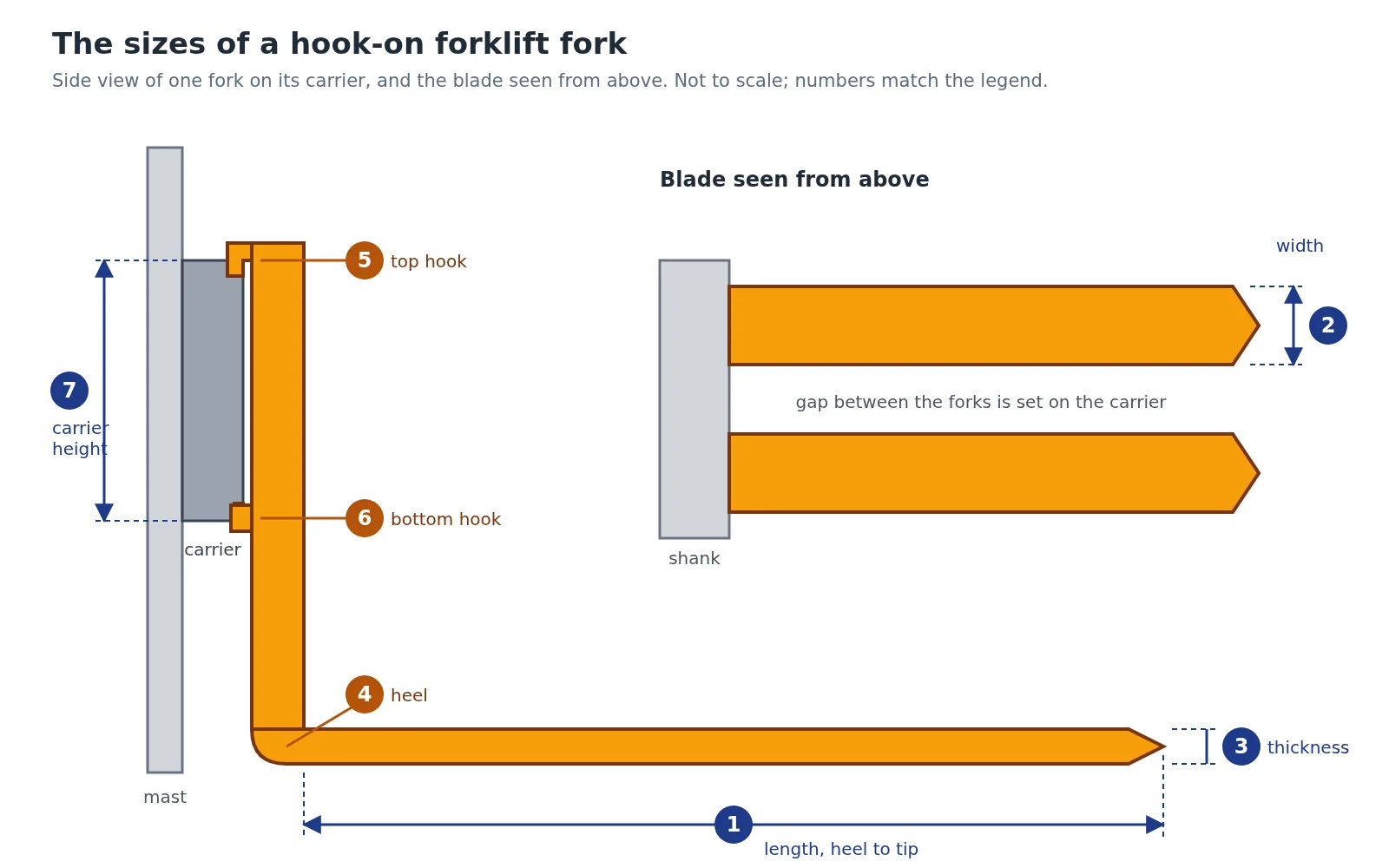
Each fork has three sizes. The length is the flat blade from the bend (the heel) to the tip. The width is how broad the blade is when you look down on it. The thickness is the depth of the blade, and it is the size that carries the load, because a fork works like a short beam fixed at one end. Makers print all three on a data sheet, often as “L × W × T” or, on European sheets, as “s/e/l” (thickness, width, length).
Here are the published figures for trucks sold in India:
| Truck | Rated capacity at load centre | Fork length | Fork width | Fork thickness | Carrier class |
|---|---|---|---|---|---|
| ACE AF 15D (diesel) | 1,500 kg at 500 mm | 920 mm | 100 mm | 40 mm (35 mm in the same brochure’s dimension table) | Not stated |
| ACE AF 20D (diesel) | 2,000 kg at 500 mm | 1,070 mm | 122 mm | 40 mm | Not stated |
| STILL RX 70-25 (diesel) | 2,500 kg at 500 mm | 1,000 mm | 100 mm | 40 mm | II A |
| STILL RX 70-25/600 (diesel) | 2,500 kg at 600 mm | 1,000 mm | 100 mm | 45 mm | II A |
| STILL RX 60-25/600 (electric) | 2,500 kg at 600 mm | 1,200 mm | 100 mm | 45 mm | II A |
| ACE AF 30D (diesel) | 3,000 kg at 500 mm | 1,070 mm | 125 mm | 45 mm | Not stated |
| STILL RX 70-30 and RX 70-35 (diesel) | 3,000 and 3,500 kg at 500 mm | 1,000 mm | 100 mm | 50 mm | III A |
| ACE AF 40D (diesel) | 4,000 kg at 500 mm | 1,070 mm | 125 mm | 45 mm | Not stated |
| ACE AF 50D (diesel) | 5,000 kg at 600 mm | 1,220 mm | 150 mm | 50 mm | Not stated |
| ACE AF 80D (diesel) | 8,000 kg at 600 mm | 1,200 mm | 150 mm | 65 mm | Not stated |
| ACE AF 100D and AF 120D (diesel) | 10,000 and 12,000 kg at 600 mm | 1,200 mm | 175 mm | 85 mm | Not stated |
Two patterns stand out. Thickness climbs steadily with capacity, from 40 mm to 85 mm, while length stays close to 1 to 1.2 metres from the smallest truck to the largest. Thickness also depends on how far out the load sits, as well as on its weight. STILL fits 40 mm forks to the RX 70-25 rated at a 500 mm load centre, but 45 mm forks to the RX 70-25/600, which carries the same 2,500 kg at 600 mm. The load centre is the distance from the fork’s upright face to the middle of the load, explained in the guide to forklift capacity and load centre.
The ACE AF 15D brochure prints 40 mm in its specification table and 35 mm in its dimension drawing table for the same fork. That is why the fork in front of you, and the marks stamped on it, settle the question, not a chart.
What are forklift fork classes?
A fork does not bolt on. On most forklifts it hangs on a steel plate called the carrier (also called the carriage), with one hook over the top bar and one under the bottom bar. For a fork from one maker to fit another maker’s truck, the hook spacing has to match. IS 7525:2003 fixes those sizes in five classes, the same scheme as the international standard ISO 2328, by the truck’s rated capacity:
| Class | Truck rated capacity | Rated load centre | Carrier height (b) | Gap between hook faces (h3) | Width of the locating notch (e) |
|---|---|---|---|---|---|
| 1 | Up to 999 kg | 400 | 331 | 305 | 16 |
| 2 | 1,000 to 2,500 kg | 500 | 407 | 381 | 16 |
| 3 | 2,501 to 4,999 kg | 500 | 508 | 476 | 19 |
| 4 | 5,000 to 8,000 kg | 600 | 635 | 597 | 19 |
| 5 | 8,001 to 10,999 kg | 600 | 728 | 678 | 25 |
So a “Class 2” or “ISO II” fork hangs on a carrier about 407 mm tall, and a Class 3 fork on one about 508 mm tall. A Class 3 fork will not hang on a Class 2 carrier: its hooks are almost 100 mm too far apart. In the 2003 print, Table 2 shows the Class 5 load centre as “6700”, a misprint; Table 1 of the same standard gives 600 mm. The standard covers trucks up to 10,999 kg, and heavier trucks such as the 12-tonne ACE AF 120D sit outside it, so their forks follow the maker’s own drawing.
The standard also lets each class use one of two fork types, A or B. They differ only in how far the blade sits below the carrier: 76 mm for Type A in Classes 1 to 3 and 127 mm in Classes 4 and 5, against 114 to 257 mm for Type B. Both fit the same carrier. Replace a fork with the same type as the one fitted, or the blades will sit at a different height from the one the truck was built for. A STILL data sheet line such as “ISO II A” means Class 2, Type A.
How long should forklift forks be?
The fork should reach almost to the far side of the load, without the tips poking out beyond it. The Indian safety code for powered industrial trucks, IS 6305 (Part 1):1980, clause 4.23.4, asks the operator to set the forks far enough apart and to insert them “as far as possible under the load”. Forks much shorter than the load leave the far end hanging. Forks much longer than the load stick out past it, and in a stack or a rack those tips can push into the pallet behind.
Most loads in Indian warehouses and plants travel on pallets. ISO 6780 names six pallet sizes, listed on Wikipedia’s pallet page: 1,200 × 800, 1,200 × 1,000, 1,219 × 1,016, 1,165 × 1,165, 1,100 × 1,100 and 1,067 × 1,067 mm. How deep the pallet sits on your forks depends on which side you enter from. That depth decides two things, the fork length and the load centre:
| Depth of load along the forks | Centre of an even load | On a 1,000 mm fork | On a 1,070 mm fork | On a 1,200 mm fork |
|---|---|---|---|---|
| 800 mm | 400 mm | Tips 200 mm past the load | Tips 270 mm past | Tips 400 mm past |
| 1,000 mm | 500 mm | Flush with the load | Tips 70 mm past | Tips 200 mm past |
| 1,100 mm | 550 mm | 100 mm of load past the tips | 30 mm past the tips | Tips 100 mm past |
| 1,200 mm | 600 mm | 200 mm past the tips | 130 mm past the tips | Flush with the load |
Look at the second column. A pallet carried 1,200 mm deep puts the middle of an even load 600 mm from the fork face. IS 7525 rates Class 2 and 3 trucks, 1 to 4.9 tonnes, at a 500 mm load centre (the class table above), so that pallet already sits further out than the rating assumes, and the truck can lift less than the figure painted on it. How much less is on the capacity plate, and the guide to forklift derating shows how to read it. If you handle 1,200 mm deep loads every day, ask for a truck rated at 600 mm, like the STILL RX 70-25/600 above, and fit 1,200 mm forks.
Long loads are their own case. ACE’s brochure shows its AF 80D as an empty container handler, fitted with a wide carriage and 2,400 mm forks for stacking empty 20-foot containers. Full containers are a job for the reach stacker instead.
Why are heavier forklifts’ forks thicker and wider?
The load sits out on the blade and tries to bend it down at the heel. That bending grows with the weight and with the distance to the load centre, so a fork for 5 tonnes at 600 mm has to resist far more bending than one for 2 tonnes at 500 mm. Thickness is the size that helps most, which is why the ACE range goes from 40 mm on the 2-tonne AF 20D to 85 mm on the 10-tonne AF 100D, while length barely changes. Width rises too, from 100 mm to 175 mm, which also spreads the load on the pallet’s bottom boards.
IS 6876:2019 sets the test every new fork design must pass. For a fork arm rated up to 5,500 kg, a load of three times its rated capacity is applied twice at its rated load centre, held for 30 seconds each time, and the blade must show no permanent bend afterwards. The steel must also absorb at least 27 joules of impact at minus 20°C, and fork arms rated up to 4,000 kg must survive a million load cycles at 1.25 times their capacity without cracking. That margin is for safety. It is never spare capacity to use.
Wear eats that margin. Once the blade has worn to 90% of its original thickness, the fork comes out of service, a limit from IS 14770 covered in the forklift maintenance checklist along with the tip-height and crack checks.
What is stamped on a fork, and how do you match a replacement?
Under IS 6876:2019, clause 10.1, every fork arm carries a permanent mark on the side of its shank showing four things:
- the fork arm’s own rated capacity, in kg;
- the load centre that capacity applies at, in mm;
- the fork maker’s name or mark;
- the week or month and year it was made, or a serial number.
Note that the capacity is for one fork. A pair of forks shares the load, so each arm is rated for a share of the truck’s capacity at its load centre. If the stamp has worn off or been ground away, there is no way to tell what the fork is rated for, and it should not be used until it is identified.
To replace a fork, match these from the old fork and the truck’s capacity plate, not from a catalogue picture:
- The carrier class (1 to 5) and fork type (A or B). This decides whether it hangs on your carrier at all.
- The rated capacity and load centre stamped on the fork, at least as high as the old one.
- The blade thickness, width and length of the original. A fork of a different size from the one the truck was rated with can change what the capacity plate allows, so ask the truck maker or dealer before fitting one.
- The mounting style. IS 7525 covers hook-on forks only. IS 6876 also covers shaft or pin, bolt-on and roller type forks, and those follow the truck maker’s own drawing.
Keep the two forks matched. IS 14770, the code for checking forks in service, withdraws a set whose tips differ in height by more than 3% of the blade length, which on a 1,070 mm fork is about 32 mm (our arithmetic), so a new fork beside a worn or bent one can fail that check on the first day.
Can you fit fork extensions?
Yes, within limits. A fork extension is a steel sleeve that slides over the fork to make it longer, for a bulky but light load. IS 15634:2006 sets the rules. Its foreword says plainly that a longer fork is better than an extension where possible, and that a closed, box-shaped sleeve is better than an open channel.
Three of its rules decide whether an extension is safe on your truck:
| Rule | Clause | Worked example |
|---|---|---|
| The fork under the extension must be at least 750 mm long, and at least 0.6 times the extension’s length | 6.1 | A 1,070 mm fork can take an extension up to about 1,780 mm long (1,070 ÷ 0.6); a 920 mm fork up to about 1,530 mm |
| The extension’s capacity falls as its load centre moves out: capacity × load centre stays the same as the fork’s | 5.2 | A fork arm rated 1,000 kg at 500 mm, with an extension that puts the load centre at 750 mm, is good for about 667 kg (1,000 × 500 ÷ 750) |
| Side play between fork and extension: at least 10 mm in total and no more than one-tenth of the blade width | 6.6 | On a 125 mm wide fork the play must be 10 to 12.5 mm; on a 100 mm fork, 10 mm |
The standard also says an extension must be designed so it cannot come off the fork by accident (clause 6.2), and for each set to be marked with its maker, serial number and year, its own rated capacity and load centre, and the fork cross-section and minimum fork length it is made for (clause 10.1). An extension that carries no such mark has no stated rating. The truck’s own capacity also drops when the load moves out, as the derating section above explains, so the extension’s figure and the truck’s capacity plate both have to allow the lift.
How far apart should forklift forks be set?
Set the forks as wide as the pallet’s entry openings allow, so the load sits evenly between them and cannot tip sideways. IS 6305 (Part 1) asks for them to be “sufficiently far apart”, and clause 4.23.12 has the operator check that the fork width suits the load and then drive in until the fork heels touch it. Each truck has a range set by its carrier width. ACE lists the lateral fork adjustment as 200 to 960 mm on the AF 15D and 250 to 1,090 mm on the AF 30D with single front tyres (wider, up to 1,340 and 1,440 mm, with dual front tyres). STILL’s RX 70 sheet gives fixed lock-in positions on its 1,150 mm carrier, from 216 mm to 902 mm centre to centre.
Forks slide along the top bar and drop into the carrier’s notches to lock. After moving them, check that each one has dropped into a notch, because a fork that sits between notches can slide sideways under load. Many trucks can be ordered with a side shifter or a fork positioner instead, which moves the forks with hydraulics. Both are attachments, and an attachment’s own weight reduces the truck’s rated capacity.
Do telehandler forks follow the same sizes?
A telehandler (a lifting machine with a telescopic boom, used on building sites) also carries pallet forks, but on a fork carriage that fixes to the boom head through the maker’s own coupling. Its forks are sized by the machine’s maker for its rated capacity, which is why fork size on a telehandler is a question for the dealer and the operator’s manual rather than for IS 7525. The telehandler attachments guide explains how forks, buckets and platforms connect and why each one changes the safe load.
The capacities run close to mid-size forklifts. The JCB 530-70 is rated for 3,000 kg with a 7,000 mm lift, the JCB 540-70 for 4,000 kg to the same height, and the SANY STH634A for 2,721 kg up to 10,400 mm (catalogue specs, November 2026). For pallets that have to go onto a slab, a floor or rough ground, rather than across a smooth warehouse floor, a telehandler is often the better machine; the guide to types of forklift sets out where each fits. Compare telehandler models and speak to a dealer about the fork set that comes with each.
Where do these fork sizes come from?
- Bureau of Indian Standards, IS 7525:2003, Mounting Dimensions for Fork Carriers and Fork Arms for Forklift Trucks (in line with ISO 2328:1993): Tables 1 and 2 and Fig. 1. IS 6876:2019 lists a 2017 edition of IS 7525; we read the 2003 edition, the one publicly available.
- IS 6876:2019, Fork-lift Trucks, Fork Arms, Technical Characteristics and Testing: clauses 6, 7, 8 and 10.
- IS 15634:2006, Fork-lift Trucks, Fork-arm Extensions and Telescopic Fork-arms: foreword and clauses 5.2, 6.1, 6.2, 6.6 and 10.1.
- IS 6305 (Part 1):1980, Safety Code for Powered Industrial Trucks: clauses 4.23.4 and 4.23.11.
- ACE diesel forklift brochures for the AF 15D to AF 30D, AF 40D, AF 50D and AF 80D to AF 120D, from ace-cranes.com, read 22 November 2026.
- STILL technical data sheets (VDI 2198) for the RX 70-20/35 diesel and LPG trucks and the RX 60-25/35 electric trucks, read 22 November 2026.
- ISO 6780 pallet sizes as listed on Wikipedia’s Pallet article, read 22 November 2026.
For the rest of the forklift series, start at the forklift guides, and see the machines used for material handling in India.
Prices, specifications and features are indicative, vary by variant, location and date, and should always be confirmed with the official OEM or authorised dealer before any purchase decision. DesiMachines is not liable for decisions taken on the basis of information that may have changed after publication.
Get a forklift fork price from a dealer near you
Tell us your machine and what you need, and we will ask the nearest dealer to reach out to you with a price.