
 Excavator
316 models
 Backhoe Loader
54 models
 Crane
68 models
 Concrete Mixer
79 models
 Wheel Loader
54 models
 Compactor / Roller
45 models
 Motor Grader
42 models

 Concrete Pump
66 models
 Skid Steer Loader
11 models


A forklift maintenance checklist has two parts: a walk-round check the driver does before every shift, and a workshop service that STILL, for example, sets at every 1,000 working hours or once a year, whichever comes first. Between those two, three numbers decide when a part must come off the truck: a fork worn down to 90% of its first thickness, two fork tips more than 3% of the blade length out of level, and a lift chain stretched by more than 2 to 3%.
The fork limits come from an Indian Standard, IS 14770. The chain limit comes from forklift makers. The rest of this guide takes each check in turn, in the order a driver or fitter would do them.
DesiMachines does not list forklifts yet, so makers are named here only to explain the work, using their own published manuals. If you are still choosing a truck, start with the guide to types of forklift.
What should a forklift daily checklist include?
Everything that lifts, stops or steers the load. STILL’s operating manual for its RX 70 diesel and LPG trucks (October 2025 edition) asks the driver to run through a fixed list from top to bottom before daily use. If anything is damaged, the truck is not used until it has been repaired. The table below follows that list, with the reason each check matters.
| Part | What to check | Why it matters |
|---|---|---|
| Forks | Bent, cracked or badly worn? Fork locks holding? | A fork that slides sideways or cracks drops the load. |
| Lift chains | Links intact, both chains equally tight | The chains carry the whole load on the carriage. |
| Mast rails | A thin film of grease on the roller tracks | Dirty, dry tracks can jam the carriage, which leaves the chains slack. |
| Hydraulics | Leaks at cylinders, hoses and pipes; work every lever once | Valves left unused for a long time can stick. |
| Under the truck | Fresh drips of oil, fuel or coolant | A leak found in the morning is cheaper than a burst hose at noon. |
| Tyres and wheels | Cuts, uneven wear, air pressure on pneumatic tyres | Worn or soft tyres reduce stability and stretch braking distance. |
| Brakes | Service brake has a firm pressure point; parking brake holds | The truck must stop safely with a load on the forks. |
| Engine (diesel or LPG) | Engine oil and coolant level | Low oil or coolant is the usual start of an engine failure. |
| Fuel system or battery | Tank and lines for damage and leaks; battery for damage | IS 6305 says a truck with a fuel leak stays parked until it is fixed. |
| Overhead guard, seat, seat belt | Guard secure; seat and belt working | These protect the driver if a load falls or the truck tips. |
| Lights, horn, warning units | All working | People on foot rely on them in busy aisles. |
| Plates and labels | Capacity plate and warning labels present and readable | The capacity plate is the only safe guide to what the truck can lift. |
The capacity plate deserves a word. It tells the driver the load the truck can lift at each height and load centre, and IS 6305 Part 1 asks for every plate and label to be kept readable. How to read one is explained in the guide to forklift capacity and load centre.
When a check fails, the driver should not try a quick fix. IS 6305 Part 1 (the Indian safety code for powered industrial trucks) says the driver reports the fault at once, nobody uses the truck until it is put right, and a board showing the truck is out of order is hung on it. Only trained and authorised people repair it.
How do you check forklift forks for wear?
Look first, then measure. IS 14770:1999, which is the Indian adoption of ISO 5057, sets out how forks in service are inspected and when one must be taken off. It asks for a full inspection at least once every 12 months, and sooner on hard work, carried out by trained people. Any one of these faults takes the fork out of service:
| Check | Withdraw the fork when | Worked example (our arithmetic) |
|---|---|---|
| Surface cracks | Any crack is found, especially at the heel and the top and bottom hooks | No allowance: one crack is enough |
| Blade and shank thickness | Thickness has worn down to 90% of the original, or below the maker’s minimum | A 50 mm fork is finished at 45 mm; a 40 mm fork at 36 mm |
| Height of the two fork tips | The tips differ by more than 3% of the blade length, or the truck maker’s figure | On a 1,200 mm blade, more than 36 mm out of level |
| Positioning lock | The lock that holds the fork in place is damaged or does not work | Fork slides along the carriage when it should not |
| Hooks (mountings) | Hook faces are so worn or crushed that the fork sits loose on the carriage | Visible rocking or gap at the top hook |
| Marking | The fork’s stamped marking can no longer be read | Capacity and maker stamp worn away |
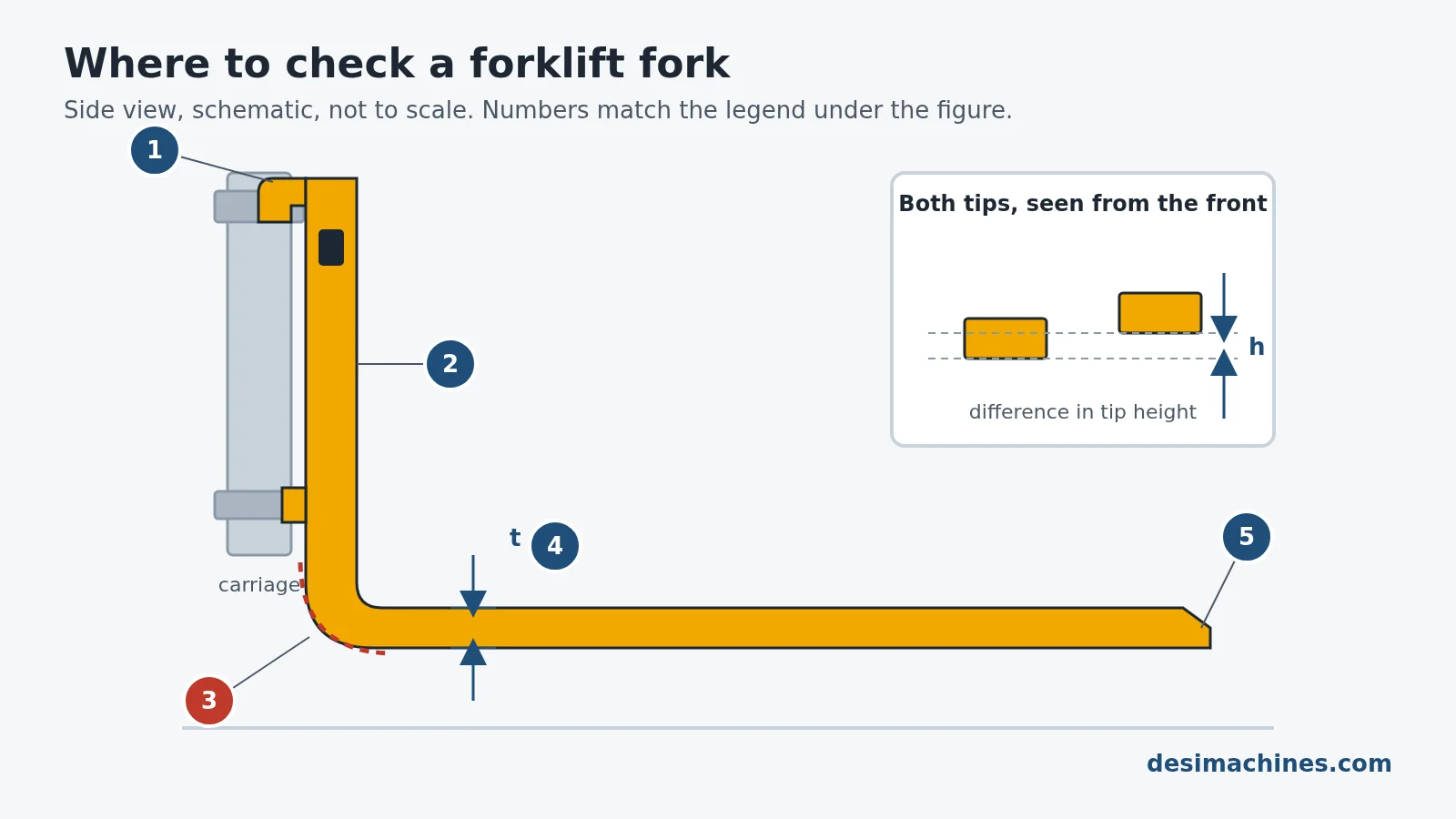
The heel takes the most wear because it scrapes the floor and pallets every time the forks go in low. Measure the blade there with calipers. You need the thickness the fork started with, so write it in the truck’s log on day one, or ask the fork maker for it. If the blade has lost 10% of that thickness, the fork is finished.
Two habits help. STILL’s manual says to replace both forks together, so the pair stays matched. And IS 14770 does not recommend welding cracks or worn faces at all. Only the fork maker, or an expert of equal standing, may decide whether a fork can be repaired, and a repaired fork must pass a load test before it goes back: 2.5 times its rated capacity for forks under 5,000 kg, and 2.1 times above that.
When should forklift lift chains be replaced?
When they have stretched past the maker’s limit, or sooner if they show damage. Lift chains (leaf chains) run over a pulley at the top of the mast and carry the fork carriage, so the full load hangs on them. Thousands of lifts slowly wear the pins and links, and the chain grows longer. STILL’s UK service team puts the line at 2% stretch as a warning and 3% as the point where the chain must be changed (STILL UK, July 2021). Toyota Material Handling’s US team gives the same 3% limit. Very narrow aisle trucks may work to the tighter 2%.
Stretch is measured with a chain wear gauge, a simple tool that reads the percentage directly. That is a fitter’s job at the regular service. The driver’s job is to notice the warning signs between services:
- A slapping or knocking noise from the mast as it moves.
- One chain hangs slacker than the other.
- Rust on the links.
- Fork tips dragging on the floor when the forks are lowered.
- A broken link, or a pin that has turned in its plate (a sign of dry running).
Cleaning matters as much as checking. STILL’s manual calls load chains safety parts and forbids cold or chemical cleaners and anything acidic, corrosive or containing chlorine, because these attack the steel. Clean with a paraffin-based solvent, blow the water out with compressed air, then spray chain lubricant at once while moving the chain a few times.
One more danger: a slack chain when lowering. If the carriage or load comes to rest on a rack beam, or the carriage rollers jam with dirt, the chains go slack. When it frees itself the load can fall. The fix is to lift until the chains are tight again and set the load down somewhere else.
What is done at a forklift service every 1,000 hours?
A full check of the truck by a trained fitter, plus oil and filter changes. Service intervals differ from maker to maker, so your truck’s own service book is the one to follow. As one current example, STILL’s RX 70 manual (October 2025) sets the standard service at every 1,000 operating hours or yearly, with a bigger one at 3,000 hours or every two years. The main items:
| System | Every 1,000 hours or yearly | Extra at 3,000 hours or every 2 years |
|---|---|---|
| Engine | Change engine oil and oil filter; replace main air filter; check V-belt, coolant and cooling system | Replace safety air filter and V-belt; coolant every 6,000 hours or 3 years |
| Fuel | Check for leaks; replace fuel filter yearly | None extra listed |
| LPG system | Check for damage; check shut-off valve and cylinder valve; replace LPG filter | Replace all LPG hoses; replace evaporator every 3,000 hours or 3 years; replace spark plugs |
| Mast and forks | Check, adjust and lubricate lift chains; check rollers, mast rails, cylinders, forks and fork locks | All 1,000-hour items |
| Hydraulics | Check oil level, leaks and working order | Change hydraulic oil; replace return-line, breather and high-pressure filters |
| Brakes and steering | Check brake parts, pedal travel and parking brake; brake test; grease steering axle | Change foot-brake fluid |
| Drive axle | Check mountings and leaks; gearbox oil changed once after the first 1,000 hours | Change gearbox oil |
| Tyres and chassis | Check tyre wear and pressure, wheel nut torque, chassis for cracks, overhead guard | All 1,000-hour items |
Use the oil grade written in the service book. The RX 70, for example, calls for HVLP 68 hydraulic oil to DIN 51524 Part 3, and STILL warns against mixing oils of different quality. How hydraulic oil and filters keep a system healthy is covered in the guide to hydraulic system maintenance, and choosing engine oil works the same way as for any diesel machine.
Indian conditions often call for shorter intervals. STILL lists the reasons a truck needs servicing sooner: dirty or broken floors and roads, dusty or salty air, high humidity, very high or low temperatures and multi-shift work. A forklift in a cement plant, a port or a monsoon-soaked yard meets several of these at once.
If your loads go up onto building slabs or across rough ground, a forklift is the wrong machine and will wear out fast. That work suits a telehandler. Compare telehandler models and talk to a verified dealer.
What extra checks do diesel, LPG and electric forklifts need?
The mast, forks, chains, brakes and tyres are checked the same way on all three. What changes is the power side.
| Forklift type | Daily | At the regular service |
|---|---|---|
| Diesel | Engine oil and coolant level; fuel leaks | Oil and filters, air filters, fuel filter, V-belt, exhaust; particle filter (where fitted) checked yearly and ash-cleaned every 10,000 hours |
| LPG | Cylinder secure and its valve undamaged; no sign of a gas leak, tested with soap solution if in doubt | LPG filter, valves, hoses and evaporator; spark plugs |
| Electric | Battery locked in place; battery plug free of moisture and dirt, contacts and cable undamaged | Battery acid density (lead-acid), plug and harness, cable connections; electrical insulation tested at least yearly |
For LPG trucks, IS 6305 Part 1 asks for every removable gas cylinder to be examined before it is reused or refilled. Look for dents, scrapes and gouges, damaged valves or level gauge, dirt in the relief valve, a missing relief-valve cap, leaks at valves or threads, and worn filling seals. A cylinder with any of these is not used until it is put right, and leaks in the gas system are traced with soap solution.
Electric trucks need less engine-type work but more battery care. Charging, topping up with distilled water and changing batteries are covered in the electric forklift battery guide, and the wider running differences in diesel vs electric forklift.
Tyres are the same story on every type. STILL sets a minimum tread of 1.6 mm on pneumatic tyres, wear down to the wear mark on solid and superelastic tyres, and both tyres on an axle changed together if they wear unevenly. When solid tyres are due is explained in forklift solid tyre replacement.
How often does a forklift need a safety inspection?
At least once a year, and after any accident or unusual incident. STILL’s manual puts this duty on the company that runs the truck: a specialist checks its whole technical condition and looks for damage from misuse. A written test log is made, kept until two more inspections have been done, and a sticker on the truck shows the inspection date.
The forks have their own clock. IS 14770 asks for the fork inspection described above at intervals of not more than 12 months, so it fits neatly into the same yearly visit.
Who does what matters too. IS 6305 Part 1 says only qualified and authorised people maintain, repair, adjust and inspect industrial trucks, and that replacement parts must be original or of at least the same quality. A driver can do the daily checks and simple top-ups. STILL’s manual gives checking the hydraulic oil level as an example of work that needs no special training. Brakes, mast, chains and fuel systems belong with a trained fitter.
What should a forklift maintenance log record?
Enough for the next person to see what was checked, what was found and who signed it off. IS 6305 Part 1 asks for scheduled maintenance, lubrication and inspection, with records kept where they are needed or where an authority requires them. Its sample check form is a good model for a log sheet:
| Section | What goes in it |
|---|---|
| Header | Truck number, sheet number, the chains’ basic dimension in mm (the reference the chain is measured against) and the minimum allowed fork thickness |
| Driving gear | Steering, brakes, wheels, chassis, drive control switch, drive |
| Lifting gear | Hydraulic system, mast, lifting system, forks, platform or attachments |
| Overhead guard and other items | Condition, plus anything else found |
| Sign-off | Date of check, action ordered, who carried it out and when, signature of the person who inspected |
Writing the chains’ basic dimension and the forks’ minimum thickness at the top of the sheet is the clever part. It turns the two most important wear checks into a simple comparison with a number the fitter wrote down on day one.
Keep the daily checklist sheets with the service records in one file per truck. When a truck is sold, that file is the best proof of how it was looked after. Machines, tenders and news for warehouses, ports and factories are gathered on the material handling equipment page, and the rest of this series sits in the forklift guide.
Sources: IS 14770:1999 (identical to ISO 5057:1993, reaffirmed 2004) and IS 6305 Part 1:1980, both from the Bureau of Indian Standards; STILL RX 70 and RX 60 operating manuals (October 2025 editions), read November 2026; STILL UK’s guidance on changing lifting chains (July 2021) and Toyota Material Handling USA’s note on mast chain wear, read November 2026. Worked examples in the fork table are our own arithmetic from the IS 14770 limits.
Prices, specifications and features are indicative, vary by variant, location and date, and should always be confirmed with the official OEM or authorised dealer before any purchase decision. DesiMachines is not liable for decisions taken on the basis of information that may have changed after publication.