
 Excavator
316 models
 Backhoe Loader
54 models
 Crane
68 models
 Concrete Mixer
79 models
 Wheel Loader
65 models
 Compactor / Roller
45 models
 Motor Grader
42 models

 Concrete Pump
66 models
 Skid Steer Loader
11 models


A forklift weighs more than it can lift. A 3-tonne forklift, the size most Indian warehouses and factories buy, weighs about 4.4 to 5.4 tonnes (4,400 to 5,400 kg) on its own, a 1.5-tonne truck about 2.6 to 3 tonnes, and a 10-tonne diesel truck 13.3 tonnes or more, depending on the mast fitted.
This guide gives forklift weight in kg by capacity and by power type, explains where the extra weight comes from, and shows what that weight means when the truck has to cross a floor, ride a goods lift, climb a dock ramp or travel on a truck. The figures come from three makers’ published sheets, read in November 2026: ACE, an Indian maker, for its diesel trucks from 1.5 to 12 tonnes; STILL’s technical data sheets for its RX 70 diesel and LPG trucks and RX 60 electric trucks; and Hyster’s model pages for its diesel, LPG and electric ranges. The site rules come from the Indian safety code for powered industrial trucks, IS 6305 (Part 1):1980. Where a number is our own arithmetic, the text says so.
How much does a forklift weigh in kg?
Makers print the weight of the truck ready to work, with forks, fluids and (on an electric truck) the battery, but with no load. STILL calls it service weight, ACE calls it total weight and Hyster just weight. It is the number to use for every floor, lift and transport check below. Here is how it runs by rated capacity, the load the truck is built to lift at its rated load centre (usually 500 mm on trucks up to about 4 tonnes and 600 mm on bigger ones, with 600 mm versions of some smaller trucks):
| Capacity class | Diesel and LPG trucks | Electric trucks, with battery | Trucks behind the figures |
|---|---|---|---|
| 1.5 to 1.6 tonnes | 2,650 to 2,993 kg | 3,030 kg | ACE AF 15D, Hyster H1.6A; electric Hyster J1.5UT |
| 2 tonnes | 3,400 to 4,090 kg | 4,040 kg | ACE AF 20D, Hyster H2.0A, STILL RX 70-20/600; electric Hyster J2.0UT |
| 2.5 tonnes | 3,990 to 4,410 kg | 4,226 to 5,019 kg | Hyster H2.5A, STILL RX 70-25; electric Hyster J2.5UT and E2.5XN2, STILL RX 60-25 |
| 3 tonnes | 4,362 to 4,900 kg | 4,910 to 5,367 kg | ACE AF 30D, STILL RX 70-30, Hyster H3.0A; electric Hyster J3.0UT and E3.0XN2, STILL RX 60-30 |
| 3.5 tonnes | 4,638 to 4,910 kg | 5,310 to 5,702 kg | STILL RX 70-35, Hyster H3.5A; electric Hyster J3.5UT and E3.5XN2, STILL RX 60-35L |
| 4 to 5 tonnes | 6,435 to 7,010 kg | 7,217 to 8,121 kg | Hyster H4.0UT to H5.0UT; electric Hyster E4.0XN to E5.0XN |
| 6 to 7 tonnes (600 mm) | 9,010 to 9,650 kg | Not in the sheets we read | Hyster H6.0UT and H7.0UT |
| 8 tonnes | 10,550 to 13,880 kg | Not in the sheets we read | ACE AF 80D with a 3 m to 6 m mast; Hyster H8.0FT-9 weighs 12,417 kg |
| 10 tonnes | 13,300 to 16,685 kg | Not in the sheets we read | ACE AF 100D with a 3 m to 6 m mast |
| 12 tonnes | 14,050 to 17,435 kg | Not in the sheets we read | ACE AF 120D with a 3 m to 6 m mast |
Read the table as a band, not one number. The ranges inside each class come from different makers, different masts and different load centres, and ACE’s own brochure says its dimensions, weights and capacities can vary by plus or minus 5 percent.
The pattern is clear, though. Small trucks weigh close to twice what they lift: the ACE AF 15D weighs 2,650 kg for a 1,500 kg rating and Hyster’s electric J2.0UT 4,040 kg for 2,000 kg. In the middle the ratio falls to about 1.5, so a 3-tonne truck is a 4.5-tonne machine. At the top it falls further: ACE’s 12-tonne AF 120D weighs 14,050 kg with its standard 3 m mast, under 1.2 times its rating (our arithmetic from the sheets).
Why does a forklift weigh more than it lifts?
Because the load hangs out in front of the wheels, and the truck’s own weight is what stops it tipping forward. A counterbalance forklift (the common type with forks at the front and a heavy body at the back) works like a see-saw. The front axle is the pivot. The load sits ahead of it on the forks. The truck’s body, engine or battery, and the cast-iron counterweight at the back sit behind it and push the other way.
STILL’s sheet for the RX 70-30 diesel shows the balance in numbers. The truck weighs 4,362 kg. Empty, 2,321 kg of that rests on the rear axle. With its rated 3,000 kg on the forks, the rear axle carries only 725 kg, less than a tenth of the 7,362 kg total, and the front axle carries 6,637 kg. The heavier the load, or the further out it sits, the more weight leaves the rear wheels. When none is left, the truck tips. That is why the capacity plate is a limit and not a guideline, and why the capacity falls when the load centre moves out, as the guide to forklift capacity and load centre explains with load charts.
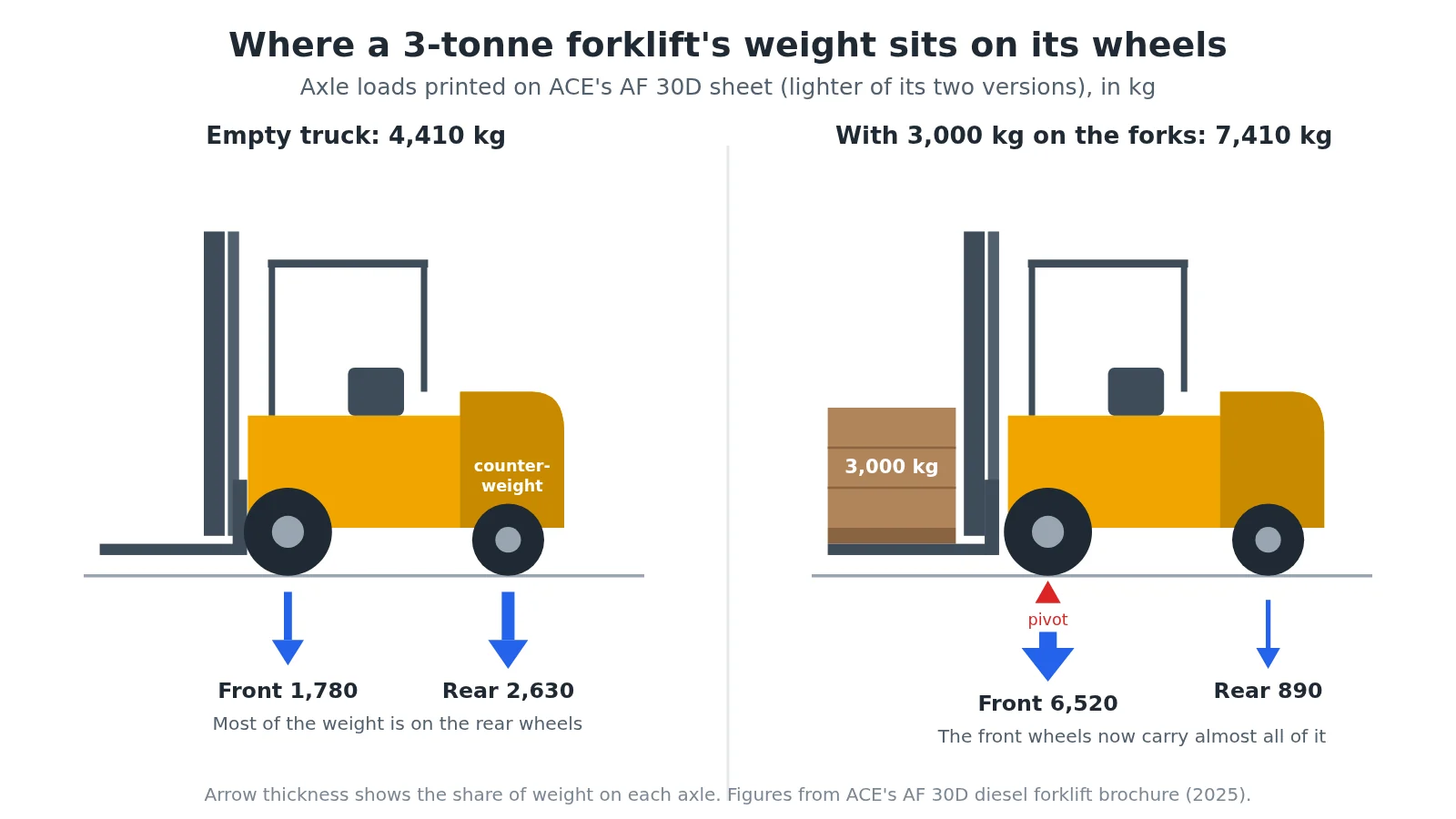
The same balance explains why a forklift weighs less for its capacity as it gets bigger. The counterweight has to beat the load’s pull around the front axle, and on a large truck the counterweight and engine sit further behind that pivot, so each kilogram of truck does more work.
Is an electric forklift heavier than a diesel forklift?
Yes, by a few hundred kilograms at the same capacity, because the battery is heavy and the maker uses it as part of the counterweight. Here are 3-tonne trucks side by side:
| Truck | Power | Rated capacity | Weight |
|---|---|---|---|
| STILL RX 70-30 | Diesel | 3,000 kg at 500 mm | 4,362 kg |
| STILL RX 70-30 T | LPG | 3,000 kg at 500 mm | 4,443 kg |
| STILL RX 60-30 | Electric (1,558 kg battery) | 3,000 kg at 500 mm | 5,040 kg with battery |
| Hyster H3.0A | Diesel or LPG | 3,000 kg at 500 mm | 4,642 kg |
| Hyster J3.0UT | Electric, 80 V | 3,000 kg at 500 mm | 4,910 kg |
| Hyster E3.0XN2 | Electric | 3,000 kg at 500 mm | 5,367 kg |
| ACE AF 30D | Diesel | 3,000 kg at 500 mm | 4,410 or 4,900 kg (two versions) |
Within one maker the gap is easy to read. STILL’s electric RX 60-30 weighs 678 kg more than its diesel RX 70-30, about 16 percent, and Hyster’s electric J3.0UT 268 kg more than its H3.0A, about 6 percent (our arithmetic). LPG adds little: STILL’s LPG versions of the RX 70 weigh 81 kg more than the diesel ones.
The battery is the big item. On the RX 60-30 it weighs 1,558 kg, almost a third of the whole truck, and other RX 60 versions carry an 1,863 kg battery. Because it is counterweight, the battery’s weight is part of the truck’s stability. IS 6305 (Part 2):1980 asks every electric truck’s plate to show the minimum and maximum battery mass allowed. Fitting a lighter battery, including a lighter lithium pack that the truck was not built for, can leave the truck short of counterweight. Battery types and changeover are covered in the guide to the electric forklift battery, and the running-cost side in diesel vs electric forklift.
What changes a forklift’s weight?
Two trucks with the same capacity can differ by a tonne or more. The usual reasons, each visible in the sheets:
- A taller mast. ACE’s 8-tonne AF 80D weighs 10,550 kg with a 3 m mast and 13,880 kg with a 6 m mast, 3,330 kg more, while its capacity at full height drops from 8,000 to 6,000 kg. A taller mast is more steel up front, which the truck has to balance.
- A longer load centre. STILL’s RX 70-25 weighs 4,009 kg rated at a 500 mm load centre, and the RX 70-25/600, rated for the same 2,500 kg at 600 mm, weighs 4,329 kg. The /600 version has a longer wheelbase, 1,820 mm against 1,760 mm, and 320 kg more weight to balance a load that sits 100 mm further out.
- The drive version. ACE lists its 2-tonne AF 20D at 3,400 or 3,900 kg and its AF 30D at 4,410 or 4,900 kg, two versions of each; the sheet lists different transmissions and single or dual front wheels for these trucks.
- Electric, LPG or diesel, as in the table above.
- Attachments, a cab and other tyres. A side shifter, a fork positioner or a clamp adds its own weight and takes capacity away. STILL’s RX 70 sheet prints its weights without a cab and warns that different tyres, masts or accessories give other values. Fork sizes and attachments are in the guide to forklift fork size.
So the right weight for a site check is the one for your truck as built, not the brochure’s lightest version.
How do you find the exact weight of your forklift?
Read the identification plate. IS 6305 (Part 2):1980, clause 3.1, asks every powered industrial truck to carry a durable plate in a prominent place, and the weight line on it depends on the power type:
- A diesel or LPG truck shows its unladen mass in working condition, without removable attachments but with the forks.
- An electric truck shows its unladen mass without the battery, and separately the minimum and maximum battery mass allowed. Clause 3.3 asks the battery to carry its own plate showing its mass in working order, or to have that mass stamped on the battery box. Add the two for the truck’s working weight.
If the plate is missing or painted over, the maker’s data sheet for the exact model, mast and battery is the next best source. A trip across a public weighbridge settles it for a used truck, and settles it with a full fuel tank and whatever attachment is fitted.
Can a floor, mezzanine or goods lift take a forklift?
Only if it is built for the truck’s weight plus the load plus the driver. IS 6305 (Part 1):1980 says this twice. Clause 3.5.6.1 says a lift (elevator) used to carry powered industrial trucks must support the total mass of the truck, the load and the operator, and that only designated lifts may be used. Clause 4.11 tells the operator not to drive onto a lift until the operator is sure it will take that mass.
The total adds up fast. A 3-tonne electric truck such as STILL’s RX 60-30, carrying its full rated load, puts 8,040 kg on the floor before the driver steps on. Even the smallest truck in the table, ACE’s 1.5-tonne AF 15D, comes to 4,150 kg with a full load. A goods lift or a light mezzanine rated for a few tonnes of stacked goods is not rated for that.
The total is only half of it. A floor feels the wheel loads, and the table below shows how much sits on each axle:
| Truck | Empty: front / rear axle | With rated load: front / rear axle |
|---|---|---|
| ACE AF 15D, diesel, 1,500 kg | 1,170 / 1,490 kg | 3,640 / 520 kg |
| ACE AF 30D, diesel, 3,000 kg (lighter version) | 1,780 / 2,630 kg | 6,520 / 890 kg |
| STILL RX 70-30, diesel, 3,000 kg | 2,042 / 2,321 kg | 6,637 / 725 kg |
| STILL RX 60-30, electric, 3,000 kg | 2,411 / 2,629 kg | 7,163 / 877 kg |
A loaded 3-tonne truck puts 6.5 to 7.2 tonnes through its front axle. If that axle has two tyres, each one presses about 3.3 to 3.6 tonnes onto one small patch of floor (our arithmetic). That point load, not the average across the floor, is what cracks a thin slab or a chequered-plate mezzanine. Before a forklift works on an upper floor, a mezzanine or an old shed slab, ask a structural engineer to check it for the front axle load in this table, and mark the limit at the entry.
Where the floor or lift cannot take a counterbalance truck, a lighter machine often can. A hand-pushed or electric pallet truck carries the same pallet at a small part of the weight, as the guide to electric pallet trucks and stackers shows.
What should you check before a forklift drives onto a ramp, dock or truck?
The same rule runs through IS 6305 (Part 1). Clause 3.5.7.3 says the floor of a road vehicle or railway wagon must support the total mass of the truck, the load and the operator, and must be checked for breaks, holes and other defects first. Clause 3.5.7.1 asks for the vehicle’s brakes to be on and its wheels chocked before the forklift enters. Clause 3.5.7.2 warns that a semi-trailer not coupled to its tractor may need supports, or the forklift’s weight at the front can tip it up. The UK safety regulator’s guide L117 (2013) adds that bridge plates and loading ramps should be strong enough for the truck and its load, fixed so they cannot move, and marked with their maximum load.
The slope matters too. ACE rates its AF 30D to climb an 18.5 percent slope fully loaded (19.5 percent empty) and its 8 to 12-tonne trucks to 18 percent. A ramp that rises 1 m in 5 m is a 20 percent slope, steeper than that (our arithmetic). IS 6305 (Part 1) clause 4.12 asks the operator to stay within the truck’s rated gradient and never turn on a slope.
How do you move a forklift on a truck or trailer?
Start from the weight on the plate, then add any attachment. A 3-tonne class truck at 4.4 to 5.4 tonnes needs a carrier with at least that much spare payload, and a 10-tonne ACE AF 100D at 13,300 kg or more needs a trailer. Height matters as much as weight: ACE gives the AF 30D an overhead guard height of 2,120 mm and the AF 100D a lowered mast height of 2,840 mm, and both sit on top of the truck bed. Check the route for low bridges, gantries and overhead wires before the load leaves.
Lift or drive the forklift on only by a method rated for its weight: a crane with slings at the maker’s lifting points, or ramps marked for at least the truck’s weight. Lower the forks to the bed, apply the parking brake and tie the truck down at the points shown in its operator’s manual. For anything over a short yard move on a public road, note IS 6305 (Part 1) clause 4.4.1: running a forklift on main roads outside the premises needs the local transport authority’s permission.
Is a telehandler heavier than a forklift for the same load?
Yes, much heavier. A telehandler (a lifting machine with a telescopic boom, built for building sites and rough ground) has to hold its load far out in front on the boom and ride over uneven ground, so it carries more steel and more counterweight. The JCB 530-70 is rated for 3,000 kg and has an operating weight of 7,220 kg, and the JCB 540-70 is rated for 4,000 kg at 8,498 kg (spec as of Nov 2026). That is 2.1 to 2.4 times the rated load, against about 1.5 times for a 3-tonne forklift.
The extra weight buys reach: both lift to 7 m and place pallets over an edge or onto a slab from outside the building, which also keeps the machine’s weight off the floor it is loading. A forklift is the lighter truck for flat, paved yards and warehouses. Which one fits which job is set out in the guide to types of forklift, and the machines that lift whole containers in port and rail yards are covered in the reach stacker guide. For site lifting, compare telehandler models and ask the dealer for the operating weight of the exact version you are quoted.
More on the forklift series sits in the forklift guides, and the machines used across warehouses, ports and factories are listed under material handling.
Sources: ACE diesel forklift brochures for the AF 15D to AF 30D and the AF 80D to AF 120D (2025); STILL technical data sheets (VDI 2198) for the RX 70-20/35 and RX 60-25/35; Hyster EMEA model pages for the A, UT, FT, J and XN ranges; Bureau of Indian Standards IS 6305 (Part 1):1980 and IS 6305 (Part 2):1980; HSE L117, Rider-operated lift trucks (2013). Maker figures read November 2026.
Prices, specifications and features are indicative, vary by variant, location and date, and should always be confirmed with the official OEM or authorised dealer before any purchase decision. DesiMachines is not liable for decisions taken on the basis of information that may have changed after publication.
