
 Excavator
294 models
 Backhoe Loader
51 models
 Crane
68 models
 Concrete Mixer
79 models
 Wheel Loader
54 models
 Compactor / Roller
45 models
 Motor Grader
42 models
 Dozer
41 models
 Concrete Pump
66 models
 Skid Steer Loader
11 models
 Telehandler
13 models


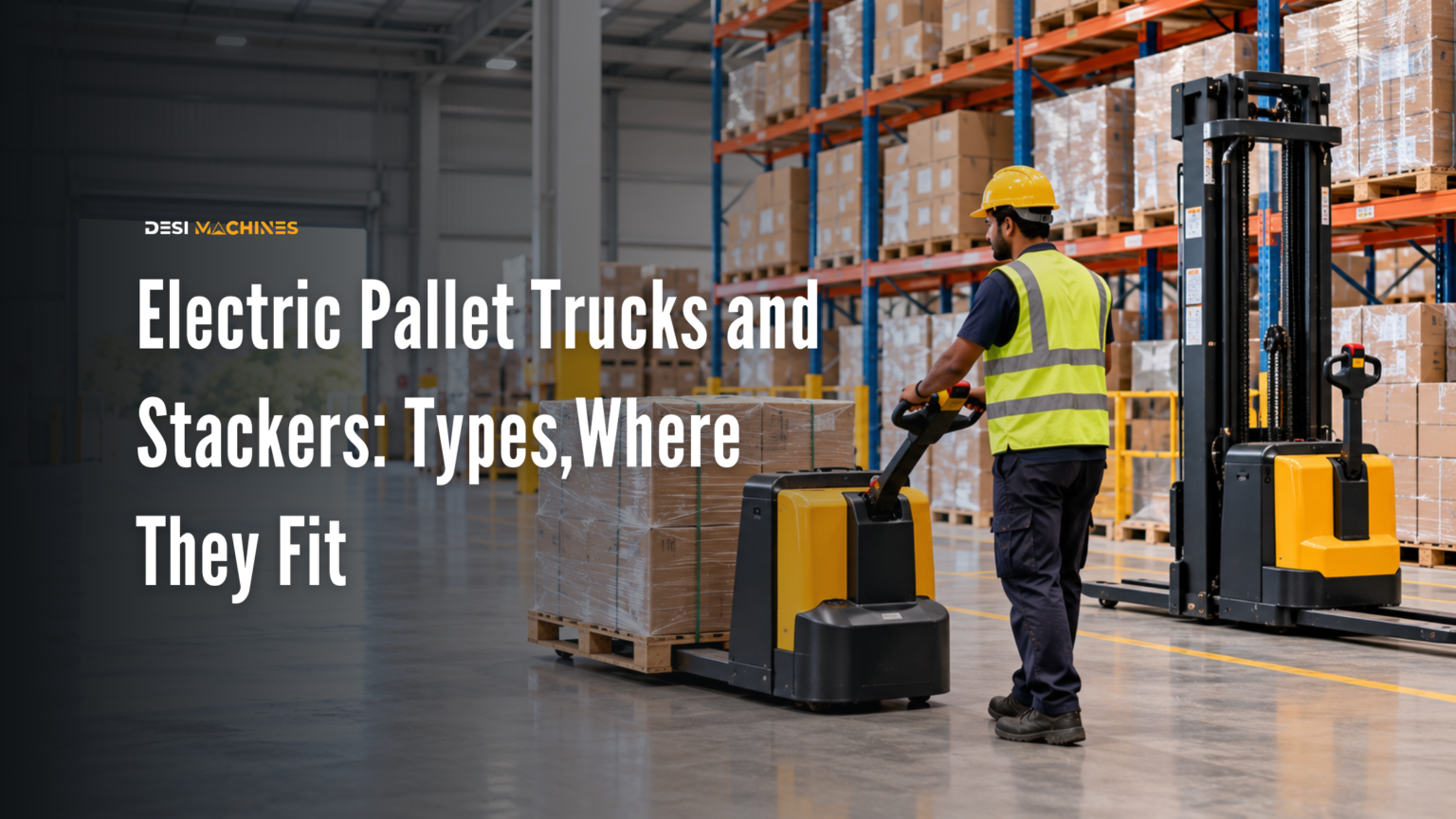
An electric pallet truck moves a loaded pallet of 1.5 to 3 tonnes (1,500 kg to 3,000 kg) across a flat floor, but it lifts that pallet only about 12 cm off the ground. When the pallet has to go up onto a rack or on top of another pallet, the machine you need is an electric stacker, which carries less, usually 1 to 1.6 tonnes, and raises it to between 1.4 m and about 4.2 m.
Both run on a 24-volt battery, both need a smooth concrete floor, and both are warehouse machines first. That is why a building contractor meets them in the cement godown, the tile and sanitaryware store and the finished floor of a new shed, and almost never out in the site yard.
The figures on this page come from two makers’ published sheets, read in October 2026: Godrej’s Indian range of battery operated pallet trucks and stackers (which also sells Crown models in India), and Hyster’s technical guides for its P2.0SE pallet truck and S1.0E and S1.2E stackers. Machines of this kind are not listed on DesiMachines, so no model below is linked and no price is given.
What is the difference between a pallet truck and a stacker?
A pallet truck moves pallets. A stacker moves them and lifts them high.
The pallet truck has two long forks that slide into the gaps of a wooden or plastic pallet. Press the lift button and the forks rise just enough to take the pallet’s weight off the floor, then the truck drives away with it. Hyster’s P2.0SE sheet puts that lift at 120 mm (about 5 inches). The forks sit 85 mm off the floor when lowered, which is why they fit inside a standard pallet.
A stacker adds a mast. The mast is the upright steel frame on the front of the machine, and the forks climb up it on chains, the same way a forklift’s forks do. Hyster’s S1.0E stacker has a standard lift of 2,380 mm (about 2.4 m), with masts offered from 1,440 mm to 4,180 mm.
The manual versions of both still sell in large numbers. A hand pallet truck, also called a hydraulic pallet jack, lifts by pumping the handle and moves by the worker pulling it. The hand pallet trucks in Godrej’s range are rated at 2.3 and 2.5 tonnes. In the electric version, called a battery operated pallet truck or BOPT in the Indian trade, a motor does both the driving and the lifting.
How high each machine lifts the forks (maker figures)
Lift height is the top of the forks above the floor. Source: Hyster S1.0E/S1.2E and P2.0SE technical guides; Godrej semi-electric stacker range. Read October 2026.
What types of electric pallet truck and stacker are sold in India?
Godrej’s Indian range shows the main types side by side. The split is by how the operator works it and how high it lifts.
| Type | How the operator works it | Capacities in Godrej’s Indian range | Best for |
|---|---|---|---|
| Electric hand pallet truck | Walks behind a compact powered truck | 1.5 tonne (Godrej EDGE) | Short moves in tight aisles, shops, backrooms |
| Pedestrian powered pallet truck (BOPT) | Walks behind, steers with the handle | 1.6 and 2 tonne (Crown WP 3200); 2 and 3 tonne (Godrej) | Godowns, loading docks, factory floors |
| Rider powered pallet truck | Rides on a platform at the back | 2 and 2.5 tonne (Crown WT 3000) | Long runs across a large warehouse |
| Semi-electric stacker | Pushes it by hand; a motor does the lifting | 1 to 1.5 tonne, lifting up to 3.3 m | Occasional stacking on a small budget |
| Electric stacker | Walks behind or stands on a platform; motors drive and lift | 1.2 and 1.5 tonne (Godrej); 1.2, 1.4 and 1.6 tonne (Crown ES/ET 4000) | Putting pallets on racks and on top of each other |
Source: Godrej Enterprises intralogistics range pages, read October 2026.
The pedestrian truck is the one most Indian buyers mean by “electric pallet truck”. The rider version only earns its extra cost when the distances are long enough that walking behind the machine slows the whole shift. Crown, on the rider WT 3000, says its folding platform suspension cuts the shock reaching the operator by more than 80%.
How much can an electric pallet truck carry, and how far can it go up a slope?
The capacity on the nameplate is only true when the load’s weight sits where the maker measured it. That point is the load centre: the distance from the back of the forks to the middle of the load. Both Hyster sheets rate their machines at a 600 mm load centre, which suits a 1,200 mm long pallet loaded evenly.
The table puts one walk-behind pallet truck and one walk-behind stacker from the same maker side by side.
| Figure from the maker’s sheet | Pallet truck: Hyster P2.0SE | Stacker: Hyster S1.0E |
|---|---|---|
| Rated load | 2.0 tonne (2,000 kg) | 1.0 tonne (1,000 kg); S1.2E 1.2 tonne |
| Load centre | 600 mm | 600 mm |
| Lift height | 120 mm | 2,380 mm standard (1,440 to 4,180 mm by mast) |
| Fork height, lowered | 85 mm | 89 mm |
| Ground clearance, middle of the wheelbase | 30 mm | 29 mm |
| Travel speed, walking | 6 km/h (8 km/h stand-on) | 6 km/h |
| Maximum slope, loaded / empty | 8% / 20% | 13.8% / 24.6% |
| Battery | 24 V, 375 Ah lead-acid (292 kg) | 24 V, 200 Ah lead-acid (185 kg) |
| Machine weight with battery | 753 kg | 790 kg |
| Turning radius | 1,795 mm | 1,426 mm |
Source: Hyster P2.0SE Product Technical Guide and Hyster S1.0E, S1.2E Technical Guide (data to VDI 2198), read October 2026.
A slope of 8% means the floor rises 8 cm for every metre you travel, about 1 in 12. That is a gentle dock ramp. Hyster adds a note on the P2.0SE sheet: if the truck will climb ramps often within an hour, consult the dealer, because steady climbing works the drive motor and the battery harder than flat running.
On a stacker, the rated load also falls as the forks go higher. Hyster warns on its stacker sheet that a raised load makes the machine less stable. Ask for the capacity plate or the maker’s chart that shows what the stacker can safely hold at each height, and read that, not the brochure headline, before you rack anything near the top of the mast.
Moving material outdoors instead? Compare live telehandler models and prices and get a dealer call back.
How long does the battery last, and lead-acid or lithium?
Godrej says a full charge on its battery operated hand pallet trucks gives 3 to 5 hours of continuous running, depending on load and use, and that charging takes 2 to 3 hours. Few pallet trucks run nonstop. On a normal shift the truck stands idle between jobs, so one charge usually covers the day’s actual driving.
The battery choice is the same one buyers face on forklifts, and the electric forklift guide sets out lead-acid against lithium in full. The short version for a pallet truck is weight. Hyster’s P2.0SE sheet lists 24-volt lead-acid packs of 250 to 500 Ah weighing about 212 to 370 kg, and lithium-ion packs of 228 to 456 Ah weighing about 72 to 185 kg. So a lithium pack weighs well under half as much as a lead-acid pack of similar size.
Two habits protect a lead-acid battery. Charge it before it runs flat, and top up the water as the maker’s manual says. Godrej’s 1.5 tonne electric stacker helps with the first: it locks the lifting function once the battery is 80% discharged, so the operator has to put it on charge. Ask whether the machine you are buying does the same. For the wiring side, charging an electric machine from a site supply is covered in the site charging guide.
What is an electric pallet truck best suited for?
Godrej lists warehouses, manufacturing plants, retail and e-commerce distribution centres, and cold stores as the places its battery operated pallet trucks normally work. All of them share the same three conditions: a smooth floor, short trips and many pallets a day.
In construction and building supply, the same conditions turn up in a few places:
- A dealer’s or contractor’s godown stacked with cement bags, tiles, adhesives or sanitaryware on pallets.
- The finished ground floor of a new shed or factory, once the slab has cured, for moving fittings and stock around.
- The receiving bay of a large project, where trucks unload palletised material onto a concrete apron.
- Indoor plant work, where a diesel machine’s exhaust is not acceptable.
The pallet itself matters. ISO 6780 sets six standard pallet sizes, and 1,000 by 1,200 mm is the one most used in Europe, as the ISO 6780 pallet sizes listed on Wikipedia show. Pallet trucks are built around those sizes. A pallet made locally to odd dimensions, or one with boards across the bottom where the small load wheels under the fork tips need to come down, can stop a pallet truck from working with it at all.
Can a pallet truck or stacker work on a construction site?
Only on a finished concrete floor. Both Hyster sheets give about 30 mm of ground clearance under the middle of the machine, and the wheels are small polyurethane rollers, 85 mm across under the forks on the P2.0SE. A brick edge, a hose or a rut deeper than a thumb’s width will stop one, and loose soil or gravel will bury the front wheels. Godrej says the same thing about its hand pallet trucks: they perform best on flat, smooth surfaces.
A floor built for these trucks has to be thick and level enough to take them. The warehouse shed cost guide shows how a godown floor is laid thicker as the trucks that will work on it get heavier.
Out in the yard, the job of lifting and moving pallets belongs to machines built for rough ground. A telehandler takes a pallet off the truck and places it on an upper floor, as the telehandler applications guide explains. The JCB 530-110, JCB 540-70 and ACE AT 30 are the telehandlers buyers ask about most. Where the load is a heavy item to be picked and carried rather than a pallet, a pick and carry crane such as the Escorts Hydra 15 or Escorts Hydra 14 is the usual answer on Indian sites. A skid steer loader with pallet forks covers the small plots.
Electric pallet truck: the pros and cons
| For | Against |
|---|---|
| No exhaust, so it can work indoors, in food stores and in cold rooms | Needs a smooth, level concrete floor; about 30 mm of ground clearance |
| One worker moves 2 to 3 tonnes without pulling or pumping by hand | Lifts only about 12 cm; stacking needs a stacker or a forklift |
| Quiet: Hyster gives 75 dB(A) for the P2.0SE and 66 dB(A) for the S1.0E stacker | Struggles on long or steep ramps: 8% maximum slope loaded on the P2.0SE |
| Small electric motors (2 kW drive on the P2.0SE) and low running cost | The battery wears out and is the largest single replacement cost |
| Short turning circle for narrow aisles | A flat battery stops the work until it is charged or swapped |
What decides the price of an electric pallet truck in India?
Neither maker read for this guide publishes an Indian price, so this guide gives none. The things that move the quote are easy to list, though, and asking about each one makes two quotes comparable:
- Type. A compact electric hand pallet truck, a walk-behind BOPT, a rider truck and a stacker are different machines, and the stacker carries the extra steel and hydraulics of its mast.
- Capacity and lift height. A bigger rated load means a bigger frame, motor and battery, and a taller stacker mast means more mast.
- Battery. The chemistry, the amp-hour size and the charger can change the price more than the truck itself. Lithium costs more to buy than lead-acid.
- Service. A nearby service engineer and stocked spare batteries are worth paying for. A pallet truck that stops for a week stops the godown with it.
For short projects, renting is common. If you buy, equipment finance works for warehouse machines the same way it does for any other.
What should you check before you buy an electric pallet truck or stacker?
1. The floor. Walk the whole route. Note every joint, drain cover, threshold and ramp. Measure the steepest ramp and compare it with the maker’s loaded slope figure.
2. The heaviest load and where it sits. Weigh your heaviest regular pallet, including the pallet itself, and buy a capacity above it. If loads overhang the pallet, the load centre moves out and the safe capacity drops.
3. The pallets. Measure them. Check the fork length and the outside width of the forks against the pallet openings, and check that the bottom boards leave space for the front wheels.
4. The lift height, for a stacker. Measure the top rack beam, then ask for the capacity at that height from the capacity plate or the maker’s chart.
5. The aisles. The sheet’s aisle-width figure is what the truck needs to turn with a pallet on the forks. Compare it with your narrowest aisle.
6. Battery and charger. Lead-acid or lithium, the amp-hours, the charging time, and the socket the charger needs. Ask whether the machine locks the lift at low charge.
7. Service and safety. The nearest service centre, the spare battery lead time, an emergency stop on the handle, the brake that holds the truck on a slope, and training for whoever will drive it.
Other electric machines for Indian sites
Pallet trucks and stackers handle goods inside buildings. The machines that build those buildings are starting to go electric too. The electric excavators listed in India include battery models such as the LiuGong 922FE Battery, and concrete pumps such as the Schwing Stetter SP 1200 E run on an electric motor instead of a diesel engine. For lifting people rather than pallets, see electric scissor lifts. Every electric guide in the series sits on the electric construction machines guide.
Browse the telehandlers and electric excavators listed in India, and send an enquiry to get a dealer call back.
Prices, specifications and features are indicative, vary by variant, location and date, and should always be confirmed with the official OEM or authorised dealer before any purchase decision. DesiMachines is not liable for decisions taken on the basis of information that may have changed after publication.