Excavator
294 models
Excavator
294 models  Backhoe Loader
51 models
Backhoe Loader
51 models  Crane
68 models
Crane
68 models  Concrete Mixer
79 models
Concrete Mixer
79 models  Wheel Loader
54 models
Wheel Loader
54 models  Compactor / Roller
45 models
Compactor / Roller
45 models  Motor Grader
42 models
Motor Grader
42 models  Concrete Pump
66 models
Concrete Pump
66 models  Skid Steer Loader
11 models
Skid Steer Loader
11 models  Telehandler
13 models
Telehandler
13 models 


In short: the electric vs diesel excavator cost question comes down to two numbers you can collect in an afternoon: what your machine burns per hour, and what your site pays per unit of electricity. A diesel machine drinking 12 litres an hour costs about Rs 1,140-1,250 an hour in fuel alone at a pump rate of Rs 95-104 a litre (indicative, as of Jul 2026). On the electric side, every 10 kWh an hour the machine draws costs roughly Rs 58-75 an hour at industrial tariffs of Rs 5.8-7.5 a unit. The energy line really is cheaper. Whether the machine is cheaper depends on something more basic: whether there is a grid connection at your site at all.
Electric vs diesel excavator cost: the two numbers that decide it
Every comparison you read about electric machines argues about batteries. Owners argue about something simpler. A machine earns the same money either way, so the only question that matters is what it costs you to keep it working for an hour.
On a diesel machine that cost is litres per hour multiplied by your pump rate. On an electric machine it is kilowatt-hours per hour multiplied by your tariff per unit. Both are two-number sums, and both are sums you can do yourself rather than take from a brochure.
The reason so few owners have done the second sum is that the inputs are harder to find. Diesel consumption you can measure with a pump and a notebook. Energy consumption you have to ask a dealer for, and the answer depends heavily on the duty cycle, which is a polite way of saying it depends on how hard the machine works.
What diesel actually costs you an hour
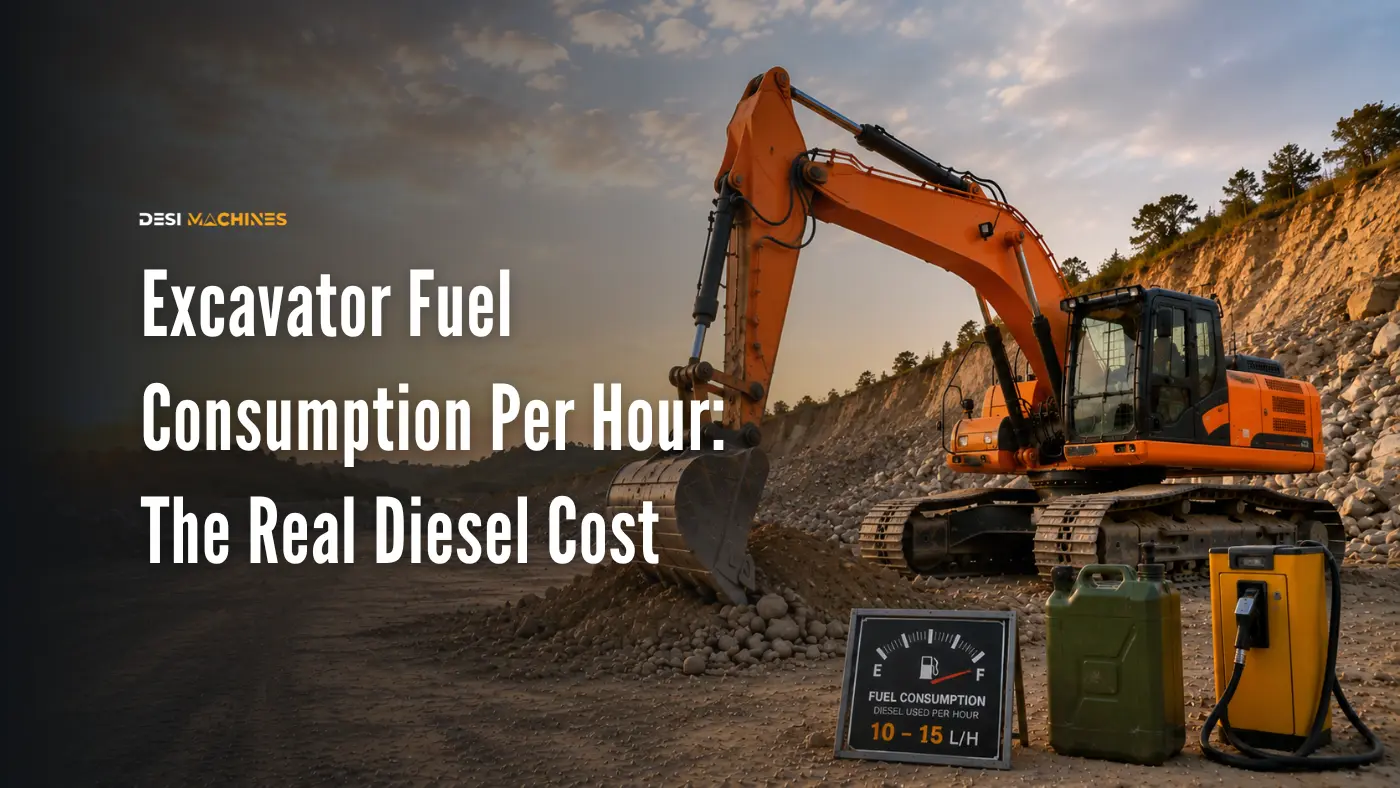
Start with the side you already know. Our own working figure is that excavator fuel consumption per hour is the number owners guess at most confidently and measure least often, and the money follows directly from it.
At Rs 95-104 a litre across the big cities (indicative, as of Jul 2026), every single litre per hour of burn costs about Rs 800 a day on an eight-hour shift and roughly Rs 20,000 a month at 200 hours. Scale that to a real machine and the numbers get serious quickly.
| Burn rate | Fuel cost per hour | Per month at 200 hours |
|---|---|---|
| 8 litres/hour | Rs 760-830 | Rs 1.52-1.66 lakh |
| 12 litres/hour | Rs 1,140-1,250 | Rs 2.28-2.50 lakh |
| 18 litres/hour | Rs 1,710-1,870 | Rs 3.42-3.74 lakh |
Fuel cost calculated at Rs 95-104 a litre (indicative, as of Jul 2026). Your own burn rate is the number to use here, not a published one.
That monthly column is usually the largest cheque an owner writes on a working machine, which is why the electric proposition gets attention at all. Anything that halves it is worth an afternoon of arithmetic.
What electricity actually costs you an hour
Electricity is billed per unit, and the tariff depends on which category your connection falls under and which state you are in. Industrial energy charges under the FY 2026 tariff orders sit in the region of Rs 5.8-7.5 a unit across states such as Punjab, Uttar Pradesh and Tamil Nadu. Commercial connections are dearer, generally Rs 8.1-9.4 a unit in the same states. Your own bill is the figure to use, since demand charges, duty and fuel surcharges all move the effective rate.
The arithmetic from there is one line. Multiply the machine’s consumption by your tariff:
| Machine draws | At Rs 5.8-7.5 a unit (industrial) | At Rs 8.1-9.4 a unit (commercial) |
|---|---|---|
| 10 kWh/hour | Rs 58-75/hour | Rs 81-94/hour |
| 30 kWh/hour | Rs 174-225/hour | Rs 243-282/hour |
| 50 kWh/hour | Rs 290-375/hour | Rs 405-470/hour |
Energy charges as reported under state FY 2026 tariff orders; effective rates vary with category, load and surcharges. Take the kWh-per-hour figure from the dealer for a duty cycle close to your work.
Put the two tables next to each other and the gap is obvious. Even a machine drawing 50 kWh an hour on a commercial tariff lands under Rs 500 an hour, against Rs 1,140-1,250 for a diesel machine burning 12 litres. That is the whole electric argument in one comparison, and on the energy line it holds up.
The rest of this piece is about why that saving so often fails to reach the owner.
The charging problem nobody puts in the brochure
An electric excavator needs a substantial supply, and it needs it where the machine sleeps. Two situations follow.
If your work sits inside a plant, a yard, an urban redevelopment site or anywhere with an existing connection of adequate load, the sums above apply more or less as written. Add the cost of the charging point and any load enhancement your distribution company asks for, both of which are one-time.
If your work is on a highway stretch, a canal, a rural site or a greenfield project, there is no connection. The machine then charges from a generator, which burns diesel to make electricity and loses a share of it in the conversion. You have paid a premium for an electric machine and gone back to buying diesel, with worse efficiency than the engine you removed. No amount of tariff arithmetic rescues that arrangement.
This single question decides more electric purchases in India than battery specifications do. Answer it before you look at a single spec sheet.
What gets cheaper, and what gets riskier
Fuel is the visible saving. There are quieter ones, and there are new exposures that owners tend to discover late.
| Cost line | Diesel machine | Electric machine |
|---|---|---|
| Energy | Rs 1,140-1,250/hr at 12 litres/hour | Rs 58-75/hr per 10 kWh drawn (industrial tariff) |
| Engine servicing | Oil, filters, fuel filters, DEF on newer machines | None of it |
| Battery | Starter battery only | Traction pack: the single largest replacement risk |
| Service network | Wide, in almost every district | Thin; high-voltage work needs trained technicians |
| Purchase price | Published bands on most models | Generally quoted on request |
| Resale | Established second-hand market | Little Indian resale history to price against |
Three of those rows deserve a sentence each.
The battery is the replacement risk that has no equivalent on a diesel machine. Get the warranty terms in writing, including how capacity loss over time is treated, because a pack that has faded to a shorter working day is a commercial problem long before it is a technical failure.
The service network matters more in India than the brochure suggests. Diesel machines can be kept running by a competent local mechanic almost anywhere. High-voltage systems cannot, and a machine waiting for a specialist is a machine earning nothing. Our own note on what machine downtime really costs applies with more force here, not less.
Resale is the one nobody can price yet. India has barely any second-hand market for electric earthmoving machines, so the depreciation curve that sits in every excavator cost of ownership model is guesswork on this side. Assume the worst case until the market gives you evidence.
Comparing what is actually available before you commit is worth an hour. Browse the current range of excavators, including the Volvo EC500 Electric, and put a diesel machine of the same class alongside it.
Is an electric excavator worth it in India yet?
For a specific and growing set of jobs, yes. For the average contractor, not this year.
The case works where the grid is already at the site and the work has an independent reason to avoid an engine: urban projects under night-time noise limits, indoor and enclosed demolition, tunnel and basement work, industrial premises with their own supply, and contracts where the client writes emissions or noise conditions into the tender. In those settings the machine wins work that a diesel machine is not allowed to do, which is a stronger argument than the fuel saving.
On ordinary highway, irrigation and rural earthmoving, the practical answer stays diesel. No connection, a thin service network, an unpriced resale market and a purchase premium you cannot yet size are four problems the fuel saving has to overcome, and today it does not.
The honest position is that this is a decision to revisit annually rather than settle permanently. The energy arithmetic already favours electric. The infrastructure has not caught up.
How to run the numbers on your own machine
Four steps, in order, and none of them need a consultant.
Measure your current burn rate over two or three tankfuls of typical work rather than trusting a remembered figure. Then ask the dealer for the electric machine’s consumption in kWh per hour on a duty cycle resembling your own work, in writing. Take your effective tariff from an actual bill, not a headline rate. Finally, ask what the machine costs and what the battery warranty covers, and treat the difference against a diesel machine of the same class as the amount your hourly saving has to repay.
If you want the framework the rest of the cost lines sit in, the excavator cost per hour method covers ownership, wear and operator costs alongside fuel, and the electric models reaching the Indian market covers what is actually available.
The bottom line
Electricity beats diesel on the energy line by a margin no owner should ignore: roughly Rs 58-75 an hour for every 10 kWh drawn, against Rs 1,140-1,250 an hour for a 12-litre-an-hour diesel machine. That part of the argument is settled.
What is not settled is everything around it. A grid connection at the site, a service network within reach, a battery warranty worth reading and a purchase price you can actually get quoted are the four conditions, and on most Indian sites at least two of them are missing. Where they are all present, run the numbers properly, because the saving is real.
When the capital side is what decides it, look at what the monthly outgo does to your cash flow before you commit. Compare equipment finance options and speak to our team about a written quotation for both machines.
Prices, tariffs, specifications and features are indicative, vary by variant, state, category and date, and should always be confirmed with the official OEM, authorised dealer or your electricity distribution company before any purchase decision. DesiMachines is not liable for decisions taken on the basis of information that may have changed after publication.