
 Excavator
294 models
Excavator
294 models  Backhoe Loader
51 models
Backhoe Loader
51 models  Crane
68 models
Crane
68 models  Concrete Mixer
79 models
Concrete Mixer
79 models  Wheel Loader
54 models
Wheel Loader
54 models  Compactor / Roller
45 models
Compactor / Roller
45 models  Motor Grader
42 models
Motor Grader
42 models  Dozer
41 models
Dozer
41 models  Concrete Pump
66 models
Concrete Pump
66 models  Skid Steer Loader
11 models
Skid Steer Loader
11 models  Telehandler
13 models
Telehandler
13 models 


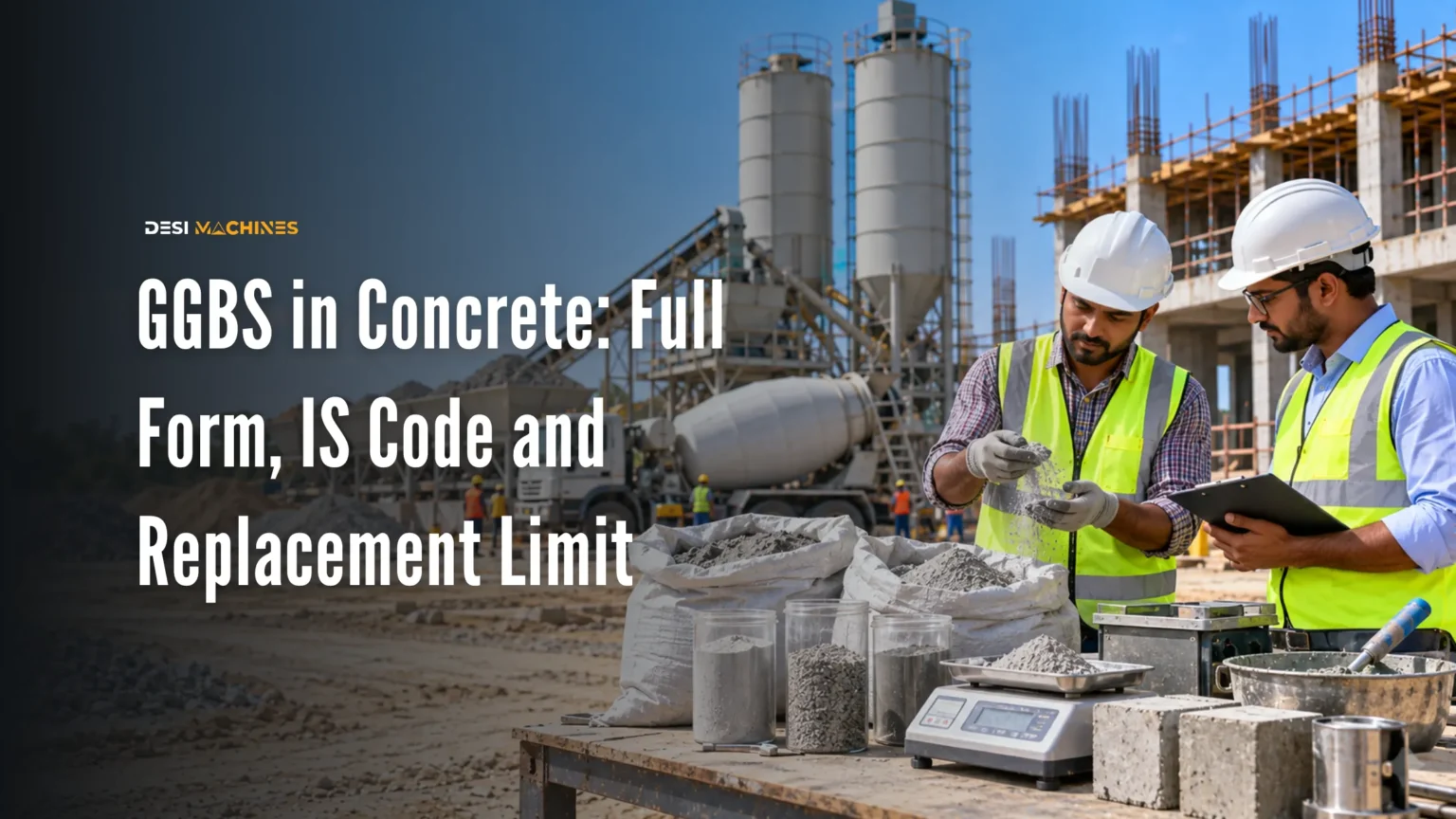
GGBS is ground granulated blast furnace slag: the glassy material that forms alongside molten iron in a blast furnace, quenched with water, dried and ground into a fine grey powder that takes the place of part of the cement in concrete. IS 16714:2018, the Bureau of Indian Standards specification written for it, treats it as two things at once, a raw material for making cement and a mineral admixture added straight into the mix.
The question most people arrive with is how much of the cement it may replace. That number is not in the GGBS standard at all. It comes out of IS 456, the concrete code, which lets a mix count slag towards its cement content up to the limit set for Portland slag cement, and that limit is 70 percent. Fly ash, by the same route, stops at 35 percent.
What does GGBS stand for, and where does it come from?
Four words, each doing a job. Slag is the non-metallic material that separates out when iron ore is smelted; IS 16714 describes it as a product “consisting essentially of glass containing silicates and alumino-silicates of lime and other bases, which is developed simultaneously with iron in blast furnace”. Granulated means the molten slag was quenched with water or steam rather than left to cool in air. Ground means it was then dried and milled.
The speed of that cooling is the whole point. Quench it and the material freezes as glass, which stays chemically restless and reacts with water and lime later. Cool it slowly and it crystallises into something closer to rock, useful as aggregate but no use as a binder. That is why the standard puts a floor under glass content and checks it under a microscope.
That makes GGBS a steel-plant by-product rather than a quarried material, reaching a site either from an integrated steel plant’s own grinding unit or from a cement company that buys granulated slag and grinds it. India has plenty of both, listed in our rundowns of the country’s steel companies and their plant locations and its national cement makers, state by state.
One confusion is worth clearing early. Portland slag cement, the PSC sold in bags, already has slag ground into it at the factory. GGBS is the slag on its own, delivered separately, so whoever designs the mix sets the proportion. Which bagged cement suits which job is answered in our guide to choosing the cement type, grade and brand.
Which IS code covers GGBS, and what does it ask for?
IS 16714:2018, published April 2018, with Amendment No. 1 in December 2019. Before it, the only Indian standard here was IS 12089:1987, covering granulated slag for making Portland slag cement. The 2018 foreword names the gap it fills: a separate standard was needed for ground slag, both for blending into cement and “for making concrete by direct addition”.
| Requirement (IS 16714:2018) | Limit | Clause or table |
|---|---|---|
| Fineness, by Blaine air permeability | 320 m²/kg, minimum | Table 2 |
| Glass content | 85 percent, minimum | Clause 5.3 |
| Moisture content | 1 percent by mass, maximum | Clause 5.2 |
| Slag activity index, 7 days | 60 percent of the control cube, minimum | Table 2 |
| Slag activity index, 28 days | 75 percent of the control cube, minimum | Table 2 |
| Magnesium oxide (MgO) | 17.0 percent, maximum | Table 1 |
| Manganese oxide (MnO) | 5.5 percent, maximum | Table 1 |
| Sulphide sulphur (S) | 2.0 percent, maximum | Table 1 |
| Sulphate (as SO₃) | 3.0 percent, maximum | Table 1 |
| Insoluble residue | 3.0 percent, maximum | Table 1 |
| Loss on ignition | 3.0 percent, maximum | Table 1 |
| Chloride content | 0.1 percent, maximum | Table 1 |
| Additives permitted in grinding | 1.0 percent, maximum | Clause 4 |
Two of those need translating. Fineness of 320 m²/kg is the surface area of all the particles in one kilogram. IS 455 asks only 225 m²/kg of finished Portland slag cement, so GGBS is ground finer than the bagged cement it often goes into, because slag is slower to wake up and finer powder reacts faster.
The slag activity index is the test that decides whether a consignment is worth buying. A laboratory makes mortar cubes from a half-and-half blend of the GGBS and a control OPC 43 grade cement, then compares their crushing strength against cubes of the control cement alone. At seven days the blend must reach 60 percent of the control, at 28 days 75 percent. Those two figures are the standard’s own admission that slag starts slow and catches up, and the whole site routine around GGBS follows from it.
Amendment No. 1 tidied the chemistry: of the three ratio requirements in Table 1, a consignment must satisfy any one of the two at serial numbers (viii) and (ix) rather than all of them. The full text sits in the BIS specification for ground granulated blast furnace slag. One thing to know before a specification argument: IS 456:2000 predates all of this, and its clause 5.2.2 still permits GGBS “obtained by grinding granulated blast furnace slag conforming to IS 12089”, naming the 1987 standard while the material you buy today is tested against the 2018 one.
How much of the cement can GGBS replace in concrete?
IS 456 clause 5.2.2 permits the replacement but puts no number on it. The number appears under Table 5, which sets minimum cement content and maximum water-cement ratio by exposure condition. Its Note 1 says the cement content there is “inclusive of additions mentioned in 5.2”, and that fly ash or GGBS may be counted towards cement content and water-cement ratio “if the suitability is established and as long as the maximum amounts taken into account do not exceed the limit of pozzolona and slag specified in IS 1489 (Part 1) and IS 455 respectively”.
Follow that sentence to its two destinations and the answer falls out:
- Slag. IS 455 clause 4.1 sets the slag constituent of Portland slag cement at 25 to 65 percent; Amendment No. 4, May 2000, raised the ceiling to 70 percent.
- Fly ash. IS 1489 (Part 1) clause 5 allowed 10 to 25 percent; Amendment No. 3, July 2000, replaced that with 15 to 35 percent.
So the code lets a mix count up to 70 percent slag, or up to 35 percent fly ash, towards its cement content. That gap is the biggest practical difference between the two, and it is why large pours and coastal work in India lean on slag rather than ash.
Share of the binder, by mass
Fly ash
up to 35%, IS 1489 (Part 1), Amd 3
GGBS
up to 70%, IS 455, Amd 4
50%: above this, IS 456 credits slag with better sulphate resistance
0%
50%
100%
Ceilings are the amounts a mix design may COUNT towards cement content under IS 456 Table 5, Note 1.
Reading the diagram
- Fly ash bar, 35 percent. IS 1489 (Part 1)’s ceiling on the fly ash share of Portland pozzolana cement, as amended in 2000.
- GGBS bar, 70 percent. IS 455’s ceiling on the slag share of Portland slag cement, as amended in 2000. It also sets a floor of 25 percent.
- Dashed line at 50 percent. Not a limit, but the level above which IS 456 credits slag with real durability. It appears twice in the code.
Three conditions sit around those ceilings and none is optional. “If the suitability is established” means trial mixes and a design mix, not a proportion settled on site; the quantities for an ordinary mix are in our guide to calculating cement, sand, aggregate and steel. Table 5’s minimum cement content must still be met after the replacement, so a thin mix cannot be thinned further: a buried plinth beam sits in moderate exposure, meaning a floor of 300 kg per cubic metre and M25, as set out in our breakdown of plinth beam concrete, steel and shuttering quantities. The maximum works the other way: clause 8.2.4.2 caps cement at 450 kg per cubic metre, and says plainly the cap is on cement “not including fly ash and ground granulated blast furnace slag”.
Specific jobs tighten the band further. For dry lean concrete under a road slab the specification allows GGBS at 25 to 50 percent of the cementitious material with ordinary Portland cement held at or above 100 kg per cubic metre, set out in our guide to DLC mix, thickness and machines; for cement-treated sub-bases it is the permitted cement types that matter, in our guide to CTSB and CTB strength and thickness. IS 456’s annexe on self compacting concrete asks for mineral admixture “to the order of 25 percent to 50 percent by mass of cementitious materials”, slag being the usual choice.
GGBS or fly ash: which is better for an Indian site?
Neither, as a general answer. Both are by-products that replace cement, both slow the early strength gain and lengthen curing. What separates them is how far each can be pushed, and what the code credits each with.
| GGBS | Fly ash | |
|---|---|---|
| What it is | Quenched, ground blast furnace slag from iron making | Pulverised fuel ash collected from coal power station flue gas |
| Its own Indian standard | IS 16714:2018 | IS 3812 (Part 1) |
| Blended cement it makes | Portland slag cement, IS 455 | Portland pozzolana cement, IS 1489 (Part 1) |
| Share countable under IS 456 Table 5 | Up to 70 percent | Up to 35 percent |
| Share IS 456 asks for against alkali silica reaction | At least 50 percent slag | At least 20 percent fly ash |
| Fineness its standard demands | 320 m²/kg minimum | Graded by category in IS 3812 (Part 1) |
| Where it is strongest | Sulphate ground, coastal and marine work, thick pours | Plaster, masonry and general building concrete |
The alkali silica reaction row rewards a second look, because it is the code’s clearest statement of how the two differ. Alkali silica reaction is a slow expansion caused by alkalis in the cement attacking certain aggregates, and IS 456 allows either material as part replacement of low-alkali OPC “provided fly ash content is at least 20 percent or slag content is at least 50 percent”. Fly ash does the job at a fifth of the binder; slag needs half. Both are allowed, but not interchangeable at the same dose.
A mineral admixture and a chemical admixture are different things, and a mix can carry both; plasticiser and retarder dosages are in our guide to concrete admixture types, uses and dosage.
Where does GGBS actually earn its place?
In ground and water that attack ordinary concrete. IS 456’s table for concrete exposed to sulphate attack carries a note that says it as directly as a code ever does: “Portland slag cement conforming to IS 455 with slag content more than 50 percent exhibits better sulphate resisting properties.” A second note covers chloride and sulphate together, and there too allows slag cement above 50 percent slag, or a blend of ordinary Portland cement and slag, where there is enough information on how such blends perform.
That is the 50 percent threshold again. Put the sulphate note beside the alkali silica clause and a rule of thumb falls out: a token 15 or 20 percent of slag is a cost decision, not a durability one. The reputation slag carries belongs to mixes where it is half the binder or more.
The other case is heat. Cement gives off heat as it sets, and in a thick raft, a pile cap or a bridge pier that heat cannot escape from the middle, so the inside expands against a cooler outside and the concrete cracks before carrying any load. IS 455’s foreword credits slag cement with a low heat of hydration and says it can be used for marine works with advantage. Replacing half the cement with slag spreads the heat over more days, which is why large Indian infrastructure pours specify it.
What changes on site once GGBS is in the mix?
Curing gets longer, and this is not advisory. IS 456 clause 13.5.1 requires exposed surfaces to be kept wet for at least seven days with ordinary Portland cement and at least 10 days where mineral admixtures or blended cements are used, with a recommendation that the period extend to 14 days. What the seven-day rule really says is covered in our explainer on the curing period for a slab under IS 456, and where no water line reaches a column or an upper floor, the sprayed alternative and its coverage figures are in our guide to curing compound types and coverage per litre.
Under-curing is how GGBS jobs fail, and the slag activity index explains why: at seven days the material is running at 60 percent of plain cement, reaching 75 percent only by 28 days. Stop watering on day seven, as a mason does out of habit, and the surface of a slag mix has barely started.
Storage gets stricter. Clause 10 requires GGBS to be kept in silos protected from the entry of moisture, with bags off the ground, because of the 1 percent moisture limit: a powder this fine is spoiled by damp long before anyone can see it. Treat a bag that has sat in a puddle as scrap.
The last change is paperwork, and it is the one buyers skip. The BIS Standard Mark on GGBS is optional under clause 8.3, which says the material “may also be marked with the Standard Mark”. Clause 13 is not optional: the supplier shall submit a test certificate for each batch covering all the requirements of the standard, and bulk consignments must carry one under clause 7.2. So insist on the batch certificate showing fineness, glass content, moisture and slag activity index. Not a logo on the bag.
How is GGBS sold, and how should you price it?
Clause 7 sets the packing: a 50 kg bag unless buyer and seller agree otherwise, drums and bulk also allowed, and anything from 1,000 kg (one tonne) up counted as bulk. Every bag must carry the net quantity and the batch number by week, month and year of packing, so a bag with no packing date is a bag to refuse.
On price there is no national rate to quote, and anyone quoting one is guessing. GGBS is a by-product sold out of a limited number of grinding units, so what reaches your site is set mostly by how far it has travelled. Compare binders on one basis instead:
- Ask for a landed rate per tonne, freight and unloading included, from the nearest grinding unit that will actually deliver to your district. A factory-gate quote tells you nothing.
- Convert cement to the same unit. A tonne is 20 bags of 50 kg, so take the delivered bag rate off your last invoice and multiply by 20; current bag rates by state are in our reference on cement price per bag across India.
- Apply the replacement you will actually use, not the ceiling, then subtract what the longer curing costs in water, labour and watchman days.
Run that sum before committing. On a site far from a steel belt the freight eats the whole saving, and the reason to use slag there is durability, not money.
Can a self-loading mixer handle a GGBS mix?
Partly, and the honest answer sits in our own machine data. A GGBS mix is a proportion by mass, so both binders have to be weighed, and across the 764 machines listed on this site, checked in both spec stores a product page can draw from, not one publishes a silo, binder, powder or additive field. The only hoppers in the catalogue are the stationary concrete pump’s own 600 to 625 litre concrete hopper. Two silos dosing cement and slag together belong to a batching plant, a different class of equipment from anything in our range.
What the on-site machines can do is weigh. Of the 38 self-loading concrete mixers listed, 31 publish how they measure a charge, split three ways: load cells, pressure transducers, or a computerised batching system. Two record the field as not stated and five do not carry it. The Fiori DBS 4300 is the one publishing computerised batching with printed certificates, which is what an engineer wanting proof of a 50 percent replacement will ask to see; the AJAX ARGO 4500 publishes a pressure transducer with load cell and the Schwing Stetter SLM 4300 dual pressure sensors.

The limit is the layout, not the weighing. These machines have one loading bucket, 320 to 600 litres on the models publishing a capacity, feeding one drum, so cement and GGBS go in as two separate weighed charges, one after the other, into the same bucket. That works and it is recorded, but it depends on an operator following the sequence every single batch. A job specifying a high replacement therefore usually either takes ready-mixed concrete and runs it in transit mixers, or batches on site with the proportion signed off and the printout kept.
If you are choosing a machine for this kind of work, the weighing method is the specification to read first. Compare self-loading concrete mixer models and prices and ask each dealer what the machine records per batch.
Where GGBS fits beside the other materials on a job is mapped in our building materials guide, and the machines that mix and place the concrete it goes into are listed under concrete mixer models and prices. The clause references above are drawn from the BIS code of practice for plain and reinforced concrete and the GGBS specification linked earlier.
Prices, specifications and features are indicative, vary by variant, location and date, and should always be confirmed with the official OEM or authorised dealer before any purchase decision. DesiMachines is not liable for decisions taken on the basis of information that may have changed after publication.
Machines, tenders and news for this industry: Building Construction