
 Excavator
316 models
 Backhoe Loader
54 models
 Crane
68 models
 Concrete Mixer
79 models
 Wheel Loader
54 models
 Compactor / Roller
45 models
 Motor Grader
42 models

 Concrete Pump
66 models
 Skid Steer Loader
11 models


The equipment used in a steel plant falls into two groups: the fixed process plant (blast furnaces, converters, casters, rolling mills and the overhead cranes in each bay) and a mobile fleet of wheel loaders, excavators, dozers, cranes, forklifts, dump trucks and slag carriers that moves everything around it. A large share of that mobile fleet works on slag. The Indian Bureau of Mines puts blast furnace slag at about 300 to 540 kg for every tonne of iron, and steel slag at 150 to 200 kg for every tonne of steel, and all of it has to be dug out and carried away every day.
This guide is for a fleet owner or contractor who is thinking about work inside a steel plant, and for anyone who wants to know what each machine does there. It walks through the plant shop by shop, explains how slag is handled, what a steel-mill wheel loader carries that a quarry loader does not, and who owns the machines. The steel makers and their plants, state by state, are listed in the blog on steel companies in India, so they are not repeated here. No prices are quoted.
What equipment is used in a steel plant?
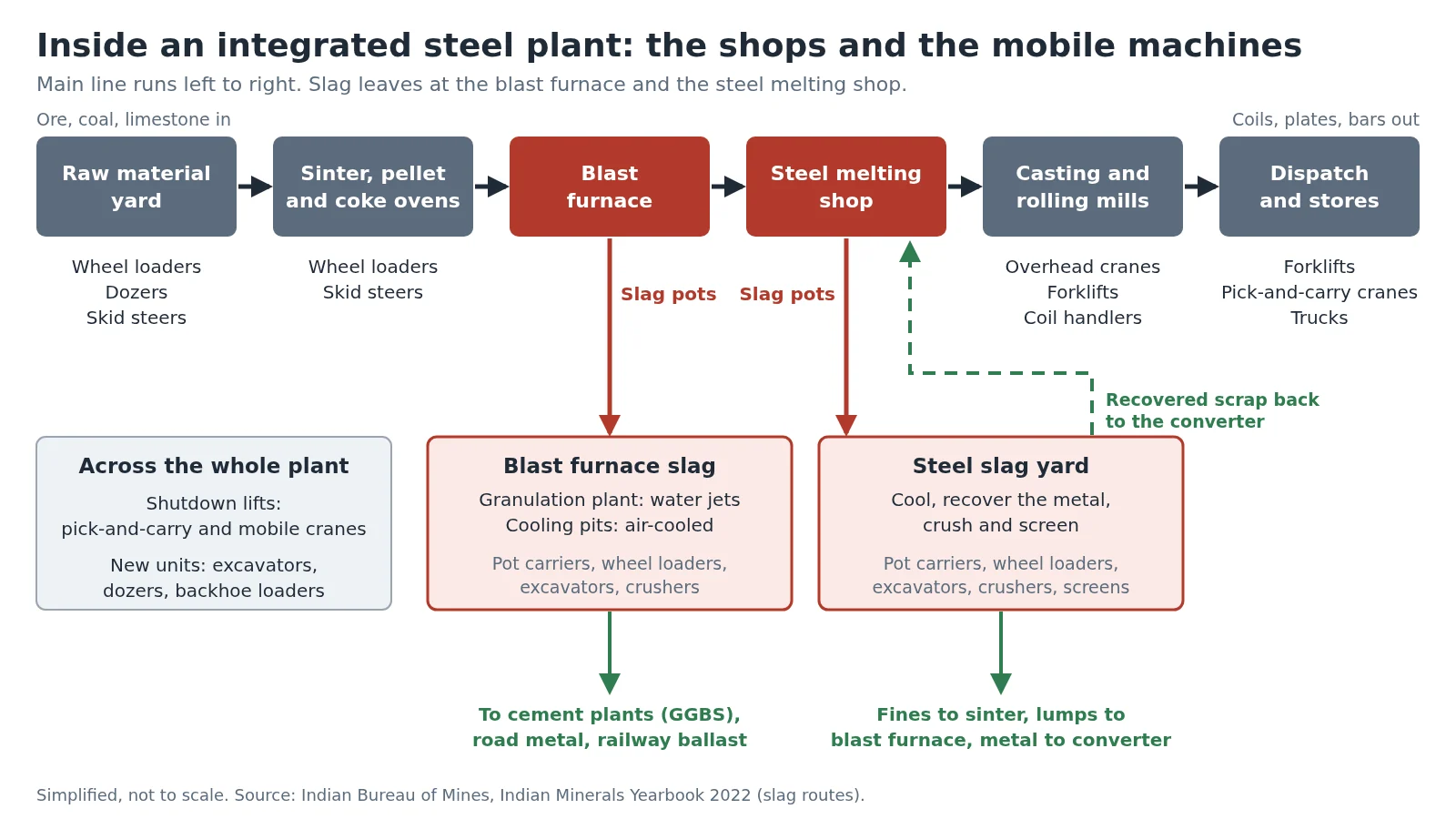
An integrated steel plant is a chain of shops, and each shop needs its own mobile machines. Iron ore, coal and limestone come in at one end. Coils, plates, bars and rails leave from the other. In between, the mobile fleet feeds the shops and clears up after them.
| Shop or area | What happens there | Mobile machines at work | What the machine has to put up with |
|---|---|---|---|
| Raw material yard | Ore, coal, limestone and dolomite are piled up and taken back onto conveyors | Wheel loaders, dozers, skid steer loaders | Dust, spillage, heavy ore |
| Sinter plant, pellet plant, coke ovens | Ore fines are baked into lumps; coal is baked into coke | Wheel loaders, skid steers for clean-up | Heat, fine dust |
| Blast furnace | Ore, coke and limestone melt into hot metal (molten iron) and slag | Slag pot carriers, wheel loaders and excavators in the slag pits | Molten slag, radiant heat |
| Steel melting shop | Oxygen is blown through hot metal and scrap in a converter to make steel | Slag pot carriers, wheel loaders, magnet handlers in the scrap bay | Hot slag, metal lumps, bursts when hot slag meets water |
| Casting and rolling mills | Steel is cast into slabs, blooms and billets, then rolled | Overhead cranes do the main lifting; forklifts and coil handlers help | Heavy, hot product in tight bays |
| Dispatch and stores | Finished steel and spares go out by rail and road | Forklifts, pick-and-carry cranes, trucks | Long shifts, tight loading bays |
| Maintenance and shutdowns | Furnaces are relined and worn parts are changed | Pick-and-carry cranes, larger mobile cranes | Short windows, heavy lifts |
The fixed plant is what most lists of “steel plant equipment” mean: the furnaces, converters, casters, mills and the overhead cranes that run on rails along each bay. Engineering firms build and install it, and a plant buys it rarely, as part of a new unit or a rebuild. The mobile fleet is different. It wears out in a few years, and much of it is hired. That is where a machine owner fits in, so the rest of this guide stays with it.
For the wider picture across steel, cement and refinery plants, with the most asked-about models and open tenders, see the page on machines for steel, cement and process plants.
Which machines work the raw material yard?
Wheel loaders and dozers do most of the mobile work in the raw material yard. The big stockpiles of ore, coal and limestone are built and reclaimed by stackers and reclaimers, which are fixed machines running on rails beside the conveyors. The loaders work around them.
A loader in the yard feeds hoppers when a reclaimer is down and builds the smaller piles of flux and additives. It loads trucks too, and clears the spillage that builds up under every conveyor. Dozers push material towards the reclaimer and trim the sides of a pile so it stays safe to work. Skid steer loaders get into the low, narrow spaces under conveyor galleries where a big loader cannot reach.
The material sets the bucket. Iron ore is far heavier than coal for the same bucketful, so a bucket sized for coal will overload a loader on ore.
How is slag handled in a steel plant?
Slag is the rocky waste that separates from the metal in a furnace. It forms from the limestone and other fluxes reacting with the earth and stone in the ore, and it floats on top of the molten metal because it is lighter. A steel plant makes two main kinds, and each takes a different route.
Blast furnace slag. According to the Indian Bureau of Mines, the slag floating on the hot metal is flushed out into slag pots and sent either to a granulation plant or to cooling pits. At the granulation plant, jets of high-pressure water quench the molten slag into glassy grains. The granules are crushed and ground, and much of the output is sold to cement plants; ground fine, it becomes the GGBS that replaces part of the cement in concrete, as the guide to GGBS explains. Slag left to cool in a pit is dug out, crushed and used as road metal and railway ballast.
Steel slag. At the converter, the steel is poured off first, and then the slag is tipped through the mouth of the vessel into slag pots. This slag carries much more metal. The Bureau puts iron in blast furnace slag at about 0.7%, and in steel slag at 16 to 25%. It also carries free lime, which can make it swell as it weathers. So steel slag is cooled, the metal in it is recovered, and the rest is crushed and screened. The fines go back to the sinter plant and the lumps go back to the blast furnace.
| Slag | Where it forms | How it is cooled | Machines that handle it | Where it goes |
|---|---|---|---|---|
| Granulated blast furnace slag | Blast furnace | Quenched with high-pressure water jets | Wheel loaders and trucks move the granules | Cement plants, GGBS |
| Air-cooled blast furnace slag | Blast furnace | Left to cool in a pit | Slag pot carriers, wheel loaders, excavators with rock breakers, crushers | Road metal, railway ballast |
| Steel (converter) slag | Steel melting shop | Cooled in pits or yards | Slag pot carriers, wheel loaders, excavators, crushers and screens | Metal back to the converter, fines to sinter, lumps to the blast furnace |
The tonnage is what keeps the fleet busy. Take a plant that makes 1 million tonnes of steel a year. At 150 to 200 kg of steel slag per tonne, that is 150,000 to 200,000 tonnes of steel slag a year, or about 410 to 550 tonnes every day of the year. The blast furnace slag comes on top of that. Most of it is lifted at least twice: once out of the pit and once into the crusher or a truck.
Some of it comes out as skulls: lumps of metal and slag frozen together in a pot or ladle. They are too big and too tough for a bucket, so they have to be broken into pieces before a loader can move them. How the crushing and screening line itself is laid out is covered in the guide to the crushing and screening plant.
What makes a steel-mill wheel loader different?
A wheel loader for a slag yard is a standard loader with a heat and impact package added at the factory. Volvo’s brochure for its slag handlers is a useful checklist, because it lists each item model by model. Volvo offers the package on five of its loaders, from the Volvo L150H to the Volvo L350H, and all five are listed in India.
| Problem in the slag yard | What the package adds |
|---|---|
| Radiant heat from hot slag | Heat-resistant fuel and oil lines, heat-protected lift and tilt hoses, heat-resistant hydraulic fluid, fire-protective material |
| Fire | Two 6 kg fire extinguishers, one at the cab and one at the rear; fire suppression system as an option |
| Slag bursts and falling pieces | Steel cab roof, reinforced flat windshield, cover plates under the cab, belly guards, guards on the centre hinge, axle seals and linkage |
| A machine that stops in a hot zone | Emergency switch and parking brake release, emergency “limp home” gear, wire-hung ladders, an optional escape ladder |
| Dust and fumes in the cab | Cab filtration that sends 90% of the cab air through the main filter |
| Tyre cuts on sharp, hot slag | L5 tyres (a deep rock tread) and a bucket that allows for tyre chains |
The bucket changes as well. Volvo’s slag bucket has a thick floor, hardened edges and an 80 mm one-piece cutting edge. Heaped, it holds 3.9 m³ (3,900 litres) on the L150H and up to 6.8 m³ (6,800 litres) on the L350H.
All that steel adds weight. Volvo’s own table puts the L150H at 28,250 kg as a slag handler, counting the guards and the slag bucket. The standard L150H weighs 24,100 to 25,600 kg (as of November 2026), so on this model the slag version is about 2.7 to 4.2 tonnes heavier, and it rides on L5 tyres where the standard machine has L3. The wheel loader tyre guide explains the L3 to L5 tread ratings.
| Model | Operating weight (standard machine) | Engine power | Slag bucket, heaped |
|---|---|---|---|
| Volvo L150H | 24,100 to 25,600 kg | 300 HP (224 kW) | 3.9 m³ |
| Volvo L180H | 27,000 to 28,400 kg | 337 HP (250 kW) | 4.1 m³ |
| Volvo L220H | 31,200 to 33,100 kg | 375 HP (280 kW) | 4.6 m³ |
| Volvo L260H | 34,000 to 39,000 kg | 416 HP (310 kW) | 5.3 m³ |
| Volvo L350H | 50,000 to 56,300 kg | 532 HP (397 kW) | 6.8 m³ |
None of the five has a published price yet, so ask the dealer to quote the slag package as a separate line. Other makers sell steel-mill versions of their loaders too, so ask any loader dealer whether a heat package exists for the model before you plan a slag contract around it. To compare sizes and specifications across makers, browse the range of wheel loaders and send an enquiry for the one that fits your contract.
Which machines handle scrap, steel and shutdown lifts?
Scrap goes back into the converter. In the basic oxygen process, cold scrap can make up 25 to 30% of the charge, with hot metal making up the rest. That scrap comes from the plant’s own mills, from the metal recovered out of slag and from outside. In the scrap bay it is sorted and loaded by machines with an electro-magnet or a grab: purpose-built material handlers, or excavators fitted with the same tools, with wheel loaders pushing up the piles.
Inside the casting and rolling bays, the overhead cranes do the heavy lifting. Outside them, forklifts and coil handlers move coils, bundles and spares to the dispatch bays and stores.
Shutdowns are the other big job. When a furnace is relined or a mill stops for repairs, the plant needs cranes that can drive in, lift and drive out again. Pick-and-carry cranes such as the Escorts HYDRA 15 carry motors, pumps and pipe sections across plant roads on their own wheels, and larger mobile cranes do the heavy lifts.
Does a steel plant own its machines or hire a contractor?
Both. A plant keeps some machines of its own, but much of the slag, scrap and material handling is given out on long contracts, with the contractor bringing the machines and the operators.
One long-running example in India is Ferro Scrap Nigam Ltd (FSNL). The Indian Bureau of Mines records that it recovers and processes scrap from the slag and refuse dumps at nine steel plants, and handles converter slag and other mill services. FSNL was a government company under MSTC until January 2025, when MSTC transferred all of its shares to Konoike Transport of Japan. Its own list of services today includes handling iron and steel skulls, rejected slabs, blooms and billets, and sludge, lime dust and mill scale.
Plants also hire machine work directly. On 23 October 2026 the SAIL tender site carried a Bhilai contract for handling, loading, dispatch and crane operation of slabs and blooms, for 36 months, and a Durgapur contract for scrap yard management and auxiliary crane operation, for 730 days. Both are set out in the blog on SAIL vendor registration. Contracts of this length are why a slag or scrap fleet is usually planned around one plant.
How does a steel plant buy or hire machines?
There are two routes, and they rarely meet. When a plant buys a machine outright, its purchase department buys it like any other item, from registered suppliers. When it wants machine work done, its contract department puts out an open tender, often on GeM, and the scope of work names the machines, the shifts and who supplies the operator.
For a fleet owner, the tender is the way in. A supplier registration is for firms that sell goods to the plant. The SAIL blog linked above walks through the portals, the digital signature and the papers, and new plant work across India is listed as live tender opportunities.
What should you check before taking a machine into a steel plant?
A slag or scrap contract runs for years, and the machine has to last that long in heat and dust. Go through these points before you bid:
- Read the scope of work. Note which shop, which material, how many hours a shift and whether you supply the operator.
- Match the machine to the material. A loader sized for coal is too small for ore or slag at the same bucket size.
- Ask the dealer whether the model comes with a heat package, and what it includes: guards, heat-protected hoses, fire extinguishers or suppression, and a strong windshield.
- Price in the tyres. Slag cuts tyres, so plan for deep-tread L5 tyres or chains.
- Check the cab air. A good filter matters on a 12-hour shift in dust.
- Ask the plant what its safety rules require of machines and operators before you move a machine in.
- Check where the nearest service point and spares are. A loader down in the slag yard stops the work the contract pays for.
How the rest of the heavy-equipment industry buys and runs machines is covered in the heavy equipment guide. To size a loader for a plant contract, compare live wheel loader models and specifications and connect with a dealer.
Sources: slag figures, cooling routes and FSNL’s role are from the Indian Bureau of Mines’ Indian Minerals Yearbook 2022, Iron, Steel and Scrap and Slag (released April 2024). Slag-package items, slag bucket sizes and slag-handler weights are from Volvo CE’s wheel loaders in slag handling brochure, read in November 2026. Standard operating weights and engine powers are catalogue figures as of November 2026. FSNL’s ownership and services are from its own website and MSTC’s disclosure of 21 January 2025. The converter steps and the scrap share are from the Wikipedia article on basic oxygen steelmaking. The slag tonnage example is our own arithmetic.
Prices, specifications and features are indicative, vary by variant, location and date, and should always be confirmed with the official OEM or authorised dealer before any purchase decision. DesiMachines is not liable for decisions taken on the basis of information that may have changed after publication.