
 Excavator
316 models
 Backhoe Loader
54 models
 Crane
68 models
 Concrete Mixer
79 models
 Wheel Loader
54 models
 Compactor / Roller
45 models
 Motor Grader
42 models

 Concrete Pump
66 models
 Skid Steer Loader
11 models


If a sheet of plywood is going under a kitchen sink, the three letters stamped on it matter more than its brand or its thickness. Plywood in India comes in three grades under IS 303:2024, the Bureau of Indian Standards (BIS) specification for general-purpose plywood: MR (moisture resistant), BWR (boiling water resistant) and BWP (boiling water proof), and the grade tells you one thing only, how well the glue between the layers stands up to water.
Two more standards sit beside it. Marine plywood is made to IS 710 for boats and pontoons, and shuttering plywood to IS 4990 for concrete formwork. Both are bonded with BWP glue and treated against rot and insects. This guide explains each grade, the appearance types such as AA and AB, the E1 and E2 formaldehyde classes, standard thicknesses and sheet sizes, how to read the stamp, and which grade belongs where, from a bedroom wardrobe to slab shuttering.
Key points
- IS 303:2024 has three grades, MR, BWR and BWP. The 1989 edition it replaced had only two, BWR and MR.
- Under IS 848, BWP glue must come through six cycles of 8 hours in boiling water and 16 hours of drying; BWR glue goes through three such cycles, and MR glue is soaked at 60°C, never boiled.
- Marine plywood (IS 710) and shuttering plywood (IS 4990) are both BWP-bonded and preservative treated, so every marine sheet is BWP, but a BWP sheet is not automatically marine.
- The standard thicknesses are 3, 4, 5, 6, 9, 12, 15, 19, 22 and 25 mm.
What are the grades of plywood in India?
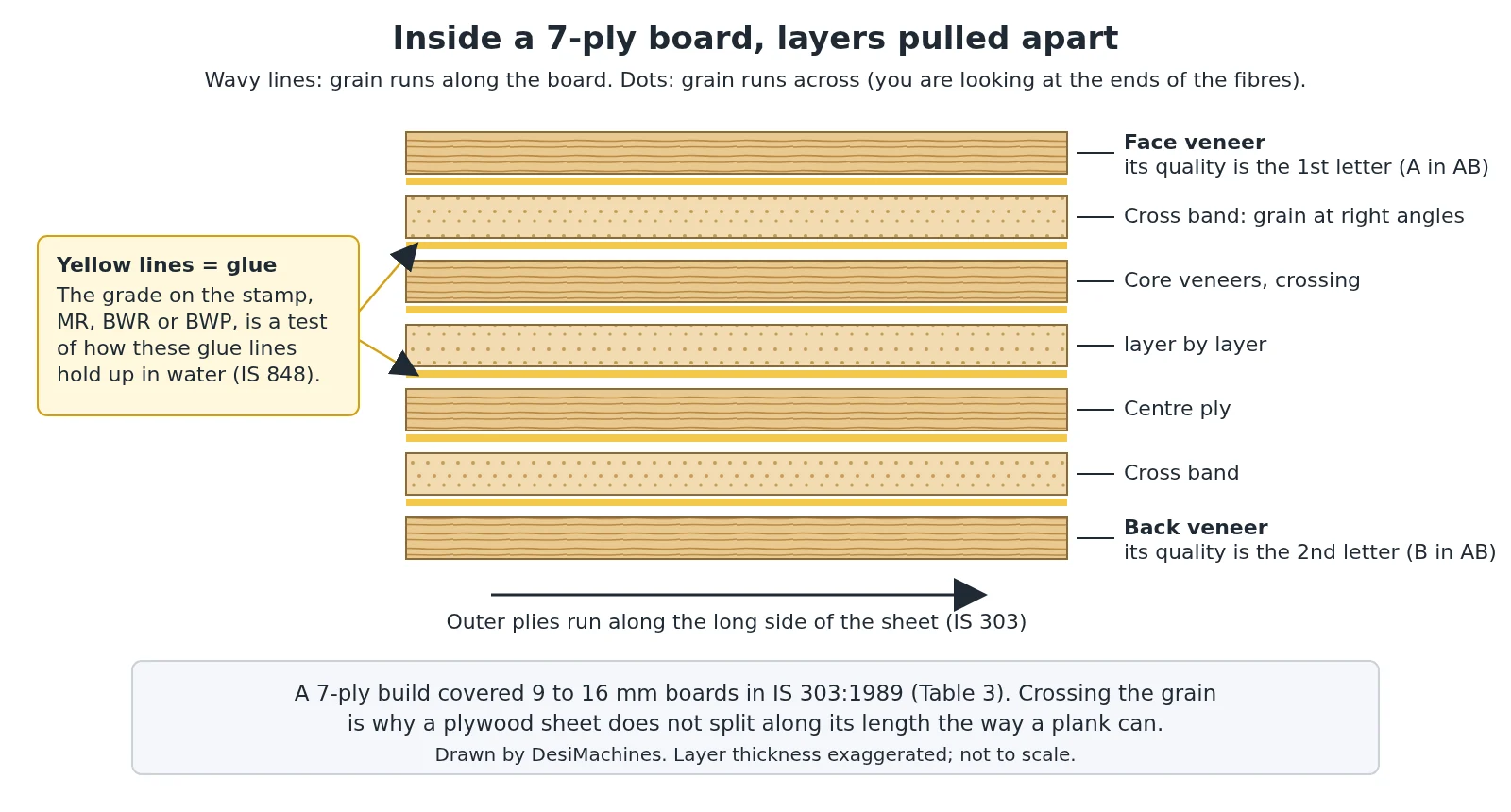
India has three grades of general-purpose plywood: MR, BWR and BWP. Plywood is made by gluing thin sheets of wood, called veneers, on top of each other with the grain of each layer turned across the one below. The wood can be any of dozens of species. What the grade describes is the glue line, the thin layer of resin between two veneers, and how long it holds when the board gets wet.
The grade names come from the adhesive standard, IS 848:2006, which covers the two families of resin used in Indian plywood: phenolic resins (phenol formaldehyde) and aminoplastic resins (made from urea, melamine and similar compounds). IS 848 sorts plywood glues into three types by a cyclic test, in which glued test pieces are soaked or boiled, dried in an oven at 65°C, and then soaked again.
Table 1: The three plywood grades and the glue test behind each (IS 848:2006, Table 1)
| Grade | Full name | Cyclic test the glue must pass | What IS 848 says the joint withstands |
|---|---|---|---|
| MR | Moisture resistant | 3 cycles: 3 hours in water at 60°C, then 8 hours drying at 65°C | Cold water for a long period and hot water for a limited time, but it fails in boiling water |
| BWR | Boiling water resistant | 3 cycles: 8 hours in boiling water, then 16 hours drying at 65°C | Cold water indefinitely and boiling water for a limited period; survives outdoor weather for only a few years |
| BWP | Boiling water proof | 6 cycles: 8 hours in boiling water, then 16 hours drying at 65°C | Highly resistant to weather, cold and boiling water, steam and dry heat |
For all three, the pass rule is the same. After the last cycle the plies must not have separated at the edges or the surface. Then the tester prises the layers apart with a knife: the wood itself should tear, and if at least half the broken surface is torn wood fibre the bond passes; more than 75 percent counts as an excellent bond. If the glue line gives way before the wood does, the sample fails.
What is the difference between MR, BWR and BWP plywood?
The difference is how much water the glue can take before the layers start to come apart. MR plywood is for dry indoor work. BWR takes splashes and damp. BWP is built for places that stay wet.
The boiling test sounds harsh, and it is meant to be. Eight hours in boiling water followed by a night in a hot oven squeezes years of wetting and drying into a few days. A BWP glue line has to survive that six times over. An MR glue line is never boiled at all, because IS 848 already says it will fail in boiling water.
Two things the grade does not tell you. It says nothing about the wood species, and nothing about how strong the board is in bending. A BWP board with a poor core can still disappoint. Those are covered by other parts of the standard, explained in the sections below.
The history explains a common shop-counter muddle. The 1975 edition of IS 303 had four grades. The 1989 revision deleted BWP and CWR and replaced WWR (warm water resistant) with MR, leaving only BWR and MR. For the next 35 years a buyer who wanted a BWP sheet bought marine plywood under IS 710 or shuttering plywood under IS 4990, which is why many people still use “BWP” and “marine” as if they were the same word. IS 303:2024 brought BWP back into the general-purpose standard, so a BWP sheet stamped IS 303 is now an ordinary, legitimate product.
Is BWP plywood the same as marine plywood?
No. All marine plywood is BWP-bonded, but marine plywood is a separate product made to a stricter standard, IS 710. Its scope is plywood for building and repairing sea and river craft, pontoons, where the board faces alternate wetting and drying and attack by marine organisms.
The marine standard controls the whole sheet, not just the glue. The figures below are from IS 710:2010; BIS’s July 2024 circular on the revision, IS 710:2024, which replaced it from 26 December 2024, lists the timber, size, strength, formaldehyde and marking clauses as the ones that changed.
- Face veneers come only from a named list of species, such as gurjan, teak, poplar and Mysore gum (eucalyptus), and faces free of sapwood.
- The glue is BWP type to IS 848, with no extender added by the plywood maker and fillers limited to 10 percent of the glue solids.
- The finished board is pressure-impregnated with a preservative, at least 12 kg per cubic metre of a copper-chrome type (CCA, CCB or ACC) or 100 kg per cubic metre of creosote.
- Test pieces are boiled for 72 hours and must still meet a minimum glue shear strength while wet.
- The stamp carries the abbreviation of the timber used in each ply, for example GUR for gurjan or POP for poplar.
Table 2: General-purpose BWP, marine and shuttering plywood side by side
| Point | IS 303 BWP grade | IS 710 marine | IS 4990 shuttering |
|---|---|---|---|
| Made for | General use: furniture, panelling, kitchens, wet areas | Boats, river craft, pontoons | Concrete shuttering and formwork |
| Glue | BWP type to IS 848 | BWP type to IS 848, no extender | Phenol formaldehyde, BWP type to IS 848, no extender |
| Preservative treatment | Declared by the maker (clause 7.1.1) | Pressure treated, at least 12 kg/m³ copper-chrome type | Treated, at least 12 kg/m³ copper-chrome type |
| Timber | Many species allowed | Named species list for faces and cores | Any species meeting the tests |
| Extra on the stamp | Grade, appearance type, formaldehyde class | Species abbreviation for each ply | Type: CS, CSC or CSFF |
If a sheet is going into a boat or a pontoon, buy IS 710. For a bathroom vanity or an outside door frame, an IS 303 BWP sheet does the job, and paying extra for marine buys protection the job does not use.
What is shuttering plywood and which grade is it?
Shuttering plywood is BWP-grade, preservative-treated plywood made to IS 4990 for concrete formwork, the temporary mould that holds wet concrete until it sets. The standard’s foreword sets out the job: the board must survive repeated wetting and drying, keep a hard face, and carry the weight of the concrete plus the shock of pouring and vibrating it.
IS 4990 has three types, and the type is printed on the board:
- CS is plain shuttering plywood.
- CSC has a plastic coating.
- CSFF is film-faced, with a phenolic resin film pressed onto the face to give a smooth, waterproof surface.
In the 2011 edition, the film had to carry at least 100 g of resin per square metre, the face veneer had to be at least 1.2 mm thick, and coated and film-faced boards had to come through 72 hours of boiling without the surface softening or cracking. IS 4990:2024 replaced that edition from 26 December 2024, and BIS lists the timber, size, strength and formaldehyde clauses as changed. The 2011 edition also obliged the maker to give you, on demand, the glue and preservative used, the timber species, the board’s density, and loading and deflection tables for working out how far apart the supports, called bearers, can go. Ask for that table before you space the bearers under a slab.
The handling annex of IS 4990:2011 has three habits that make a board last more pours. Coat the faces with mould oil, which works as a release agent and protects the surface, and re-coat after every 3 to 4 uses. Seal every cut edge with a sealant such as chlorinated rubber paint. And never drag one board across the face of another, because grit scratches coated and film faces.
How many pours a sheet gives, and what that does to cost, is worked through in our plywood price per sq ft post. For the rate a contractor charges per square metre of formwork see the shuttering rate per sqm guide, and for the sheet count the shuttering area calculation. When the deck can come down is covered in shuttering removal time for a slab.
The deck only does its job once the concrete is in it. On a slab of any size that concrete comes from a mixer or a pump, so compare concrete mixer models and concrete pumps for the pour, and talk to a verified dealer before the shuttering goes up.
What do AA, AB and BB mean on plywood?
The two letters after the grade describe how the two surfaces look. The first letter is the face, the better side, and the second is the back. A is the best surface, with the fewest knots and patches allowed; B allows more, and C more again, up to a limit the maker declares. So an AB sheet has an A face and a B back.
The 1989 edition of IS 303 had three types, AA, AB and BB, and its defect table shows how strict A is. On an A surface a single crack along the grain, called a check, could be no longer than 50 mm, with no more than 300 mm of checks in a square metre. A B surface allowed checks up to 100 mm each and 1,000 mm per square metre. IS 303:2024, as amended, lists six types: AA, AB, AC, BB, BC and CC. For a C surface the maker has to declare the maximum number of defect categories it allows per square metre.
A buying rule follows from that. If both sides of the board will be covered with laminate or veneer, the surface type barely matters, and a lower type does the same work for less. Pay for an A face only where the bare wood will show.
The 2024 standard also gives each board a bending class, F10, F20, F30, F40 or F50, which BIS lists on the maker’s licence next to the grade. It is a measure of the board’s strength in bending, which matters for shelves and lofts that span a gap. Ask for it when the sheet has to carry load.
What are E1 and E2 on plywood?
E1 and E2 are formaldehyde classes. Formaldehyde is a gas given off by some plywood glues, and part of the sharp smell of a newly made cupboard. IS 303:2024 puts every board into class E1 or E2 by measuring the formaldehyde content of an oven-dried sample with the perforator method of IS 13745. E1 is the lower-emission class. A second test, which measures the steady flow of formaldehyde into the air of a closed chamber, is optional, and BIS licences say whether a maker covers it.
The 2024 revisions of IS 710 and IS 4990 added a formaldehyde content requirement too. For wardrobes and children’s rooms, where the board sits in a closed room for years, ask for E1.
What thickness and size does plywood come in?
The standard thicknesses under IS 303:2024 are 3, 4, 5, 6, 9, 12, 15, 19, 22 and 25 mm. Any other thickness agreed between maker and buyer is allowed. The thicker the board, the more veneers it has, and the number of layers is nearly always odd so that the two faces run the same way.
Table 3: Number of plies and board thickness (IS 303:1989, Table 3)
| Plies | Board thickness |
|---|---|
| 3-ply | 3, 4, 5, 6 mm |
| 5-ply | 5, 6, 8, 9 mm |
| 7-ply | 9, 12, 15, 16 mm |
| 9-ply | 12, 15, 16, 19 mm |
| 11-ply | 19, 22, 25 mm |
| More than 11-ply | As ordered |
Shops in India sell “18 mm” plywood, a size that is not on the IS list; the nearest standard thickness is 19 mm. Measure with a vernier caliper before you accept a load. The 2010 marine and 2011 shuttering standards allowed ±10 percent on boards thinner than 6 mm and ±5 percent on 6 mm and thicker, so a 19 mm board should measure between about 18 and 20 mm.
Sheets are sold as “8 by 4”, which is 8 feet by 4 feet, about 2,438 by 1,219 mm, or 32 sq ft. The standards work in round millimetres. The 2004 amendment to IS 303 listed 2,400 × 1,200 mm as the largest standard board (about 31 sq ft), with 2,100 × 1,200, 1,800 × 1,200, 2,100 × 900 and 1,800 × 900 mm below it; IS 4990:2011 added smaller formwork sizes such as 1,200 × 600 and 900 × 900 mm. In the 2024 editions BIS asks licensed makers to declare the sizes they make. Count in the size the seller actually supplies, because the gap between 31 and 32 sq ft adds up over a house.
How do you check the ISI mark and grade stamp on plywood?
Look at one corner of the face. The 1989 edition of IS 303 asked for the marking on the face near a corner, legible and indelible, and that is still where to look. A genuine stamp on general-purpose plywood carries:
- the maker’s name or mark,
- the year of manufacture and a batch number,
- the grade and appearance type, written like BWP/AB or MR/BB,
- the IS number, which tells you which standard the board was made to: IS 303, IS 710 or IS 4990,
- the BIS Standard Mark (the ISI mark) with the maker’s licence number below it, beginning CM/L,
- the line “For BIS certification details please visit www.bis.gov.in”, which BIS’s 2025 product manual for IS 303 requires on every board.
Marine plywood adds the species code for each ply, and shuttering plywood adds its type, CS, CSC or CSFF. Since 2024 the formaldehyde class is also part of the licence for general-purpose plywood.
Then check the licence. Type the CM/L number into the licence search on the BIS website or the BIS Care app and confirm that the maker’s name and the product match the sheet in front of you. The words “BWP” or “marine” printed on their own, with no IS number and no ISI mark, are a sales claim and not a standard.
Which plywood grade should you use where?
Match the grade to the wettest moment the board will see, not to the average day. IS 848’s own descriptions in Table 1 are the guide.
Table 4: Which grade goes where
| Where the board goes | Grade or standard | Why |
|---|---|---|
| Bedroom wardrobes, beds, bookshelves, dry panelling | MR (IS 303), preferably class E1 | Stays dry; MR glue takes cold water for a long period but not hot water |
| Kitchen cabinets away from the sink | BWR (IS 303) | Steam and splashes; BWR takes cold water indefinitely |
| Sink base, bathroom vanity, washing area | BWP (IS 303) | Leaks and standing water; BWP glue takes boiling water and steam |
| Outdoor joinery and balcony work | BWP (IS 303) | BWR survives outdoor weather for only a few years |
| Boats, river craft, pontoons | Marine (IS 710) | Named timbers, pressure treatment, 72-hour boil test |
| Concrete shuttering and formwork | Shuttering ply (IS 4990): CS, CSC or CSFF | Treated and tested for the load of wet concrete |
One caution covers every row. The grade protects the glue, not the wood. A BWP board left with raw cut edges in a wet cabinet can still swell and rot at the edges, which is why IS 4990 tells formwork crews to seal every cut edge. Edge-band or seal cut edges in kitchens and bathrooms too.
The GST rate on plywood is listed in the GST and HSN codes for building materials guide. Allow for offcuts when you order, as the wastage of materials in construction guide explains, and for formwork suppliers see formwork companies in India.
The grades, types and classes above come from the BIS product manual for IS 303:2024 (May 2025) and the glue tests from IS 848:2006, with marine and shuttering details from IS 710:2010 and IS 4990:2011 and BIS’s July 2024 circulars on their revisions, and the ply and defect tables from IS 303:1989 and its amendments. More materials guides sit on the building materials guide hub, and the machines that mix and place the concrete for a slab are listed under concrete mixer models and prices.
Prices, specifications and features are indicative, vary by variant, location and date, and should always be confirmed with the official OEM or authorised dealer before any purchase decision. Grades, test limits and code clauses should be confirmed against the current edition of the Indian Standard and the maker’s BIS licence before you buy. DesiMachines is not liable for decisions taken on the basis of information that may have changed after publication.
Machines, tenders and news for this industry: Building Construction