
 Excavator
294 models
Excavator
294 models  Backhoe Loader
51 models
Backhoe Loader
51 models  Crane
68 models
Crane
68 models  Concrete Mixer
79 models
Concrete Mixer
79 models  Wheel Loader
54 models
Wheel Loader
54 models  Compactor / Roller
45 models
Compactor / Roller
45 models  Motor Grader
42 models
Motor Grader
42 models  Dozer
41 models
Dozer
41 models  Concrete Pump
66 models
Concrete Pump
66 models  Skid Steer Loader
11 models
Skid Steer Loader
11 models  Telehandler
13 models
Telehandler
13 models 


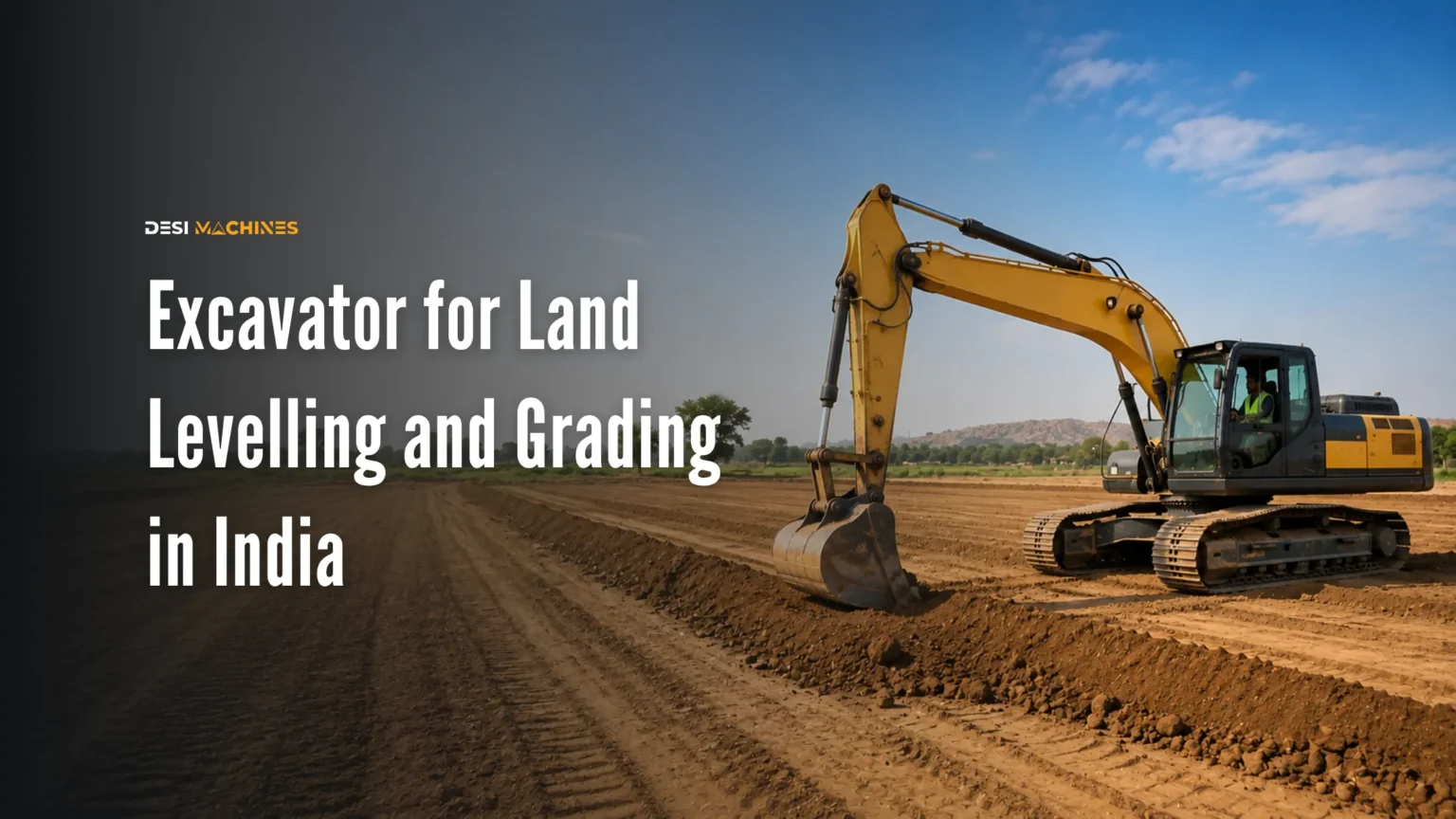
Land levelling with an excavator means using the machine’s bucket, and on smaller machines its front dozer blade, to cut down high ground, fill low ground and spread the soil to a planned level. An excavator does the rough work well: it strips topsoil, moves the mitti (soil) where you want it, backfills trenches and knocks a bumpy plot into shape. What it does not give you is the fine, flat finish a motor grader leaves on a road bed. For a house plot, a farm field, a shed floor or a small approach road, an excavator is usually the only machine you need.
Can an excavator do land levelling and grading?
Yes, for rough and intermediate work. Levelling is simply moving soil from where there is too much to where there is too little, and an excavator is built to move soil. Grading is the finishing step that shapes the surface to a slope and a level, and here the excavator reaches its limit.
The difference matters because it decides what you hire. Rough grading gets the ground within roughly 50 to 100 mm (5 to 10 cm) of the level you want. Fine grading takes it to within 10 to 25 mm and gives the smooth, even surface a road layer or a floor slab needs. An excavator sits on a fixed track base and works by swinging an arm, so the operator is judging level by eye and by a string line. A motor grader drags a long blade between its own wheels, which averages out the bumps mechanically.
In practice most Indian sites are levelled by excavator and finished by something else. On a small plot, the finishing pass is often done with the same machine and a bit more patience, or with a tractor and a leveller.
| Machine | What it is good at on levelling work | Where it falls short |
|---|---|---|
| Excavator | Cutting high spots, filling low spots, spreading soil, backfilling, working in tight corners and against boundary walls | No mechanical averaging, so a truly flat finish is slow |
| Motor grader | Fine grading, cambers and slopes over long open stretches | Needs room to work, cannot dig, a much bigger purchase |
| Bulldozer | Pushing large volumes of soil over short distances, clearing and rough shaping | Rough finish, heavy on soft or finished ground |
| Backhoe loader | Small plots where one machine has to dig, load, level and travel on the road by itself | Less stable on slopes, smaller front shovel than a dozer blade of the same width |
The motor grader versus bulldozer comparison covers the finishing machines in more detail, and excavator applications puts levelling alongside the other jobs the machine handles.
How do you level ground with an excavator?
You work to a reference, not by eye alone. Fix the level first, then cut, then fill, then smooth. Skipping the reference is the single reason plots come out looking level and drain the wrong way after the first rain.
1. Set your levels. Drive pegs at the corners and at intervals across the plot, and mark the finished level on each with a line level, a water pipe level or a dumpy level. On a plot that has to drain, mark a fall of about 1 in 100 towards the outlet. Everything after this is just matching the pegs.
2. Strip the topsoil. Take off the soft top layer, roots and grass and stack it to one side. Soil with organic matter in it settles later, so it does not belong under a floor or a road. On farm land, that stripped topsoil is worth spreading back on top at the end.
3. Cut the high ground. Work from the high side, taking level bites with the bucket and swinging the spoil towards the low ground. Do not tip a full bucket into one heap; spread it as you go, or you make more work for yourself later.
4. Fill in layers. Fill in layers of 150 to 300 mm (15 to 30 cm) and compact each layer before the next one goes on. A deep loose fill dropped in one go will sink for years, and no amount of surface levelling fixes it. Where the fill matters, a compaction wheel on the excavator compacts each layer without bringing a second machine to site.
5. Smooth with the back of the bucket. This is the trick that separates a tidy job from a rough one. Extend the arm out, lay the bucket over so its flat back faces down, rest it on the ground and pull it towards the machine. Operators call it back-dragging, and dragging the bucket back over the surface is what gives a smooth, even finish. Light pressure, steady speed, and overlap each pass by a third.
6. Finish with the blade. If the machine carries a front dozer blade, use it for the last passes. Lower it, reverse slowly, and it will trim the ridges the bucket left behind.
Two habits cost people money here. Working with the tracks sitting on the ground you have just filled compacts it unevenly and leaves track marks you then have to grade out, so plan your route across ground you have already finished. And on wet mitti, stop. Soil worked wet turns to slurry, loses strength and has to be dug out and replaced.
What does the dozer blade on a mini excavator do?
The dozer blade is the flat steel blade mounted across the front of the tracks on smaller excavators, worked by its own hydraulic ram. It has three jobs, and levelling is only one of them.
It stabilises the machine. Lower the blade before you dig hard or lift, and the machine stops rocking on its tracks. On a mini this is the difference between a clean trench wall and a wandering one.
It backfills and spreads. Push the loose spoil back into a trench with the blade instead of picking it up bucket by bucket, and a job that took twenty swings takes two passes.
It levels. Reversing with the blade down trims the surface flat behind the machine, and it will hold a level far better than a bucket held out on an arm.
Two details are worth checking on any machine you are considering. A float function lets the blade follow the ground under its own weight instead of holding a fixed height, which gives a much smoother finish while back-blading. An angling blade can be turned to cast soil to one side, useful for shaping a bund or a drain, though most machines in this class carry a straight blade.
Blade width is set by machine width. The blade has to cover the tracks or it leaves ridges, so a 1,550 mm (1.55 m) wide machine carries a roughly 1,550 mm blade. That also means blade width is a good short-hand for how much ground the machine covers in one pass.
Which excavators come with a dozer blade in India?
Blades belong to the small end of the range. Of the 294 excavators listed on DesiMachines, 47 publish dozer blade dimensions, and almost all of them sit under 8 tonnes. The heaviest machine listing a blade is a 13-tonne class Volvo; above that, excavators come without one and levelling is bucket work only.
| Machine | Operating weight | Blade width | Blade height | Ground pressure | Indicative price (Aug 2026) |
|---|---|---|---|---|---|
| Tata Hitachi TMX 20 Neo | 2,300 kg (2.3 Ton) | 1,450 mm | 320 mm | 29.4 kPa | ₹22–24 Lakh |
| Liugong 9027F | 2,750 kg (2.75 Ton) | 1,550 mm | 302 mm | Not specified | ₹22–24 Lakh |
| JCB 30 PLUS | 2,870 kg (2.87 Ton) | 1,550 mm | 268 mm | 39.2 kPa | ₹26–28 Lakh |
| Kubota U30-6S | 3,195 kg (3.2 Ton) | 1,550 mm | 340 mm | Not specified | ₹26–29 Lakh |
| JCB 35Z HD | 3,790 kg (3.79 Ton) | 1,750 mm | 357 mm | 31.3 kPa | ₹28–30 Lakh |
| Yanmar ViO50-6B | 4,735 kg (4.74 Ton) | 1,970 mm | 400 mm | 29.9 kPa | ₹31–33 Lakh |
| Komatsu PC71 | 7,050 kg (7.05 Ton) | 2,260 mm | Not specified | 33.2 kPa | ₹32–35 Lakh |
| JCB 81 | 8,050 kg (8.05 Ton) | 2,300 mm | 397 mm | Not specified | ₹33–35 Lakh |
Prices above are indicative, as of Aug 2026, taken from our listings at the time of writing, and they move with variant, state and dealer. Ground pressure in the table is the weight the tracks put on each square metre of soil, measured in kilopascals (kPa); the lower it is, the less the machine sinks and the less it churns ground you have already levelled. Most minis here sit around 26 to 35 kPa, which is why a mini can work on a finished plot where a wheeled machine would rut it.
For a levelling job the useful comparison is blade width against the width of what you are levelling. A 1,550 mm blade covers a house plinth or a farm bund comfortably. It is small against road work: the common motor grader blade in India is 3,660 mm (3.66 m), more than twice as wide, and the widest excavator blade listed here reaches 2,590 mm on a 13-tonne machine. The guide to machine weight by classexplains how the rest of the range is split up.
Looking for a machine in this bracket? Browse the mini excavators listed with prices and send an enquiry for availability in your state.
Which bucket is best for levelling — a grading bucket or a digging bucket?
A grading bucket, also sold as a ditching or mud bucket, is a wide shallow bucket with no teeth and a straight cutting edge. That is the bucket for levelling. The width spreads soil in fewer passes and the smooth edge leaves a clean surface instead of the score marks teeth cut into it.
A standard digging bucket with teeth will do the job, and plenty of contractors level with nothing else, but the finish is rougher and you spend longer on it. If the machine is going to do levelling work regularly, a grading bucket pays for itself in hours saved.
A tilting grading bucket goes further and swivels 45 degrees each way, so the operator can hold a slope for a drain or a batter without repositioning the machine. It costs more and needs an extra hydraulic line, so it earns its place on landscaping and canal work rather than on a one-off plot.
Two rules of sizing hold. A wide bucket on a small machine will not fill in hard soil, so match the bucket to the machine’s lifting capacity, not to the job you wish it could do. And never put a grading bucket into rock or hard murram — the straight edge is made for shaving soil, and it bends. The excavator bucket types guide sets out the full range, and excavator attachments covers what else fits the same machine.
Excavator or motor grader: which machine for your levelling job?
Pick by the shape of the ground, not by the size of the job. An excavator suits ground that has to be cut, dug or reached into; a grader suits ground that is already roughly at level and has to be made flat and true over a long run.
Choose an excavator when the plot is small or awkward, when there are walls, trees or existing structures to work around, when soil has to be dug out or brought up from a low corner, when trenches have to be backfilled, and when the same machine has to do other work on the same site. This covers most house plots, farm land, ponds, small approach roads and building sites. Pond digging and levelling on farms also draw on land development machines for farms other than excavators.
Choose a motor grader when you are shaping a road formation, holding a camber or a designed slope over hundreds of metres, or working to a specified tolerance for a road layer. Highway and PMGSY road work is graded, not excavated to level, and the tolerance is the reason.
A great many Indian jobs use both in sequence: the excavator cuts and fills to rough level, the grader finishes, a roller compacts. On smaller work the grader stage is dropped and a tractor-drawn leveller does the last pass at a fraction of the cost. If the grading has to be accurate over a large area, machine control systems are the modern answer, and grade control systems for excavators explains how they work. The motor grader applications guide covers what the finishing machine actually does.
For a quick answer on your own plot, match a machine to your job by choosing the work and the ground.
What to check before you buy a machine for levelling work
Four things decide whether a machine is comfortable on levelling work, and none of them is engine power.
Does it have a blade, and does the blade float? A blade with a float function follows the ground on its own weight and finishes far better than one held at a fixed height by the operator.
How wide is the blade against the tracks? The blade should cover the full track width. A blade narrower than the tracks leaves ridges you have to come back for.
What is the ground pressure? On soft ground, wet fields and finished surfaces, a machine at 26 to 30 kPa keeps working where a heavier one sinks. Undercarriage and track width is what sets that number.
Will it get to the site? A 3-tonne mini travels on a small trailer behind a pickup. An 8-tonne machine needs a proper trailer, and that transport cost repeats on every move.
On cost, machines of this class run from roughly ₹22 Lakh to ₹35 Lakh as an indicative segment band in August 2026, with the individual figures in the table above. Most buyers finance the purchase rather than pay outright, and the equipment finance options show what the monthly outgo looks like before you commit. If levelling is occasional work rather than your main business, hiring a machine with an operator for a few days is usually the cheaper answer.
How to level a plot with an excavator
An excavator will level a plot properly if you set your pegs first, cut from the high side, fill in shallow layers and finish by back-dragging the bucket. A front dozer blade makes that finishing pass much easier, which is why it is worth having on any machine under 8 tonnes. When the surface has to be flat and true over a long run, that is grader work, and it is a separate machine.
Ready to look at machines? Compare the full range of excavators with live prices and send an enquiry for a quote in your state.
Prices, specifications and features are indicative, vary by variant, location and date, and should always be confirmed with the official OEM or authorised dealer before any purchase decision. DesiMachines is not liable for decisions taken on the basis of information that may have changed after publication.
Machines, tenders and news for this industry: Power and Renewable Energy