
 Excavator
294 models
Excavator
294 models  Backhoe Loader
51 models
Backhoe Loader
51 models  Crane
68 models
Crane
68 models  Concrete Mixer
79 models
Concrete Mixer
79 models  Wheel Loader
54 models
Wheel Loader
54 models  Compactor / Roller
45 models
Compactor / Roller
45 models  Motor Grader
42 models
Motor Grader
42 models  Concrete Pump
66 models
Concrete Pump
66 models  Skid Steer Loader
11 models
Skid Steer Loader
11 models  Telehandler
13 models
Telehandler
13 models  Dozer
Dozer 


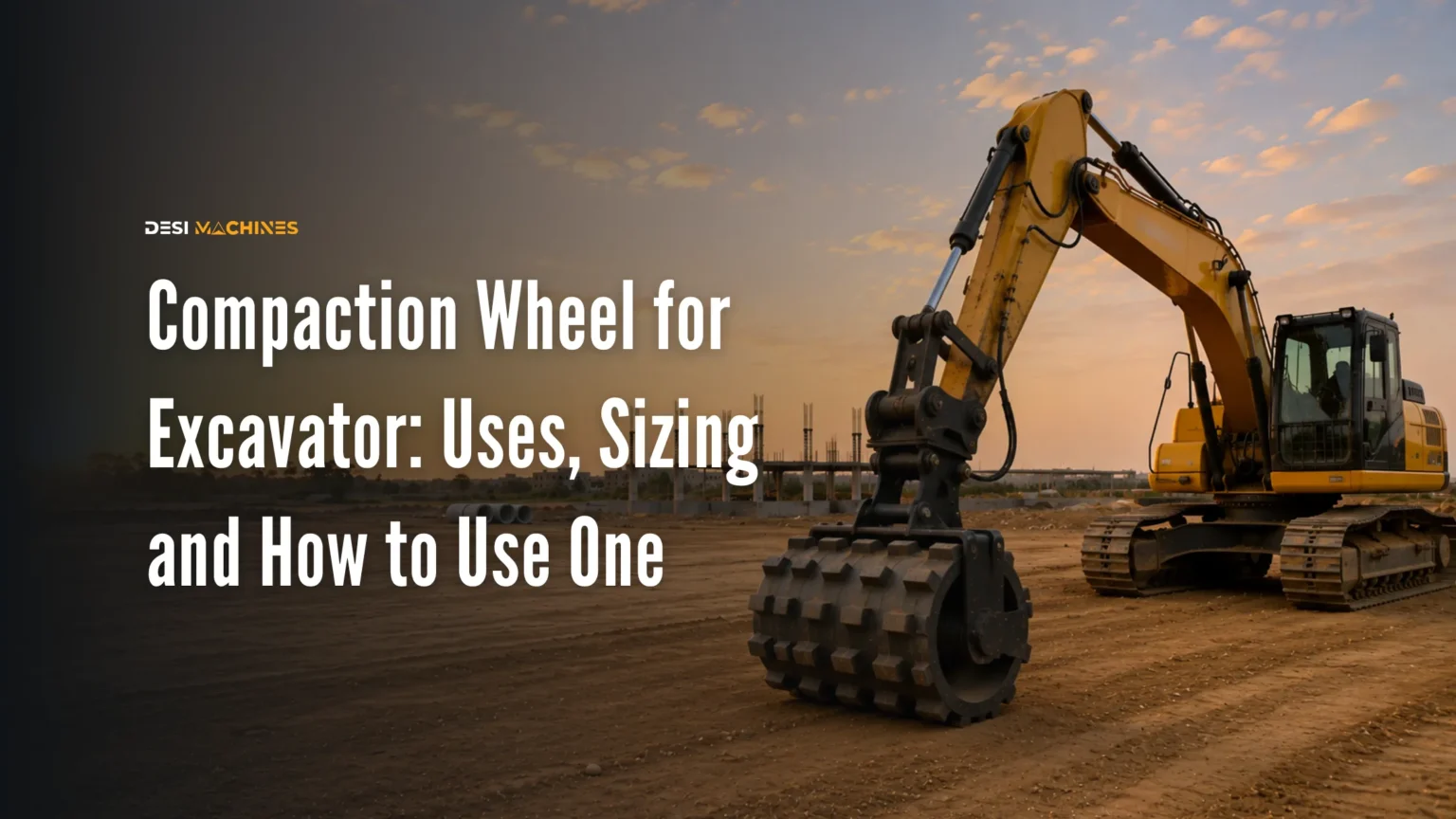
It is also one of the cheapest attachments an excavator owner can add, and one of the most under-used. Contractors backfill trenches with the bucket, run a plate compactor down them by hand, or skip proper compaction entirely and come back six months later to a sunken road.
How does a compaction wheel work?
By pressing, not by vibrating, on the basic type — the machine supplies the force.
The wheel hangs off the excavator arm where the bucket normally goes and rolls along the trench as the operator crowds the arm in and out. The weight going into the ground is the weight of the wheel plus however much of the machine’s own weight the operator chooses to put through it, and that is far more pressure than a man-operated plate can apply.
The lugs are what make it work. A smooth drum bridges over loose material; the padfoot lugs punch into the layer and knead it from inside, which is the right action for the clayey and mixed soils most Indian trenches are dug in. That is the same principle as a sheepsfoot roller on an embankment, in a form small enough to fit a trench.
Two versions exist. The plain wheel is a free-rolling drum with no hydraulics, which is the common and cheap one. The powered or vibratory type takes oil from the machine’s auxiliary line — the same line that feeds a hydraulic rock breaker — and adds vibration to the pressure. If your machine already has an auxiliary circuit fitted for a breaker, it can usually run one.
Where does a compaction wheel earn its money in India?
Anywhere the work is a long, narrow trench that has to be filled back properly.
Water and sewer pipelines. The biggest use by far. Jal Jeevan Mission and AMRUT-type distribution work, sewer lines in towns, and the underground pipeline irrigation schemes replacing open canals are all the same job: dig a trench, lay the pipe, and put the ground back so it does not settle. Backfill that is not compacted in layers will settle, and on a road it settles visibly.
Cable and duct trenches. Power, telecom and street-lighting trenches through built-up areas, where the reinstatement is inspected and the contractor is liable for the surface afterwards.
Road cuts and service crossings. The narrow cut across a road for a crossing is where sunken patches come from, and it is too small for any roller.
Foundation and column backfill. Around footings and pile caps, where a roller cannot work and hand compaction is slow.
The common thread is confinement. On open ground a soil compactor does the work faster and better. The moment the space is narrower than a roller drum, the compaction wheel is the machine that can still reach it, because the excavator stands outside the trench and works down into it.
Compaction wheel, plate compactor or trench roller?
Three tools cover the same job at different scales, and picking wrong costs either money or density.
| Tool | How it is powered | Best for | Limit |
|---|---|---|---|
| Compaction wheel on an excavator | Machine weight and arm force | Long trenches the machine is already working on | Needs the excavator standing there |
| Excavator-mounted plate compactor | Auxiliary hydraulics | Trench bottoms, slopes, confined corners | Lower pressure than a wheel; needs the auxiliary line |
| Walk-behind plate compactor | Its own small engine | Small patches, footpaths, paver bedding | Slow over any length; one man per machine |
The practical rule: if the excavator is standing at the trench anyway, the wheel does the compaction for the cost of the attachment and no extra labour. If the machine has moved on and you are compacting behind it, a plate is the honest choice. The excavator attachments guide covers how the auxiliary line and quick coupler side of this works, and the plate compactor guide covers the walk-behind machines.
What size compaction wheel fits your excavator?
Match it to the machine’s operating weight first and the trench width second.
An attachment that is too heavy makes the machine unstable when the arm is out at reach, and one that is too light will not compact anything in stiff soil, because the weight is the whole working principle. Every supplier lists a machine weight range for each wheel, and it should be treated as a limit rather than a suggestion.
To place your own machine in that range, these are the classes most Indian trenching work is done with:
| Machine | Operating weight | Typical trench work |
|---|---|---|
| Tata Hitachi NX 80 | 7,500 kg | House service connections, cable trenches, lanes |
| Liugong 914E | 13,500 kg | Distribution water lines, town sewer work |
| XCMG XE215i | 21,000 kg | Trunk mains, deep sewers, road crossings |
| SANY SY220C-9XL Sparc+ | 22,200 kg | Trunk mains, deep sewers, road crossings |
Operating weights as listed, Aug 2026. Two further checks before you commit to one. The wheel should be no wider than the trench you actually dig, or it will ride on the sides instead of the fill. And the mounting has to match the machine’s pin sizes or its quick coupler, which is worth confirming with your dealer rather than discovering on site. If you are still choosing the machine itself, the excavator size classes guide sets out what each class is suited to.
How do you use a compaction wheel properly?
In layers, with patience, and not directly on top of a fresh pipe.
Fill in layers, not in one go. The usual working practice is loose layers of roughly 200 to 300 mm, each compacted before the next goes in. A trench filled in one metre lifts and rolled on top is not compacted; the bottom two-thirds are exactly as loose as when the bucket dropped them, and that is what settles later.
Give the pipe its cover first. The material immediately around and just above a pipe is placed and consolidated by hand, and the wheel only comes onto the trench once there is enough cover over the crown for the pipe to be safe. Your project specification will state that cover depth; follow it, because a cracked pipe under a finished road is the most expensive mistake on this kind of work.
Watch the moisture. Soil compacts best slightly damp. Bone-dry material will not bind however many passes you make, and saturated material pumps under the wheel instead of consolidating. In the monsoon this often means waiting rather than working, which is cheaper than doing it twice.
Count your passes. Four to six passes per layer is a common working range, but the honest test is watching the surface: when the wheel stops sinking into the layer and starts riding on top of it, that layer is done. On specified work, a field density test decides it and nothing else does.
Keep the machine stable. Track parallel to the trench, keep the wheel within a comfortable arm reach rather than at full stretch, and stay far enough back from the edge that the trench wall does not collapse under the tracks.
What should you check before buying or hiring one?
It is a simple attachment, so there are only a few things that matter.
Check the lugs, which wear and sometimes break off; a wheel with missing lugs compacts unevenly. Check the drum shell for cracking and past welding, especially around the lug roots. Turn the drum by hand if you can and listen for the bearings, which are the one part that genuinely fails. And check the mounting bracket and pin bushes for wear, since a worn mount rattles and puts load into the arm.
For a contractor doing occasional trench work, hiring the attachment with the machine is usually the better arithmetic. For anyone running continuous pipeline work, the wheel pays for itself quickly because it removes a labour gang from the backfill operation.
Whether you buy the attachment or not, the machine underneath it is the bigger decision — compare the current range of excavators and prices and talk to our team about what suits your trench depths and site access. If the machine will be hired, the excavator rental guide covers what a fair rate looks like and what should be included.
Compaction wheels, in short
A compaction wheel turns the excavator that dug the trench into the machine that fills it back properly, using the machine’s weight through padfoot lugs. It is the right tool where a roller cannot fit and hand compaction is too slow, which is most pipeline, cable and road-crossing work in India. Size it against your machine’s operating weight and your trench width, fill in 200 to 300 mm layers, keep the wheel off a freshly laid pipe until there is proper cover, and judge the passes by whether the wheel is still sinking rather than by a number.
If the material you need to reduce is steel rather than soil, that is a different attachment again: an excavator metal shear cuts beams, plate and scrap to size.
For the full picture on what else the machine can carry, read the excavator attachments guide, and the soil compaction guide for how density is actually achieved and tested.
Prices, specifications and features are indicative, vary by variant, location and date, and should always be confirmed with the official OEM or authorised dealer before any purchase decision. DesiMachines is not liable for decisions taken on the basis of information that may have changed after publication.