
 Excavator
294 models
 Backhoe Loader
51 models
 Crane
68 models
 Concrete Mixer
79 models
 Wheel Loader
54 models
 Compactor / Roller
45 models
 Motor Grader
42 models

 Concrete Pump
66 models
 Skid Steer Loader
11 models


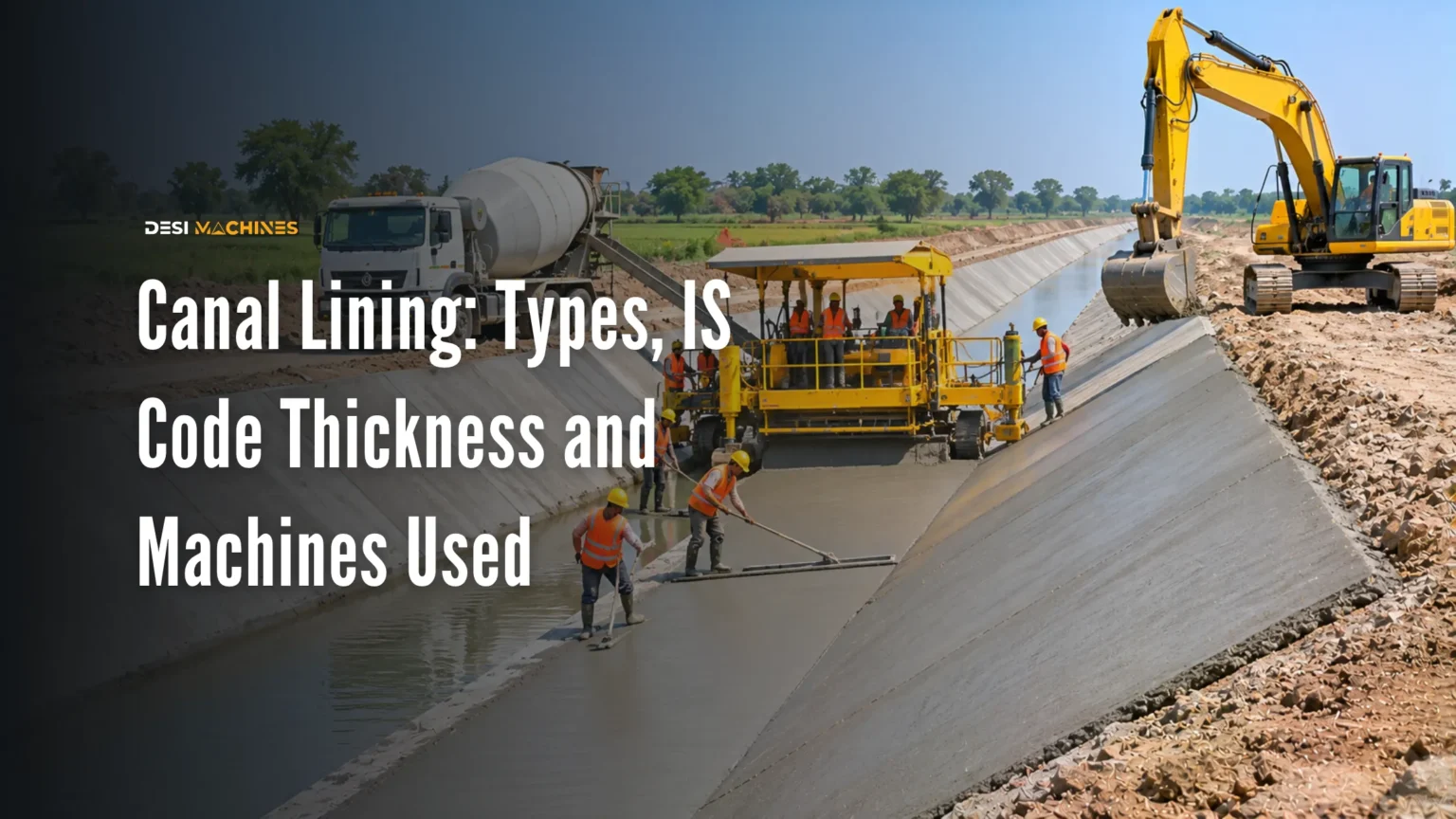
Most lined canals in India carry a skin of plain concrete 50 to 150 mm (5 to 15 cm) thick, laid over the bed and both sloping sides so the water stays in the channel instead of soaking into the ground. That skin is canal lining. How thick it must be depends on how much water the canal carries, and the Indian Standard that sets it, IS 3873:1993, puts a small field channel at 50 to 60 mm and a big main canal at 120 to 150 mm.
Lining is laid on canals of every size, from the main canal leaving a dam to the small watercourse that reaches a farmer’s field. This guide explains the types of lining, the thickness rules, how a concrete lining is laid step by step, and which machine does which part of the job. It finishes with a worked example of how much concrete one kilometre of a mid-sized canal takes.
What is canal lining and why is it done?
Canal lining is a hard or sealed layer placed on the inside of a canal to stop seepage, which means water leaking out through the bed and banks into the soil. An unlined earth canal can lose a large share of its water this way before it reaches the fields at the tail end.
IS 10430:2000, the standard on designing lined canals, lists what lining does:
- It controls seepage, so more water reaches the command area (the farmland the canal serves).
- It prevents waterlogging. Seepage raises the water table in nearby land, and that can bring salts up to the surface and spoil the soil for crops.
- It lets water flow faster. A smooth lined channel carries the same discharge through a smaller cross-section, which saves land and digging.
- It resists erosion of the bed and banks.
- It cuts maintenance: less silt to clear, fewer weeds, and rats and other burrowing animals cannot make holes in the banks that lead to breaches.
The same standard says a canal reach whose soil already lets water through very slowly (permeability of 1 x 10⁻⁶ cm/s or less) generally need not be lined if the water speed stays within safe limits. Everywhere else, IS 3873 notes that the benefits of lining generally justify its first cost.
What are the types of canal lining?
IS 10430 groups canal linings into three families. Rigid linings are hard materials such as concrete, brick or stone. Flexible linings are sheets that seal the canal but need a cover over them. Combination linings use a sheet on the bed and a hard lining on the sides.
| Family | Lining types | Where it is used |
|---|---|---|
| Rigid | In-situ cement concrete; precast concrete or stone slabs; burnt clay tile or brick; stone masonry; stone pitching; soil cement; shotcrete; asphaltic concrete | Most main canals, branches and distributaries. In-situ concrete is the most common. |
| Flexible | Geomembranes (HDPE, PVC or LDPE plastic sheet) with a cover of earth, tiles, bricks or precast concrete; bituminous felt; fibre-reinforced plastic; composite or rubber membranes | Where seepage control matters most or the soil moves; always protected by a cover layer |
| Combination | Membrane in the bed with brick, tile or concrete on the sides | Wide beds where a hard bed lining is costly |
The choice comes down to cost and what is available nearby. IS 10430 asks the designer to look at the soil, the water table, the climate, the materials within an economic distance, the labour and machinery on hand, and how well linings have held up on canals in the same area.
Two of its numbers help when comparing types. The standard caps water speed at 1.5 metres per second for stone pitching, 1.8 m/s for brick or tile lining and 2.7 m/s for cement concrete, so concrete can carry the same water through a narrower canal. For economic comparison it assumes a life of about 60 years for concrete, brick, tile and stone pitched linings. Brick, tile, stone and precast slab linings are easier to repair than in-situ concrete, because a damaged piece can be lifted out and replaced.
Shotcrete, concrete sprayed through a hose onto the trimmed earth, is one of the rigid types; how it is mixed and sprayed is covered in the guide to shotcrete process and mixes.
How thick should concrete canal lining be?
IS 3873:1993 gives the minimum thickness of in-situ concrete lining by canal capacity, which is the flow the canal is built to carry, measured in cumecs (cubic metres of water per second). Capacity and water depth rise together, so the table reads either way.
| Canal capacity (cumecs) | Depth of water (m) | Lining thickness (mm) |
|---|---|---|
| 0 to 5 | 0 to 1 | 50 to 60 mm (5 to 6 cm) |
| 5 to 50 | 1 to 2.5 | 60 to 75 mm (6 to 7.5 cm) |
| 50 to 200 | 2.5 to 4.5 | 75 to 100 mm (7.5 to 10 cm) |
| 200 to 300 | 4.5 to 6.5 | 90 to 100 mm (9 to 10 cm) |
| 300 to 700 | 6.5 to 9.0 | 120 to 150 mm (12 to 15 cm) |
A hydel channel, one that feeds a power station, should be thicker than an irrigation channel of the same size. It is drained less often for repairs, and quick drops in water level put more strain on it. The concrete itself is a design mix of grade M10 or M15. On site, the thickness may vary by 10 mm either way as long as the average is not below the figure specified.
Precast lining is thinner because it is made in a yard under control. IS 3873 sets precast concrete tiles and stone slabs at 35 to 50 mm thick, 0.45 m wide and 0.45 to 0.90 m long, bedded on at least 12 mm of 1:3 cement mortar with 20 to 25 mm joints.
How is concrete canal lining laid, step by step?
The lining is only as good as the ground under it, which engineers call the subgrade. Most of IS 3873 is about getting that ground right before any concrete arrives.
- Dig close, trim late. In firm soil the canal is first dug to about 30 cm above the final shape, and the last cut is made just before lining so the surface does not dry out or get damaged. Concrete templates set on sample profiles about every 20 m on straight stretches and 10 m on curves guide the side slopes.
- Compact the ground. Soil is compacted at its best moisture in layers no thicker than 15 cm, to at least 95 percent of its standard density. The sides are compacted to a depth of 30 cm. On a new embankment the standard wants one monsoon to pass so the bank settles before lining starts.
- Lay a plastic sheet where needed. On porous ground such as murum, a black low-density polythene film goes under the concrete so the soil cannot draw water out of the fresh mix. IS 9698 asks for a film at least 150 microns thick.
- Mix and place the concrete. The concrete is mixed in a machine, not by hand, and placed within 20 minutes of mixing. For hand placing on slopes, the slump (a test of how wet and runny the mix is) is kept at 60 to 70 mm so it barely stays on the slope.
- Work in panels. When laid by hand, concrete goes in alternate panels 2 to 3 m wide between steel channel forms, and the panels in between are filled a day later. It is compacted with vibrators, never by tamping.
- Cure for 28 days. Twelve hours after laying, small earth or lean-mortar bunds about 8 cm high are built on the bed and kept flooded. The sides are covered with wet hessian or gunny bags and sprinkled day and night for 28 days.
Joints get extra care because water leaks through them first. Under each construction joint sits a concrete sleeper (a small beam) 20 cm wide and 15 cm deep, with a 25 cm strip of 150-micron polythene on top of it. When a paving machine lays the lining, PVC water stops go in at the joints instead, no more than 4 m apart. The top edge of the side lining is turned flat into the bank for about 300 mm so rainwater cannot run in behind it.
The slump figures above are tighter than the general concrete ranges, and the method for checking them on site is in the guide to the slump test of concrete.
Which machines are used for canal lining?
A canal lining job uses ordinary earthmoving and concrete machines for most of the work, and a special paving machine only on big canals. Here is what each stage needs, based on the methods IS 3873 describes.
| Stage | Machine | What it does |
|---|---|---|
| Digging and trimming the profile | Excavator or backhoe loader | Cuts the canal to shape and trims the bed and slopes to the template lines |
| Compacting the bed and banks | Soil compactor with padfoot drum; plate compactor or rammer on slopes | Sheep-foot (padfoot) rollers recompact loosened bed soil; vibro-compactors work sandy side slopes |
| Making concrete on site | Self-loading concrete mixer or transit mixer | Supplies mixed concrete within the 20-minute placing window |
| Placing and compacting concrete | Screed vibrators; plate vibrator pulled up the slope by a winch | Spreads and compacts each panel to the set thickness |
| Machine laying on large canals | Slip-form canal paver | Lays the bed and both slopes in one continuous pass |
| Curing | Water tanks and hoses | IS 3873 suggests one 5,000-litre tank per 500 m of lining with at least 300 m of hose |
For the digging and trimming, a backhoe loader handles small channels and a crawler excavator the larger ones; the JCB 3DX and the Tata Hitachi EX 210 Infra are among the models buyers ask about most. Why a padfoot roller suits clay banks is explained in the guide to the sheepsfoot roller, and the smaller machine used on slopes in the guide to the plate compactor.
The self-loading mixer is the usual concrete source on rural canals, because canal sites are long, narrow and far from any ready-mix plant. Of the 38 self-loading mixers listed on DesiMachines as of November 2026, 37 list a drum capacity between 2.0 and 4.8 cubic metres; the Bull VMP 4000, for example, lists 4.0 m³. When a transit mixer fed from a batching plant makes more sense is covered in self-loading mixer vs transit mixer. On a long lining contract, whether that plant should move along the canal is weighed up in mobile vs stationary batching plant.
A slip-form canal paver has a shaped steel plate that matches the canal’s cross-section, and it moves along the canal, leaving finished lining behind it. IS 3873 describes two kinds: a subgrade-guided type that runs on the trimmed canal itself, for small to moderate canals, and a rail-guided type that runs on rails along both banks, for larger canals. Slip-form concrete is stiffer, with a 50 mm slump, and must have an air-entraining admixture. These pavers are not listed on DesiMachines.
Looking for the machines a canal contractor runs? Compare self-loading concrete mixers and their specs and connect with a dealer.
How much concrete does one kilometre of canal lining take?
About 790 cubic metres for the mid-sized canal worked out below, or about 200 loads of a 4 m³ self-loading mixer. The method is simple and works for any trapezoidal canal: find the lined length around the cross-section, multiply by the thickness, then by the length of canal.
1 full supply level
2 bed width 3.0 m
3 lined height 2.1 m
4 slope 1.5 : 1
5 concrete lining 75 mm
Take a canal designed for about 8 cumecs, with water 1.5 m deep on a 3 m bed. That puts it in the 5 to 50 cumec row of IS 3873, so the lining is 60 to 75 mm. Freeboard, the dry height of lining kept above the water, is 0.6 m for a canal of 3 to 10 cumecs under IS 10430, so the lining runs 2.1 m up each side. The side slope is 1.5 to 1, the steep end of the 1.5 : 1 to 2 : 1 range IS 10430 recommends for sandy loam in cutting.
| Step | Working | Result |
|---|---|---|
| Sloping length of each side | 2.1 m x square root of (1.5 x 1.5 + 1) | 3.79 m |
| Lined length around the section | 3.0 m bed + 2 x 3.79 m | 10.57 m |
| Concrete per metre at 75 mm | 10.57 m x 0.075 m | 0.79 m³ |
| Concrete per kilometre at 75 mm | 0.79 m³ x 1,000 | about 793 m³ |
| Concrete per kilometre at 60 mm | 10.57 m x 0.060 m x 1,000 | about 634 m³ |
| Self-loading mixer loads at 4 m³ | 793 / 4 and 634 / 4 | about 200 and 160 loads |
The figures leave out the coping strip at the top of the lining, the sleepers under the joints and wastage, so an estimate should add those on top. The same 10.57 m girth also gives the polythene film needed under the concrete, about 10,600 square metres per kilometre before overlaps.
Why does canal lining crack or fail?
A lining that cracks, lifts or slides within a few seasons nearly always has a ground problem underneath, not a concrete problem. IS 3873 and IS 10430 point to four causes.
- Water pushing from behind. If the water table outside the canal is higher than the water inside, or the canal is drained quickly, water trapped behind the lining pushes it off. The fix is underdrainage and pressure-relief holes under IS 4558.
- Swelling soil. Black cotton and other expansive clays swell when wet and shrink when dry. Where swelling pressure is above 50 kN/m², IS 10430 refers the designer to IS 9451; small pockets of such clay are dug out and replaced.
- Salty ground. Where soil salt is over 1 percent or sodium sulphate over 0.36 percent, IS 3873 asks for the subgrade to be sprayed with hot bitumen at about 2.35 kg per square metre before lining.
- Weak joints and an unsettled bank. Joints are where deterioration starts, which is why the standard keeps them few and backs each one with a sleeper and a plastic strip. Lining a fresh embankment before it has been through a monsoon invites settlement cracks.
Old lined canals still silt up, and clearing them from the bank is a separate job with long-reach machines, set out in the guide to canal desilting and dredging excavators. The fuller list of machines that canal, dam and irrigation projects buy is on the irrigation and dam construction page, and lining a farm pond follows its own rules, covered in farm pond construction.
State irrigation departments put canal lining and relining work out to tender through the year; current packages are listed under construction tenders and opportunities. When you are ready to equip the job, browse excavators and self-loading concrete mixers and talk to a dealer.
Sources: IS 3873:1993, laying cement concrete and stone slab lining on canals; IS 10430:2000, design of lined canals and selection of lining; IS 9698:1995, lining of canals with polyethylene film.
Prices, specifications and features are indicative, vary by variant, location and date, and should always be confirmed with the official OEM or authorised dealer before any purchase decision. DesiMachines is not liable for decisions taken on the basis of information that may have changed after publication.