
 Excavator
294 models
Excavator
294 models  Backhoe Loader
51 models
Backhoe Loader
51 models  Crane
68 models
Crane
68 models  Concrete Mixer
79 models
Concrete Mixer
79 models  Wheel Loader
54 models
Wheel Loader
54 models  Compactor / Roller
45 models
Compactor / Roller
45 models  Motor Grader
42 models
Motor Grader
42 models  Concrete Pump
66 models
Concrete Pump
66 models  Skid Steer Loader
11 models
Skid Steer Loader
11 models  Telehandler
13 models
Telehandler
13 models  Dozer
Dozer 


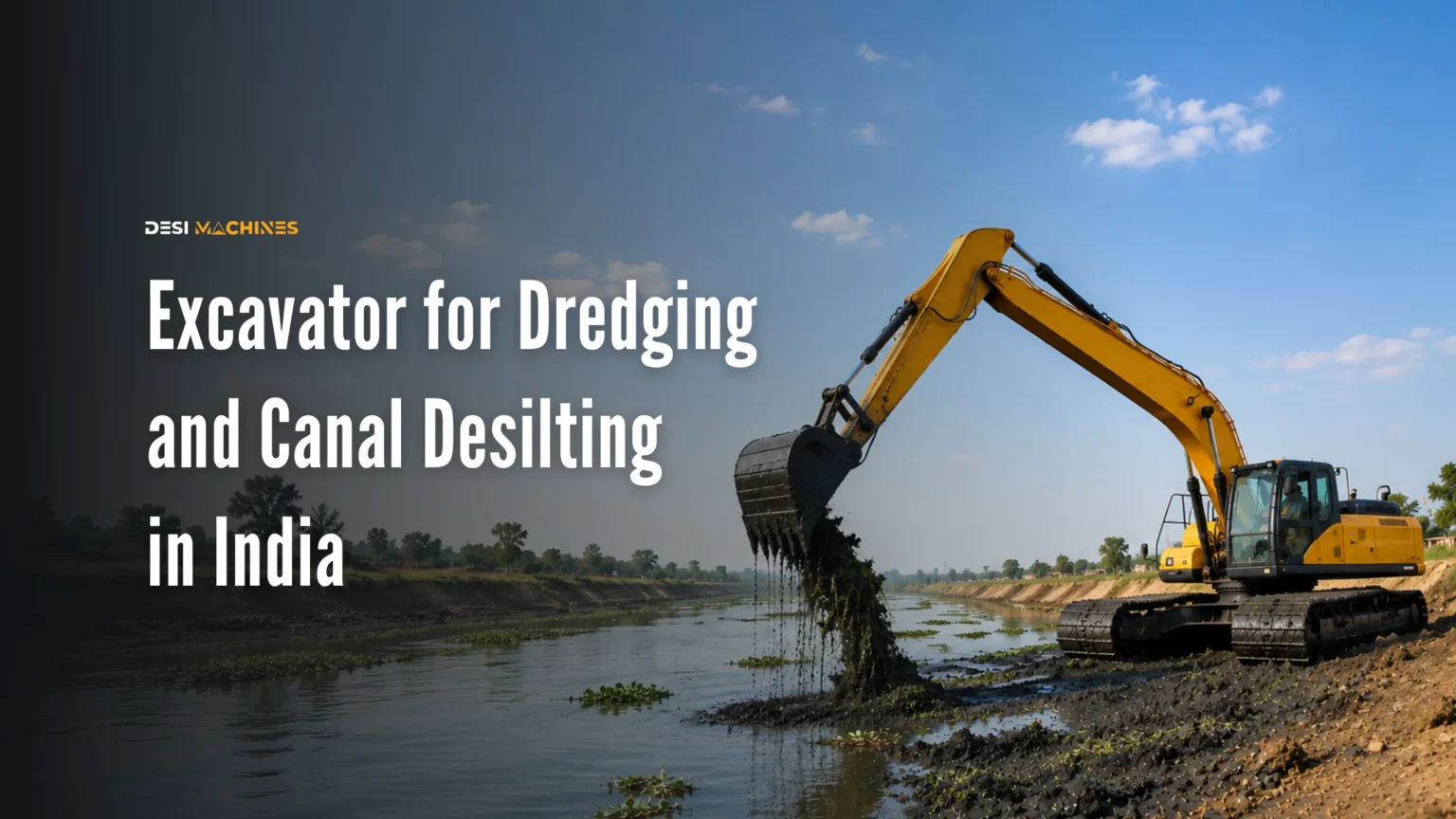
An excavator for dredging is a tracked excavator fitted with a longer boom and arm than normal, so it can reach out over water or soft ground and pull silt from a canal, pond or riverbed without driving into it. On the machines sold in India for this work, the reach runs from about 15 metres (15,000 mm) to 22 metres (22,000 mm) from where the machine stands, against roughly 10 metres on an ordinary 20 tonne excavator.
The trade for that reach is bucket size. A long boom carries a small bucket, usually 0.45 to 0.52 m³ against 0.86 to 1.5 m³ on a standard machine, because a long arm swinging a heavy load would tip the machine over. Silt is wet and heavy, so this matters more than most buyers expect.
This guide explains what dredging and desilting actually need, which machines in the Indian market do the job, how far each one reaches, what they cost, and when renting beats buying.
What is the difference between desilting and dredging?
Desilting means removing settled mud and sand from a canal, drain, pond or tank so it holds water and flows properly again. Dredging means deepening or widening a channel below the water line, usually a river, harbour or reservoir. Desilting restores what was there; dredging changes the shape of the channel.
The distinction decides the machine. Most desilting work in India happens on a nahar or village tank that is dry or half-dry before the monsoon, and it is done from the bank with an excavator. Real dredging in deep, permanently wet water is done with floating dredgers, suction pumps or pontoon-mounted machines, and an ordinary excavator has no business there.
Between the two sits the work most contractors are actually paid for: canal cleaning, nallah desilting in towns, farm pond deepening, and clearing silt from irrigation tanks. All of it is bank work, all of it is reach-limited, and all of it is what a long boom machine is built for.
Which excavator is used for dredging and desilting?
A long-reach excavator, sometimes called a long boom machine on Indian sites. It is a standard tracked excavator with the boom and arm replaced by longer sections, so the operator sits on firm ground at the top of the bank and works the bucket out across the channel.
Three things separate it from a normal machine, and all three follow from the same physics. The boom and arm are longer, roughly 8 to 12 metres of boom against 5.7 metres on a standard 20 tonne machine. The bucket is smaller, to keep the load light at full extension. And the machine is heavier at the back, with more counterweight to balance what is hanging out in front. The sections themselves are explained in the excavator boom guide.
The table below is built from the working-range figures published for the long-reach machines currently listed, with an ordinary 20 tonne machine at the top for comparison.
| Machine | Operating weight | Max digging reach | Max digging depth | Bucket |
|---|---|---|---|---|
| Tata Hitachi EX 210 Infra Super+ (standard 20 t) | 20,300 kg (20.3 tonne) | 9,910 mm (9.9 m) | 6,600 mm (6.6 m) | 0.86–1.5 m³ |
| SANY SY245C-9LR | 24,150 kg (24.2 tonne) | 15,030 mm (15.0 m) | 11,970 mm (12.0 m) | 0.45 m³ |
| Hyundai R245LR SMART X Plus | 24,500 kg (24.5 tonne) | 15,265 mm (15.3 m) | 11,754 mm (11.8 m) | 0.52 m³ |
| XCMG XE245i LR | 22,800 kg (22.8 tonne) | 15,430 mm (15.4 m) | 11,610 mm (11.6 m) | 0.5 m³ |
| Tata Hitachi EX 215LC-SLR | 20,800–21,300 kg | 15,560 mm (15.6 m) | 11,628 mm (11.6 m) | 0.5 m³ |
| JCB NXT 245HD LR | 23,850 kg (23.9 tonne) | 15,620 mm (15.6 m) | 12,040 mm (12.0 m) | 0.45 m³ |
| SANY SY285C-9LR | Not specified | 17,770 mm (17.8 m) | 14,190 mm (14.2 m) | 0.45–0.65 m³ |
| Liugong 925E XLR | 25,400 kg (25.4 tonne) | 18,361 mm (18.4 m) | 15,124 mm (15.1 m) | 0.5 m³ |
| Liugong 930E XLR | 30,200 kg (30.2 tonne) | 20,882 mm (20.9 m) | 17,209 mm (17.2 m) | 0.5 m³ |
| SANY SY545C-10LR | 54,500 kg (54.5 tonne) | 22,000 mm (22.0 m) | 15,740 mm (15.7 m) | 1.0 m³ |
Read the reach column against your channel, not against the price. A canal 12 metres wide needs a machine that reaches past the middle from one bank, or you pay to bring it round to the other side and set up again.
How far can a long-reach excavator dig from the bank?
The figure to use is maximum digging reach, measured from the centre of the machine’s slew ring to the bucket teeth at full stretch. On the 24 tonne class listed above that is about 15 metres. Step up to a 30 tonne machine and it becomes roughly 21 metres; the largest listed, a 54.5 tonne machine, reaches 22 metres.
Two cautions before you take the number at face value. First, reach at full extension is not working reach. The machine can touch that distance, but it cannot dig a full bucket there, and an operator will normally work comfortably at 80 to 85 per cent of the quoted figure. Second, the machine must stand back from the edge of the bank, often two to three metres on soft ground, and that distance comes straight off your usable reach.
Depth follows reach. The same 24 tonne machines dig about 11.6 to 12 metres below their own tracks, against 6.6 metres on a standard 20 tonne machine. For canal and pond work that is far more depth than the job needs, which is why the reach number, not the depth number, decides the purchase. How depth varies across ordinary machines is set out in the guide to excavator digging depth by size.
Can a normal 20 tonne excavator do desilting work?
Yes, for narrow channels, and this is how most desilting in India is actually done. A standard 20 tonne machine such as the Tata Hitachi EX 210 Infra Super+ reaches 9,910 mm (9.9 m) and digs 6,600 mm (6.6 m) deep, which covers a village tank, a field channel or a drain up to roughly eight metres wide worked from one bank.
It also has an advantage the long-reach machine does not: a bucket of 0.86 to 1.5 m³ against 0.45 to 0.52 m³. On a narrow nallah the standard machine will shift silt two to three times faster, because each pass carries that much more.
For small farm ponds and tank work with tight access, a smaller machine is often the better answer again. The SANY SY80C-9 SALT weighs 7,620 kg, reaches 6,675 mm (6.7 m), digs 4,467 mm (4.5 m) and puts only 28 kPa of ground pressure under its tracks against 46 kPa for the 20 tonne machine — which matters a great deal on a wet bank. Sizing is covered in the excavator size classes guide.
Where the standard machine fails is width. Once the channel is wider than the machine can reach, no amount of bucket size helps, and that is the point at which a long boom stops being a luxury.
What is an amphibious excavator, and when do you need one?
An amphibious excavator replaces the normal tracks with sealed steel pontoons — hollow floats with tracks running around them — so the machine can sit on water or on mud too soft to carry a tracked undercarriage. It moves slowly, but it can work in places where a conventional machine would sink.
You need one when the silt has nowhere firm to stand nearby: wide reservoirs, marshland, tailing ponds, riverbeds where both banks are soft, and channels too wide to reach across from either side. If there is a hard bank within reach, a long-reach machine on the bank will do the same work faster and cheaper.
The Liugong 922E Amphibious is the amphibious machine currently listed. It weighs 29,000 kg, reaches 14,830 mm (14.8 m) on the ground, digs 10,890 mm (10.9 m) deep and carries a 0.45 m³ bucket — long-reach numbers on a floating undercarriage. It is a specialist purchase, and for a single contract most contractors hire rather than buy.
What does a long boom excavator cost in India?
Taken from the machines listed at the time of writing, a 24 tonne class long-reach excavator sits at roughly ₹65–84 lakh (indicative, as of Aug 2026), against ₹60–65 lakh for a standard 20 tonne machine. The long boom version of a machine typically carries a premium of several lakh over the standard model of similar weight.
| Machine | Class | Indicative price (Aug 2026) |
|---|---|---|
| SANY SY80C-9 SALT | Small, tank and pond work | ₹30–32 lakh |
| Tata Hitachi EX 210 Infra Super+ | Standard 20 tonne | ₹60–65 lakh |
| XCMG XE245i LR | Long reach, 15.4 m | ₹65–70 lakh |
| Liugong 925E XLR | Long reach, 18.4 m | ₹65–70 lakh |
| Liugong 922E Amphibious | Amphibious, 14.8 m | ₹65–70 lakh |
| Liugong 930E XLR | Long reach, 20.9 m | ₹75–80 lakh |
| Hyundai R245LR SMART X Plus | Long reach, 15.3 m | ₹78–80 lakh |
| Tata Hitachi EX 215LC-SLR | Long reach, 15.6 m | ₹79–84 lakh |
| JCB NXT 245HD LR | Long reach, 15.6 m | ₹81–83 lakh |
| SANY SY245C-9LR, SY285C-9LR, SY545C-10LR, Komatsu PC210LC-10M0 SLF | Long reach | Price on request |
These are ex-factory figures with GST included. A long-reach excavator runs on tracks and is not registered with the RTO, so what you pay to put it on site is a landed cost — the machine plus trailer transport to the site, plus insurance and any warranty package you take. There is no registration or TCS to add, but long booms travel as an oversize load and transport is dearer than for a standard machine. Compare live long reach excavator models and prices before you fix a budget, and read loan versus lease versus cash if the machine is being financed.
Should you buy or rent a machine for a desilting contract?
Desilting work in India is seasonal. Canals are cleaned before the monsoon and irrigation tanks after it, which leaves a long-reach machine idle for much of the year unless you have deep excavation or demolition work to fill the gap. That seasonality, more than the price, is the argument against buying one.
Rent when the contract is a single season, when the channel width is unusual and you need a reach you will not need again, or when the job is amphibious. Buy when desilting tenders are a steady part of your order book, when you can keep the machine busy on deep foundation work between seasons, or when hire rates in your district are high enough that two seasons cover the premium over a standard machine.
A middle path many contractors take is to own a standard 20 tonne machine for everyday earthwork and hire a long boom for the few weeks it is needed. Rates and terms are set out in the excavator rental guide. If you are buying and the budget is tight, a well-checked second-hand machine is worth considering — the checks are listed in the used excavator buying guide.
What to check before you put a machine on a canal bank
Silt work is one of the few excavator jobs where the ground under the machine is the main risk, not the load in the bucket.
- Stand back from the edge. A wet bank fails as a block, not a crumble. Keep the tracks at least two to three metres back from the lip on soft material and more if the bank was cut recently.
- Work along the bank, not across it. Track parallel to the channel so the machine’s length spreads the load along firm ground, and swing to dump on the land side.
- Watch ground pressure, not just weight. The 20 tonne machine above puts 46 kPa under its tracks and the small 7.6 tonne machine only 28 kPa. On a soft bank the lighter machine is often the safer choice, and wider track shoes help further — the long-reach Hyundai runs 800 mm shoes against 600 mm on the standard machine. Track and shoe choices are covered in the excavator undercarriage guide. Published figures for every size class, and how much a wider shoe actually saves, are in the guide to excavator ground pressure.
- Use the right bucket. A ditching or mud bucket — wide, shallow, no teeth — moves wet silt far better than a digging bucket and leaves a clean channel profile. Options are set out in the excavator bucket types guide.
- Wash the undercarriage daily. Silt packs into the rollers and idlers and grinds them out fast. Budget for it in the running cost, and keep to the service intervals in the manual, because a long boom works its hydraulics harder than a standard machine does.
- Plan where the silt goes. Wet silt drains and shrinks. Stack it back from the edge so it does not slide into the channel you just cleaned, and give it time to dry before it is carted.
Browse the full range of excavators and speak to a dealer about the reach your channels actually need.
Dredging and desilting machines: the short version
Desilting is bank work and dredging is channel work, and that difference picks the machine. Under about eight metres of channel width, a standard 20 tonne excavator does the job faster because its bucket is two to three times bigger. Past that, a long-reach machine of 15 to 22 metres reach earns its premium, at a bucket of roughly 0.45 to 0.52 m³ and a price of about ₹65–84 lakh (indicative, as of Aug 2026). Where no bank will carry a machine at all, an amphibious excavator on pontoons is the only answer. Match the reach to the width of your channel, keep the tracks well back from a wet edge, and hire rather than buy if the work is one season long.
If you are still working out which machine suits your sites, start with excavator applications for the full range of jobs these machines do, or read why long-reach excavators suit deep excavation for the other main use of the same machine.
Canal work is not the only wet job these machines do. For open wells, farm ponds and recharge pits, see the excavator for well digging guide.
Specifications and prices on this page are taken from our listings at the time of writing. Prices, specifications and features are indicative, vary by variant, location and date, and should always be confirmed with the official OEM or authorised dealer before any purchase decision. DesiMachines is not liable for decisions taken on the basis of information that may have changed after publication.