Excavator
316 models
 Backhoe Loader
54 models
 Crane
68 models
 Concrete Mixer
79 models
 Wheel Loader
65 models
 Compactor / Roller
45 models
 Motor Grader
42 models

 Concrete Pump
66 models
 Skid Steer Loader
11 models


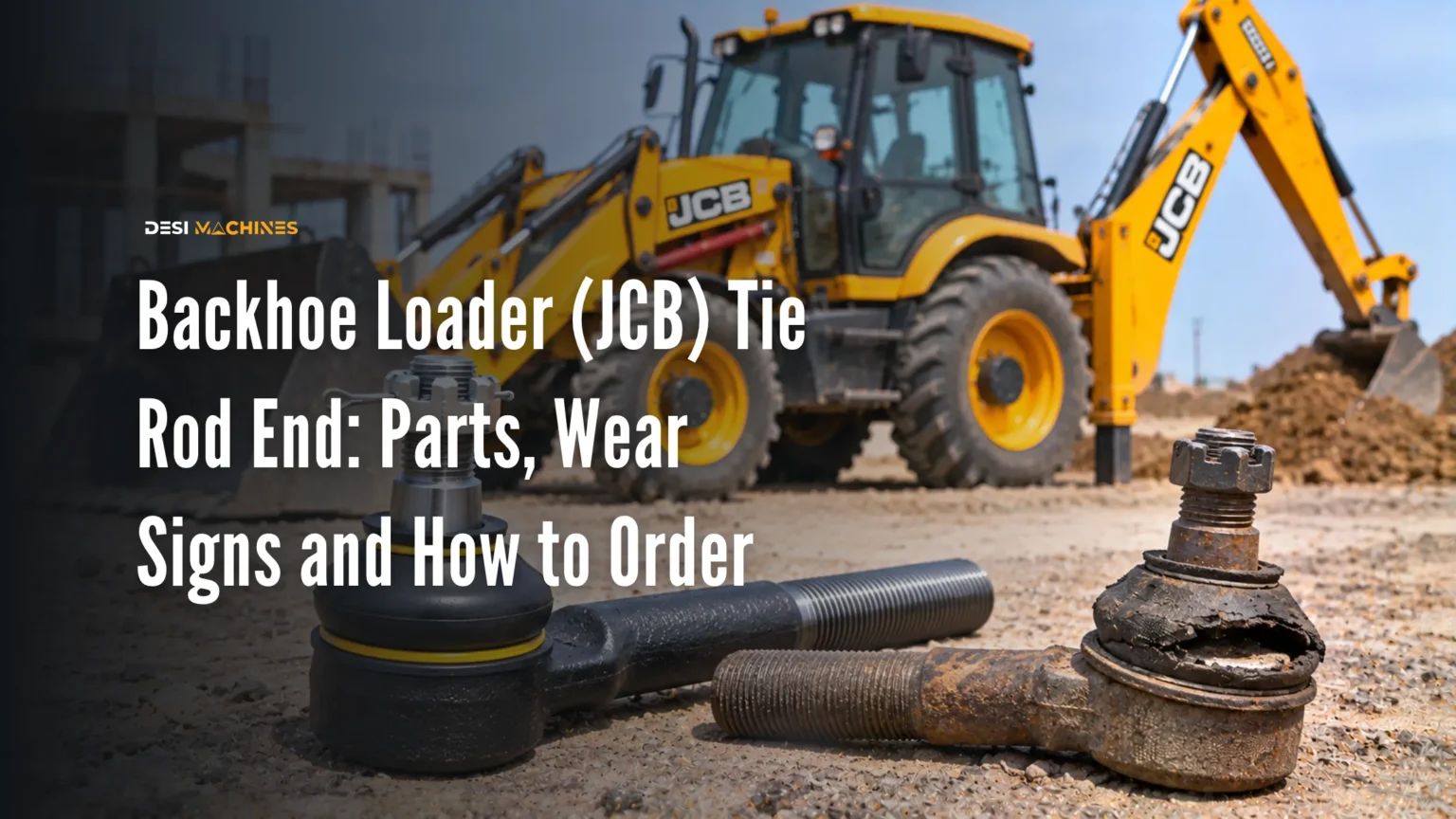
Twenty-eight of the 51 backhoe loaders listed in India publish a front steer axle, and on every one of them a single rod runs across that axle so both front wheels turn together. That rod is the tie rod, also called the track rod, and the swivelling joint at each end of it, the tie rod end, is the part that wears out and the part a dealer actually sells you. A backhoe loader is the machine most people in India call a JCB.
The tie rod is small, cheap relative to the axle it sits on, and almost never listed on a specification sheet. It is also the first thing an experienced buyer puts his hands on, because a worn joint tells you how the machine was driven. This guide covers what the part does, what is inside it, how to feel the wear, which machine classes have one at all, and what a dealer needs from you to send the right one.
What does the tie rod do on a backhoe loader?
The tie rod ties the two front wheels to each other so that turning one turns the other by the right amount. The steering cylinder pushes on one side of the axle, and without a rod across it the second wheel would simply drag. That is the whole job: no oil passes through it, no load from the loader arm goes through it, and it does nothing at all when the machine runs straight on good ground.
Both wheels turning by “the right amount” does not mean the same amount. In a turn the inside wheel has to swing further than the outside one, because it is tracing a tighter circle. BIS calls this Ackermann steering and notes that it “inherently has a greater steering angle on the side of the machine toward the inside of the turn” in IS 16480 : 2018, Earth Moving Machinery, Rubber Tyred Machines, Steering Requirements, clause 3.5. The angled steering arms at the hubs produce that difference, and the tie rod’s length is what holds the geometry where the maker set it. Lengthen or shorten it and both front tyres start scrubbing.
The same standard defines a steering system as everything “between the operator and the ground-contacting wheels participating in steering the machine” (clause 3.1), which is why a seized tie rod end is a steering fault and not a suspension one. What drives the rod differs by machine, and the backhoe loader steering system guide sets out the hydraulic side, the working pressure and the oscillating axle. Five of the machines listed here, the JCB 3DX family and the 4DX, publish the rod in the specification itself, as a “power track steering rod system provides equal turn steering”. For a requirement you want quoted, the backhoe loader spare parts listing takes it to a dealer, and the backhoe loader parts and components guide explains each assembly around it.
What are the parts of a tie rod end?
A tie rod end holds six parts, and five of them can be inspected without taking anything off the machine. The ball stud is a steel ball on a tapered shank; the ball swivels and the shank is what clamps into the steering arm. Around the ball sits the socket, a hardened cup inside the housing, often with a spring-loaded seat behind it that takes up small amounts of wear on its own. Over the joint is the boot, a rubber cover holding grease in and dust out, and a split boot is the single most common reason a joint dies early. Many ends carry a grease nipple for topping up; sealed ends have none and are greased for life. At the other end of the housing, a threaded shank screws into the rod tube, and a lock nut jams against the tube so the setting cannot creep.
Only the ball and socket wear in normal service. Everything else fails by damage: a torn boot, a bent stud from an impact, a stripped thread from over-tightening, a nipple snapped off by a grease gun. Which is why the boot is worth a look on every greasing round rather than once a year.
Tie rod end: where each part sits
A tie rod end shown in section: a ball stud swivelling inside a hardened socket in the housing, covered by a rubber boot, with a grease nipple on the housing, and a threaded shank with a lock nut joining the housing to the tie rod tube.
ball stud, tapered shank up into the steering arm
socket and housing: the ball swivels in here
boot
grease nipple
lock nut
tie rod tube, threaded shank inside it
to the second front wheel
Reading the diagram: grease enters at the nipple, fills the socket and is held there by the boot. When the boot splits, grease leaves and grit arrives, and the ball starts to knock in its socket.
Tie rod or track rod: are they the same part?
They are the same part under two names, and both names are in daily use on Indian sites. “Track rod” and “track rod end” come from British practice, which is the wording on machines of British design and on the manuals mechanics here were trained from. “Tie rod” and “tie rod end” come from American practice. Parts counters answer to either. A third name you will hear for the end itself is ball joint, which is accurate as far as it goes, but a backhoe loader has ball joints in other places too, so saying “track rod end” removes the doubt.
One real difference hides inside the names. The end that threads in from the left is not the same item as the one from the right. One carries a right-hand thread and the other a left-hand thread, so turning the tube lengthens or shortens the rod evenly at both ends. That is how the toe gets set. Toe is how much the front wheels point inwards or outwards when the machine sits straight. On a machine that has been steered into something hard, a mechanic may reset it by slackening the lock nuts and turning the tube. Pointed slightly inwards is normal on most steer axles; the actual figure belongs to the operator manual for your variant, and no number here would be safe to quote across every make.
Which machines have a tie rod, and which do not?
A machine has a tie rod only if it steers by turning its wheels. Machines that steer by bending in the middle have no rod at all, which surprises buyers moving from a backhoe loader to a wheel loader. Our own catalogue separates the two groups cleanly, because the makers publish different fields for each: a wheel-steered machine publishes a steer axle and a steering angle, and an articulated machine publishes an articulation angle instead.
Table 1: Steering layout by machine class, as published on the machines listed here
| Machine class | Machines listed | What the specification publishes | Tie rod across the axle? |
|---|---|---|---|
| Backhoe loader | 51 | 28 describe a front steer axle; 22 add ±16° oscillation | Yes, on the front axle |
| Motor grader | 42 | 36 publish a steering angle of 40° to 50°; 13 also publish frame articulation of 20° to 25° | Yes, front wheels steer and the frame bends as well |
| Telehandler | 13 | All 13 publish a steering type: four-wheel steer on 7, two-wheel on 1, selectable two-wheel, four-wheel and crab on 3, rear-wheel hydrostatic on 2 | Yes, and a four-wheel-steer machine has a rod at each end |
| Wheel loader | 54 | All 54 publish a steering angle of ±35° to ±43°; 38 describe the front axle as fixed; none describe a steer axle | No, the frame bends behind the cab |
| Pick-and-carry crane (hydra) | 68 | All 68 publish an articulation angle of 36° to 55°; none publish a steering angle | No, the chassis articulates |
This is a general guide based on machine size class. Always confirm the fit with your machine’s operator manual or the manufacturer before buying or fitting.
So the rod is a backhoe loader, grader and telehandler part. The motor grader parts guide covers the grader front axle and its leaning wheels, and the telehandler parts guide covers machines that steer at both ends. On the articulated side, the wheel loader parts guide and the hydra and farana crane parts guide deal with the centre pivot and its pins, which is where play shows up on those machines instead.
How do you know a tie rod end is worn?
Play in the joint is what you are looking for, and you can find it with your hands and no tools. Park on level ground, stop the engine, and get the front wheels straight. Hold the rod near one end and push and pull it along its own length: a good joint moves with the wheel, a worn one lets the rod move while the wheel stands still. Then grip the tyre at the 3 and 9 o’clock positions and rock it; if the rod end is the loose part you will see the stud lift or rattle in its socket. Last, look at the boot. Split, hard or missing means the joint is on borrowed time even if it still feels tight.
On the move the signs are a steering wheel that needs small constant corrections to hold a line, a knock from the front end over broken ground, kickback through the wheel on rough sites, and front tyres wearing feathered on one edge. None of those is proof on its own, because three other joints can produce the same feel.
Table 2: Telling the worn joint apart
| What you feel | Where the play shows when you rock the wheel | Likely part |
|---|---|---|
| Rod moves, wheel does not | Movement at the rod end itself, along the rod | Tie rod end |
| Wheel rocks top to bottom, hub tight to the axle | Movement at the top and bottom of the hub, wheel tilting | King pin and bushes |
| Wheel rocks with a rumble, worse at speed | Movement between wheel and hub, with noise when turning | Wheel bearing |
| Wheels creep off line with no slack anywhere | No mechanical play; the cylinder or valve drifts | Steering cylinder or its seals |
Work through the table in that order before ordering anything. A rod end replaced to cure a bearing rumble leaves the fault exactly where it was.
Why do tie rod ends wear out on Indian sites?
Dust and water get in first, grease leaves second, and the ball starts hammering its socket third. A backhoe loader works where the ground is loose, often in standing water during the monsoon, and the rod sits low and forward with nothing shielding it. A boot that has been nicked by a stone on a village road will pass grit into the socket for months before anything is audible.
The duty cycle does the rest. A backhoe loader spends its day shunting a few metres at a time with the wheels hard over, and most of that shunting happens on uneven ground. Twenty-two of the machines listed here publish a front axle with ±16° of oscillation, which lets the axle rock to keep both tyres down, and every degree of that rock is taken through the steer joints while they are also holding a steering load. Add a loaded front shovel pressing the axle down and the joints carry more than a road vehicle’s ever do. The steering and front axle guide explains why makers accept that trade-off.
Three habits shorten life more than anything in the design: skipping the grease points at the interval in the manual, using the front wheels to push material by steering against a heap, and climbing kerbs or rock edges with the wheels already turned. The pins and bushes guide covers the same wear story on the loader and backhoe linkage, which is driven by the same two things, grease and grit.
What decides the price of a tie rod end?
Five things move it, and none of them is the machine’s badge. The first is which axle you have: a two-wheel-drive steer axle and a four-wheel-drive drive-and-steer axle carry different hubs and steering arms, so the ends differ even on the same model name. The second is the axle maker, because the joint belongs to the axle and not to the machine. The third is what you are buying: a single end, a matched pair, a complete rod with both ends fitted and set, or a steering kit that bundles the ends with the king pins and bushes. The fourth is thread hand and size, since left and right are separate items and a few machines use a larger shank. The fifth is whether the boot, lock nut and grease nipple come in the box or are priced on their own.
Condition of the mating parts quietly decides the real bill. A stud that has been loose long enough to wallow the taper in the steering arm means the arm is suspect too, and a seized end often has to be cut off, which brings the rod tube into the job. Checking the arm before you order saves a second trip. Pricing itself belongs to the dealer, who quotes against your axle and variant.
How do you order the right tie rod end?
Order against the axle, not the machine name. Our catalogue shows exactly why: of the 44 backhoe loaders that publish a front axle description, 9 name the axle itself rather than describing it, and several name two different axles for one model depending on drive. CASE 770 NX and its siblings publish a CNH PS1300 axle for the two-wheel-drive build and a Carraro or NH 26.17M for four-wheel drive. Mahindra Earthmaster VX publishes a Mahindra axle for two-wheel drive and a Carraro for four-wheel drive. Twelve of the 51 machines listed are catalogued in both two-wheel and four-wheel drive versions, so “it is a 770” or “it is a 3DX” does not identify the part. JCB 3DX is one of the five that publish the track steering rod in the specification itself.
Five details let a dealer match it first time. Give the make, model and variant exactly as it reads on the machine plate, and say two-wheel or four-wheel drive. Read the axle make and number off the axle casting or the plate, not off the brochure. Take the part number stamped on the old end if it can still be read. Then say which end you need: left, right, or both. Carry the old part if the number has worn away, because thread hand and stud taper are easier to match in the hand than over a phone. Where the number is gone and the machine is old, the operator manual’s parts section is the fallback, and a dealer can cross-check it against the axle.
Comparing machines rather than parts? Browse the full range of backhoe loaders and ask the dealer to confirm the front axle specification for the exact variant before you buy. The wider parts and running costs guides cover the rest of the machine.
Machine counts and axle, steering and front axle descriptions in this guide are taken from the backhoe loader, motor grader, telehandler, wheel loader and pick-and-carry crane models listed on DesiMachines at the time of writing; the Ackermann and steering-system definitions are from IS 16480 : 2018, clauses 3.5 and 3.1. Specifications and features are indicative, vary by variant, location and date, and should always be confirmed with the official OEM or authorised dealer before any purchase decision. DesiMachines is not liable for decisions taken on the basis of information that may have changed after publication.
Get a tie rod end price from a dealer near you
Tell us your machine and what you need, and we will ask the nearest dealer to reach out to you with a price.